Phillips Exeter Academy

333: The true number of the beast?

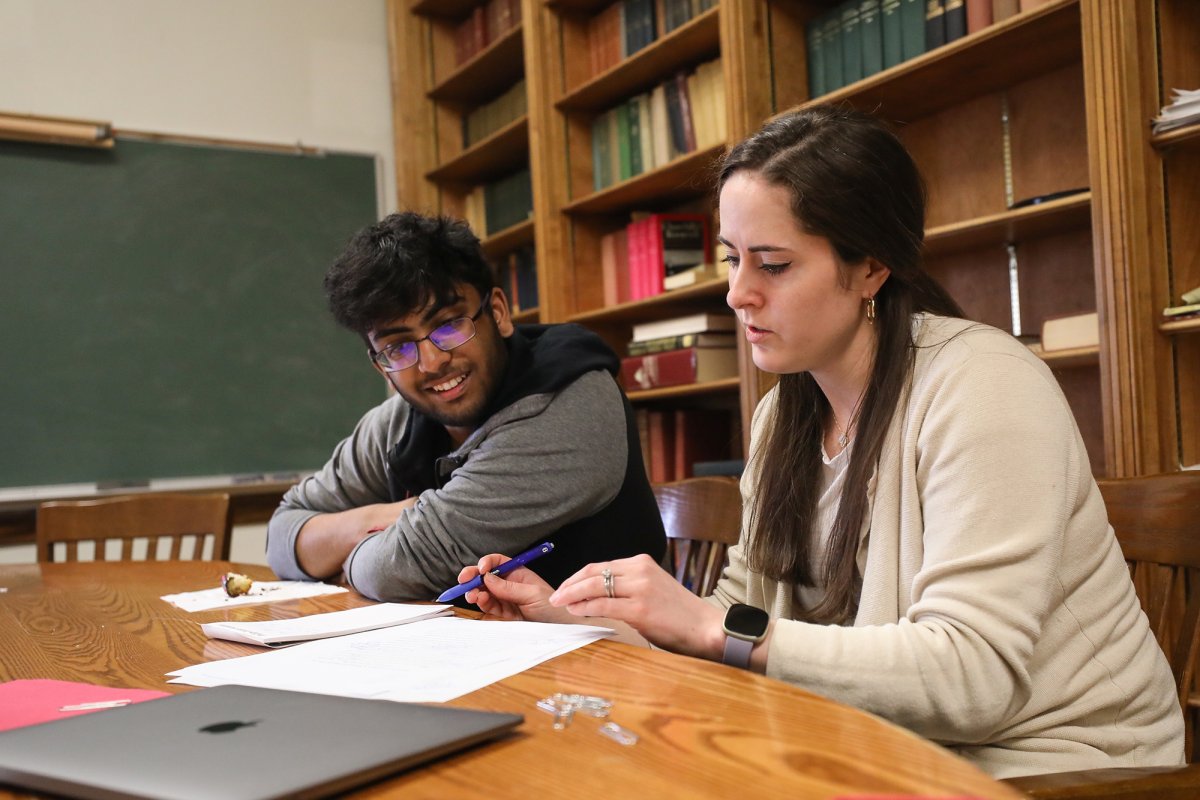
Teacher sits with student reviewing papers

As spring unfolds on Exeter’s campus, nearly 300 students are confronting one of the most daunting academic challenges presented them during their time at the Academy: the “333.” The notorious U.S. history term paper, with a required length of 12 to 15 pages — or approximately 4,000 words — is meant to train students in the type of independent research, critical thinking, analytical writing and time management skills they will need in their college careers.

Uppers, along with some seniors and a few ambitious lowers, take on the assignment as the capstone of the final course in the History Department’s three-term American history sequence. Since 2016, this course has been called History 430: U.S. History 1941–Present, but before that it was known for three decades as History 333. While the numbering change was intended to reflect the academic rigor of the course, the 333 term paper was by then considered an integral rite of passage at the school — and the name stuck.

The famous Louis Khan-designed Class of 1945 Library serves as the students’ hulking home base during the four weeks they spend working on their 333s. Roughly 15 class sessions of History 430 are devoted to the project, with students spending most of that class time working independently or conferencing one-on-one with their teachers.

To help students avoid last-minute, late-night writing binges, History 430 teachers set careful guidelines along the way, including notes, detailed outlines and a rough draft. The timely completion of these mini-assignments factor into the final grade for the paper, which comprises 40% of a student’s grade for the course.

“A lot of students can sit down and fire out a four-to-five-page paper at the last minute,” says Instructor in History Sally Komarek, who is teaching four sections of 430 this term. “But the longer the paper gets, you need an outline, and you need to think about how things are organized. We try to get them to build those habits now.”

The 333 process begins with pre-research, or some “low-stakes perusing,” as Komarek puts it. The students can write on any topic related to U.S history; she tries to get students to choose topics they are passionate about, to make the project easier and more enjoyable. After taking copious notes — some students use Google Docs, or a software program called Noodle Tools, while others rely on old-fashioned index cards — the students settle on a single-focused research question and are required to hand in a detailed outline. Students need a minimum of eight to 10 sources for their 333’s bibliography, including reference books, secondary sources, periodicals and scholarly articles, and the majority is expected to be made up of primary sources.

One of Komarek’s students, Arya Palla ’23, is writing about U.S. intervention in Nicaragua in the 1980s, and the public perception versus the reality of America’s activities there. He’s making good use of the many archived newspapers and other online resources the Library provides access to, and has found that completing the smaller assignments along the way have relieved much of the pressure inherent in the term paper.

“It’s the school’s most infamous paper, so obviously everyone’s going to have some anxiety around it,” Palla says. “But since it’s so structured, I think it becomes a lot easier to go through the process. Before you know it, you’ve kind of already written the paper through your notes.

For her topic, Lally Lavin ’23 chose the 1995 self-help book The Rules: Time-Tested Secrets for Capturing the Heart of Mr. Right. “It’s a little bit more recent, but the authors address a lot of changing social norms throughout the 1900s,” she explains. “I’ve used it as an opportunity to explore what’s going on with feminism, women entering the workforce, education rates and all of that from the 1960s to the ’90s.”

Though aware of the paper’s fearsome reputation, Lavin is pleasantly surprised — so far — at the reality. “I don’t think it’s as scary as people make it out to be,” she says. “But I also haven’t finished it yet.”

Because not all sections of History 430 can meet in the library at once, and many teachers teaching multiple sections need to manage their own workload, the students are completing their term papers in waves. By early May, while Palla, Lavin and their classmates are buckling down for some serious writing, Komarek’s other two sections are just beginning the process. And other students are basking in the warmer weather, along with the knowledge that they have made it through this Exeter milestone.

“I remember being a prep and a lot of the uppers in my dorm at the time talking about the 333,” says Keanen Andrews ’23, who wrote his paper on the rise of the Greenwood District of Tulsa, Oklahoma, known as “Black Wall Street,” and its destruction at the hands of white rioters in 1921 for History Instructor Nolan Lincoln’s 430 class. “It was in the back of my mind when I was a younger student, and now that it’s done, I know it was difficult and challenging, but I do feel complete. I put everything into the paper, and I enjoyed it.”

Visiting scholar tackles race and the Supreme Court

In early May, the U.S. Supreme Court landed squarely in the national spotlight with the unprecedented leak of a draft opinion that would revoke the abortion rights guaranteed in 1973’s Roe v. Wade. Barely a week later, Exeter’s Department of History hosted a visit by the award-winning historian Orville Vernon Burton, co-author of a new book on the Court’s three-century-long history on race.

A native of South Carolina who has held named professorships at Clemson University and the University of Illinois, Burton has written numerous books on American history and has served as an expert witness for minority plaintiffs in voting rights and discrimination cases across the United States.

During his visit to the Academy, Burton gave a lunchtime seminar on “Taking History to Court” in the Latin Study and an evening talk at the Class of 1945 Library, during which he discussed Justice Deferred: Race and the Supreme Court, which he wrote with the civil rights lawyer Armand Derfner. He visited two sections of History 553: Law and American Society, taught by History Instructor Kent McConnell, a longtime mentee and friend.

Finally, Burton sat down for a conversation with Lauren Jebraili ’23, an upper in the Law and American Society class. Jebraili, who grew up in the Washington, D.C. area, plans to major in history. She spoke with Burton about the cases that inspired him to write Justice Deferred, along with issues of freedom of speech and religion, balancing the power of federal and state government, and today’s Supreme Court, among other topics. 

Here are some edited excerpts from their conversation:


What made you focus on writing about the law and history [in Justice Deferred]?
We really thought this was a time that people needed to understand how the Supreme Court works. And we use this book not as a case book, not as a legal book, but as a history of race in America as seen through the eyes of the Supreme Court, using the Supreme Court as a lens to understand the history of race and race relations in America.
We talked in class about the Barnette v. West Virginia case [in which a school tried to expel students for refusing to say the Pledge of Allegiance]. What do you think about the line between freedom of speech and freedom of religion — and how far do we actually have those freedoms under the law?
On that case, it’s very clear [that the students] were following their religious tenets, and that should be a freedom of [religious] expression. It gets more tricky with other things, like hate speech or encouraging violence and things like that. This is a tough issue, and will continue to be, and the court changes over time on this issue. I see it and worry about what’s going on in, in fact, our universities about who can speak and who cannot speak.
When you were writing Justice Deferred, were there any cases specifically that you wanted to ensure were there?
We looked at thousands of cases and discussed those that were most relevant to how the law has been interpreted and changed over time. In the first case dealing with African Americans, the federal government was sued by John Quincy Adams, the former president, in the Amistad case [United States v. The Amistad, 1841]. The Court found for the Africans, and then it begins to go the other way. I learned so much from looking at the dissents. We used to so often excuse people for their times — “Oh, well, that was earlier and people didn’t know” — but the dissents often showed that other people knew, at the same time, what was right.

The [Court’s] defining of race itself I find very fascinating. The Naturalization Act of 1790 limited naturalization to free white persons. In 1870, you have a change because of the 14th Amendment, which says that African Americans can be naturalized. In 1922, a Mr. Ozawa believed that they had changed the law enough that it no longer applied to people…like himself, who had been born in Japan [but came to the United States as a child]. The Supreme Court hemmed and hawed and finally they said that what [the law] actually meant was that you had to be Caucasian. The next year, a Mr. Thind, whose ancestry actually went back to the Caucasian Mountains — a real Caucasian — applied for citizenship. The Court tried to provide some rationale for its decision [to deny him] and finally decided that “Caucasian” really meant “white.”

The case that really speaks to me because this is what I grew up with [is 1967’s Loving v. Virginia], which said Black and white and people of other races could marry…The Supreme Court has dealt with all these issues, and really, so do we in this book. That’s not the most important case, but I think it catches the confusion of — what is race? There is no such thing. The Court has struggled time and time again to define race.

That’s really interesting. That would be the crucial part, because when you want to have discussions about race in the first place, you’re working on the assumption that race is an actual thing, but it’s really just a concept.
That’s right. It’s a social construct that we have put together. And yet, it means something legally, or has. We’ve tried to move away from that, I think, with the 14th Amendment. The 13th, 14th, and 15th Amendment are part of the Constitution, and I think if Supreme Court justices read those…as broadly as they read [the First, Second, and Third Amendments], it seems to me there’s no problem, although they’ve been ruling the other way in the last few years.
 
I wanted to ask about Roe v. Wade, and whether that case is less about abortion rights and more about — does the state have the right to determine the abortion [question] or does the federal government have that right? What are your thoughts on that?
I truly believe that the 13th, 14th and 15th Amendments, which Abraham Lincoln is responsible for — they all are done in his name and his legacy — changed the Constitution. Before that, everything was relegated to the states. But the 13th, 14th and 15th Amendments give Congress the right to pass these laws that expand individual liberty to protect them in those states where they are not protected. Lincoln took what we think of as positive liberty — and also what I call our mission statement, the Declaration of Independence — and put it into our rule book, the Constitution, so that these rights are guaranteed.
As a teacher, what is the main thing you want to teach students about the law and how the law should be working?
What I’m concerned about is that I think democracy is in a crisis that it has not been since 1860. The very things that Lincoln faced in 1860, we’re facing today…When you ask me the most important cases, it’s these cases that are trying to keep people from being able to vote. That’s the opposite of what a democracy is. I want [students] to see that people have been able to make positive changes, that groups of people like Martin Luther King, and many, many before him, came together to get unjust laws changed. This is something that Lincoln understood, I believe. It’s important that we can do something, and the basis of that is the vote.


"How to Learn a Language"

lesson 1: fly to a country you do not dare to call your own.
taste the words that flow off the tongues of your relatives,
and when you spit them out, a jam of syllables and accents,
watch for the lemon-sour purse of their lips.
can you feel your misshapen gratitude when your grandmother hands you a gift,
a souvenir? remind yourself that your time here is temporary.

lesson 2: tolerate a thousand stilted video call conversations
with your grandmother, realize you are looking for an escape
between every sentence, hiss when your mother grips you tighter.
you will whisper how do you say this in chinese?
and the phone will say connectivity issues
and while she answers your grandmother’s face will be frozen in a smile.

lesson 3: hear the arguments flare when they think you’re asleep
and let them fester in your memory when you lie awake.
remember, cancer is equally devastating in all languages.
remember, hospital bills are expensive in every country.
remember, your grandmother has curly hair, soft between your fingertips.
remember, you must pronounce her name correctly when you start praying.

lesson 4: do not learn, and do not recognize the tears that flow
when your grandmother dies the way your stiff syllables always did–
slow, painful, withering away into ash and air.
bite down on your mutinous tongue, let the blood rise sharp and hot in your mouth,
feel a fraction of the pain she must have,
count how many times you told her i love you
and know that no matter how much you practice saying it now
it can no longer be enough.

lesson 5: listen to the things your mother whispers on her knees,
the musk of incense seeping into the floorboards.
do you recognize what rots in the space between her sentences,
the crevices of her cries, the way every word trembles with regret?
speak in those lagging video calls with a grandfather
you are determined to call your own, let the words fall flat
 and pick up their remnants, because at least you are trying,
and maybe this time it is enough to say
 我爱你.
i love you.
know that this is worth all the misshapen words in the world.

Kaylee Chen ’23 received the American Voices Medal, one of the highest writing honors awarded in the 2022 Scholastic Art & Writing Awards competition, for this poem.

Editor’s note: This article first appeared in the spring 2022 issue of The Exeter Bulletin.

Invisible

Aging, I fear I will be seen as irrelevant
not be seen at all, be alone, become invisible.
If it happens, I could just notice that others don’t notice me,
remain calm about it.

Spots, unwelcome guests. I notice my aversion.
Could I welcome them?
Skin, tight no longer, jowls and neck loosely defined.
Eyelids: soft, delicate tissue. Redundant or beautiful?
Do these dermatologic signs of decay hide the mood within?

You have to know me, be interested in me to
know I feel happy, energetic, vital
and also afraid about the loss of my vitality.

Getting older, I notice my walking, gaining interest in its
sensations,
the universe beginning to become contained within me.
Bone, joint, muscle: pleasant ache, minuscule twinge.
Surprisingly unsteady step: less sure, foot rises higher, falls flatter.

I notice myself enlivening my steps, making myself spry,
testing the moments while I think I might still fake it.
Wanting to deny the inevitable: a good game,
harmless fun when I notice. Or bittersweet?

Others see that I am old: they don’t deny it.
They assist me by making me invisible,
seeing me but not noticing, desiring nothing, asking too little
helping me enter the realm of the imperceptible.


Editor’s Note: Ira Batra Garde, a psychiatrist, is currently writing a novel about an Indian military surgeon during the tumultuous reckoning that encompasses both World Wars. This poem originally appeared in the anthology Walking With the Shadows, Leaving Them Behind: Selected Poems by the Pegasus Physician Writers at Stanford, which features creative works written by physicians and medical students.

This article first appeared in the Fall 2022 issue of The Exeter Bulletin.

Exonian Excellence

Mock Trial Teams Finish 1-2-3 at State Championships

Exonian argumentative (and theatrical) talent ran deep during the New Hampshire Mock Trial Championships in February, with Big Red teams capturing the top three spots. John Lee ’22, Arhon Strauss ’23, Angela Zhang ’23, Teja Vankireddy ’22, Sav Bartkovich ’23, Michael Hsieh ’23 and Charles Potjer ’24 defeated their Exeter teammates Colin Jung ’24, Selim Kim ’24, Anderson Lynch ’23, Michael Nardone ’24, Liam Brown ’23, Angelina Gong ’25, David Goodall ’24, Alysha Lai ’23 and Amara Nwuneli ’25 by only four points in the final round, earning the chance to compete in the National High School Mock Trial Championship that will be held virtually in May.

Gold Medal in Academic Writing

Parmis Mokhtari-Dizaji ’24 won the gold medal in the fall 2021 cycle of the annual Academic Writing Contest held by the Harvard International Review, a quarterly magazine focusing on international affairs and featuring articles and commentary by leading scholars and policymakers worldwide. In addition to writing her essay, which explored the role of COVID-19 in isolating supply chain networks and accelerating deglobalization, Mokhtari-Dizaji gave a 15-minute presentation and oral defense of her argument before a board of the magazine’s judges.

Exonians Bound for Carnegie Hall

Two Exeter musicians have been selected to join the Carnegie Hall National Youth Orchestra, a monthlong summer program of intensive musical training and performance. Violinist Jane Park ’24 and bassoonist Adam Tang ’25 will join the prestigious youth ensemble starting in late July for a week in residence at Purchase College, State University of New York, then head to Miami to work side by side with the New World Symphony Orchestra and perform at the Frank Gehry-designed New World Center. The ensemble will then return to New York City for a week of training, culminating with a performance in Carnegie Hall’s famed Stern Auditorium.

Students, Faculty and Alums Collaborate on High-Level Research Study

Current Exeter student Ella Kim ’23 and recent grad Catherine Griffin ’19 are among the co-authors of a new study published in the journal G3:Genes|Genomes|Genetics this spring. Titled “Transgenic Drosophila Lines for LexA-dependent Gene and Growth Regulation,” the study highlights work that led to the CRISPR-based course taught in spring 2021 by Science Instructors Anne Rankin ’92 and Townley Chisholm, as well as a new curriculum developed by Exeter Summer teacher Liz Morse based on experimental genetics. Rankin, Chisholm and Morse are also among the study’s co-authors, along with Dr. Seung Kim ’81 of the Stanford University School of Medicine and students and instructors from the Lawrenceville School, Oxford University and Stanford.

National Ocean Sciences Bowl Debut

After officially launching during the winter term, Exeter’s new Ocean Awareness and Action Club (O2AC) got off to a running start thanks to a last-minute entry into the Nor’easter Bowl, a regional ocean science academic competition that is part of the National Ocean Sciences Bowl (NOSB). “We completely crushed it,” says club co-head Tanya Das ’22, who competed on the winning team alongside co-head Ariana Thornton ’24, Ayman Naseer ’24, Alexander Luna ’24 and Helena Kline ’24. They will now represent Exeter for the first time ever in the NOSB finals, held virtually on May 6-15, 2022. Meanwhile, Das and her fellow O2AC members are looking to continue educating themselves as well as recruit new members and potentially find alumni speakers to bolster the club’s focus on raising awareness about — and taking action to combat — marine pollution. “Our current project is the ocean link project, where we’re creating a website [that shows] different people at Exeter and their connection to the ocean,” she says. “Right now the ocean seems kind of far away, kind of separate, and we want to make it seem closer and show how we’re all connected to it.”

Math Club Hosts International Middle School Competition

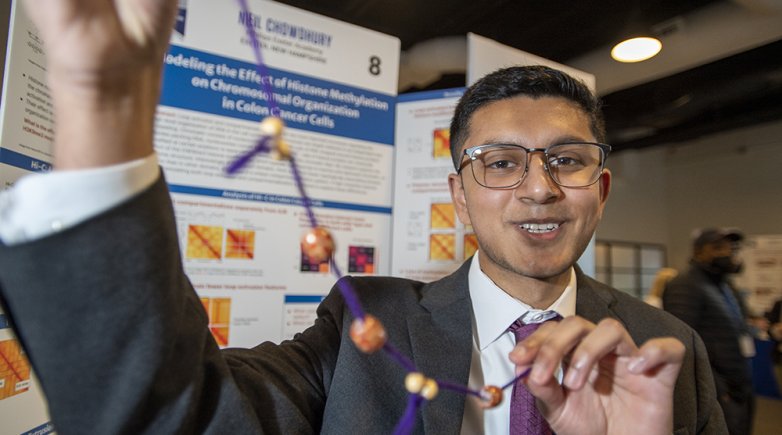
The blizzard conditions on January 30 didn’t prevent 35 Exeter students —all members of the Math Club — from hosting a math competition attended by nearly 800 middle school students from around the world. Teams of up to four students faced off in the live online competition, which included an individual round, team round and a high-stakes “guts round” of 24 questions answered in only 75 minutes. Kevin Cong ’22, Neil Chowdhury ’22, Jacob David ’22, Lucy Xiao ’22, Eric Yang ’22, Max Xu ’23, Alan Bu ’24 and other Math Club leaders devoted long hours to writing and editing problems of varying difficulty, producing the competition, grading the responses and conducting statistical analysis. They also hosted two live panels during the competition, covering “Math Life at Exeter” and women and nonbinary-identifying people in the mathematical professions.

Editor’s note: This article first appeared in the spring 2022 issue of The Exeter Bulletin.

All things being equal

Diversity, equity and inclusion have risen to the forefront of educational thought in recent years. Exeter hired its first director of equity and inclusion in 2018 and accelerated its efforts in DEI after the events of the summer of 2020. This push for equity helped lead Exeter to institute new curricular programs, to devote more administrative attention to DEI topics, and to announce need-blind admissions this past fall, among other initiatives.

I recently had the pleasure of discussing this movement for equity with John Palfrey ’90, president of the MacArthur Foundation and former principal of our sister school to the south. During his time at Andover, he helped implement need-blind admissions, and he has continued to support equitable policies at the MacArthur Foundation by leveraging “creative people and institutions” and supporting socially responsible investment. He talks about equity in education as making efforts to safeguard equitable educational outcomes and making sure everyone feels a sense of belonging and can participate fully in school life.

Given this conception of equity, I think it’s possible to sort discussions about equity and its promotion into two categories: conversations of policy implementation and conversations about maintaining equity in daily interactions. The former has to do with institutional programs and the latter has to do with the day-to-day experiences of marginalized groups, such as in the classroom. And while conversations about equity in education typically and rightfully often focus on inequities in the public education system, independent boarding schools such as Exeter might be able to support equity in their own important and unique ways.

First, and perhaps most obviously, the Deed of Gift established Exeter as a school to educate “youth from every quarter,” a straightforward and seemingly simple statement for a diverse student body. As Palfrey notes, the charge highlights the power education has “to bring people together across all kinds of difference in ways that almost nothing else can.” I think that like the U.S. Constitution, the way we interpret those words — and that document as a whole — has evolved over the past 240 years, but the purpose and the message remain much the same. In the 1850s, a commitment to “youth from every quarter” meant building Exeter’s first dorm to support students who couldn’t pay for room and board in town. In the 1950s, it meant expanding financial aid outreach by bringing in newspaper boys from the Midwest. In the 1970s, it meant making sure Exeter was working well for promising young women. Today, it means drawing attention to and supporting students of color and students from a variety of socioeconomic backgrounds.

The notion that Exeter should be a diverse, national school has its roots in a pro-democracy project. That hope, in 1781, was to help educate the youth of the new nation as a means of strengthening it. This project continues: The kind of intermixing possible at a national school like Exeter, Palfrey says, “could help bridge some of the stark divides that we suffer from as a democracy.” However, given the inequity still present in our society, it’s not easy to figure out exactly what means would best further Exeter’s goals. As Palfrey sees it, persisting inequity seems to indicate that “very few of these programs have worked especially well.” This is not to downplay the significant progress made in the past few decades; we merely point out that institutional policy- making is often not as straightforward as one may hope. Further experimentation and exploration are necessary. This is why moves such as instituting need-blind admissions are crucial in ensuring Exeter can make good on its unique position in higher education.

The conversations about managing day-to-day interactions within the Academy prove little easier. While it is straightforward to point out the benefits of treating people equitably, humans are notoriously fickle beings and myriad factors may impede our behaving equitably. So, what can we do to make sure our daily interactions support an equitable environment, or at least do not perpetuate inequity? How can we make sure the Harkness table works for everybody?

Palfrey thinks that the project starts before anybody walks into a classroom. It entails “approaching the Harkness table with an inclusive mindset and with attention to the students’ various backgrounds and needs.” He says it involves thinking carefully about the questions one poses before class and may require having conversations with students after class. And while Exeter boasts a phenomenal faculty, it can be difficult for even the most skilled instructors to support their students every time they need it and with the right type of support. Addressing errors and learning to fine-tune methods will help ensure support is always there for a struggling student.

However, there is a robust and growing literature at the intersection of philosophy and psychology that argues on normative and pragmatic grounds that we should address such mistakes without calling into question the character of the person who made the error. People are imperfect, and studies show that to denigrate someone for making an honest mistake tends to alienate peers and undermine the good intent on which they were trying to act. Palfrey and I agree that this method of constructive, amicable feedback can be difficult given the sensitivity of the topics involved, but it seems important to maintain the type of open, honest conversation that allows discussion-based learning to thrive in classrooms, dorms, faculty and trustee meetings — indeed, at all levels of the institution.

Exeter has laid significant foundations for further progress in the push for equity. The decision this fall to go need-blind, the creation of a DEI Task Force and the adoption of a DEI vision statement address the challenges of accessibility, and address the hard intellectual work done in conversations about institution-level policy implementation. But the hardest work may be yet to come. It is tricky to balance discretion and the openness that gives Exeter’s distinct pedagogy its strength and helps bind the community together. Figuring out what to do when things go awry is likewise a delicate task. Palfrey and I believe that, while it may be challenging for Exeter’s leadership to guide the community through these difficult topics, their directives in making the Academy a more equitable institution have the potential to invigorate and further strengthen Exeter as a place of learning.

Cameron Frary ’20 is currently a student at Bates College. While at Exeter, he penned columns for The Exonian with a focus on the Academy’s history. He is also the 2020 recipient of the Gordon Editorial Award, given annually to an Exeter student who displays through editorial journalism a passionate dedication to personal freedom, particularly freedom of conscience and its expression.

Editor’s note: This article first appeared in the spring 2022 issue of The Exeter Bulletin.

Equity initiatives

It’s hard for me to believe that I am already wrapping up my fourth year at Exeter. I’m grateful to take this moment to reflect upon some of the ways Exeter has grown to become a more diverse, equitable and inclusive community.

The Office of Multicultural Affairs (OMA), Dean of Faculty (DOF) and Office of Equity and Inclusion (OEI) teams have evolved and expanded over the past few years. The additions of an Asian student coordinator and an LGBTQA+ student coordinator in OMA, an assistant director in the OEI and an assistant dean in DOF have increased the bandwidth of our offices and the opportunities for broad engagement with the community. An exciting slate of programming is now offered, including a Lunar New Year celebration, Black History Monthgala, Dia de Los Muertos, a webinar series and the OMA Leadership Summit.

We’ve also created ample opportunities for students to learn about diversity, equity and inclusion within the curriculum. The Core Values Project: Conversations about Anti-oppression, Community Values and Justice is a joint Office of Equity and Inclusion and Dean of Students project that builds on the antiracist mini courses developed last year. Discussion group facilitators work in pairs to pitch project ideas, and their peers select a discussion group that interests them. Some of this year’s Core Values Projects include Balikbayan: The Return Home, Exonians in the Philippines Study Away Proposal; An Artistic Exploration of Queerness: Showcasing Queer Identity Through Art and Performance; and Windows and Mirrors: Multimedia Representation of Anti-oppression, Community Values and Justice at Exeter.

New classes were also added to the Courses of Instruction, including MAT40J:Mathematics of Social Justice, INT535: Asian American History and Literature and EXI545: The Intersection of Science, Health and Race in America.

I am confident that our students are graduating with the critical-thinking skills they will need to be successful in an increasingly global and interconnected world.

The Office of Institutional Advancement has worked with members of the General Alumni Association Board of Directors to bring a series of affinity-based networking opportunities called Identity + Affinity to the alumni community. In late February, a Black Alumni Affinity Programming Committee produced a fantastic program, “For Us, By Us: The History of 164 Years of Black Excellence at Exeter,” in which Alexanderia Baker Haidara ’99 presented her historical research. Big thanks to GAA director Una Basak ’90 and the members of the planning committee, including Haidara, Ciatta Baysah ’97, Julian Bobb ’90, Lori Lincoln ’86, Lars Ojukwu ’03, Mike Oneal ’74 and Russell Washington ’89. The Identity + Affinity Series continues with programming for Asian American/Pacific Islander, LGBTQA+ and Hispanic/Latinx affinities.

I’ll be joining IA “on the road” this year to bring Core Values Project discussions to alums and parents all around the country. You will have the opportunity to experience the same types of conversations we are having here on campus.

Looking ahead, we will host the Exeter Diversity Institute, or EDI, this summer, with educators from all over the country coming to campus to discuss how to navigate identity and promote equity in school communities and at the Harkness table. In August, we’ll have an EDI for Academy employees, and we’ll welcome a talented and diverse cohort of new colleagues to PEA.

September will kick off the second year of the Equitable Exeter Experience, a pre-orientation program for students of color, students with high financial need, students who are the first in their families to go to college and students who are members of the LGBTQA+ community.

One of my favorite things about Exeter is that we are never comfortable with staying the same. We are always looking for ways to grow, progress and improve. I’m proud of this community and I can’t wait to see what the future brings for us.

Editor’s note: This article first appeared in the spring 2022 issue of The Exeter Bulletin.

Student Teachers

I’m often asked if, with my busy schedule, I am able to spend time with students and learn about their experiences at Exeter. The answer is an emphatic yes. The time I spend with our students gives me energy and joy, and importantly informs how I think about the rest of my work. There often is no more important part of my day.

I am a regular at athletic contests, music, theater and dance performances, and art exhibitions throughout the year. I always come away amazed by the talents of our students, and proud of how they show up and support each other. As much as I like to attend games and performances, I also enjoy attending practices and rehearsals, because that gives me more opportunities to engage with students, coaches and teachers. At a recent dance rehearsal, the student choreographer took great pride in explaining her work to me before she supervised the rehearsal — I learned a lot! From my seat in the Goel Center, I realized how the addition of that building has completely transformed student experiences in theater and dance, just as the additions of The Bowld and new field house have done the same for music and athletics.

I often meet with students to hear about issues that concern them and to get their input on initiatives we are working on as an administration. In conversations with the student-led Environmental Action Committee, students shared their ideas about how we might build greater environmental awareness on campus, bring more speakers on environmental topics to assembly, expand curricular offerings, and create new internship opportunities — ideas that will be reflected in our climate action plan that is under development. A recent meeting with leaders of our Muslim Student Association led to a decision to make Eid al-Fitr (the breaking of the fast after Ramadan) a no-class day, on par with how we support other major religious holidays — an important decision for our community, and something we are able to do without reducing the number of classes. Other administrative leaders have joined me in numerous meetings with student leaders this year to discuss our protocols for handling reports of sexual misconduct and supporting students.

I also host events at Saltonstall House or elsewhere on campus to celebrate students’ accomplishments and get to know them better. I host or attend cast parties, captains’ brunches, and meetings with affinity groups and student clubs. These gatherings often lead to wide-ranging discussions on issues important to the students. I hear what gives them joy, see the strength of their friendships and listen to their concerns.

Even in unplanned, casual moments, I learn a lot. I recently had lunch with a student who shared his experience as a leader of a Core Values Project initiative focused on equity and inclu- sion in athletics. Our conversation reminded me that while it is hard to make time in our schedule for new initiatives, it’s important to do so if they are to remain priorities.

These are just a few examples of ways that I interact with students in order to understand how they experience their time at Exeter. I consistently see their joy in being here and how much they care about each other and their school.

As we welcome reunion classes back to campus this spring for the first time in three years, I am excited that many of you will be able to see firsthand all that is happening here, and witness how our students are thriving, in and outside the classroom. Every day I’m reminded of how lucky we all are to be part of such a vibrant community that is so deeply committed to preparing youth from every quarter to lead purposeful lives.

Let's go! Barbin coaches 1,000th game

Coach Dana Barbin has spent his life in a hockey rink. Sometimes even when he was not supposed to. The Exeter native — who played at Exeter High School before going on to enjoy an outstanding career at the University of New Hampshire — would occasionally sneak into one of the Academy rinks for an extra skate and workout. For the past 35 years, he’s just walked in the front door.  

Barbin officially stepped onto campus in 1987 and immediately found a spot behind the boys hockey bench. On Feb. 26, he celebrated his 1,000th game as a coach with a 3-2 victory over — who else — Andover during winter E/A.   

Barbin spent his first five seasons as an assistant under coach Bill Dennehy before he assumed the head coaching role in 1992. Barbin served as the head coach for the next 29 years before returning to his role as an assistant under current head coach — and his former player — Tim Mitropoulos ’10 in 2021.  

Barbin has amassed quite the laundry list of accomplishments while building Exeter hockey into one of the premier prep programs in the country. He led Big Red to a 30-3-0 record and a Division I New England title in 1999, and has seen hundreds of former student-athletes continue their careers at the NCAA Division I, II and III levels and 11 former players drafted into the NHL. Barbin, who also played and coached internationally in Denmark in the 1980s, was inducted into the New Hampshire Legends of Hockey in 2011. Over the course of his head coaching career, Barbin put together a staggering 582-235-53 record.  

Congratulations, Coach! 

Editor’s note: This story first appeared in the spring 2022 issue of The Exeter Bulletin.

The Kirtland Society