
Phillips Exeter Academy

Exonians win trip to physics’ global epicenter

An experiment proposal from members of Exeter’s Physics Club has been selected as one of three winners in the 2023 CERN Beamline for Schools competition, earning eight Exonians a trip to Switzerland to put their hypothesis to the test.

Known as “Myriad Magnets,” the team consisting of recent graduates Isabella Vesely ’23, Aubrey Zhang ’23, and Daniel Jeon ’23 and current students Ishaan Vohra ’24, Achyuta Rajaram ’24, William Lu ’24, William Soh ’24 and Peter Morand ’25 will be invited to Geneva for a two-week stay in September to use one of the European Organization for Nuclear Research’s (CERN) particle accelerators. CERN operates the largest particle physics laboratory in the world.

The group’s proposal involved building an adjustable arrangement of permanent magnets for steering and focusing a beam of high-energy particles, which are traveling at nearly the speed of light.

“We sought to investigate alternative, more sustainable technologies, for bending and focusing beams. Our design uses only permanent magnets, thus requiring no electricity to operate,” Vohra said. “The design would serve as a proof of concept for future multi-functional and environmentally friendly electromagnet alternatives in particle accelerators.”

The 10th edition of the annual competition, put on by CERN and the German Electron Synchotron (DESY), received 379 entries from secondary schools in 63 countries. One team from the Netherlands, and another from Pakistan joined Exeter as winners of the competition. The winners were selected by a committee of CERN and DESY scientists.

“Beamline for Schools supported us to directly explore and apply new skills, particularly in the intersection of physics and engineering,” said Vesely. “We are excited to put our design to the test in CERN’s cutting-edge facilities and, most of all, work with and learn from some of the world’s best physicists and engineers.”

The team from Exeter built on last year’s experience, when they finished as a runner-up, and worked for months, consulting with experts both on-campus and afar, to design an even more ambitious proposal. Science instructors Jim DiCarlo and Scott Saltman mentored the club members through the process.

“Mr. DiCarlo and Mr. Saltman provided invaluable advice that helped us refine our magnet design and experimental setup, and we also sought advice from external physicists and engineers at the Fermi National Accelerator Laboratory, the Denmark Technical University, and the University of Liverpool,” Vohra said.

Grevious leads Big Red at Outdoor Nationals

Exeter track and field rung the closing bell on the 2021-22 athletic calendar and Big Red went out with a bang. Seven members of the track team represented Exeter at the Nike Outdoor Nationals at historic Hayward Field at the University of Oregon, and Big Red were no strangers to the podium.

Byron Grevious led the way for Exeter, which terrific performances in both the 5000m and two mile. Grevious finished fifth in the country in the 5000m with a time of 14:36.15. Grevious was just one of six members of the Class of 2024 in the event. He followed his fifth place finish with a 12th place overall finish in the two mile, coming in at 9:04.02 and finishing first among just four second year runners. His nationals performance capped quite the end of his outdoor campaign, as also claimed New England titles in the 1500m and 3000m at Interschols three weeks ago.

Big Red earned trips to the podium four more times four the four days of competition.

Oliver Brandes ’23 earned third place in the Emerging Elite category of the 800m with a time of 1:55.14 while classmate Owen Dudley ’23 follwed in 19th place, crossing at 1:57.33.

Aiden Silvestri ’22, who was the New England champ in the 300m hurdles at Interschols, ran to a fifth place finish in the Emerging Elite 400m hurdles at with a time of 55.81.

The New England champion 4x400m relay team of Chaz Cordle ’22, Dudley, Brandes, and Silvestri teamed up and earned a third place finish in the Emerging Elite section, putting together a time of 3:25.95.

Tanner Boulden ’24, who finished second at New England’s, placed fourth in the Emerging Elite Javlein with a throw of 154-05 while Sava Thurber ’22, fourth at New England’s, finished ninth with a toss of 148-03.

“This group performed like true Exonians,” said Exeter head coach Hilary Hall. “They went out with a task at hand, set forth a plan, and executed the plan with drive and focus. I could not be more proud of this group.”


Big Red Crew finishes with strong Nationals performance

The Exeter girls and boys crew program traveled to Sarasota, Florida to compete in the US Rowing Youth National Championships this past weekend and proved their mettle as one of the top programs in the country.

The girls top boat of Jacqueline Luque ’22, Jamie Reidy ’24, Emma Lyle ’22, Charlotte Pulkkinen ’22, Matilda Damon ’23, Ellie Ana Sperantsas ’24, Kate Nixon ’23, Lucy Weil ’22, Edie Fisher ’24 finished 11th overall in the country and first among high school programs. The girls placed 12th overall in the Time Trials on Thursday which advanced to the Semifinals.

Big Red placed fifth in the Semifinal round and advanced to Sunday’s B Finals, which saw them finish fifth in their heat and 11th overall in the country with a time of 6:48.083. Their exciting finishing at Nationals came after a New England Championship for the girls first boat at the NEIRA Championship Regatta at the end of May.

The boys first boat of Ryan Kim ’23, Weiyi Huang ’23, Will Bernau ’24, Andreas Lorgen ’22, Rohan Radhakeesoon ’24, Shrayes Upadhyayula ’22, Henry Blakemore ’23, Alex Luque ’22, and Mikey Bean ’22 competed well and earned a spot in the D Finals after a solid performance in Time Trials and finished 25th overall in the country.

The boys first boat performance came after an undefeated regular season of racing and a second place finish at the New England Championships. The boys program also earned the W. Hart Perry Cup as the top boys 8+ program in New England as the second and third boats each claimed first place at New England’s in May.

To view full results click here, to watch the races on-demand click here. 

Classics for everyone

Students and teachers in Exeter’s Classical Languages department know the Latin Study as an elegant space used for classes, lunchtime seminars and meetings of the Kirtland Society. Tucked away off its own hallway in the Academy Building, near the righthand entrance to the Assembly Hall, the stately room is also an ideal spot to engage in quiet conversation or contemplation.

Non-classics students, on the other hand, might not even know the Latin Study exists.

But a group of Exonians — including students, teaching interns and faculty members in the Classical Languages department — are working to change that. As part of a Core Values Project (CVP) that began during the 2021–22 academic year, students helped reimagine the room as a space that reflects the vibrancy and diversity of the classics discipline and those who study it, as well as a more accessible, welcoming place for everyone on campus to enjoy.

“I think a lot of people think the Latin Study is only for classics students, and the way it’s used can sometimes give off that reputation,” says Blake Simpson ’23, who participated in the CVP. “I think it’s really appealing to try and update in a way that’s beneficial to the whole community.”

Like similar projects on campus, this one grew out of a series of conversations launched in 2020 around how Exeter could become a more anti-racist school. Led by teaching interns Alexandria Frank and Lina Wang of the Classics Department, more than 20 students joined the CVP each term. Many were classics students; others weren’t, and some of them had never even been in the Latin Study before.

“We started with a lot of brainstorming and figuring out what sorts of changes they’d like to see,” Frank says. “We were thinking through the overall aesthetic of the space, in combination with how it can become more inclusive and represent Exeter as it is today.”

The reimagination started with the walls of the room, which were previously adorned with four large portraits of former classics instructors at the Academy. “Students felt that when they came into the space, they were faced with four old white men,” Wang says. “That kind of sends a message about who this space is for, and who represents classics.”

A portrait of John Kirtland, founder of the Kirtland Society, will remain. The three others will be removed and replaced with a variety of different images, including — in the center of one wall — a painting of the severed head of the gorgon Medusa by Rowan Flanagan ’24. Flanagan’s piece, titled “Perseus Triumphant,” is the first in what will be a rotating series of exhibits, featuring posters from an array of visiting speakers and artwork by students, including those who (like Flanagan) aren’t studying classics. Planned future additions include prints of works by the artist Romare Bearden, whose series A Black Odyssey featured scenes based on Homer’s epic poem blended with images from African mythology and religion.

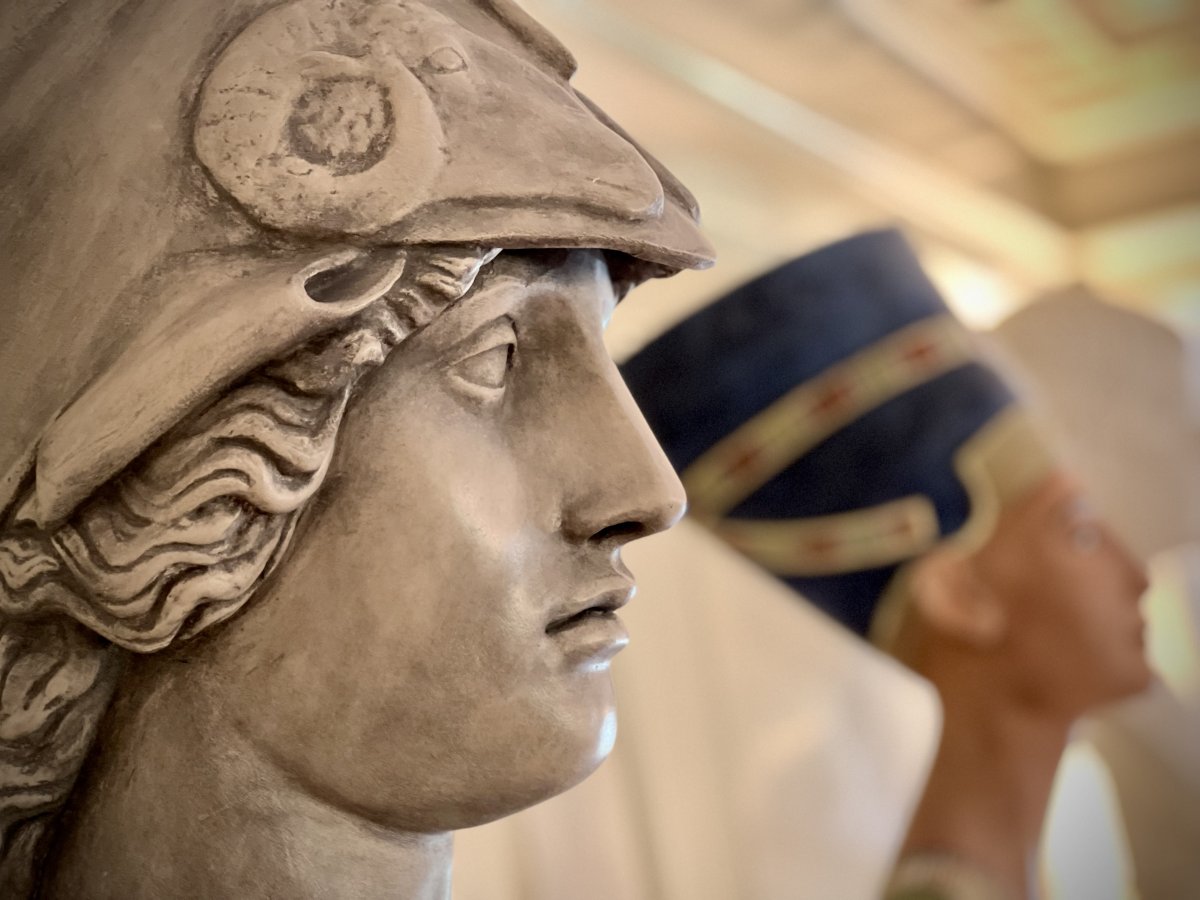
On a high shelf lining one wall, newly unboxed busts of the goddess Athena, wearing her military helmet, and the Egyptian queen Nefertiti have replaced a formerly all-male lineup dominated by Augustus and Cicero. Nola Weeder ’24 appreciates seeing a greater number of women depicted in the artwork that now decorates the Latin Study. “It was really cool to see [the changes] implemented, and how it wasn’t just men covering the entire room,” she says. “It’s a lot more representative.”

Frank and Wang credited Classical Languages Instructor Sally Morris with helping to commission the bust of Nefertiti, which was modeled on a 14th-century sculpture recovered in 1912 from the ruins of the royal city of Amarna and is painted in vibrant colors, in the style of the original.

“We’ve been having a lot of conversations about how these stoic white marble busts aren’t how they were in antiquity,” Frank says. In fact, evidence suggests most ancient sculptors, including Greeks and Romans, practiced polychromy (all-over color). But the paint wore off over time, leading to a persistent myth that these artists deliberately left their sculptures bare.

“You see these big white busts with no paint and no detail on them, and they seem almost devoid of any character,” agrees Rishi Gurudevan ’25, another participant in the CVP. “In reality, that’s not what they were meant to be.”

Gurudevan also appreciated the group’s efforts to expand the Latin Study’s vision of antiquity beyond Greece and Rome, and incorporate a more global view into both the art on the walls and the books on the shelves. “We focused on representing Persian, Northern African, Indian and Chinese populations as well, and really challenging the definition that’s been presented to us of this Greco-Roman world,” he says. “Cultures from all over the world have had massive impacts on how we live today.”
Ana Luisa and Jens Nystedt

Once their son, Erik ’22, made the decision to go to Exeter, Ana Luisa and Jens Nystedt wasted no time in getting involved with the school themselves. They started by attending parent events near their home in Greenwich, Connecticut. “We’ve always been involved in our kids’ schools since they were young,” Ana Luisa says. “Because we had no background in boarding schools, it was helpful to touch base with other parents who were a little bit more experienced.”

The Nystedts also took advantage of the fact that they were within driving distance of Exeter’s campus. In addition to Family Weekend, where Ana Luisa remembers getting her first taste of Harkness discussion in a history classroom, they attended Exeter Leadership Weekend, the fall event open to parent and alumni volunteers, in both 2018 and 2019.

“You do feel part of the community when you see familiar faces coming back,” Ana Luisa says. “You also get to know more about how to support the school — how things work, and where the needs are.” 

After Andrea ’24 joined her brother at the Academy, the Nystedts saw her flourishing just as he had. “I think both of them really appreciate the diverse student body, the ability of teachers to be almost always available, and being in an environment where they are surrounded by their friends at any moment,” Jens observes.

A bridge between parents and the school

When members of Exeter’s Family Engagement and Giving team approached the Nystedts about joining the Parents Committee, they embraced the opportunity to deepen their participation in the community. “Given the positive changes and the growth we’ve seen in our kids, when there was an opportunity for us to give back, we really welcomed it,” Jens recalls.

As the current National Chairs of the Parents Committee, the Nystedts see themselves as a resource for their fellow Exeter parents, especially those newer to the community who are in the same place Jens and Ana Luisa were a few years ago. “Sometimes they feel more comfortable engaging with another parent,” Jens says. “We are simply a bridge to help them approach the school when they need some extra help or have some questions.”

In addition to volunteering, he sees an additional opportunity to give back for those parents who can provide financial support to the school. “We’re all benefiting from previous parent and alumni donations to Exeter,” he points out. “I think it’s absolutely key to realize that there is a funding gap, and if we can help to fill that gap, it’s the best way to make sure the opportunities that our children have had is something future children can have as well.”

Feeling connected to their kids

Just as importantly, their work with the school also enables the couple to feel more connected to their children’s lives. A four-year senior and proctor in Main Street, Erik ran cross country and winter track and co-captained the tennis team. He also launched a club at the Academy focused on remote control airplanes. Andrea lives in Dunbar and serves as a dorm rep for Student Council; she’s also on the cross country, track and tennis teams, co-heads two ESSO clubs, and participates in Sans (a cappella group), the Lionettes (dance group), Model UN and The Exonian, where she’s an editor of the humor section.

The impact of the Harkness system is also clear. “They’ve become more independent thinkers, and they can articulate their ideas better,” Ana Luisa says. “They’re taking more initiative in their own learning, which is great to see, and they’re more mature in trying to hear all sides of an argument before making up their own minds.”

“Harkness discussions have made [Erik and Andrea] much better debaters around the dinner table,” Jens agrees. “For good and for bad.”

'You are ready': Class of 2022 graduates in style

Dazzling sunshine bathed campus Sunday as Exeter celebrated its commencement ceremony on the front lawn of the Academy Building for the first time since 2019. The 312 members of the class of 2022 joined in a procession that began on the south side of campus, crossing Front Street to take their seats in front of a proud and excited audience of their teachers, family and friends.

After welcoming and expressing gratitude to faculty, staff and family members, President of the Senior Class Bona Yoo kicked off the ceremony by inviting her classmates to remember their younger selves, and to reflect on how far they had come.  

>> Watch the full graduation ceremony

“We took this crazy bet on ourselves, picked up our bags, left everything we knew and congregated from all corners of the world to live together in Exeter, New Hampshire,” Yoo said. “We had to start from scratch and build with what we had, and what we had was each other.”

We are wiser, stronger, but most importantly, we've built a family of lifelong friends this early on in life. That is truly a rare thing."
Bona Yoo '22, senior class president

In addition to revisiting some “snapshots of bliss” — from a sunrise walk with her roommate to celebrating the first football win over Andover in eight years this past fall — Yoo also acknowledged the “gut-wrenching lows” she and her classmates endured together, particularly the upheaval caused by the COVID-19 pandemic.

“For the past two years, we’ve been fighting pretty hard to stay connected and to keep our traditions alive,” she said. “We learned how to connect and to stay resilient. We stunned each other with our talents, our capacities to listen and our ability to challenge one another’s values and notions.”

“We are wiser, stronger, but most importantly, we’ve built a family of lifelong friends this early on in life,” Yoo concluded. “That is truly a rare thing. Because we tend to be inherently self-critical, and because we’re always striving for more … it’s imperative that we celebrate ourselves not just today on grad day, but also tomorrow, and on your good days and on your bad ones.”

Principal’s farewell address

Principal William K. Rawson ’71; P ’08 began his farewell message to the seniors by noting the special connection between himself and the class of 2022. “Your first Assembly was my first Assembly,” he said. “You were nervous and excited preps [and] I was your nervous and excited new principal.”

Rawson lauded the students’ accomplishments and pursuit of excellence in the classroom, the arts and athletics, as well as how they had worked to make the school a more equitable and inclusive community, among other contributions. “I also admire the way you have cared for and supported each other,” he continued. “You care deeply for each other. You always show up for each other. In doing so, you have set a powerful example for the classes that will follow.”

Rawson repeatedly drew parallels to his own graduation from Exeter 51 years earlier, at one point sharing a quote from a speech made on that day by his classmate Roberto Garcia ’71. Rawson echoed Garcia’s statement of optimism and purpose, and his emphasis on the important of “human connections” when it came to making a difference in the world.

“You are ready to take your place in the world and follow the examples of generations of Exonians who have come before,” Rawson said. “You are ready to be the kinds of citizens and leaders that our world needs — citizens and leaders who will act with empathy, understanding and respect for their fellow human beings … and who will work together to break patterns of injustice and form a better world.”

You are ready to be the kinds of citizens and leaders that our world needs."
Principal Bill Rawson '71

Honors and Special Awards

In addition to Yoo’s and Rawson’s speeches, Dean of Faculty Ellen Wolff P’17 and President of the Trustees Morgan C.W. Sze ’83; P’19, P’22, P’25 presented various graduating seniors with this year’s endowed college scholarships, as well as a number of special awards and prizes:

The Faculty Prize for Academic Excellence: Audrey Aslani-Far 

The Cox Medals: Audrey Aslani-Far, Emma Finn, Valentina Kafati, Bona Yoo, Felix Zou

The Yale Cup: Aiden Silvestri

The Ruth and Paul Sadler ’23 Cup: Kate Mautz

The Perry Cup: KG Buckham-White

The Williams Cup: Neil Chowdhury, Emma Finn

The Eskie Clark Award: Anne Chen

The Thomas H. Cornell Award: Dorothy Baker

The Multicultural Leadership Prize: Zara Ahmed, Adam Belew, Mali Rauch, Marina Williams


Ceremony program

A string quartet comprised of seniors Sava Thurber (violin), Aaron Venzon (viola) and Josephine Elting (cello), and upper Jesalina Phan (violin) played before the ceremony and during the processional.

Seated onstage with Rawson during the graduation ceremony were retiring faculty members Kirsten Russell and Ralph Sneeden. Peter Vorkink, Gordon Coole and Viviana Santos are also retiring this year.

Rawson’s speech was preceded by a performance of “The Road Home,” composed by Stephen Paulus, by the seniors of Exeter’s Concert Choir: Moksha Akil, Kiesse Nanor, Nicholas Talleri, Otto Do, Garrett Paik, Catherine Uwakwe, Alexander Luque, Aryana Ramos-Vasquez, Narmana Vale, Jacqueline Luque, Isaac Saunders, William Whitney and Daniel Zhang.

Finally, seniors Neil Chowdhury and Grace Emmick assisted Rawson in handing out diplomas to their classmates. The ceremony was followed by a luncheon on the lawn in front of the Class of 1945 Library for graduates and their guests.

A return to tradition

The tradition of holding graduation on the Academy Building lawn began in 1983 and continued until the pandemic’s arrival caused the in-person ceremony to be canceled in 2020. Last year, the class of 2021 returned to celebrating their graduation in person, but the ceremony was held in Phelps Stadium to accommodate social distancing and other health and safety protocols.

Gold medals and E/A weekend cap spring season

The final day of the spring sports calendar is always a thrill, and this year held to form. Exeter crew was busy striking gold at the New England Interscholastic Rowing Association Championship Regatta, while the rest of Big Red traveled down to our Blue counterparts for Exeter/Andover weekend.

Incredible performances on Lake Quinsigamond in Worcester, Massachusetts, put a bow on a highly successful season for boys and girls crew. The boys first boat claimed second place overall, while the boys second and third boats each earned a gold medal in their grand final races. The girls first boat capped an undefeated season and claimed gold in their grand final race, beating out the second-place finisher by seven seconds. The girls second boat claimed first in their alternate final race, while the third boat finished sixth in New England.

The girls varsity lacrosse team opened the weekend in thrilling fashion Friday night. Trailing by two goals with a minute left, Big Red came roaring back to force overtime. Eden Welch ’23 trimmed the deficit with 54 seconds left before Victoria Quinn ’22 scored off a feed from Adora Perry ’24 as the buzzer sounded to even the score at 10-10. Exeter maintained possession off the opening draw of the extra period, and Quinn set up a cutting Welch, who potted the game-winner just 63 seconds into overtime. Welch finished with a game-high six goals, while Allie Bell ’25 was outstanding in net, making several key stops down the stretch.

Boys varsity lacrosse kept the winning vibe going on Saturday. Exeter took a 4-2 lead into halftime and never looked back, taking an 8-3 victory over the Blue. Aidan Olazabal ’24 was the star for Big Red, making 18 saves in between the pipes; Baron Fisher ’22 and Declan Murphy ’22 each scored three times to power the offense. Boys JV lacrosse earned a thrilling 11-10 victory over Andover.

Varsity baseball broke a scoreless tie in fourth inning when Kodi Dotterer ’22 laced a triple to deep right field to knock in a pair of runs and stake a 2-0 lead. The lead would remain intact before Andover pushed six across the plate in the bottom of the sixth inning to claim a 6-2 victory.

Big Red softball wasted little time getting on the board as Taylor Nelson ’22 blasted a two-run home run in the top of the first inning. The Andover bats would chip away and jump ahead 3-2 in the fifth before plating a trio of runs in the sixth. Alex Singh ’22 singled in the sixth to knock in Nelson and cut the deficit to three, but Andover would hold on for a 6-3 win.

Big Red and Big Blue capped the day on the track. Exeter boys, anchored by an impressive performance and win in the 4×100 relay, earned an 81-54 victory over the Blue, while the hosts topped the Big Red girls by a score of 80-56.


Summer break, but no pause in learning

Exeter’s Global Initiatives program has long set the Academy apart in giving students opportunity to explore our world and put their critical thinking and cultural competencies to use. This summer, Exeter is wasting no time getting back on the road, with the first of six experiential learning trips starting June 4.

PEA faculty will lead dozens of our students on trips as near as Vermont’s Northeast Kingdom and as far as an archaeological dig in central Italy.

Here are brief descriptions of the planned trips:


Conserving Pollinators
Monteverde, Costa Rica
June 4-11

More than three-quarters of the world’s crops depend on pollinators. These animals provide essential ecosystem services and play a crucial role in the production of many fruits and vegetables. But a changing climate, pesticide use and habitat loss or degradation threaten pollinator communities. Through the observation, collection and identification of local pollinators in Costa Rica, students will help gather data critical to understanding the impacts of these threats to this fragile but vital ecosystem.


Environmental Stewardship
Northeast Kingdom, Vermont
June 5-13

Vermont is a place of deep connection to the rhythms of the natural world, a place of close communities living close to the land. Using Quimby Country Cottages in Vermont’s Northeast Kingdom as HQ, students will explore and live the idea of stewardship through the contexts of recreation and adventure, community and food, and the arts and sciences. Participants emerge with a deep sense of place and a template for engaging their own homes in ways that offer mutual flourishing to human and nonhuman communities.


Introductory Biology
Yellowstone National Park, Montana
June 5-10

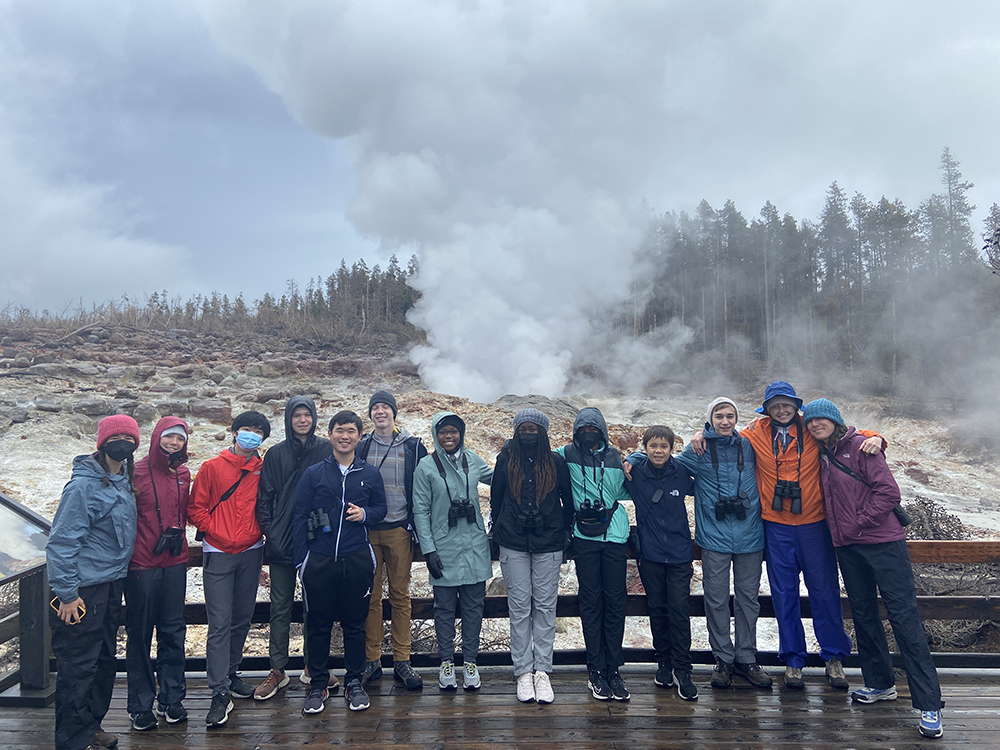
Students gain first-hand experience with the Greater Yellowstone Ecosystem as it relates to their spring term Introductory Biology curriculum. The week will be spent making day trips into Yellowstone National Park and working with instructors from Yellowstone Forever Institute on topics that include wolf reintroduction, grizzly bear conservation, and the Bison/Brucellosis dynamic.


View this profile on Instagram


Exeter Yellowstone 2022 (@exeter_yellowstone_2022) • Instagram photos and videos

ESSO Service
New Orleans
June 5-11

Students take part in a hands-on service project while learning about New Orleans culture and the lasting effects of Hurricane Katrina on its infrastructure. This trip focuses on helping to rebuild homes, replant gardens, resurrect community parks and contribute to neighborhood revitalization projects. Students will also meet homeowners and community members who were negatively impacted by the devastating 2005 hurricane.


View this post on Instagram


A post shared by EXIE @ NEW ORLEANS (@pea_nola2022)


Classical Archaeology
Lazio, Italy

June 17-July 11

To really engage with the ancient past, students need to get their hands dirty. Archaeology can answer important questions that literature cannot, especially about the habits and beliefs of non-elite Greeks and Romans as seen by the artifacts and buildings they left behind. PEA students will join The Gabii Project, a dig in what was a renowned city during Roman times and where, legend holds, Rome’s mythical founder, Romulus, and his brother, Remus, were educated. 


Social Entrepreneurship
Berlin, Germany
June 5-26

After 70 years of dramatic change, Berlin offers an incredible range of activities for all interests. Students will converse with Berlin business owners and customers in various fields while exploring downtown neighborhoods. They will live and take classes at CIEE Berlin Global Institute. Using startup-friendly Berlin as their classroom, students will learn to leverage their business skills to create sustainable solutions to community challenges in this social entrepreneurship course. During the first half of the program, students learn how to develop and pitch a business. During the second half of the program, students will use the U.N. Sustainable Development Goals as a framework for discussing various challenges facing Berlin.


View this profile on Instagram


Exeter in Berlin (@peaberlin2022) • Instagram photos and videos

Cycling takes home NERCL Championship

The Exeter cycling team has been crowned as champions once again as they claimed the New England Road Cycling League Championship yesterday on the road course at New Hampshire Motor Speedway. This marks the second straight league title for Big Red.

Owen Loustau ’22 paved the way as he has all season, claiming first place overall as he covered the 15 mile race in 35:52.20 in the Boys A section. Duke Garschina ’23 finished fourth overall in the Boys A group with a time of 38:15.30.

Ale Murat ’23 powered Exeter in the Girls A section, crossing at 37:38.60 to claim third place overall. Leta Griffith ’25 followed to finish in fourth.

“Led by Owen and Ale, our team came together as a family,” said Big Red head coach Don Mills. “They stepped up and performed well all season, especially today as several key riders were out.”

Hisham Alireza ’23 and EJ Barthelemy ’23 finished first and third, respectively, in the 11.5 miles Boys C race. It was a tight finish as Alireza came in at 33:50.90, edging out the second place finisher by 1.5 seconds while Barthelemy followed at 33:54.70.

Sophie Fernandez ‘22 and Rianna Skaggs ’23 earned third and fourth place in the Girls C 9.2 miles race with respective times of 28:28.60 and 28:47.70.

Exeter’s writer-in-residence launches to new heights

Students, faculty and other members of the Exeter community gathered in Rockefeller Hall in the Class of 1945 Library on Tuesday evening to hear Kim Coleman Foote, the 2021-22 George Bennett Fellow, read from her work.

A writer of fiction, creative nonfiction and experimental prose, Foote said at the outset of her reading that her time at Exeter had been “bookended” by two milestones in her writing career. Soon after arriving on campus, she sent off her manuscript, Coleman Hill, a short-story collection inspired by her family’s experience of the Great Migration, to agents. She received an offer of representation within two weeks, achieving a goal she had been pursuing since 2005.

“Then just yesterday, I sold two books,” Foote announced, to a round of applause. “My books will finally get published, and this is a dream that I’ve had since I was a little girl growing up in New Jersey.”

At the Library, Foote read from “Her Story,” a story in the collection set around 1989 in Vauxhall, New Jersey, and written from the perspective of her great-aunt. “I actually wrote it while I was here at Exeter, and it was inspired by the long and dreary and lonely and depressing and gray and cold winter that we had here,” she said. 

The spring term reading followed a well-received Assembly Foote gave in the fall, in which she read another story from the collection, a darkly comic tale she said was “inspired by true events, about when my mother and her siblings and her cousins plotted to kill their grandmother.”

During her time at Exeter, Foote has also been working on a Black female-centered novel about the transatlantic slave trade, based partially on research conducted while on a Fulbright Scholarship to Ghana. The experience also inspired her to write a third manuscript, a memoir about the black diaspora experience in Ghana.

Foote grew up hearing the family stories that inspired her story collection, and began writing her own stories around the age of 7. She holds an MFA in creative writing from Chicago State University, and her recent publication credits include Best American Short Stories, Iron Horse Literary Review, Ecotone, The Rumpus, Green Mountains Review, and Prairie Schooner. In addition to the Bennett Fellowship, Foote has received fellowships from the National Endowment for the Arts, New York Foundation for the Arts, the Center for Fiction and MacDowell. In 2022-23, she will be a fellow at the Fine Arts Work Center in Provincetown, Massachusetts.

The George Bennett Fellowship (Writer-in-Residence) at the Academy was established by Elias B.M. Kulukundis ’55 in honor of his former English teacher at the Academy, George E. Bennett. An Exeter native and member of the Class of 1923, Bennett began teaching at his alma mater in 1929 and spent 37 years in the English Department.

Now coordinated by Instructor in English Todd Hearon, the Bennett Fellowship program is one of the country’s most sought-after postgraduate writing fellowships. Awarded to a promising author who has not yet published a book, it includes a stipend for one academic year, as well as housing, meals and benefits for the author and their family. In addition to working on their own writing, the fellow is asked to make themselves available “in an informal and unofficial way” to students interested in writing, including members of English classes and student literary organizations.

Before taking questions from the audience, Foote offered her thanks for the opportunity to spend the year at Exeter. “After my MFA, I worked for about 15 years in higher ed administration … 9-5, all year round,” she said, adding that she managed to write and revise three manuscripts during that time. “I’m sincerely grateful for this opportunity to quit my job — which is tremendously scary — and for the first time in my life call myself a writer full-time.”