Phillips Exeter Academy

Making it big … the non sibi way

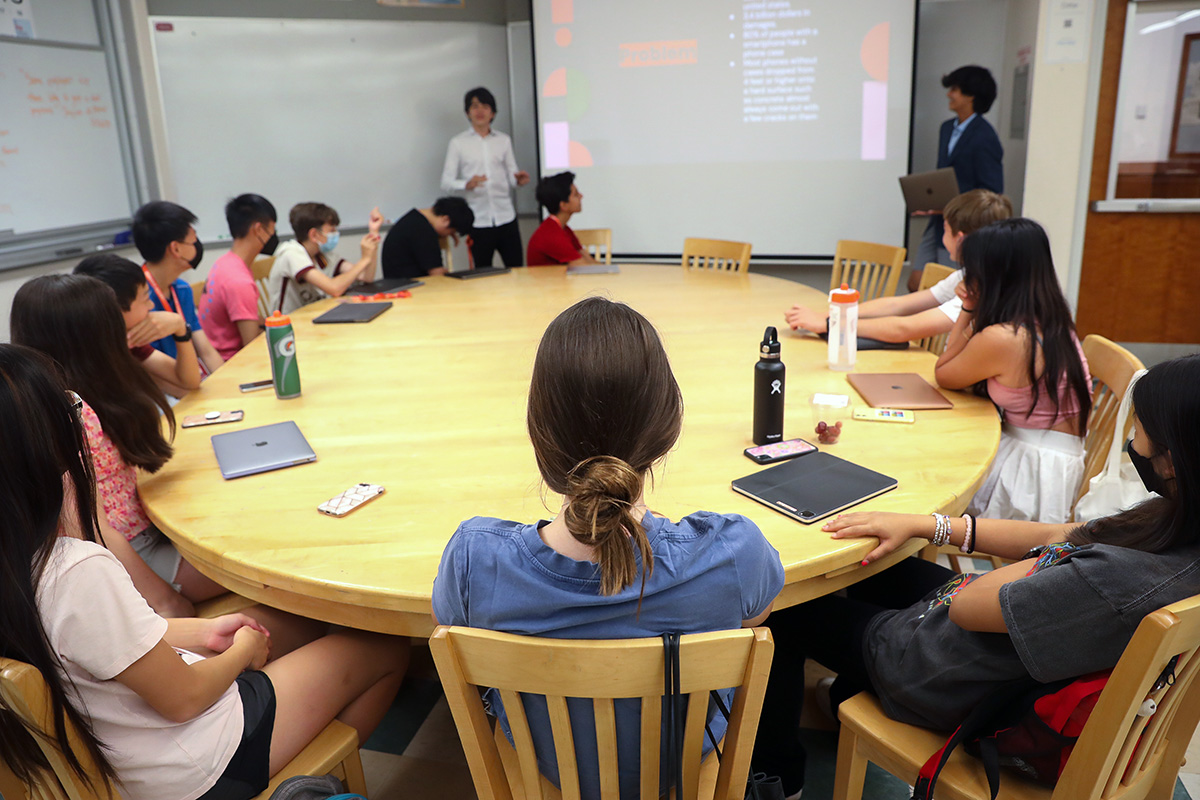
Ishaan Velan and Joaquin Cavalcante took their places standing at the front of a classroom in Phelps Science Center as theme music from the hit reality TV show Shark Tank blared through the speakers of a nearby laptop.

For their final project in Entrepreneurship: Moral Money Making, a course in Exeter Summer’s Access Exeter program for seventh- and eighth-graders, Velan and Cavalcante were presenting their business idea for their teachers and peers to evaluate — and decide whether or not to invest.

“We found in research that over 50 million phone screens are shattered per year only in the United States,” said Cavalcante, an eighth grader from Rio de Janeiro. “We’re spending money … on phone cases and they can’t do their job well.” Enter their (hypothetical) product: a highly durable cell phone case made of a more sustainable bioplastic material derived from biological substances rather than petroleum.

>> How to apply to Exeter Summer

As this “Kind Shark Tank” exercise continued, the two students discussed estimated costs and revenue for their company, and described how at $55, their phone cases would still be priced lower than those made by competitors like Casetify, Nimble and Popsicase. “Unlike them, we’re very eco-friendly with our bioplastic cases,” said Velan, a seventh grader from Chicago. “And they’re fully customizable to create the ultimate phone that’s personalized just for you.”

The students’ pitch, like other businesses presented by their classmates, were firmly in line with the core philosophy of the Entrepreneurship course, one of three in the Access Exeter cluster titled Kind By Design: Make it Big in a Good Way. As the title indicates, Kind By Design focuses on aligning principles of business and technology with a philosophy of doing good not only for fellow humans, but for the earth as a whole. One of nine clusters offered during Exeter Summer’s 2022 session, it challenged students to take a non sibi approach to creating a useful product, marketing it ethically and building a profitable yet sustainable business around it.

Design inspired by nature

In Science in Nature: Biomimicry Beyond Benign, another course in the Kind By Design cluster, students took to the laboratory to explore how some of the most successful products draw cues from the natural world.

“We take concepts from nature and…apply them in a way that’s more ecofriendly and sustainable, but still innovative,” said Jim Enright, a longtime Exeter Summer instructor who has also taught classes in marine biology and business/economics in the Upper School.

In this lab-focused course, students studied the three principles of biomimicry — sustainable, innovative and inspiring — as well as some of the ways scientists have used it to create exceptional products. For one lesson, they studied porcupine quills, the unique structure of which has inspired scientists to design more effective hypodermic needles, among other innovations.

The students also conducted hands-on experiments, including building their own lava lamps using a mixture of water, vegetable oil, guar gum, vinegar and baking soda. “We looked at porcupine quills at 8,200 times magnification under the electron microscope,” Enright added. “That’s cutting-edge technology that’s not available at probably 99% or more of high schools in the country, [and] certainly not [at] middle schools.”

Ethical marketing

In Marketing: Dignified Digital Design, the third course in the cluster, students looked at well-known brands such as Apple, Disney, Starbucks, Tesla, Coca-Cola and The North Face, focusing on the way they market their products. The curriculum touched on an array of topics, from green marketing and affiliate marketing to search engine optimization (SEO), all with the intention of helping students hone their ability to distinguish between ethical and non-ethical marketing.

Instructor Davidson Joseph taught entrepreneurship in a previous session of the Kind By Design cluster, and pioneered the “Kind Shark Tank” activity for Exeter Summer. “I think the most rewarding thing is to see students at the end of the year come back and say, ‘Mr. Joseph, I’m serious about starting my own business,’” he says.

As part of their final marketing project, the students worked in groups to produce short commercials for their chosen brands. “I enjoyed learning about how commercials are made, and how you should have very short cuts — maximum five seconds — to really keep the audience engaged,” said Konrad Olczak, an eighth-grade student from Switzerland. “That was something that I probably saw [before], but I never actually realized it or analyzed it.”

Building a better business

In the Entrepreneurship class, Instructor Trevor Marrero ’12 — who attended Exeter Summer before matriculating at the Academy in ninth grade — used a variety of different media, including articles, podcasts and YouTube videos, to explore how to build a business that is sustainable as well as profitable. To give students a behind-the-scenes look at the day-to-day challenges of business in the real world, he invited several fellow alums and friends to talk to his students about their entrepreneurial ventures.

For Cian Sloan, a seventh grader from Ireland, listening to the guest speakers share their early experiences starting their businesses was particularly eye-opening. “It really showed me the amount of work you need to do to be an entrepreneur, and just all the finer things behind it and how to approach it,” he said.

Maika Liu, a seventh grader from the Philippines, agreed: “I was really inspired by their stories and how hard they had to work to get where they are today.”

Back in the “Kind Shark Tank,” Velan and Cavalcante fielded a few pointed questions from the “Baby Sharks,” their fellow students. They then looked to the two “Sharks” in the room — Marrero and Richard Schieber, associate dean of Exeter Summer and an instructor in the Academy’s Modern Languages department — for a verdict. “I like it,” Marrero said. “I’m gonna make an offer. I want 20% of your company, but I’m only going to give you $100K.”

The two students huddled together, then came back with a counteroffer: $150,000 for a 15% equity stake. “I’ll give you a hundred K for 15%,” Marrero said.

The two students wavered. Then Schieber jumped in. “I like your presentation,” he said. “I’m going to give you $100,000 for 10%.” Satisfied, the young entrepreneurs shook hands with Schieber as Marrero and their classmates applauded.

Lamont Gallery takes stock of its own treasures

The wonder of art is born, in large part, from the imagination of the observer. The artist renders the work, and the observer fills in details. Managing Miscellanea, the exhibition currently running until Sept. 24 at the Lamont Gallery, has been curated by Gallery Manager Stacey Durand and Exhibitions and Collections Manager Dustin Schuetz from the Lamont Gallery’s art collection. While there are many impressive and evocative pieces on display, details of their provenance are scarce, and this is what makes the exhibit so intriguing. The gallery managers know for certain that the collection ranges from known works of importance by influential artists to work left behind by students. Wondering which is which is the fun of the exhibition and walking through it gives the undeniable feeling of having wandered into a treasure hunt.

Since its inception in 1952, developing a collection has never been part of the Lamont Gallery’s mission. Despite this, it has accumulated 700-800 prints, paintings, sculptures and artifacts, which comprise, inescapably, a collection. These works have arrived under a variety of circumstances: donations, bequests, student work and, in at least one instance, an unexpected truckload. What may not occur to a well-meaning donor is that stewardship of this art; keeping it well maintained, properly stored and documented over time are all part of the calculation in accepting an item. Because of this, the Gallery has ceased accepting new additions for the last seven years. In the meantime, Schuetz has been charged with uncovering as much possible about the collection and he has been making some impressive progress.

Two of the most important works in the Lamont Gallery’s collection are paintings by Diego Rivera, the famous Mexican muralist and husband to Frida Kahlo. Both are currently on loan, one to the Museum of Fine Arts Boston and the other to the San Francisco Museum of Modern Art for its exhibition “Diego Rivera’s America.” A replica of this second piece, a portrait of Corliss Lamont, is displayed for the Managing Miscellanea exhibition.

Corliss Lamont graduated from Exeter in 1920. He was a humanist philosopher, author, poet and the director of the American Civil Liberties Union for 30 years. His family were all major donors to Phillips Exeter, with seven of them graduating from the Academy between 1888 and 1942. The Lamont Room in the Academy Library and The Lamont Poetry Fund which supports visiting poets, were both named after Corliss Lamont. The Lamont Gallery is named after Corliss’ nephew, Thomas Lamont II ’42, who died in World War II. Frida Kahlo died during the painting of this portrait and calla lilies, her favorite flower, figure meaningfully to the side of Lamont in the picture.

While the Rivera works are known to be important, another piece hangs across the gallery with a backstory only just discovered during the writing of this article. The large dark background pops with swaths of color, and the author’s signature is illegible but for the first three letters “Sch.” On the back, a label with cryptic markings provides clues: the word Kootz appears along with a series of numbers and letters “76 B” “6.55” and “VI.55.” They could be the title, the date or some other record of the work.

Kootz was a gallery which existed in New York during a short period from the 1940s to the 1960s and hosted works by famous abstract expressionists of the time including Picasso, Robert Motherwell, Jackson Pollock and Willem de Kooning. The idea that this piece was there, rubbing frames with the greats, sent Schuetz to search records of the Kootz Gallery housed at the Smithsonian and he was able to determine the work to be that of Gérard Ernest Schneider, a major pioneer of the style known as Lyrical Abstraction.

A casual Google search of the artist’s name, now that it is known, turns up images with striking similarity to the painting owned by the Lamont Gallery, but this answer is only obvious once the mystery has been solved. Certainly, experts might be brought in to speed the effort, but this work is but a single example among hundreds with literally no organizing principle guiding their presence in the Lamont Gallery collection.

Nevertheless, experts do visit the Academy periodically. Recently an alumni artist came to lecture and, during a display of her works, Schuetz noticed an item bearing strong resemblance to an unsigned piece in the collection. When shown the painting, the artist confirmed that its similarity, much like the Googled pictures of Schneider’s work, meant that it was undoubtedly hers. During our visit to the gallery, the piece was being packaged up for transport back to the collection of its creator.

Art from former students and faculty

Another abstract piece suspected to be the work of a former student dominates one of the first walls in the exhibit. This oversized triptych of irregular panels bursts with geometrically precise color. There is a small signature and the likely date “’73” at the bottom of the work. The only clues to proper assembly are the holes on the back of the frame. Though the frame is slightly damaged, it’s easy to understand Schuetz and Durand’s urge to assemble it once it was found in storage. Nothing more is known about the piece beyond its innate appeal, but the guess is that it was displayed for a few years and then moved to storage.

By contrast, an impressive and mature looking abstracted cityscape of the Italian city of Matera at the back of the gallery expertly blends color and suggests clear artistic mastery even to the untrained eye. This painting was done by a former head of the gallery, the late Glen Krause. An instructor emeritus, Krause served as an art instructor at Phillips Exeter from 1946-1966, chair of the Art Department from 1962-1966 and director of Lamont Gallery 1953-1966. His three sons attended Exeter. The artist had a stroke later in life, and there is a clear demarcation in his style from before and after. This piece is meaningful as a representative of the artist’s work before the impact of the stroke.

A low-lit side room is devoted to World War I and II posters, with wartime slogans in French and English. Their vividness is even more surprising given that they are printed on fragile newspaper. The colors have been preserved by decades spent safely, but unfortunately folded, in dark storage drawers. It is suspected that they may have been left to the Gallery by a history teacher but why or what their significance may be is currently unknown. Nevertheless, they are impressive examples of their type.

Indeed, the entire exhibition, with its air of mystery and undeniable excellence provides impressive examples of technical mastery, specific styles and certainly any number of notable tales of provenance just waiting to be discovered by the gallery managers, students of the Academy or perhaps even by you should you find time to visit before it closes. The Lamont Gallery is open to public visitors by appointment. Please go to the “Visit the Lamont Gallery” page of the Lamont Gallery website to make an online reservation.

Challenge and triumph

You wake with a start, uncertain of where you are. A sharp ache in your neck reminds you — at your desk, slumped over its scratched surface, your laptop pushed to the side. When you poke at the keyboard to wake it from its own slumber, your bleary eyes dart immediately to the clock: 2:15 a.m. Panic surges through your body and you’re instantly, painfully awake. You take in your surroundings: Books — so many books — laid out on the bed, the desk, the floor. Some with their spines flattened, others bristling with tiny Post-its in neon hues. Your internet browser tabs contain a dozen more scholarly articles, not to mention those newspaper stories from the 1920s you painstakingly tracked down during hours spent in the Class of 1945 Library.

And, of course, you see the hard copy of your rough draft, marked with your teacher’s nearly illegible scrawl. Your thesis was vague, your argument meandered, you used the wrong format for footnotes and bibliography. And the draft is only six pages long.

Willing the panic to subside, you walk to the window, push it open and peer into the darkness. The night air still carries a chill, but you can see cherry blossoms on a few nearby trees. Then you notice a light in a neighboring dorm, and two more in the dorm next to that. You have no idea whose rooms these are, yet in that moment you imagine other students at different points around campus, seated at their own desks. You are not alone. They too are in the midst of that classic Exonian rite of spring: writing the U.S. history term paper commonly known as “the 333.”

It’s that very challenge — the feeling of owning your work, of pushing your limits … that makes [the 333] such an enduring, and important, part of the Exeter experience.”

I remember my own experience with the assignment well. As the daughter of an Exeter emeritus history instructor — my father, Bruce Pruitt, taught from 1973 to 2009 — I inherited his love of the subject matter, but I also inherited his perfectionism, and the related (as I now, years later, understand it) tendency to procrastinate. I composed the final draft of my 333 largely in the wee morning hours of the due date, without the help of the internet, on a clunky Toshiba laptop that was thrillingly high-tech to me at the time. The rough draft was in fact only six pages long, and I’m certain that at one point I did not believe I would ever be able to get it done.

Yet despite the History 333 term paper’s fearsome  reputation, and despite any individual struggles, I think most Exonians would agree with me: It’s that very challenge — the feeling of owning your work, of pushing your limits and achieving something that once seemed impossible — that makes it such an enduring, and important, part of the Exeter experience.

While many high school history curricula are organized around preparation for Advanced Placement exams or other standardized tests, studying history at the Academy involves little memorization of dates or battle locations or branches of royal family trees. Instead, the Harkness approach to history centers on in-depth critical reading and independent thinking, combined with classroom discussions that often draw meaningful connections between past and present. Writing is an essential part of that approach, as is giving students a solid grounding in how to do research and craft an analytical argument.

The 333 is the capstone assignment of the three-term U.S. history sequence, a requirement for graduation that is most often taken in a student’s upper year. In the fall term, students focus on the nation’s colonial origins up to the outbreak of the Civil War and complete a library research assignment. In the winter, they build upon that experience, learn about the period between 1861 and 1941, and write a short research paper of five to seven pages. By spring term, devoted to U.S. history after 1941, they are ready to confront the 333 — known prior to the 1986-87 school year as “the 32.”

Though it is unquestionably the longest paper that most students will write during their time at the Academy, the required length of the 333 has been adjusted over the years. Currently, it is 12 to 15 pages, or approximately 4,000 words, along with footnotes and a bibliography — heavy on the primary sources. “It’s become more involved,” says Bill Jordan, longtime history instructor and director of the Washington Intern Program. “The availability of sources has dramatically expanded. You used to have to go down and use the microfilm to read The New York Times, and now you just press a button and you’ve got a million articles right there.”

“If there’s one piece of the Exeter experience that gives students the best preparation for writing papers, it’s the 333,” says Betsy Dolan, dean of college counseling. In addition to preparing students for the rigors of college academics, the process of writing the paper offers students an opportunity to take ownership of their work in a way that remains rare among high school assignments, she says. From choosing a topic to tracking down sources to finding the perfect pointed research question, she adds, the 333 requires significant agency, self-knowledge and self-discipline. The term paper’s very length and difficulty also contributes to the unique feeling of satisfaction and accomplishment that students get at the end. Looking back on their 333 experience, many students view it as a process of learning not just about a particular historical topic but about themselves. For some, the experience leaves a more lasting mark, fueling a calling to a future career. “When you go to alumni events, virtually every-body remembers what they wrote their 333 about, and they love talking about it,” says Emeritus History Instructor Jack Herney ’46, ’69, ’71, ’74, ’92, ’95 (Hon.).

Layne Erickson ’18 certainly recalls finding such meaning in the process of writing her 333 — albeit by accident. When all the books for her first-choice topic (the use of animals for military purposes) were taken, she picked another book at random off the shelf to see where that led her. The book was Duty, Honor, Country: A History of West Point by Stephen E. Ambrose, and it included a section on the first women to graduate from the U.S. Military Academy at West Point in 1980.

That paper, along with my senior thesis at Princeton and my Ph.D. dissertation, were kind of the pillars of my educational evolution."

Erickson ended up writing her 333 on the classes of 1980 at the U.S. Military Academy, the U.S. Naval Academy and the U.S. Air Force Academy, all of which made the decision to admit women in 1976. As a senior, she applied to all three service academies, and this spring she became the first Exeter alumna to graduate from West Point. “Upon doing that research, I saw not only the darker side of the challenge, where these women were being faced with a lot of disrespect and unfairness and genuine harassment, but I was really inspired by the steps that they took to push through it,” Erickson says. “I thought, someone really does need to take on that challenge to be the next group. Every year, somebody’s got to be next.”

The process of writing the 333 itself pushed her limits, as Erickson was forced to restructure her entire draft based on feedback from her teacher. “I rewrote that whole thing in three or four days,” she says. “I would not say I look back on the 333 fondly, but I do look back on it with respect, as quite the challenge.”

Peter Orszag ’87 won a Negley Prize (see sidebar, “The Negley Prize Explained”), given to one of the year’s best American history essays by an Exeter student, for his History 32 term paper, “The Joint Chiefs of Staff: The Need for Reform.” Orszag, who later served as director of the U.S. Office of Management and Budget in the administration of President Barack Obama, says the experience of researching and writing his paper — combined with his participation in the Washington Intern Program during his senior year — helped propel him toward a career in public service. “That paper, along with my senior thesis at Princeton and my Ph.D. dissertation, were kind of the pillars of my educational evolution,” Orszag says. “The attractiveness of public service was part of the educational ethos at some of the schools I attended before Exeter, but it really was turbocharged while I was there.”

The process also helped build Orszag’s love of writing. Currently CEO of financial advisory at the investment bank Lazard, he has maintained a sideline, writing columns for Bloomberg News. “I’ve always found it clarifying for the thought process when you have to put something down ‘on paper,’” Orszag says. “The experience associated with the History 32 paper was beneficial because it reinforced the importance of writing clearly and well, and that’s something I’ve continued to enjoy to this day.”

As with Orszag and Erickson, the process of writing her 333 taught Flora MacIvor ’03 about herself, as much as about the topic she chose: the anti-Communist crusades and mass arrests that peaked in the years after World War I. “I had this idea in my mind of what I was going to say and what I was going to argue,” MacIvor recalls. “But then when I started researching, the research did not support what I believed personally.”

Having never worked with primary sources before arriving at Exeter her lower year, MacIvor dove into those she found in the library, and let them guide her to a conclusion different from the one she had initially assumed. “I think that’s something that’s stuck with me my whole life,” she says. “It’s great to have a personal opinion, but then when you actually start to look at what the facts are, you have to be ready to admit that you’re wrong.”

MacIvor’s experience also gave her the confidence to take on the yearlong challenge of writing a thesis, an option but not a requirement for her as a history major at Duke. She went on to earn a master’s in cultural studies at the University of Toulon in France and is now a professor of English as a foreign language at Aix-Marseille University.

Research and analytical writing, along with Harkness discussion, have always been the pillars of Exeter’s history curriculum, but a single lengthy term paper was not always given as much prominence. Herney, who joined the faculty in 1968, says that while assigning a U.S. history term paper was established tradition by the early 1970s, “it didn’t have the cachet, or the notoriety, that it later had.”

The change seems to have occurred sometime in the early 1980s, when the U.S history course was divided into two semesters: History 31 and History 32. At the end of the second course, the final term paper became known as the 32. Beginning with the 1986-87 school year, when the Academy began operating on a three-term system, History 31 and 32 became History 331, 332 and 333.

It’s great to have a personal opinion, but then when you actually start to look at what the facts are, you have to be ready to admit that you’re wrong."

Over the next three decades, articles chronicling the struggle and satisfaction of producing the 333 would become springtime fixtures in The Exonian. “Every Upper’s Nightmare,” read one headline from 1994 (the year I completed my 333). “The 333 is hell,” the paper’s board opined in 1996. “Do you really think it’s a coincidence that 333 is half of 666?” In a 2005 article headlined “The Terrors and Triumphs of the 333,” Hyan Park ’06 spoke with a number of current seniors who looked back on the paper as “a milestone of their Exeter careers” and “a valuable and meaningful experience.”

When the U.S. history courses were renumbered in 2016 to more accurately reflect their academic rigor, the change didn’t sit well with some students. “I remember we insisted on continuing to call [the term paper] the 333, because the 333 meant something,” says Erickson, who was among the first students to take History 430. “I don’t even remember the number they changed it to.”

“We were all told we had to call [the paper] ‘the 430,’ but students just couldn’t move on from it,” recalls Reference and Instruction Librarian Kate Lennon Walker, who has helped students conduct research for their U.S. history term papers for the past 14 years. “I think they will always write a 333, no matter what the course number is.”

Given how large the 333 has loomed over the years, it’s not surprising that, six years after the course number change, the brand endures. “I remember being a prep and a lot of the uppers in my dorm at the time talking about staying up late nights writing their 333s,” says Keanen Andrews ’23, who wrote his term paper this spring on the rise of the Greenwood District of Tulsa, Oklahoma, known as Black Wall Street, and its destruction at the hands of white rioters in 1921 for History Instructor Nolan Lincoln’s 430 class. “It was in the back of my mind when I was a younger student and, now that it’s done, I know it was difficult and challenging, but I do feel complete. I put everything into the paper, and I enjoyed it.” 


The Negley Prize explained

On June 17, 1946, Richard V.W. Negley of the class of 1906 wrote from his home in San Antonio, Texas, to E.S. Wells Kerr, then serving as the Academy’s first dean. The subject of his letter was a somber one: Negley’s two sons, Albert Sidney Burleson Negley ’31 and Richard Van Wyck Negley Jr. ’33, had both died in World War II. Richard Jr. was killed in action in the Pacific, while Albert was reported to have perished while being held as a Japanese prisoner of war.

“When the government was proceeding to the settlement of [Richard Jr.’s] account at the War Department, it seemed to Mrs. Negley that it would be appropriate to use some portion of the money due him to establish a small endowment at Exeter in his memory,” Negley wrote. “Later on, Albert had to be included in the plan … for he was as devoted to Exeter as Dick.”

With the $2,640 in “New York exchange” that was included with the letter, the Negleys endowed the Albert Sidney Burleson Negley 1931 and Richard Van Wyck Negley Jr. 1933 Memorial Fund, to be used for one of three purposes: purchasing books for the Academy Library; rewarding members of the Golden Branch, a literary society that sponsored debates; or as a prize for an outstanding history essay written by an Academy student. The Negley Prize was most likely first awarded in the spring of 1948 to Alan R. Trustman ’48, N. Gair Greene ’48 and F. Garrett Shanklin ’48.

Today the Negley Prize is an annual tradition, awarded for the year’s best essays in American history. Teachers in the History Department submit term papers they find exceptional to be considered for the honor each year. The winning essays — sometimes two or three, sometimes as many as six — are selected by a committee based on writing style, scope and quality of research, and are announced in the fall following the spring in which they are completed.

Prize-winning 333s

Since 1998, the winning Negley Prize papers from each year have been bound in a single volume and stored in the Center for Archives and Special Collections in the Class of 1945 Library. We have chosen 12 intriguing titles that reflect the wide-ranging interests of Exeter students, and their willingness to delve deeply into issues that remain all too relevant in the present day.

“Illusions of Immortality: U.S. Public Health Authorities and the Spanish Flu Pandemic, 1918-1919” — Diana Gentry ’01

“Scandal and Sabotage: Richard  Nixon’s Theft of the 1968 Election” — Tom Langer ’04

“From Ambivalence to Acceptance: American Attitudes Towards Linguistic and National Identity” — Sally Pei ’06

“The Tuskegee Syphilis Study: A Medical Experiment Swept  Under the Rug” — Hillary Fitzgerald ’07

“They Bit the Hand That Fed Them: How the United States Spawned Global Terrorism During the Soviet-Afghan War” — Kevin Chen ’11

“The Equal Rights Amendment: How the ERA Lost the Ratification Battle and Remained a Triumph for the Women’s Movement Despite Its Death” — Alero Egbe ’13

“‘A Battle Royal’: The Role of Religion and Politics in the Brandeis Confirmation Struggle” — Rohan Pavuluri ’14

“Psychiatry’s Own ‘Wonder Drug’: Chlorpromazine and Its Portrayal  in the 1950s Media” — Arianna Serafini ’16

“Medicine as Social Control: Psychiatry, Psychoanalysis and the Classification of Homosexuality” — Elliot Diaz ’19

“Packing Heat: How the National Rifle Association Shaped the Interpretation of the Second Amendment” — Sam Farnsworth ’20

“A Legacy of Black Empowerment: The Unseen Triumph of the Harlem Renaissance” — Osiris Russell-Delano ’21

“Guantanamo’s Role in the War on Terror: Exception or the Norm?” —  Samantha Moore ’22


Editor’s Note: An earlier version of this story appeared in the summer 2022 issue of The Exeter Bulletin. 

Into the woods

The fanfare along the roadside near Etna Summit, in Northern California, was minimal. No cheering crowd, no news crews, no breaking of finish-line tape. Just a small family celebration. And that’s how Jackson Parell ’18 wanted it.

A lanky 20-year-old with a wide smile and blond mop of hair, Parell had put foot to ground more than 10 million times over the past 10 months and in doing so had quietly become the youngest person to complete one of the rarest feats in distance hiking, the Calendar-Year Triple Crown. It’s a challenge that requires hikers to walk the entirety of the Appalachian Trail, the Continental Divide Trail and the Pacific Crest Trail between New Year’s Day and New Year’s Eve of a given year. That’s roughly 8,000 miles of trail across 22 states with an elevation gain equivalent to hiking to the summit of Mount Everest 100 times.

Parell documented his final day hiking with an Instagram post. The caption read: “It’s good to have an end to journey toward, but it is the journey that matters in the end,” a quote by writer Ursula K. Le Guin. Remarkable as the end of an experience, he says, the day itself held no more significance than the 294 days that preceded it. Each day started and ended in a sleeping bag with thousands of steps in between and provided fulfillment. The title Parell now carries, simply a byproduct of committing to something that provided clarity in uncertain times both for himself and the world at large.


The ambitious plan to complete the Triple Crown was born in the early stages of the pandemic. After contracting COVID-19 in 2020, Parell and a group of his Stanford classmates, including Sammy Potter, were sent off campus to quarantine. While in isolation in Jackson, Wyoming, the two sparked a friendship. Later that year, as Potter was back home in Maine and Parell was vacationing at his family’s cottage in New Hampshire, they reconnected, spending a day together hiking in the White Mountains. On that trip, Potter floated the idea of devoting a year to doing little else but hiking. Within weeks, Parell and Potter had committed to it, and for the next seven months they trained, planned their routes and researched every facet of what the journey would entail. On Jan. 1, 2021, Parell and Potter set off, eventually hiking through fatigue, bouts of giardia, blisters, boredom and even wildfires to become just the 11th and 12th people ever to complete the Calendar-Year Triple Crown.

We caught up with Parell, now back at Stanford, to hear about his adventure and how he might never have taken the first step without his Exeter experience.

For most, completing just one of these trails would be a major accomplishment. What made you want to hike all three?
I think in part there was the allure of this challenge, which was really appealing. The other side of it, and maybe this is something that people who attended Exeter can identify with, is that when you get out of Exeter, you enter this great big old world with a lot of things that you can do. I ended up flip-flopping around on majors and extra-curriculars and ideas for my career. I was starting a lot of things and not really finishing them. I wanted to have a very finite challenge that I could start and finish and feel as though I accomplished something. … Also, I knew this was the only time in my life that I would have the luxury of a year off, as well as the physical ability to be able to undertake something like this.
Have you always been a hiker?
Actually, I had done little to no hiking before I came to Exeter. In Florida [where I grew up], of course, your main connection with the outdoors is the ocean. My first intro-duction to hiking was through a program at Exeter. During spring break, Mr. [Jason] BreMiller led trips to Utah with the National Outdoor Leadership School. We spent 10 days in Utah, and I remember falling in love with being immersed in nature. I was surprised by how quickly I was able to form lasting connections with the 12 other people on the trip. … We were all working together toward a common goal and there was no other distraction. Exeter is a place where you can get pulled in every direction, but those 10 days really just let me focus on the relationships around me and brought me closer to everyone that was there.
Did you and your partner, Sammy, hike together the entire time?
We walked together maybe 15 percent of the time because we had completely different paces. I like to take my time during the day. I walk at a slower pace but take fewer breaks, whereas Sammy hikes quickly and takes longer breaks.
Did your differences in hiking styles, personalities or habits cause friction?
We were mutually invested in making sure that both of us got to the finish line, so there was never any conflict. I think it ended up being a special partnership. Ten months hiking alone in the wilderness can get really lonely; having someone out there who is sharing the same emotional and physical burden is important.
Even with the mutual support, I imagine there were highs and lows.
There were some days that were the best days of my life. And then there were others that were just the absolute worst.
And maybe some days that were both?
I remember one day hiking through the Smokies, and there was about a foot and a half of snow on the ground. We woke up that morning [to climb Clingmans Dome] and it was subzero. At breakfast, our oatmeal was freezing as we were eating it. We got above the cloud layer at right about sunset and watched the most beautiful sunset I’ve ever seen. There was a sea of clouds in every direction and a couple of mountains poking up and over them. We could only spend five minutes up there because we wanted to get down below 6,000 feet before it got dark.

By the time we got to a connector road, the temperature had dropped another 10 to 15 degrees and it was snowing, so we decided to sleep in a public restroom. It’s funny. Earlier that day I had been in this incredibly euphoric state watching the most beautiful sunset; then I’m sleep-ing on the floor of a public restroom. I think that kind of captures what the experience was like. In the same day you can have both of those things happen.

What would you do if you felt sick or got hurt?
A month in, I had the most searing back pain. It probably had something to do with how much we were carrying. All of that weight, between 25 and 35 pounds, depending on conditions, resulted in this stitch in my back that honestly made it hard to breathe. I had to do a little bit of trail medicine. I took a rock and put it between my back and my backpack, and it just relieved the pressure on the muscle that was in pain. There was so much adrenaline rushing through my body. There was so much excitement for what was to come, I was not going to let a stitch in my back take me out. I think it’s funny that the rock is what saved me.
Did you ever want to quit?
There are moments on trail where that is all you want to do. At the end of the day, it’s a deeply personal experience. You’re out there for yourself. In moments of injury and moments of doubt, it was always turning inward that pushed me forward.
What does it feel like to finally be done?
It’s a little bit anticlimactic. We walked for so long and so far that it had become our life. To fathom not having to get up and walk 32 miles a day, when I took that final step, it was pretty inconceivable. What made it special was that most of my family was there the day we finished. My dad brought beads and all these Mardi Gras celebratory accessories, and we got to share a beer together. I think that finishing only hit me in the weeks and months after-wards when I was like, wow, I get to just sit on this couch and look outside or eat whatever I want, whenever I want. That’s amazing. All those little realizations slowly culminated into a feeling of closure.

Was it difficult reassimilating to life as a student? I would be lying if I said it wasn’t a really tough adjustment. The way I was able to approach life out there is so much different than when I’m at school. [At Stanford,]

I feel pulled in every which direction, much like I did at Exeter. It was nice to have a single goal and a very clear way to accomplish that goal, which was just to get up every morning and walk.

Can you share one thing you learned from this journey?
That there is no one, clear path that can lead to a fulfilling experience in life. At Exeter, there can be a mindset that there is one clear track to finding fulfillment and that is: finishing up high school in a really good way that puts you in a good place for college, that puts you in a good place for a job, then you have a family and then, I don’t know, you grow old and die. I realized that getting up every day and walking could bring me as much fulfillment as almost anything else in my life. That was a really cool thing to realize and has shifted my perspective of the future. 
 
 
Editor’s Note: This interview first appeared in the summer 2022 issue of The Exeter Bulletin.

Exeter Deconstructed: The Gavit Cup

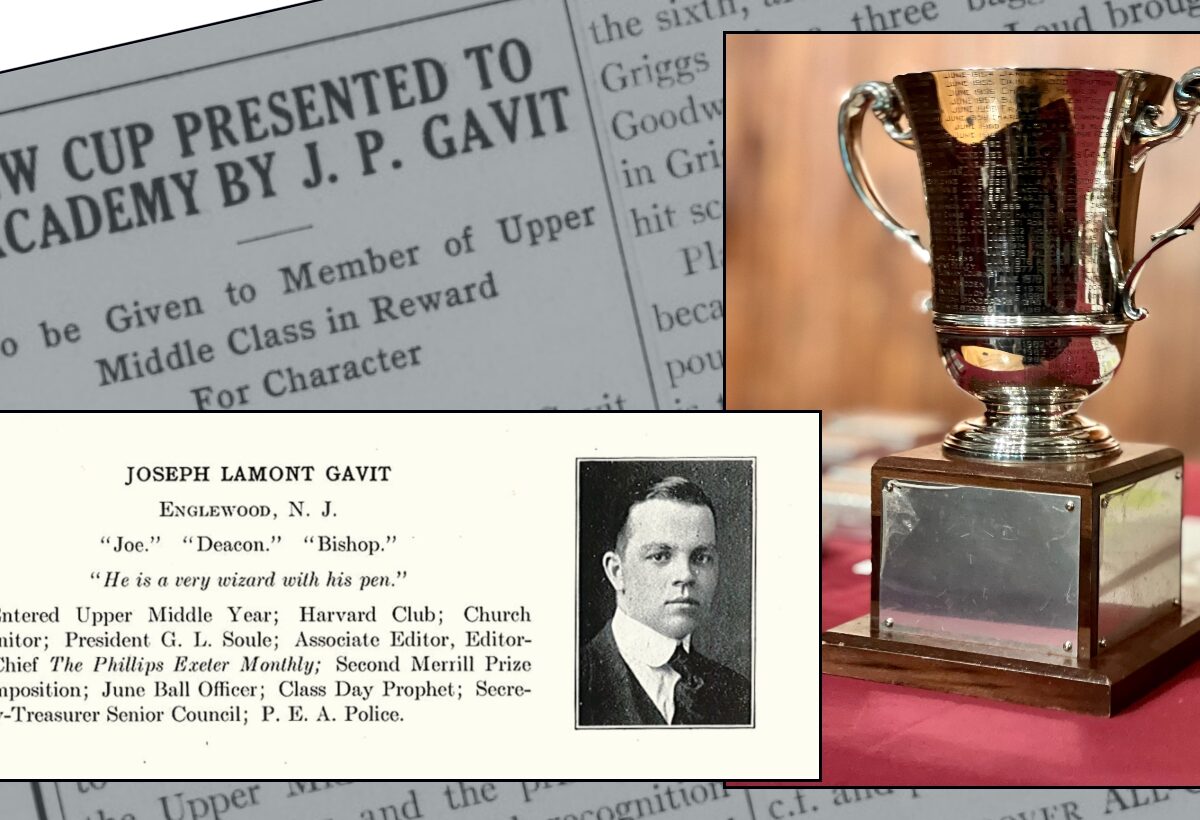
Joseph Lamont Gavit, class of 1917, arrived at Exeter at the beginning of his upper year. A gifted writer, Gavit took after his father, John Palmer Gavit, himself a playwright and newspaperman. “He is a very wizard with his pen,” the yearbook said of him, but the younger Gavit also made his mark as president of the debate society, a church monitor and secretary-treasurer of the senior council.

Sadly, just three years after graduating from Exeter, Gavit died of typhoid fever while a student at Harvard. His grieving parents established an annual prize in his name to be awarded to an upper “chosen by classmates and the principal of the Academy in special recognition of character and quality … in conduct, work, and play.”

In a letter to Principal Lewis Perry, Lucy Lamont Gavit and John Palmer Gavit specified that “the choice should not be made primarily on the basis of scholarship or marks, or primarily on the basis of athletic prowess or distinction; or of any other single factor,” but rather for “character as a whole.”

Gavit’s father presented the Gavit Cup to the first recipient on graduation day in 1923. “His mother and I have come here today to present to this school a modest token in his memory,”  he said. “A symbol of no great intrinsic value, but of exceptional significance.”

This spring, the Gavit Cup was awarded for the 100th time. It is one of the school’s longest enduring prizes among the scores awarded to deserving Exeter students. Krish Patel ’23, a day student from Dover, New Hampshire, is the newest holder. His challenge is to strive to live up to the cup’s legacy.

At the cup’s first awarding, Perry said: “A great many memories cluster around the name Joe Gavit. Those of us who were here in 1917 remember him with great affection. I hope that Joe got something from Exeter; I know that Exeter got much from Joe.”

This story first appeared in the Summer 2022 issue of The Exeter Bulletin.

Familiar faces, new spaces

Three pillars of the Exeter faculty have shifted into new leadership roles on campus, bringing with them a collective half-century of service to the Academy.

Eimer Page, Dean of Faculty

Page began her Exeter career as an instructor in English in 2004 and served as the director of Global Initiatives since the program’s inception in 2012. She started a five-year term as dean of faculty on July 1. Her vision, strong organization and risk management skills, and collaboration across campus departments and with other schools and organizations have resulted in the growth of Global Initiatives to its current offerings of 17 term programs and up to 20 additional travel programs for our students across five continents. Over the years, Page has also served on numerous campus committees, including Appointments and Leaves. She was dorm head in Dunbar Hall from 2008 to 2013 and has been recognized for her accomplishments, both inside and outside the classroom, with the Charles E. Ryberg ’63 Teaching Award, the William Lambert ’45 Dormitory Adviser Award and the George S. Heyer Jr. ’48 Teaching Award.

Jeff Ward, Director of Exeter Summer

Ward brings much experience to his new position, having served as an instructor, dean and, most recently, interim director of the Exeter Summer program. Ward has also taught in the Department of Chemistry at Exeter since 2004, was dorm head at Knight House for 10 years, has served on several faculty committees and has been an Admissions reader. He also hosts his own weekly radio show on Exeter’s WPEA. Ward has received the William Lambert ’45 Dormitory Adviser Award and the Brown Family Faculty Fund Teaching Award.

Patricia Burke Hickey, Director of Global Initiatives

Burke Hickey embarked on her latest experience at the Academy as the new director of Global Initiatives on  July 1. Burke Hickey has been an instructor in English at Exeter since 1996, full time in that role since 2013. She has also served on several committees and working groups over the years, and was dorm head in Langdell Hall and an affiliate in Amen Hall and Gould House. Burke Hickey has also coached junior varsity/varsity cycling and has been an Admissions interviewer. She has been involved in Exeter’s Global Initiatives program, including chaperoning a Chinese co-learning student trip to study urban migration in March 2014, and a March break student trip to South Africa in 2018. Prior to joining Exeter, Burke Hickey taught at the American International School in Vienna, Austria, and while at the Colorado Rocky Mountain School, she led alpine and desert trips with students and volunteered with mountain rescue. While traveling, Burke Hickey has led workshops for students on facilitating discussions about cultural differences. She has received the William Lambert ’45 Dormitory Adviser Award and the Brown Family Faculty Fund Teaching Award.

Editor’s note: This story first appeared in the summer 2022 issue of The Exeter Bulletin.

A fond farewell

Exeter is blessed with some of the finest instructors in the world, many of whom have dedicated their professional lives to teaching “youth from every quarter” at the Academy. This year, four of our beloved instructors retire with the honorary distinction of emeriti.

This designation is awarded by the principal to those retiring faculty members who have met certain years-of-service criteria and is designed to encourage their continued involvement in the Academy’s academic life and intellectual community. We are thankful for their combined 133 years of devotion to the students and to their craft. Their presence in the classroom will be missed.


W. Cordon Coole
Associate Athletic Trainer, appointed in 1987

“Gordo has been a steady presence in the gym for both our students and coaches. He has a way of keeping things in perspective and kept all of us grounded. Whether in the role of trainer, dean, instructor, coach or colleague, Gordo would appear for anyone ready for his expertise or wisdom.” — Don Mills, instructor in Physical Education


Peter Vorkink

Instructor in Religion, appointed in 1972

“It is hard to imagine the Academy without Peter Vorkink, and certainly hard to imagine the Religion Department without him. Perhaps this is because of the hard and necessary questions he helped students ask themselves — questions about who they were becoming, who they wanted to become and what really matters to them. These are the signposts that guide a life, and he combined their weight and significance with a sense of humor that left the halls echoing with the sound of laughter coming from inside his classroom.” — Kathleen Brownback, instructor in Religion, emerita


Viviana Santos

Robert W. Kesler ’47 (Hon.) Distinguished Professor and Instructor in Modern Languages, appointed in 2001

“We will miss Viviana in our department meetings, where her ability to analyze situations was always appreciated and a good source for reflection and advice. Viviana’s teaching style made her very approachable to students. Her classroom was both a comfortable and intellectually challenging space. We will miss her.” — P. Fermín Pérez-Andreu, chair of the Department of Modern Languages


Ralph Sneeden

B. Rodney Marriott Chair in the Humanities and Instructor in English, appointed in 1995

“Mr. Sneeden is legendary, not because he rests upon a pedestal but because he steps back, creates space and trusts students to rise to a challenge. … In his classroom, every moment of learning is legendary because every moment I am in wonder.” — Otto Do ’22

This story first appeared in the summer 2022 issue of The Exeter Bulletin.

Priceless Exeter history … on eBay?

Sometime in 1772, John Phillips Esq. signed his name on the opening pages of his copy of Tristia, a collection of letters in verse by the Roman poet Publius Ovidius Nasonis, better known as Ovid. On Feb. 11, 1929, Edward S. Harkness affixed his signature to a certificate for 50 shares of preferred stock in the New London Ship and Engine Company. 

Few people would see the link between an 18th-century book in Latin and a stock certificate from one of the most fateful years in financial history. But when Pablo Barrutia ’92 stumbled on these items on the auction site eBay nearly a decade ago, he immediately took notice. “Among the things I’ve always got my eye out for is anything related to Exeter, given how much Exeter means to me,” he says. Barrutia guesses that Phillips most likely had the book in his collection in 1781, when he and his wife, Elizabeth, founded Phillips Exeter Academy. He also knew that Harkness signed that stock certificate just a year before his historic $5.8 million gift to the Academy. 

As a seasoned eBay user, Barrutia waited until the closing seconds of each auction to place his bid and snagged the book for just over $100. “Of course, it’s priceless from any Exonian’s perspective,” he says.

In May, Barrutia returned to Exeter for his 30th reunion and chose the occasion to donate the two items — along with a photograph of celebrated philanthropist William Boyce Thompson, class of 1890 — so current and future Exonians can benefit from these links to the school’s history. Principal Bill Rawson ’71; P’08 accepted the donation on the school’s behalf, along with Magee Lawhorn, head of Archives and Special Collections at the Class of 1945 Library. History Instructor Emeritus Jack Herney ’46, ’69, ’71, ’74, ’92, ’95 (Hon.), whom Barrutia has consulted over the years about Exeter-related items he has considered acquiring, was also on hand for the occasion. “I’m imagining Greek and Latin students coming over and getting to look at and learn from this,” Rawson says of the book. “This is a direct connection between our Classics students, present and past.” 

Lawhorn believes that this edition of Tristia is the first volume from the founder’s personal library to join the school’s collections. “Most of our collections come from individual donors,” Lawhorn says. “We don’t have the means to really seek out and purchase rare books, so we get excited when we can ingest them, especially one with this provenance.”

Barrutia’s enthusiastic support of the Academy goes far beyond his eBay acquisitions. Inspired by his experience as a four-year scholarship student, he established the Pablo E. Barrutia and Ben Eugrin Scholarship Fund with an Exonian friend and fellow financial aid recipient. He also hosts regular recruiting events for potential Exeter students, particularly from underrepresented communities, at his home in Milwaukee. In 2016, the Academy honored Barrutia’s contributions with the President’s Award.

Now that the book, stock certificate and photograph are safely in the Jay Whipple Special Collections Vault, Barrutia is keeping an eye out for other great finds. He has amassed an impressive collection of artifacts related to the history of Wall Street — particularly in his own field, high-yield bonds — but Exeter memorabilia will always have his heart. “I’m forever grateful for the friendships I’ve established and the doors that were opened,” Barrutia says. “Without Exeter in my life, who knows where I’d be?”   

Editor’s note: An earlier version of this story appeared in the summer 2022 issue of The Exeter Bulletin.


Kevin Cong '22 wins gold at International Math Olympiad

Kevin Cong ’22 shined among the brightest young mathematicians in the world, claiming a gold medal at the 63rd International Mathematical Olympiad in Oslo, Norway.

Cong earned 36 of a possible 42 points to tie for 23rd place overall among nearly 600 competitors. Only the top 40 finishers were awarded golds.

The six-person team from the United States finished in third place behind China and South Korea. All six competitors from China earned perfect scores in the two-day program.

Cong, bound for Harvard in the fall, earned his spot on the American roster by winning a gold medal during the national competition this spring.

“My journey to becoming a member of the U.S. IMO team has been a long and enlightening one,” Cong wrote in an email. “Over the years, I’ve been blessed to have the support of many, from my parents to teachers and mentors. One of these mentors has been Mr. (Zuming) Feng, who I met both as my math instructor and adviser to (the Exeter) Math Club. Math Club was one of the first clubs I joined when I arrived on campus four years ago, and I would come to find an amazing community in it.”

“Under Mr. Feng’s guidance in problem-solving sessions and organizing events, I’ve learned much — both in new math concepts and other important skills such as being able to organize events — and also made lifelong friends.”

Feng finished a three-decade tenure in the PEA Math Department in 2021, and his influence on Exonian math students and the national IMO team over the years is far-reaching. Several Exeter students have represented the U.S. and other nations in the competition, and Exonians have helped the U.S. to victory seven times. In 2018, James Lin ’18 turned in one of only two perfect scores among 594 competitors to steer the U.S. to the win. Alex Song ’15, representing Canada, is in the IMO Hall of Fame and remains the only competitor to win five golds in the event.

The IMO recognizes team success, but the participants work on the problems individually. Each has nine hours — split into two sessions over two days — to crack six problems, with judges grading work on each problem on a zero-to-seven scale.

Campus abuzz as summer session begins

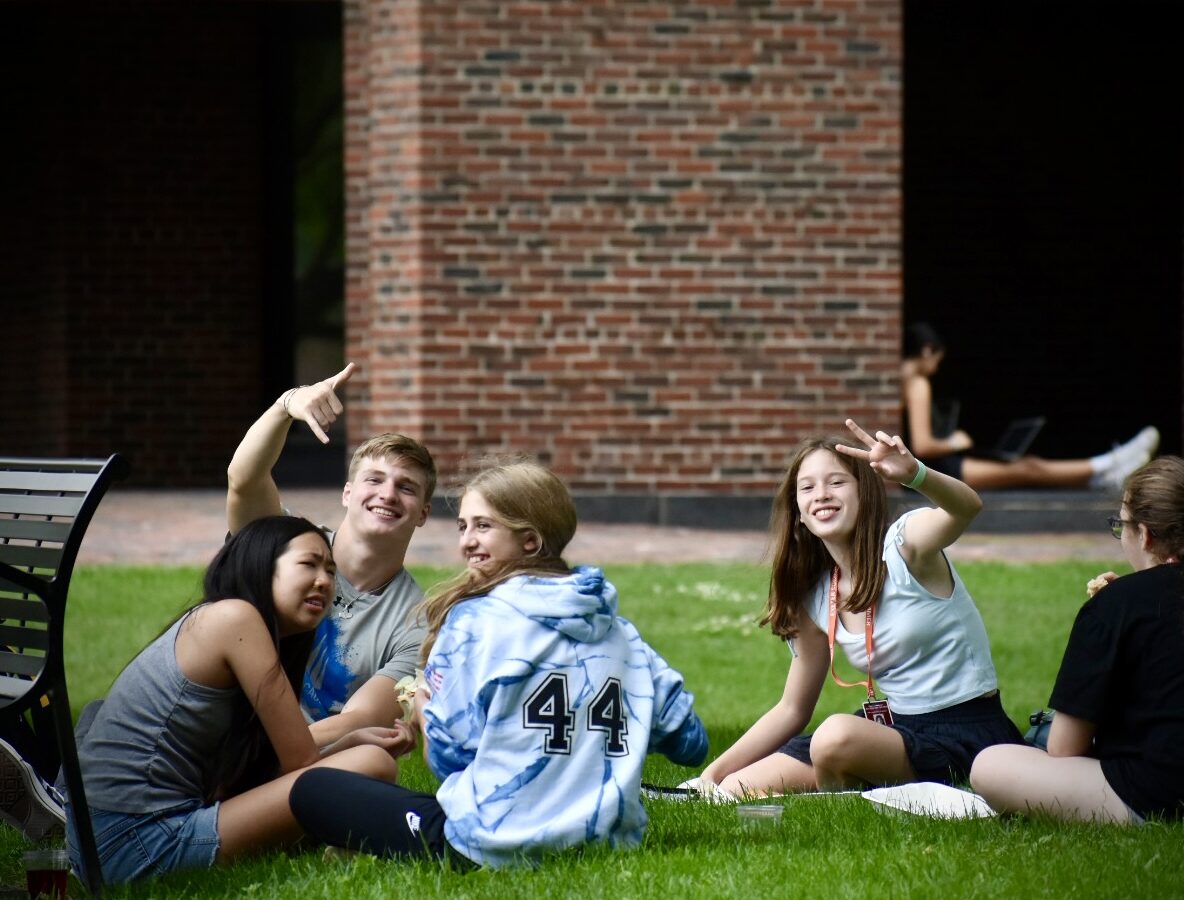
Exeter’s classrooms, dormitories, lawns and pathways buzzed back to life this week with arrival of the 104th year of Exeter Summer.

Over the course of five weeks, more than 600 learners between the seventh and 12th grades will dip their toes into Harkness and explore topics of their choosing. It is a stress-free learning environment absent grades but filled with discovery.

The youngest students on campus are part of the ACCESS EXETER program, which offers accelerated in one of nine themed “clusters” of three courses that tackle a topic through different disciplines. Seventh- and eighth-graders collaborate on passion subjects like leadership and justice, the natural world and creative design all while sharpening their skills of observation and expression.

In the UPPER SCHOOL program, high school-aged students design their own academic curriculum choosing from a diverse offering of courses as well as college preparation opportunities. Afternoons are filled with sports and activities and music lessons for all ages.

Exeter Summer runs through Aug. 5.