Phillips Exeter Academy

Student leaders reflect on impact of orientation program

For the past two years, a reimagined Equitable Exeter Experience program has greeted dozens of new students arriving on campus from less-traditional backgrounds than many of their classmates. In the days leading up to the official start of school, students of color, students who identify as high financial need, students who are the first in their families to attend college, and students who are members of the LGBTQ+ community are provided with information on the resources available to them at the Academy, practice Harkness discussions and take field trips to various Seacoast attractions.

In 2021, Director of Equity and Inclusion Stephanie Bramlett and Assistant Director of Equity and Inclusion Kevin Pajaro-Mariñez revived the program after a three-year hiatus.

“For some students, this is the most diverse place they’ve ever been,” Bramlett said. “For other students this is the least diverse place they’ve ever been. So, what does it feel like to sit around the table and have the conversations about identity, which we’re asking them to do all the time, at a school like Exeter?”

Participants are also paired with returning student mentors, giving them an outlet for questions during the program and the weeks that follow.

“This program is for the mentors as much as it is for the mentees,” Bramlett said. “This is the beauty of Exeter — everything that we do, we are growing together. So as mentors are leading, they are also learning,”

Two such mentors, Kodi Lopez ’23 and Alexander Luna ’24 provided reflections on their experiences as mentors during this year’s program:

I believe so heavily in the E3 program because my one piece of advice that I preach to new students is to find people on campus that remind them of home, and E3 allows this to happen as soon as their first day on campus. My first group of mentees grew to be very close with one another, and I have watched them accomplish great things in their first year here while leaning on each other for support. In my second year as a mentor, I was able to facilitate a low-income affinity group. I heard new students express their relief knowing that there were other students like them on campus, something that I only felt late into my lower fall, when I attended my first Association of Low-Income Exonians meeting. I could only imagine how much fuller my Exeter experience could have been if I had attended the E3 program. During my prep fall, I felt overwhelmed and lost. Exeter was so different from my hometown. While I was used to everyone in East Los Angeles being Mexican like me, I rarely saw Mexicans at Exeter. I was struggling with housing while classmates talked about visiting their many vacation homes during the summer. I felt like no-one shared the same story as me. Then, an amazing senior entered my life during early Winter term. I expressed to Giovanna Romero that I missed home, and one evening she welcomed me to hang in her room. Gio was also Mexican. She grew up in California and experienced familiar financial struggles like me. She gathered other Mexican students in her room and offered us familiar and spicy Mexican candy. We spoke in our Chicano accents, and for the first time I felt a sense of home at Exeter. She continued to be an amazing support system my prep Winter, introducing me to the OMA office and encouraging me to attend my affinity groups, places that I now love and cherish. Although I eventually found my place at Exeter, I always wished I had found it sooner. E3 participants get to meet supportive upperclassmen much sooner, hear similar stories from peers and mentors who share their identity, and most importantly would not have wasted months feeling alone in their experiences and identities like I once was. I believe so heavily in the E3 program because it bridges new students like I once was to amazing mentors like Giovanna Romero, enabling success at Exeter early on, and bringing a sense of home to new minority Exonians.

— Kodi Lopez ‘23

Being a student of E3 as a lower was probably one of my favorite experiences at Exeter. It was a great way for me to acclimate to being at Exeter, coming from a year of online schooling beforehand. I was introduced to tons of new people through the activities. The experience as a mentee led me to want to become a mentor. I thought it would be cool if I could impart some of the things I learned during my two years at Exeter to the mentees to help them with the transition. What I didn’t realize was how impactful the new students would be on me. I got to meet dozens of new people, even some that shared a similar background. I even met someone who lives near where I live and who was a part of the same program that introduced me to Exeter. No matter who you meet, I truly believe that the bonds made in E3 last throughout your time at Exeter. The activities that were planned by Dr. Bramlett, Mr. Pajaro-Mariñez, and the other faculty aided in this process a lot. Aside from the orientation, there were no lecture-based events. This allowed a flow between the mentees and even the mentors, as regularly the activities brought the two groups together. This year’s group of students truly shined in these activities. They didn’t shy away from tackling tough questions and talking about identity. I also enjoyed the time when we got to interact on our own. The Hilltop Fun Center was a great way to start the program. Even though it rained, and we couldn’t do any of the outdoor activities, the arcade machines were just as fun. You would see groups of students cheering for one another as they watched people playing the crane machines or the punching machine. Through my interactions with all the mentees, I know that they will be able to exceed at Exeter. I look forward to seeing all the participants of E3, both mentors and mentees, on the path and saying hello!

— Alexander Luna ‘24

Students reflect on foray into 'The Big Easy'

As summer break began, Exeter students and staff postponed their well-earned vacation to take part in a service trip to New Orleans in collaboration with the Exeter Student Service Organization. The purpose of this trip was to provide a domestic hands-on service project while learning about New Orleans culture and the lasting effects of Hurricane Katrina on its infrastructure.

After the trip, some students and a trip chaperone offered reflections:

“My favorite part of the trip was getting to learn and surround myself in a new and different culture from a less touristy position. We were able to travel around New Orleans and see all different areas including the 9th ward, where we stayed. My favorite volunteer work was when we helped build part of a house. I also was interested to learn about the affect Hurricane Katrina had on the city and all the hardships the people have faced even 15 years later. Overall, I had a great experience meeting new people from Exeter and NOLA, trying new cuisine, learning about the culture, and helping out communities in need.” — Gigi Lannon ‘24


“The highlights of this program for me were the aspect of community I found in our group and exploring a city that was completely different than anything I’ve seen before. I learned about how drastic the impacts of hurricanes are on places that the government does a bad job of funding. I also learned that volunteerism can be very fun when you are around great people, and you are thoroughly knowledgeable on the cause. My most valuable takeaway is that even though you are not reminded on the daily that people in other places are in need, it does not mean you aren’t responsible for reminding yourself to take action.” — Leta Griffin ‘25


“The New Orleans trip was fun, and I met so many new people that I have not met during the school year. I learned so much about the culture in New Orleans, as it was my first time going to a state in the south. I tried new cuisines and experienced new storm weather. I learned that anything can be enjoyable with people working together under any circumstance. I think that this service trip helped me appreciate the many resources I have available.” — Jessica Chen ‘24


“My favorite part of the trip was being able to connect with small businesses and residents in NOLA. I’m thankful they offered to share parts of their stories and culture with us, because it all told a bigger story steeped in history. One place I was moved by was the art studio, Studio Be, the exhibitions were not only stunning, but they featured art from a variety of perspectives and commented on many different topics. The vulnerability and presentation of the pieces are something I will never forget. After my experiences in NOLA, I will continue to be inspired by the memory and lives of those I met, and continue to be grateful for the experience.” — Rowan Flanagan ‘24


“As a chaperone, this is my first time traveling with students. I am amazed at how engaged and hardworking are our students participating those projects. They help each other, collaborate and bond throughout the trip. I also got to work with two other amazing colleagues for the trip. It was a memorable and meaningful experience for us all. The New Orleans Service Learning Trip provides students opportunities to conduct various hands on community service projects, including building the houses, gardening on a farm, cleaning city storm drains and sorting beads for a local organization. They also get the chance to learn more about New Orleans culture and the deep impact of Hurricane Katrina. Students had a great time working collaboratively and built strong friendship through the trip. They also learned to give back to the community, exemplifying non sibi values, and gain a new perspective of themselves.” — Ning Zhou, instructor in Modern Languages and chaperone


Customs old and new fill Opening Assembly

Principal William Rawson ’71; P’08 and Phillips Exeter Academy formally rang in the institution’s 242nd year Friday morning, embracing its most hallowed customs and introducing a new one at Opening Assembly.

Beginning with a student procession of the flags of the 37 countries from which the student body hails and closing with the traditional dismissal of “Senior class,” the ceremony played to students, faculty and faculty emeriti in Love Gym and to a livestream audience beyond. 

Principal Rawson cited the Academy’s Deed of Gift and the school’s mission and core values throughout his address, punctuating his remarks with themes the founders introduced in 1781 and that still permeate life on campus today: Goodness and knowledge; non sibi; academic excellence; and serving youth from every quarter.

Our objective is to teach you how to think, not what to think, and the focus, inside and outside the classroom, will always be on knowledge and goodness.”
Principal Bill Rawson '71; P'08

“We aim high at Exeter,” he said. “We will help you excel in your academic pursuits, and in all your other endeavors. Our objective is to teach you how to think, not what to think, and the focus, inside and outside the classroom, will always be on knowledge and goodness.”

He then quoted The Reverend Martin Luther King, Jr. to underscore the point: “We must remember that intelligence is not enough. Intelligence plus character — that is the goal of true education.”

Symbols of youth from every quarter

“Wow!” Principal Rawson said after watching the national flags wind through the gymnasium, a new addition to the time-honored program. “I just wish you could see my smile as I watched everyone process in and seeing all the flags.”

He then introduced the deans of students and faculty to welcome colleagues old and new. Eimer Page, a longtime instructor in English who is the new dean of faculty, introduced the instructors who are beginning their tenures at the Academy. Dean of Students Russell Weatherspoon welcomed the emerti faculty in attendance, including Richard Brown and Werner Brandes, whose appointment dates were 59 and 57 years ago, respectively.

Principal Rawson noted that the 341 newest Exonians — the class of 2026 and new lowers, uppers and seniors — represent 34 states and 20 countries. He also noted they are the first students to arrive since the school announced last fall a “need-blind” admissions policy, meaning that Exeter’s admissions decisions are made without regard to any family’s ability to pay.

His message also included the school’s commitment to equity and inclusion, telling students that commitment is inseparable from the institutional core values. “Experienced Harkness students know that listening with empathy — really being curious about why another person might feel or think differently than you do — is a critical skill, upon which your learning and personal growth will greatly depend.

“Learning in this way from each other is exciting, but we recognize that at times it also can be uncomfortable. It can be uncomfortable to have your ideas and assumptions challenged by others. We must be comfortable with being uncomfortable, and we must understand that in a thriving educational community we should expect a diversity of viewpoints on almost every subject worth exploring.”

A greener Exeter

The principal also spoke of the school’s long history of environmental stewardship, from the class of 1884’s Gifford Pinchot — one of the founding fathers of the conservation movement — to the strides made in recent years to curb carbon emissions by 60 percent.

“We will continue to build on these accomplishments this year and in the years to come, and student engagement has and will continue to be important, as we continue to explore ways to incorporate sustainability into all aspects of our programs, operations and daily lives at the Academy.”

Principal Rawson closed his remarks with a message of enthusiasm.

“It has been a great pleasure to walk about the campus these past few days and feel the excitement, energy and joy that all of you bring to a new school year,” he said. “When I was a student, I spent my summers waiting to come back. I sense a similar feeling among all of you.”

Read Principal Rawson’s full remarks here.

A conversation with Director of Counseling and Psychological Services Szu-Hui Lee

Everyone can use a bit of support, it’s just a natural part of growing up. Exeter’s Director of Counseling Szu-Hui Lee wants to make sure every student learns how to ask for it. “It’s really a life skill to know how to get help for yourself, how to pick up that phone and how to look for resources,” Lee says.

As a board-certified clinical psychologist who specializes in the treatment of anxiety disorders, cross-cultural adjustment, issues of first-generation students, identity development and relationships, Lee brings a deep understanding of adolescence to the table. We caught up with her, just as she completed her first year as director of the counseling department, to learn more about what her team does in the community and the importance of teaching students to talk about their feelings.

Q: What are some of the things you help with at the start of the school year?

Lee: When a student comes to campus for the very first time, there is a lot to adjust to. First time being away from home, having to make new friends, getting used to a new environment, it’s normal to be anxious. They might ask themselves, “Do I belong?” and “Do I have what it takes to be here?” Or they might miss their mom and dad and friends from home. I say, let’s talk about it. Let us teach you ways to not only set in place connections back home, but also how to adjust to your new home away from home. Let us help you learn ways to approach the dining hall, to engage with your teachers and classmates in class, or how to practice healthy self-care habits like sleeping, eating and exercising. Adjustment is a process but before you know it, you’ll find your groove at PEA.

Q: You just named all of the things that every teenager everywhere wrestles with.

Lee: Yes, it’s just a part of growing up. These are a very developmentally appropriate questions and life skills to obtain.  “Who am I?” Who am I in relation to my parents, to my peers, to the person I aspire to be. Our hope is that after talking with us they’re standing stronger and taller and having a firmer sense of who they are, of all of their identities, and of how they’re going to walk in the world. That’s what counselors try to help with — that journey of finding and being in touch with our authentic selves.

Q: How has the counseling department changed since you started here in 2014?

Lee: I think the counseling department has been very intentional about evolving and growing right along with the PEA community at large. As the school is increasing its attention on mental health and wellness of the whole child, as the students are asking for more support, we were very quick to respond to that. Students wanted more diversity within the counseling staff. Students wanted more choices. Our team grew from three to now five full-time counselors within just a few years. We now represent a variety of identities and a solid foundation of clinical expertise. Similarly, adults were asking for more support and more resources and more programming so with increased staffing we’re able to provide  more outreaches services.

Q: When do you first introduce the counseling team to students?

Lee: We get in front of students the minute school starts. We participate in the International Student Orientation Program, new student orientation, and we meet all new students in their Health Education classes. We are there introducing ourselves and informing students about who we are and our services. Then we make sure that we are in front of the students at different points throughout the year when they might need extra support.

Q: Do lots of students take advantage of your services?

Lee: Yes, we see about a third of the students at PEA and demands for our services have been on a steady increase the last five years. In collaboration with all the members of our community — the students and the adults — we have really fought hard to de-stigmatize mental health and make seeking a counselor is something that you do as part of preventative and healthy self-care, not just crisis intervention. It’s wonderful that we’re seeing more people coming forward and saying, ‘Gosh, can I talk about this with you?

Q: What are some examples of self-care skills you help with?

Lee: We want students to learn lots of good life skills at this stage of their lives. Things like, ‘How do I manage my emotions? How do I navigate peer relationships? How do I shift the way I talk to my parents now that I’m more of a young adult and not a kid?’

Q: Do they learn these things through individual sessions or in groups?

Lee: We do both. We offer one-on-one individual psychotherapy sessions where students will meet with a counselor typically once a week or every other week. There are also students that meet with a counselor at the beginning of the term, the middle of the term and at the end of the term. Those are more like check-ins. Some kids will also just come in with a particular issue in mind and once that issue is resolved, we don’t see them again until perhaps they want to meet again. No matter the frequency, students know they can come meet with us and we will help them with whatever may be going on.  We also offer different skills based workshops on campus and our support groups are in development.

Q: How do the group sessions work?

Lee: We offer lots of different workshops on campus. I’ve done a five-week group workshop on perfectionism and how to manage that, for example. I’ve also done a workshop on anxiety management and a group for those who identify as female that speaks to issues of women empowerment, loving our body and positive self-talk. This was in collaboration with faculty members Ms. Lim and Ms. Marshall. Dr. Chris Thurber has run workshops on homesickness and Ms. Connie Morse has led mindfulness workshops. We do these time-limited workshops throughout the year to, again, make sure the kids can have access to us outside of individual therapy sessions. We also do outreaches in the community. We recently launched a new program where counselors are working with dorm faculty to support them with the great work they do with students in their dorms.

Q: What about privacy?

Lee: All of our services are confidential and private. It is really important that students have a safe place that they can go to on campus, we are glad to be one of those spaces.  We go over confidentiality with students when they first begin their work with us. We remind students that we are able to keep all contents private unless there are risks of harm involved. If safety of a student is in question, we obviously would need to involve other adults. Other than safety concerns, students really can utilize our time together to discuss whatever may be on their minds.

Q: How large is your team?

Lee: Our department size is comparable to, if not better than, most of our sister schools. There are five of us who work fulltime and we also have one psychiatrist and one psychiatric nurse practitioner — Marina Vijayakanthan and Jean Banville — who come in one day a week to provide psychiatric evaluations and medication management. We are really proud of our team and the comprehensive services we are able to provide out of Lamont Health & Wellness Center.

Q: How long does a student have to wait to get the care they need?

Lee: One of the reasons that our team has grown is because the demand is there. We want to make sure students have access to a counselor as soon as they need the support. In the outside world, it might take a month or two before one can schedule an appointment with a therapist and even longer to see a provider for psychiatric evaluation. Here at Exeter a student can be seen usually within a week and certainly if there’s an emergency, we can get people in the same day

Q: You’ve added new faces to the department, Marco Thompson and Johanna Mautz. What are you looking for when hiring a new team member?

Lee: We are so thrilled Mr. Thompson and Mrs. Mautz joined our team. When we hire, we always look for strong clinicians who are experts in providing evidence based treatment and who share the passion for working with adolescents. We were also very intentional about listening to what the students were asking for – to see themselves reflected in those who help them. Students really wanted to have options and choices when it comes to counselors. I was the first person of color in this department when I started in 2014. When I was hired, the school was very intentional about having more diversity on the staff to better reflect the student body. It wasn’t just to check the box of this is a person of color, but this is a person who’s interested and trained and well-versed in areas of diversity and multiculturalism. And our effort continued. I’m very proud to say that in our team, there is diversity that are represented by identities of race, sex, culture, gender, religious affiliations, to just name a few.

Q: How do students get matched with a counselor?

Lee: All of us are trained as generalists and are all able to provide evidence-based treatments to address adolescent mental health concerns. And each of us also has areas of special interest and our own styles of working with students. I’m really interested in anxiety and anxiety disorders; Marco is trained in drug and alcohol counseling; Chris specializes in adjustment and homesickness; Connie is really great at mindfulness and meditation. Jo is wonderful with family and relationships. Everything depends on what the student’s preferences are and sometimes it also comes down to scheduling. And with our team, we can offer lots of choices. And with our team, you can be certain that whoever you work with will provide you with top-notch counseling support. I should also say students are free to switch counselors during their time at PEA. It’s all about fit so perhaps students’ preferences change and that is totally fine.

Q: Do you work with other departments on campus?

Lee: We at Lamont Health & Wellness Center really believe in the integration of mental, emotional, physical health and health of the whole child. We work closely with the medical team, dietitian, and athletic training to make sure we are supporting the various needs of a student at any one time. We also work closely with Health Education & Human Development Department because their curriculum is about the health and wellness. We meet regularly with these various departments and groups to discuss campus wide initiatives, address trends we might be seeing, and also how to support individual students. We also work with deans, dorms, academic departments, and individual advisors whenever necessary as we all share the mission of supporting students.

There’s a team of us, eager and happy to help, and we’re all in the business of helping young people thrive. We often say, we can’t do this work alone, and at PEA, we don’t have to. And that feels really, really nice.

Exeter Summer program hones tomorrow's leaders

On a sunny day in July, a group of Exeter Summer students headed off campus to the Browne Center at the University of New Hampshire for a day of trust-building and team-bonding exercises. Whether working their way through the ropes course or reclining carefully on a suspended tree branch, the students made sure to have each other’s backs — and got to know each other along the way.

“We had to work together to achieve a specific goal,” says Jack Lu, a rising eighth grader from Sarasota, Florida, of the field trip. “It really helped to build bonds, as we needed to trust each other to literally stay safe.”

This summer, Lu was one of the students taking part in the first official session of the Irene F. Hamm P’87 ACCESS EXETER Leadership Program, an immersive cluster of courses for seventh and eighth graders focused on learning the principles and theory of leadership as well as acquiring practical skills for effective activism and advocacy. One of nine clusters in the five-week ACCESS EXETER program, it was created thanks to the generosity of Irene Hamm P’87, a lifelong educator who helped her husband, Charles J. Hamm ’55, found his namesake leadership-focused program for Exeter Summer’s UPPER SCHOOL in 2008.

A summer of growth

In courses entitled Youth Leadership and My Voice Matters, students in the ACCESS cluster explore the relationships between leaders and their followers, read literature written by leaders in society and write their own essays and action plans. In a third course, The Art and Science of Creating Real Change, they learn to channel their identities and desire for change through both artistic expression and hands-on action steps.


“We’re starting from a really personal space for them: What are their values? What do they believe in? What are the causes that move them?” says Ben Cromwell, who teaches The Art and Science of Change, as well as a Practical Leadership seminar in the UPPER SCHOOL. “From there, we try and expand outward as we go.”

In addition to their coursework and their trip to the Browne Center, students in both Hamm Leadership Programs visited the Edward M. Kennedy Institute for the U.S. Senate in Boston, where they participated in a mock debate over voting rights legislation. While they were in the city, the students also toured a series of giant murals created by artists in association with the organization Sea Walls to bring awareness to issues of environmentalism, especially protecting the ocean.

Each ACCESS student teams with their older counterparts for a capstone project, through which they aim to make a meaningful impact on the Exeter Summer community in some way. Lu and his capstone group created a peer-to-peer tutoring program for fellow Exeter Summer students, while Garima Biyani, a rising ninth grader from Bellevue, Washington, worked with her group to plant seeds in Exeter’s community garden.

Learning to listen

Irene Hamm, who earned her master’s degree in special education from Columbia University, spent 32 years teaching students from preschool through high school ages. After watching the Hamm Leadership Program’s success in the UPPER SCHOOL, she’s excited to see it extended to the younger group.

“I think [the program is] about teaching the students how to work with other people instead of just going their own way,” Irene notes. “Having taught seventh and eighth graders, I think they have to learn to listen to other people and yet still have their opinions, and when they approach others, approach them with thoughtfulness — and with facts.”

For Charles Hamm, whose namesake UPPER SCHOOL program recently celebrated its 14th year, his initial inspiration to create it still holds true. “The combination of good leadership and good followership has always, and increasingly, struck me as being critical to life on earth,” Charles says. “If we can jumpstart a sense of thinking, considering and approaching an understanding of what leadership might be — even if you don’t become a leader — it will enhance your ability to be a responsible follower.”

As the five-week program draws to a close, Jack Lu has taken the message to heart. “Through this experience, I’ve fully come to realize that leaders may be the ones who get most of the fame and most of the attention,” Lu says. “But without the followers, they really can’t achieve anything. The followers are equally — if not more — important than the leaders.”

Tools for the future

Cromwell says his ACCESS EXETER students come to the Hamm Leadership Program with a variety of motivations, from future leadership plans to simply connecting with the idea of the cluster. Many bring a passion for social justice to their work, and are inspired by Harkness discussions and other activities focused on gender equality, LGBTQ+ rights, racial equality, climate change and other key issues. By the end of their capstone projects, the students were “running community meetings, engaging their peers, generating ideas,” Cromwell recalls. “They really stepped up and talked in depth about the things they had done personally to advance these causes.”

 “I’ve always kind of been more like head up in the clouds, but this [experience] has brought me down to earth to a degree,” Biyani says. “I know a lot about social justice, but I haven’t really done much. When I get back, I think putting my ideas into action — volunteering, maybe getting involved in some organizations, or starting groups at my school — is definitely something that I intend to do.”

A conversation with psychologist Chris Thurber

What does an affirming, supportive, healthy conversation between a parent and child look like? How about under these tricky situations: when your child finds out the object of their affection is taking someone else to the prom; or when they receive lower-than-expected grades; or even when the kitchen garbage hasn’t been taken out yet again?

In his latest book, The Unlikely Art of Parental Pressure: A Positive Approach to Pushing Your Child to Be Their Best Self, Exeter’s Associate Director of Counseling and Psychological Services Christopher Thurber offers myriad practical examples of how to chat with your child in a manner that’s both direct and empathetic, and reveals “Four Interrogation Methods to Avoid,” such as expecting the best rather than their best.

Thurber is well versed and expertly trained to offer such insightful advice. He has served as a staff psychologist at Exeter since 1999, and earned his bachelor’s degree from Harvard and his Ph.D. in clinical psychology from UCLA. His doctoral graduate work on homesickness and summer camp generated 2015’s Summer Camp Handbook and led to multiple public appearances.

Co-written with fellow psychologist and emotional-intelligence expert Hendrie Weisinger, The Unlikely Art of Parental Pressure shines a potent spotlight on the vagaries of parental pressure and how to morph unhealthy pressure into the healthy variety. As Thurber says, an ever-present element of warmth is key to successful adult-kid interactions. Warmth is a characteristic that Thurber also emulates successfully in his writing, making this book a particular pleasure to read.

With so many parenting books out there, what makes this one stand apart?

This is the first discussion of parental pressure that shifts the narrative from how much to what kind of pressure. Specifically, the instinctive nature of parental pressure means no one can tell parents to “stop pressuring” their kids. Well, they can say that, but nothing will happen. We provide lots of realistic examples to guide parents and other caregivers to transform what they might identify as harmful pressure into healthy pressure. [Second,] we’re addressing a circumscribed topic — the pressure that caregivers apply — but we include pressure from other adult caregivers, from coaches and clergy to teachers and mentors. And the third notable difference is a challenge to society at large to improve the college admissions process.

So much of parental pressure does seem to come from a desire to get kids into a good college so they can succeed in life.

One of the most frequently quoted passages from the book is where we write, “…prestige carries weight in some circles, but it never carries the day. How did pride in our kids become more about which school’s name is on the diploma than which student’s name is on the diploma?” My co-author, Hank, and I both worry about the unhealthy pressure that is part of today’s college process. I said to Hank, “I don’t want to pick on college and university admission committees, but if we could identify one place where the culture could change and produce better mental health and a better view of what success means, this would be the starting place.” Hank agreed. So throughout the book we say to parents, “Here are places where you can change the type of pressure you apply during the college process.” Then, in the Epilogue, we discuss our collective responsibility to improve the college admissions process through a cultural shift. We think it’s doable, especially in this period of rapid, pandemic-induced changes to the college admissions process.

I appreciate the distinction you make in the book, that the best parental guidance isn’t about direction or advice or structure, it’s about a better way to present that guidance to young people — to engage with them and to engage them with it.

That’s a big point that Hank and I make in the book: changing from harmful to healthy pressure doesn’t mean lowering standards and saying, “Oh well, we’ll stop putting so much pressure on you.” It’s how to stop thinking about pressure in a quantitative way — “Should I use more or less pressure?” — and start to think about it in a stylistic way: “How am I applying the pressure?” Parents love their kids, so they’ll naturally state expectations and apply pressure to fuel progress toward those goals. But it’s futile if that pressure is of the harmful sort. The beauty is that when parents learn the distinctions between harmful and healthy pressure, they realize that they don’t need to lower their standards one bit. They simply become more effective caregivers.

How did you decide to collaborate with your co-author?

Hank contacted me out of the blue. He had written a book on pressure management and found my online courses for camp counselors. He asked whether he could host a module on pressure for camp counselors. I said, “Well, they experience some healthy pressure, but happily it’s a break for a lot of them from the unhealthy pressure that they experience elsewhere … with competitive admissions and what recent alums tell me they’re experiencing in college.” He called me about a week later and said, “OK, so we need to write a book together.” And I thought, “I just met this guy over the phone!” But it was clear that we both had lots of complementary ideas. He sent me the research basis for each chapter along with a list of things we had discussed and then I wrote. It was a wonderful synergy.

The book mentions a communications workshop you run for parents, Cracking Kids’ Secret Code. Is that related to your work at Exeter?

That’s a workshop I do during [Exeter’s] Family Weekend where I teach caregivers to listen to the subtext of what students say, then respond with empathy to that underlying thought or feeling. After working at Exeter for a few years, I started going to The Association of Boarding Schools, or TABS, conferences. I’ve presented at camp conferences, and boarding school conferences seemed exactly the same, except that people wear different clothes (not Birkenstocks and shorts, a little more buttoned up.) But from a professional standpoint, they want to learn the same things: the risk and protective factors for psychopathology, as well as techniques of strong leadership, supervision and behavior management. So, I started presenting at TABS conferences and at BSA, the British equivalent, and the Australian Boarding Schools Association. That’s been a wonderful extension of what I’ve done at Exeter. It feels really good to share what Exeter students and faculty have taught me with the world at large.

You’ve been at Exeter for more than two decades. What have you learned from your students?

I’ve learned that it is a blessing to have contact with people whose backgrounds are different than one’s own — different geographically, socioeconomically, ethnically, racially, religiously, philosophically and in other important aspects of identity — because it necessarily stretches one’s thinking and that’s just enormously energizing. And what goes along with that exposure to differences is an appreciation of what our commonalities are from a social and emotional standpoint. We all need a sense of belonging, we all fear being abandoned, we all fear losing control, we all want to feel needed, we want to feel worthy of other people’s love and affection. If you would have stated those core hopes and fears to me in graduate school, I would have said, “Of course — I’m reading about those concepts all the time!” But reading about them is different than experiencing them or wrestling with them. If I weren’t constantly learning in my various roles at Exeter, I imagine I would have moved on to a different job long ago. But it is perennially inspiring, truly. My students are great at pushing me to see things differently, to ask different questions. And, with their challenges and struggles, they remind me, in all kinds of different ways, what our psychological human universals are. Perhaps The Unlikely Art of Parental Pressure has illuminated those in fresh ways.

If you had one piece of original advice to offer parents, what would it be?

Ask your child, “How do I come across?” in different situations that involve pressure. At the end of the day, only our kids can tell us whether the pressure we are applying is helpful for harmful. Yet asking our kids how we come across feels so risky that we rarely do it. Those are missed opportunities to strengthen the relationship you have with your child. Try it and you’ll see the benefits immediately.

Seniors Make Their Mark

A favorite rite of spring at Exeter is the advent of Senior Bookmark season in the Class of 1945 Library. For the last 30 years, the library staff has invited graduating seniors to submit a list of their favorite books or media to recommend to other readers. These lists are then made into personalized bookmarks to commemorate their lives as readers and to share with the community. This year’s collection of 41 bookmarks is as eclectic as our student body. Some lists feature childhood favorites, others the classic canon. “The bookmarks have been an enormous success and more importantly a fun Exeter tradition,” says Metadata Librarian Abby Payeur. We asked Eleanor Bolker ’22 to share some thoughts about the books that made her list: 

“These books all paint a portrait of what it means to be human. They are all centered on and driven by their characters, characters who shimmer with life, characters with depth and complexity and truth to them. When you’re a kid, you’re often seeking a character who is ‘relatable,’ who thinks like you or cares about the same things or shares some piece of your identity and experience. I think that’s an important part of figuring out who you are — it certainly was for me. But each of the books contributed to something even more powerful than that for me: the ability to see myself in characters who were not necessarily like me in their identity or experience or even thinking, but who share in the most real way the beating heart of what it is to be human. That is what books are for.”

Editor’s Note: This interview first appeared in the summer 2022 issue of The Exeter Bulletin.

Three-Sport Athletes

For some, competing in one or two sports just isn’t enough. In fact, 11 members of the class of 2022 played interscholastic sports in all 12 terms of their Academy careers. Among them, Jake Shapiro ’22. “If there were eight seasons, I’d play eight different sports,” he says. His enthusiasm, along with that of fellow three-sport athlete Molly Longfield ’22, was recognized this year with the Philip Curtis Goodwin ’25 Award, presented annually to the male and female student athletes who best embody the qualities of sportsmanship and participation. How did they juggle it and what did they learn?

SPORT-ACADEMIC BALANCE

Shapiro: “I did not know how to use my time well for academics in my first year. I did homework during lunch or free blocks and didn’t spend much time with my friends. I made the decision in my lower year to make more time for friends. I found that having a social life makes it easier to get work done and helps with not stressing out.”

Longfield: “Your social life is very intertwined with your sports and academics. You learn how to multitask — doing work outside of class can also become social hour to a certain extent. Sports made my time management a lot easier.”

LEARNED LIFE SKILL

Shapiro: “The skill that all three sports have in common is not a physical skill but a mental skill. You have to learn to work with people — different teammates, teammates with different backgrounds. Playing on three teams gives you a chance to know more people on campus.”

Longfield: “I’ve been learning to take care of my body. I used to go, go, go and just let Sunday be my day off, but I’m learning that my body needs more than that. Tessa Shields ’21 got me more into lifting, which is another form of recovery and injury prevention.”


Editor’s Note: This interview first appeared in the summer 2022 issue of The Exeter Bulletin.

A Hero's Journey

When I first came to Exeter as a prep, I was very lonely. In a country where everyone is different, I felt, more than ever, the particularity of my being. I wanted to fit in, wanted to be accepted, wanted to have someone to talk to who could understand me and tell me that I was not alone. It was then that I found Jean-Christophe. It is a novel recording the life trajectory of a fictional German musician (who ultimately inspired me to learn piano at Exeter). In Jean-Christophe I saw myself: sometimes confused, sometimes passionate, always changing. We had the same struggles, same questions, same doubts and fears. In a time where I was learning how to live by myself, it was my motivation and my comfort.
I am a senior now, with my own group of friends, but I still seek out Jean-Christophe. I think a book is amazing this way: It is always there, waiting to talk to you. It strips away the trivialities of life, and in that pocket of time, it allows you to reflect through the deepest parts of your being.

In each of my recommended books and plays, you’ll find a protagonist who grapples with the quintessential question of what it means to be human. They have inspired me to think, to open up, and most important, they have accompanied me in a precarious time of my life. They are my heroes.

Making it big … the non sibi way

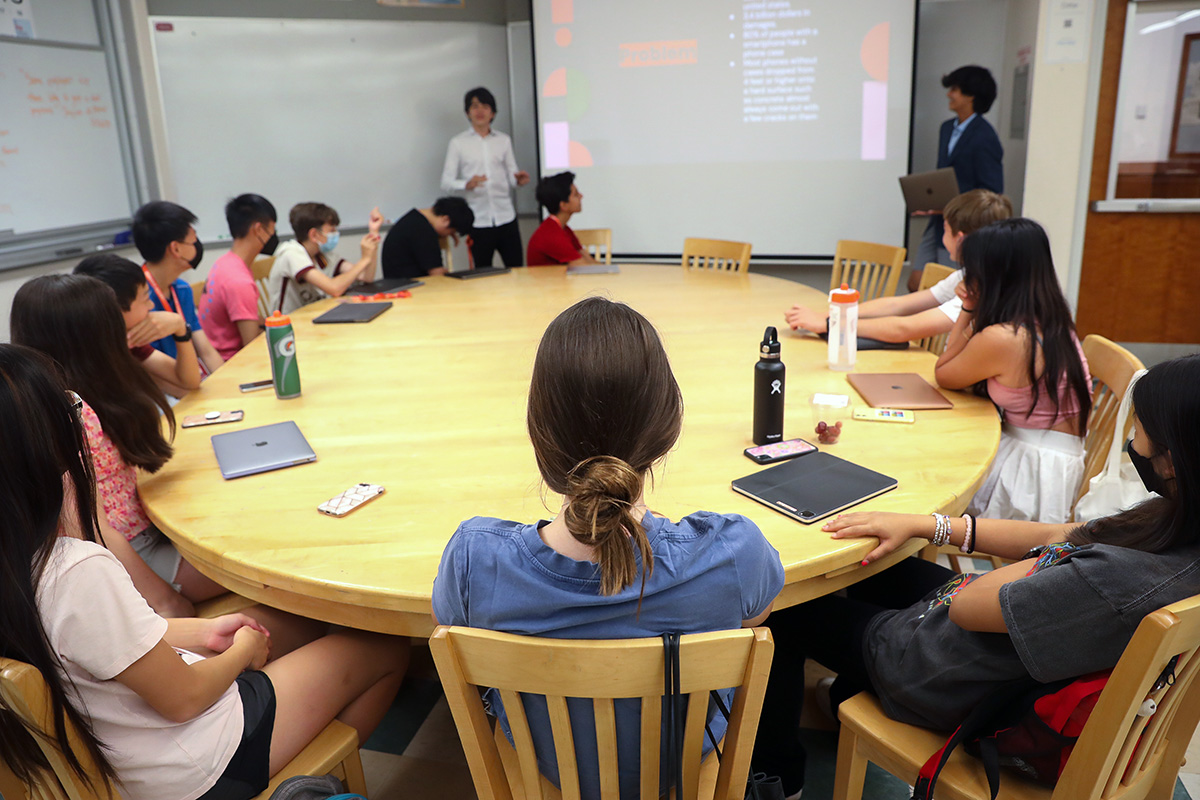
Ishaan Velan and Joaquin Cavalcante took their places standing at the front of a classroom in Phelps Science Center as theme music from the hit reality TV show Shark Tank blared through the speakers of a nearby laptop.

For their final project in Entrepreneurship: Moral Money Making, a course in Exeter Summer’s Access Exeter program for seventh- and eighth-graders, Velan and Cavalcante were presenting their business idea for their teachers and peers to evaluate — and decide whether or not to invest.

“We found in research that over 50 million phone screens are shattered per year only in the United States,” said Cavalcante, an eighth grader from Rio de Janeiro. “We’re spending money … on phone cases and they can’t do their job well.” Enter their (hypothetical) product: a highly durable cell phone case made of a more sustainable bioplastic material derived from biological substances rather than petroleum.

>> How to apply to Exeter Summer

As this “Kind Shark Tank” exercise continued, the two students discussed estimated costs and revenue for their company, and described how at $55, their phone cases would still be priced lower than those made by competitors like Casetify, Nimble and Popsicase. “Unlike them, we’re very eco-friendly with our bioplastic cases,” said Velan, a seventh grader from Chicago. “And they’re fully customizable to create the ultimate phone that’s personalized just for you.”

The students’ pitch, like other businesses presented by their classmates, were firmly in line with the core philosophy of the Entrepreneurship course, one of three in the Access Exeter cluster titled Kind By Design: Make it Big in a Good Way. As the title indicates, Kind By Design focuses on aligning principles of business and technology with a philosophy of doing good not only for fellow humans, but for the earth as a whole. One of nine clusters offered during Exeter Summer’s 2022 session, it challenged students to take a non sibi approach to creating a useful product, marketing it ethically and building a profitable yet sustainable business around it.

Design inspired by nature

In Science in Nature: Biomimicry Beyond Benign, another course in the Kind By Design cluster, students took to the laboratory to explore how some of the most successful products draw cues from the natural world.

“We take concepts from nature and…apply them in a way that’s more ecofriendly and sustainable, but still innovative,” said Jim Enright, a longtime Exeter Summer instructor who has also taught classes in marine biology and business/economics in the Upper School.

In this lab-focused course, students studied the three principles of biomimicry — sustainable, innovative and inspiring — as well as some of the ways scientists have used it to create exceptional products. For one lesson, they studied porcupine quills, the unique structure of which has inspired scientists to design more effective hypodermic needles, among other innovations.

The students also conducted hands-on experiments, including building their own lava lamps using a mixture of water, vegetable oil, guar gum, vinegar and baking soda. “We looked at porcupine quills at 8,200 times magnification under the electron microscope,” Enright added. “That’s cutting-edge technology that’s not available at probably 99% or more of high schools in the country, [and] certainly not [at] middle schools.”

Ethical marketing

In Marketing: Dignified Digital Design, the third course in the cluster, students looked at well-known brands such as Apple, Disney, Starbucks, Tesla, Coca-Cola and The North Face, focusing on the way they market their products. The curriculum touched on an array of topics, from green marketing and affiliate marketing to search engine optimization (SEO), all with the intention of helping students hone their ability to distinguish between ethical and non-ethical marketing.

Instructor Davidson Joseph taught entrepreneurship in a previous session of the Kind By Design cluster, and pioneered the “Kind Shark Tank” activity for Exeter Summer. “I think the most rewarding thing is to see students at the end of the year come back and say, ‘Mr. Joseph, I’m serious about starting my own business,’” he says.

As part of their final marketing project, the students worked in groups to produce short commercials for their chosen brands. “I enjoyed learning about how commercials are made, and how you should have very short cuts — maximum five seconds — to really keep the audience engaged,” said Konrad Olczak, an eighth-grade student from Switzerland. “That was something that I probably saw [before], but I never actually realized it or analyzed it.”

Building a better business

In the Entrepreneurship class, Instructor Trevor Marrero ’12 — who attended Exeter Summer before matriculating at the Academy in ninth grade — used a variety of different media, including articles, podcasts and YouTube videos, to explore how to build a business that is sustainable as well as profitable. To give students a behind-the-scenes look at the day-to-day challenges of business in the real world, he invited several fellow alums and friends to talk to his students about their entrepreneurial ventures.

For Cian Sloan, a seventh grader from Ireland, listening to the guest speakers share their early experiences starting their businesses was particularly eye-opening. “It really showed me the amount of work you need to do to be an entrepreneur, and just all the finer things behind it and how to approach it,” he said.

Maika Liu, a seventh grader from the Philippines, agreed: “I was really inspired by their stories and how hard they had to work to get where they are today.”

Back in the “Kind Shark Tank,” Velan and Cavalcante fielded a few pointed questions from the “Baby Sharks,” their fellow students. They then looked to the two “Sharks” in the room — Marrero and Richard Schieber, associate dean of Exeter Summer and an instructor in the Academy’s Modern Languages department — for a verdict. “I like it,” Marrero said. “I’m gonna make an offer. I want 20% of your company, but I’m only going to give you $100K.”

The two students huddled together, then came back with a counteroffer: $150,000 for a 15% equity stake. “I’ll give you a hundred K for 15%,” Marrero said.

The two students wavered. Then Schieber jumped in. “I like your presentation,” he said. “I’m going to give you $100,000 for 10%.” Satisfied, the young entrepreneurs shook hands with Schieber as Marrero and their classmates applauded.