Phillips Exeter Academy

Welcome to our new Trustees

Three alumni have recently joined Exeter’s Board of Trustees, adding a wealth of professional experience and shared dedication to the Academy and its mission.

Una Basak ’90, Sam Maruca ’73 and Mike Schmidtberger ’78 began their terms July 1.

Exeter is blessed to have a dedicated body of alumni volunteers, with diverse and expert backgrounds, to oversee the administration of the school and the management of its financial and physical resources. You can see all of our Trustees here.

Below please find below a short bio of each of our three newest volunteers:


Una Basak ’90; P’19

Lexington, Massachusetts

Una Basak lived in Merrill Hall, played field hockey and lacrosse, and volunteered for Head Start through the Exeter Student Service Organization. She holds an A.B. from Harvard College in government. Una went on to complete premedical requirements and work at the bipolar clinic at Massachusetts General Hospital.

From there, she worked at The Advisory Board Company in Washington, D.C., engaging in best-practice research with health systems across the country. She now serves on the board at her sons’ school for autism, Nashoba Learning Group, and the Lurie Center for Autism at Massachusetts General Hospital. Through the Operation House Call program at The Arc of Massachusetts, Basak teaches medical students at Boston University Medical Center and Harvard Medical School about treating individuals with developmental disabilities. An elected director of the GAA since 2018, she became a GAA vice president this year.

“I am coming to this role with a deep affection for the Academy and the recognition of a need to foster connection with our alumni of different affinities,” Basak says. “I hope to be able to continue the work to include and accommodate the differences among our alumni and work with the Academy to best address the evolution of our alumni community and engage as many alums as we can in as many creative ways as we can.”


Samuel M. Maruca ’73; P’04, P’07, P’10

Washington, D.C.

Sam Maruca entered as a prep from Lawrenceville, New Jersey, and lived in Bancroft Hall, Dunbar Hall and Lamont Hall. He was active in the glee club, orchestra, student government and basketball, and “majored” in classical languages. Maruca received a B.A. with honors in American studies from Yale College. After graduation, Sam worked for the House Administration Committee of the U.S. Congress and as a law clerk, while attending Georgetown University Law Center as an evening student. He served on The Georgetown Law Journal staff and graduated in 1982. During a long career in private practice in Washington, D.C., Maruca specialized in large case dispute resolution in the international tax field. He is currently senior counsel with Covington & Burling LLP and has an active pro bono practice. Maruca is the board treasurer of Capitol Hill Day School. Maruca has been an elected director of the GAA since 2018 and GAA secretary from 2020-22. He became a GAA vice president this year.

“I am thrilled and honored to have the opportunity to give back to Exeter through service on the board!” he says. “Thank you for your trust in me. I look forward to rolling up my sleeves and contributing in any modest way I can to perpetuating and improving this unique institution.”


Michael J. Schmidtberger ’78

New York, New York

Mike Schmidtberger entered PEA in January of his prep year. He lived in Wentworth Hall; participated in cross-country, spring track and basketball; served on the Student Council; and worked in the Elm Street Dining Hall. He holds a B.A. with honors in English from Columbia College and a J.D. from Columbia University School of Law, where he served as editor-in-chief of Columbia Human Rights Law Review. Schmidtberger is the chair of the executive committee of the international law firm of Sidley Austin LLP. His principal areas of practice are securities and commodities-related funds and corporate transactions, including related regulatory matters. Schmidtberger has been on the board of directors of the United Way of New York City since 2011 and has served as co-chair since 2016. He is also a member of the Columbia College Board of Visitors, a representative to the Partnership for New York City and a trustee of the Citizens Budget Commission.

“I am honored and quite humbled to have the opportunity to serve the Academy, and all its constituencies, as a trustee,” he says. “I remember well — I was taught by an extraordinary faculty; learned from, and made lifelong friends with, fellow students; and was treated kindly by staff. I look forward to spending more time in Exeter, NH!”  

Editor’s note: This article first appeared in the Fall 2022 issue of The Exeter Bulletin.
Exeter Deconstructed: Cilley Ball

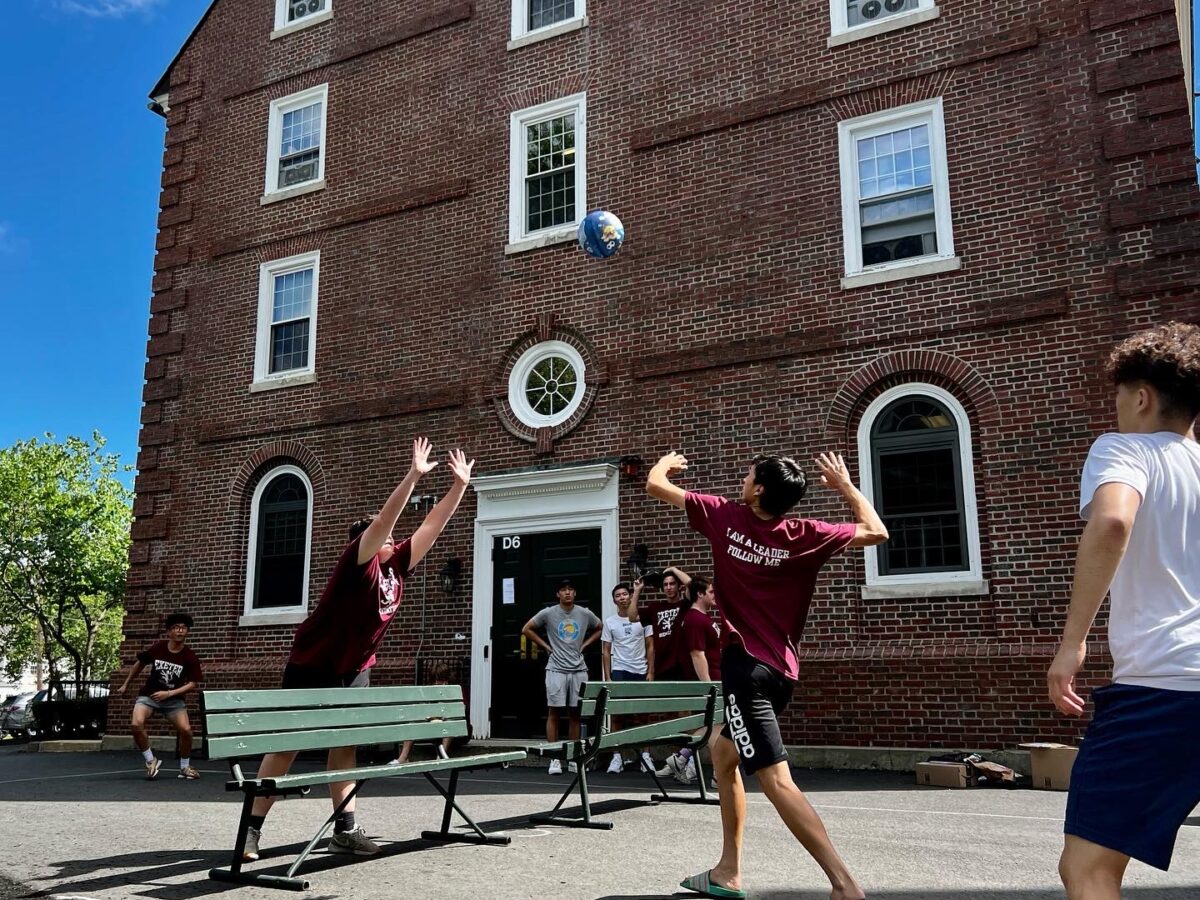
Spikeball is an amusing distraction. Cornhole is great for barbecues. The gentlemen of Cilley Hall have their own game of skill and athletic prowess that has endured for decades: Cilley Ball.

The official sport of the boys dorm is equal parts volleyball and tennis with some custom modifications. The court, set along the building’s north side, is split in half by two wooden benches to serve as the “net.” A game of “C-Ball” — as the denizens refer to it — requires two teams of two and a specific Hedstrom-brand ball. The current game ball is adorned with the puppies of Paw Patrol.

“We tend to pop about eight balls a year, so someone has to go and get balls every once in a while,” says Joe Doherty ’23, a dorm proctor and four-year C-Baller.

“There are three basic rules,” Doherty says. “One, each team gets three touches. Two, each team gets one bounce. Three, if it hits the bench, the touches and bounces reset.”

Believed to have been invented in the 1990s and modified since, Cilley Ball has been a welcome diversion for hundreds of Cilley boys.

“Those forged-on-the-court friendships are worth any dip in grades,” wrote Cilley Hall resident Max de La Bruyère ’09 in The Exonian in 2008. “Something it has taken me a few years to convince my parents.”

Editor’s note: This article first appeared in the Fall 2022 issue of The Exeter Bulletin.

New fall sports coaches named

Diana Davis ’03

Girls Varsity Cross-Country

Davis takes over as head coach of the girls cross-country program, succeeding Gwyn Coogan ’83, who led the program for 17 years. As a student, Davis was a former captain of the girls cross-country, winter track and spring track teams. Coincidentally, she is the third member of Exeter’s Math Department to also serve as the head cross-country coach, following Coogan and Rick Parris, who led the squad for 27 years. Davis, who once ran at least two miles every day for over six years, competed for Williams College and has been an assistant coach with Exeter’s program since 2020.

Lovey Roundtree Oliff

Director of Tennis and Squash

In this role, Oliff oversees all operations of Big Red’s six interscholastic tennis teams and four squash teams. Oliff has served as the girls JV tennis coach for the last two years and as the girls squash coach since 2019. As a former classroom teacher and lifelong athlete, she brings to the teams her knowledge of physical and mental preparation, effective team dynamics, and the importance of balance between athletics and the Harkness pedagogy. Oliff is still active in both sports, competing in various United States Tennis Association and US Squash leagues.


Editor’s note: This article first appeared in the Fall 2022 issue of The Exeter Bulletin.

Ecologist and human rights advocate honored with Phillips Award

“I think that what I learned most from Exeter was how to learn,” Sasha Kramer ’94 told a group of students sitting around the Harkness table in Thomas Simpson’s REL450: Social Ethics class. “I think that once you learn how to learn something, you can do anything.”

Kramer’s passion for learning, as well as a lifelong drive toward activism, has fueled a nearly 20-year-long career living and working in Haiti as the co-founder and executive director of Sustainable Organic Integrated Livelihoods (SOIL), a research and development organization that provides sustainable and cost-effective solutions to the sanitation crisis in Haiti. She returned to campus this week to receive the John and Elizabeth Phillips Award, which recognizes an Exonian who has contributed significantly to the welfare of community, country or humanity.

“As an ecologist, human rights advocate and champion of dignified and safe sanitation, you have channeled your passionate devotion to ecological research into the pursuit of basic human rights for people in Haiti and around the world,” said Trustee and General Alumni Association President Betsy Fleming ’86. She delivered Kramer’s award citation in the Assembly Hall on the Friday of Exeter’s Family Weekend and the fall meeting of the Trustees.  

Addressing a packed hall of students, faculty and visiting family members, Kramer spoke of initially feeling out of place at Exeter when she arrived as a prep from rural upstate New York. “Through the daily practice of sitting at a table with my classmates, from a wide diversity of backgrounds, my confidence grew,” she recounted. “[I]n a way that has allowed me to sit with the discomfort of difference; in a way that has reminded me that accepting our own flawed humanity can be a powerful tool for cultivating empathy.”  

Lifelong drive toward activism

Kramer dedicated many of her remarks to Haiti, the island nation that she called “my greatest teacher, my harshest critic, my deepest joy, my most acute heartache, and through it all, my most powerful inspiration.” From reading the novels of Edwidge Danticat and studying the world’s first successful slave rebellion and its impact on the course of global history, she described becoming fascinated by Haiti when she was a teenager. In 2004, while pursuing her Ph.D. in ecology at Stanford University, she traveled to the island nation for the first time as a human rights observer.

“I learned that despite all of the acute human rights abuses happening at the time, the most pervasive human rights abuse in Haiti and globally is poverty,” Kramer said. “While I witnessed terrible suffering, I also witnessed true courage.”  

She would return to Haiti six times over her last two years at Stanford. Determined to use her ecological research to confront the real-world problems of food insecurity and lack of access to sanitation, she moved to northern Haiti and co-founded SOIL in 2006. Through a system called container-based sanitation, the organization works to transform human waste into a resource for fighting climate change and restoring ecosystems, all while helping to reduce the spread of disease and providing employment for Haitian citizens.  

In the aftermath of the devastating 2010 earthquake, SOIL provided emergency public toilets used by some 20,000 people in the capital, Port-au-Prince, and built its first large-scale composting site. Now it is one of Haiti’s largest waste treatment operations, and focuses on developing social business models to provide safe household sanitation in the country’s most vulnerable urban communities.

“Empathy, perspective and perseverance”

Kramer shared with the Assembly audience the greatest lessons Haiti has taught her, saying she hoped they would be relevant to students’ lives as they grow into global citizens. “Much of my academic training focused on objective observation,” she said. “But Haiti quickly taught me that emotional intelligence — the ability to empathize with others, no matter how painful — was the most valuable tool for building the relationships that are pivotal for making change.”

Haiti also taught her perspective, Kramer said, as she set aside personal challenges in the face of “the everyday heroism of my team, who literally would walk through burning roadblocks to ensure sanitation to families cut off by insecurity.” Finally, she learned perseverance. “Undoing centuries of inequality is a lifetime commitment,” Kramer said. “It requires a dedication that takes strength in small victories and the tenacity to persist in the face of immeasurable setbacks.”

A message of gratitude

Kramer closed by thanking her fellow members of the class of 1994, who she said collectively raised more than $6,000 as a show of solidarity for the SOIL team’s work in Haiti. She also thanked the current Exonians in the classes and clubs she met with during her visit, including Simpson’s religion class; Social Innovation, an integrated studies class taught by Director of Service Learning Liz Reyes; and several ESSO groups.

“As I stand before you today, millions of Haitian children face an uncertain educational future as schools across the country close due to insecurity,” Kramer said in her closing remarks. “In a world where education should be a right but remains a privilege, I want to remind you that while this privilege does come with profound responsibility, it also brings with it an incredible opportunity — the opportunity to use your privilege and education to make a difference in the lives of others.”

After Kramer concluded her speech, a gratified Assembly Hall crowd rewarded her with another honor: a standing ovation.


Student effort taps into Exeter's green genes

When a groundswell of concern for the environment in America resulted in the first Earth Day in 1970, Exeter students were there, cleaning up roadside litter and trash around town, handing out material on pollution to local residents, and canvassing for signatures to install an incinerator and sewage treatment plant in town.

More than a half-century later, Exeter students remain at the vanguard of environmental activism, launching a new effort to raise awareness on campus of the planet’s plight and what can be done locally to respond.

With “Big Red Goes Green,” the student-led Environmental Action Committee hopes to reignite a commitment to sustainability that largely was smothered by the pandemic and the measures required to cope with it. The club’s co-heads laid out their intentions at assembly Tuesday.

“With Exeter’s busyness, environmental sustainability is often pushed to the side in favor of convenience,” Ophelia Bentley ’23 said, “and thanks to COVID, we’ve been using more plastic and producing more waste than ever.

“While climate change is far too big to be solved by any one of us alone, small actions add up and make a big difference.”

The EAC’s multi-pronged effort includes working with the Academy’s Environmental Stewardship Committee to infuse sustainability into the school’s curriculum “in an interdisciplinary way so we can give credence to the ubiquitous nature of the climate crisis” said Alia Bonanno ’23, “and to appeal to students’ every interest and background so it’s not always so ‘science-y’ and is more accessible.”

Other elements of the initiative are hosting assembly speakers focused on the environment; holding open forums to discuss issues related to climate change; the return of dorm-based E-proctors to promote sustainable measures in the dorms; and a dorm sustainability competition that features a March Madness-style tournament bracket.

The club’s co-heads — who also include Alysha Lai ’23 and Safira Schiowitz ’23 — are all seniors, but their aim is to make a lasting mark on the institution with this latest effort. “Our hope is the work we do now lasts long into the Academy’s future,” Schiowitz said. “That’s why we’re calling it a pillar instead of a theme, because we’re hoping that it will become part of Exeter’s primary values and be more at the forefront of everyone’s mind.”

Assembly presentation empowers students to confront harassment

In Assembly Hall on Tuesday, Exeter students got some practical tips on how to deal with various types of harassment not only when it happens to them, but also when they witness it happening to someone else.

“Our mission today is to empower y’all as individuals and as a community to stop the harassment that is happening in Exeter,” said Heidi Lersch, a trainer from Right To Be, a nonprofit group with a mission to end harassment in all forms. Lersch added that they had received many anonymous submissions prior to the training from students sharing information about some of the harassment they had experienced in the community. 

Launched in 2005 as Hollaback!, a grassroots organization that helped support people who had experienced street harassment, Right To Be trains individuals and communities in conflict prevention and de-escalation. Their trainings teach bystanders how to intervene when they see harassment happening, and they operate an online platform, HeartMob, where people facing online harassment can seek support. 

In an illustration of the power that bystanders can wield, Lersch shared research showing that only 25% percent of people who have experienced harassment said someone had helped them. But when people did step in, 79% of those being harassed said that the intervention improved the situation. After sharing those stats, Lersch and their co-trainer, Dax Valdes, spoke about the origins of harassment — which can range from catcalling to racist micro-aggressions to more explicit physical threats — in bias, both explicit and implicit. They also stressed how people’s identities affect how they move through public spaces and how they deal with harassment they might experience or witness.

The bulk of the presentation covered practical advice, as Lersch and Valdes laid out a set of tactics they called the “Five Ds” (Distract, Delegate, Document, Delay and Direct) that can help bystanders intervene when they see harassment happening either online or in in-person interactions.

Valdes and Lersch urged students to trust their guts and prioritize their own safety when considering how to address harassment as a bystander. “You don’t have to intervene directly,” Lersch said. “You don’t have to be the big superhero that has the wittiest comeback. That’s not what bystander intervention looks like. You can do something as simple as just checking on the person who was harassed and making sure that they’re OK.”

Throughout the interactive training, students responded to several anonymous polls using the Slido app, answering questions such as “What examples of harassment have you witnessed or experienced?” and “What are the impacts of harassment?” They reported impacts ranging from psychological fallout (anxiety, depression and PTSD) to social and economic costs (missing school or work, limiting mobility), making it clear the heavy toll such experiences are taking on many current Exonians.

Near the end of their presentation, the Right To Be trainers challenged the audience to think about how Exonians can work together as a community to prevent such harassment. “We are providing some resources and knowledge and then it’s also up to you to carry this forth,” Valdes said. “It’s not just the students in the Assembly Hall but it’s also the faculty who are hearing this information…and thinking about what can we do to keep each other safe.”

Martín Espada speaks for the silenced

“I know of no poet that embodies the disembodied, enfranchises the disenfranchised, [and] epitomizes that promise of love and freedom more than Martín Espada,” Instructor in English Willie Perdomo said by way of introduction on Friday, as Exeter welcomed the celebrated poet to the Assembly Hall stage as part of the community’s celebration of Latinx Heritage Month.

Over the next half-hour, Espada’s sonorous voice rose and fell, at times quavering with emotion or approaching musical incantation, as he read four poems from his most recent book, Floaters. Named for the derogatory term used by some U.S. Border Patrol agents to describe migrants who drown trying to cross the Río Grande from Mexico to the United States, the collection won the 2021 National Book Award for Poetry.

“This poem started with a photograph,” Espada said of the title poem in his book, referring to an image of the drowned bodies of a Salvadoran father and his young daughter in the Río Grande that went viral in the summer of 2019. He wrote “Floaters” in response to the photograph, as well as to questions that emerged in a particular Border Patrol Facebook group about its veracity.

For another poem, “Jumping Off the Mystic Tobin Bridge,” Espada drew on his experience working as a tenant lawyer in the Boston area some 30 years ago, when he represented many low-income Spanish-speaking immigrants who faced eviction or exploitation by landlords. In the poem, he recalls his own experience with racism, as a taxi driver warns him about the many “Josés” in the neighborhood where he worked:

“He could hear the sawing of my breath as I leaned into his ear, past the bulletproof
barricade somehow missing, and said:
I’m a José. I could see the 40-watt
squint in his rearview mirror.
I’m Puerto Rican, I said. It was exactly
5 PM, and we were stuck in traffic on the Mystic Tobin Bridge.”
  

Espada rounded out the Assembly reading with two even more personal selections: a tender poem inspired by his wife — “I firmly believe that times of hate call for poems of love,” he said — and a poignant yet searing missive responding to the devastation of his late father’s native town, along with much of Puerto Rico, by Hurricane Maria in 2017. He closed by thanking the appreciative crowd, many of whom rose to their feet to applaud.

Principal Rawson shares his priorities at assembly

Principal Rawson ’71 shared with Exeter students a long and ambitious list of priorities for the Academy during a question-and-answer assembly Friday with the school’s Student Council officers.

The list includes work already underway or soon to be, including the building of a new dining hall to replace Wetherell and the adoption of a climate action plan that will establish goals for drastically cutting the school’s carbon emissions over the next 10 years.

Student Council President Ale Murat ’23, Vice President Grace Puchalski ’23 and Kevin Treehan ’24 and Nate Puchalski ’23, co-secretaries, joined Principal Rawson on the Assembly Hall stage. Rawson told the students he hopes the senior class can enjoy their final year at Exeter, noting that members of the class were preps when the COVID-19 pandemic forced spring term to be held remotely in 2020 and continued to disrupt campus life over the past two school years.

“Whether you were here or elsewhere, the pandemic has taken a lot out of your education,” Rawson said. “I just want this year, for all of us, to be a great year, and I think we’re off to a good start.”

He told the students he hoped to leverage student-faculty collaboration to confront issues of common concern and vowed to visit their classes more often.

Asked how he spends his days, the principal replied, “my days are long, just like yours, and they’re not all the same, but I’m lucky to be here; it’s an exciting place to be.

“I want to spend as much time as I can with you, understanding your experience and observing your activities and accomplishments and, in some cases, just cheering you on.”

Watch the full Q+A with Principal Rawson.

Caldwell tabbed as head coach of girls lacrosse

The Exeter Athletics Department has announced Alexa Caldwell as the next head coach of the girls lacrosse program. Caldwell, who is no stranger to being on the Big Red sidelines, takes over for renowned coach Christina Breen, who is stepping down after helping build the program to be one of the best in New England and the country.

“Alexa is a pillar in our community,” said Director of Athletics Jason Baseden. “She has proven to be an outstanding coach who connects with her team and loves the work and challenges that coaching brings. She is a strong mentor and a role model for all our students in our community and we are thrilled to have her lead the girls lacrosse program.”

Caldwell takes the reigns from Breen, who was with the program since 2011, including the last decade as head coach. Breen led Exeter to a 96-44-5 overall record during her 10 years at the helm of the program while matriculating dozens of players to the college ranks.
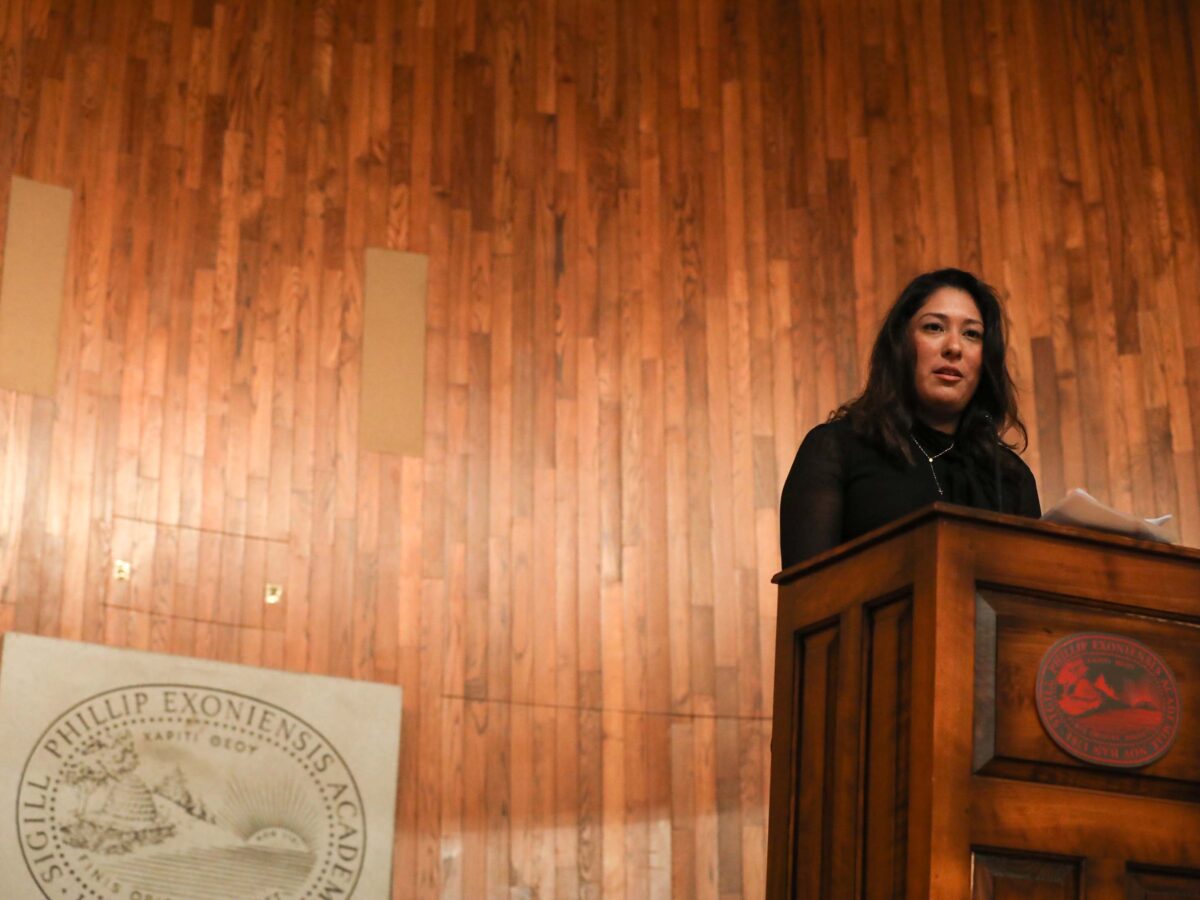
Caldwell, an instructor in history since 2015, has served as an assistant coach with the girls varsity lacrosse program for the past two seasons, helping lead Big Red to a 24-5-1 record over that span. Prior to joining the varsity coaching staff, she spent four years as the head coach of the girls JV program. She has also served as the head coach of the girls varsity soccer program since 2017.

“The girls lacrosse program has historically been a successful and competitive program and I am excited to help continue that legacy,” said Caldwell. “We all learn so many life skills from athletics and to have the opportunity to work with such a competitive team is really exciting. It is a great group of students. I feel really lucky to get to coach them.”

Prior to joining the coaching ranks, Caldwell was a standout lacrosse player at Brown University. A four-year starter with the Bears, Caldwell was named to the All-Ivy League team, Academic All-Ivy team, and Intercollegiate Women’s Lacrosse Coaches Association All-Academic team while serving as captain during her senior year. Caldwell earned her bachelor’s degree from Brown before attaining her master’s degree at Vanderbilt University.

Alumna: ‘Show up with your whole authentic self’

When Veronica Juarez ’00 first arrived on Exeter’s campus in the fall of 1996, she remembers feeling like she didn’t belong.

“I was doubled over in anxiety…wailing out loud that maybe this wasn’t such a good idea,” she told a rapt audience in the Assembly Hall on Friday, one week after the opening of a new school year. “If you don’t feel like you belong here, for whatever reason…I am here to remind you that you do — otherwise, you wouldn’t be here.”

>> Watch the assembly address from Veronica Juarez ’00

A fifth-generation Mexican American from Houston, Texas, Juarez graduated from Exeter in 2000 and became the first in her family to attend college. After graduating from Stanford University, she launched a career in politics, working for a California congressman, Houston mayor and Texas state senator. In 2013, she made a crucial career pivot, joining the ride-sharing company Lyft as only its 62nd employee.

“After so many years in the public sector, I understood that access to transportation is an enormous equalizer for communities in need,” Juarez said. Over seven years with the company, she rose to become vice president of social enterprise, a position in which she brokered contracts with government agencies to provide rides to people in need in communities all over the country.

Though she had grown disconnected from Exeter while she was building her career, Juarez said, that all changed after George Floyd’s murder in 2020, when “our country was awakened with a newfound reckoning of racial and social injustice.” She spoke with emotion about discovering the @BlackatExeter Instagram account and being moved to tears by its reports of ongoing racial discrimination at the Academy. She realized that every organization, every institution — just like every human being — is fallible, and that if she wanted Exeter to change, she needed to be part of that change.

As a result, Juarez has increased her involvement with the Academy, and was recently elected as a director of the General Alumni Association (GAA). Her Assembly talk coincided with Exeter Leadership Weekend, an annual gathering of alumni and parent volunteers.

Since leaving Lyft in 2021, Juarez has been investing on her own and working as a scout for Lightspeed Venture Partners. In her Assembly talk, she shared the breaking news that she is launching a venture capital firm alongside Claudia Romo Edelman S’72, which will invest in Latino founders. She then closed with some heartfelt advice to Exeter students, encouraging them to “find the work that sets your soul on fire.”

“You may not know what that is today, and that’s OK,” Juarez said. “But don’t be afraid to take that journey inward and discover what really lights you up….If you show up with your whole authentic self, you’re 95 percent of the way there.”