

Phillips Exeter Academy

Exeter star shines at historic Millrose Games

For the second time in four years, the most prestigious indoor track event in the nation featured an Exonian. Byron Grevious ’24 finished in sixth place in the high school boys one mile at the 115th running of the Millrose Games in New York City last weekend.

Grevious kept pace with a field of the top mile runners from around the country to finish in a time of 4:12.95. Grevious, who has made a substantial mark at the national level through his blazing times in cross country, indoor and outdoor track, follows in the footsteps of Will Coogan ’20. Coogan, currently running at the University of North Carolina, competed in the one mile at Millrose in 2020.

Grevious has earned the distinction of being one of the best high school runners in the country, competing at indoor nationals and outdoor nationals as a 10th grader before reaching new heights this year as an upper. The Southport, Connecticut, native wrapped up a cross country season by finishing second overall at the Nike Northeast Regional before claiming 12th overall at Nike Cross Country Nationals.

“My mentality changed sophomore year,” said Grevious, regarding his mindset heading into big races. “Nerves definitely used to be there leading up to the race and at the starting line. Now I get excited to see what I can do. Having the opportunity to run with such high class runners has made me more excited than nervous. I get excited to compete.”

The success he experienced in the fall has carried into winter. In just his second weekend of racing this winter season, Grevious shattered his own school record in the 3,000 meter with a time of 8:15.10 — good enough to be the fastest time by an 11th grader in the country this season. He also was a part of a school record in the distance medley relay, ran a personal best 4:14.11 one mile, and has qualified for indoor nationals in the one mile, two mile, and 5,000 meters.

“Leading up to races, I’ll sometimes go through my training log,” he said of his preparation tactics. “I tell myself I know what I can run, I’ve done these workouts, I was hitting these reps at this pace and I felt good.”

“Byron embodies a wonderful mix of steadfast focus to detail and dedication to getting the work done over a long period of time,” said head track and field coach Hilary Hall. “This is not a work for a few weeks and then take a break kind of athlete. He knows that it takes consistent, persistent work over months and years to get results and he is willing to put in that effort.”

“Byron is the whole package,” said distance and head boys cross country coach Brandon Newbould. “He is a respectable student-athlete who is well-suited to the academic rigor of the Academy and he enjoys racing and is excited about the opportunity to face America’s best.”  

The Millrose Games annually feature top runners from the around the world, including past, present and future Olympians. The high school mile field included 13 of the top milers from around the nation. Grevious wasone of just two runners from class of 2024 and one of two from the New England region.

At your service: ESSO embodies non sibi

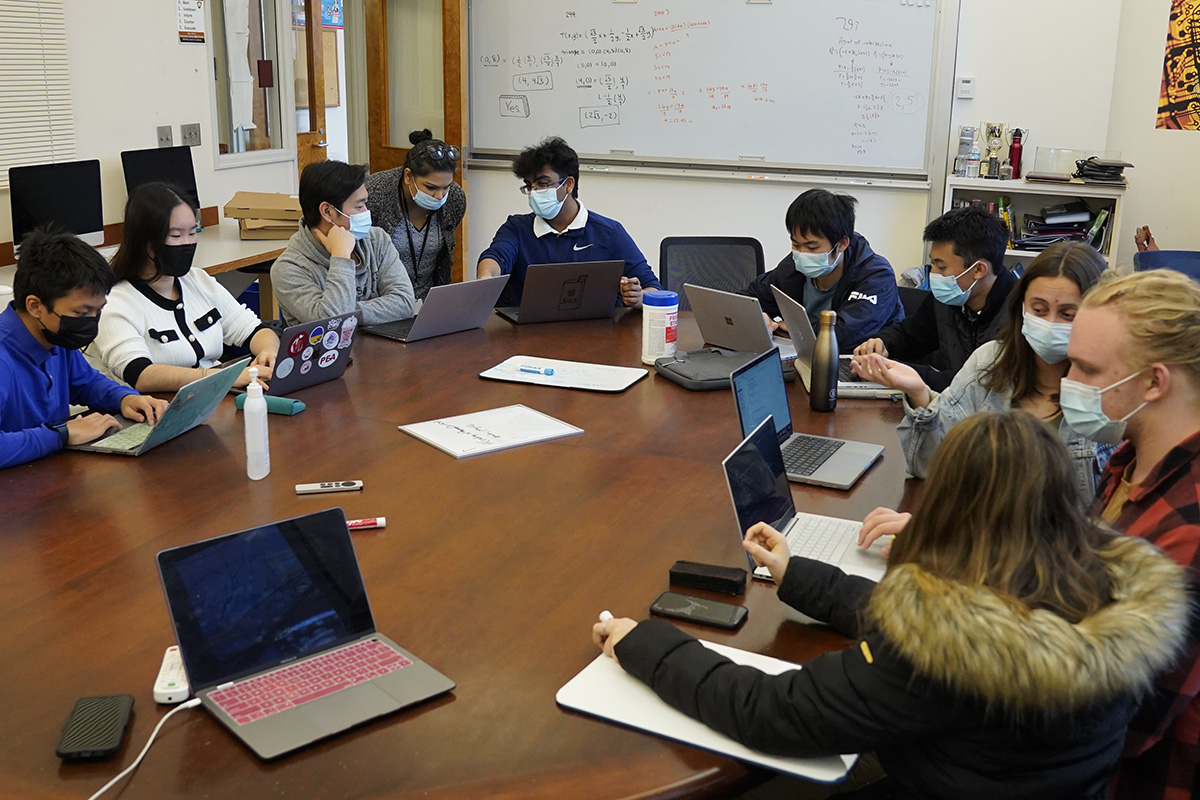
Students fill the hallways of the Cooperative Middle School just after 2 p.m. on a recent Wednesday afternoon. As hundreds of sixth, seventh and eighth graders check their lockers and headed for the exits, six members of the Exeter Student Service Organization group Girls Who Code make their way through the noisy crowd to a second-floor classroom. A cohort of middle school girls soon joins them, choosing seats at a large rectangular table in the middle of the room. They flip open their laptops, ready for another course in the basics of the programming language Python.

Like all of the more than 50 student-run clubs under the ESSO umbrella, Girls Who Code is a free service program offered by Exeter students to members of the local community. Since 1967, ESSO has built on the Academy’s founding principle of non sibi, or “not for oneself,” by sending students out into the community to serve as volunteers. “ESSO presents Exonians with an opportunity to get involved in the society in which they live,” a co-director of the organization told The Exonian in 1968.

The Girls Who Code group is affiliated with the international nonprofit of the same name, which aims to help close the longstanding gender gap in programming and other technology fields. After meeting online only during the earlier phase of the pandemic, the group returned to in-person meetings this fall, beginning with smaller gatherings at a local library.

This is only their second meeting at the middle school, located about 10 minutes from Exeter’s campus in the neighboring town of Stratham, and the group is still getting to know each other. They do a round of introductions (name, hometown, favorite ice cream flavor) and a review of what they did last session (making sentences with variables) before club co-head Joey Dong ’23 kicks things off in earnest.

“Could we maybe do a little exercise? Can you guys make a variable that stores how much money you have…and then make a print statement that says ‘I have however many dollars in my bank account’?”

As their students turn to their screens, the Exonians move around the room, offering help. Between exercises, they take turns explaining the concepts behind each one. Dong, who has been involved with Girls Who Code since the summer after her prep year, created the curriculum they’re using for a non-profit she co-founded, The Dream AI, which focuses on teaching machine learning algorithms.

Pranavi Vedula ’25 goes over the three forms of data in Python: strings, numbers and Booleans. “[Boolean] is really just a fancy way of saying true or false,” she explains. “You can set certain conditions to be true or false, then execute your code to happen based on that outcome.”

A day student from Brentwood, New Hampshire, Vedula has now experienced Girls Who Code from both perspectives, having learned from Dong and others when she was a student at the Cooperative Middle School herself. “I tried doing a little bit of coding here and there when I was younger, but it didn’t ever click and I didn’t enjoy it until after Girls Who Code,” she says. “The mentors made me feel seen, and it was the first time I felt seen for who I was. I didn’t feel overpowered, and I didn’t feel stupid.”

Now that she’s a student at the Academy herself, Vedula enjoys paying it forward by teaching coding to younger students. “Being a female in a STEM field is difficult because it’s a very male dominated field,” she says. “Having that space to connect with other female students is really valuable.”

The middle schoolers in the class agree. “[Boys] are chaos,” one sixth grader puts it succinctly. “It’s a lot harder to learn with the noise, the funny jokes, stuff like that,” another adds.

By the time class ends, the students have written code that subtracts money from their bank accounts to “buy” an array of things, from $10 cookies to UFOs for a Martian voyage, and started programming an input function that asked people their favorite ice cream flavor. They’ve also polished off a couple of bags of cookies — with some assistance from their Exonian teachers.

“Technology is such an influential field right now, [and] we can’t just have the people behind technology be male-dominated, because that’s going to be carried through in the products and in technology itself,” Dong says of her dedication to the Girls Who Code mission. “We want technology to be fair to everybody.”

Unlocking the code

Exonians in review: Winter 2023

Alumni are encouraged to advise the Bulletin editor (bulletin@exeter.edu) of their own publications, recordings, films, etc., in any field, and those of their classmates, for inclusion in future Exonians in Review columns. Please send a review copy of your published work to the editor to be considered for an extended profile in future issues. Works can be sent to: Phillips Exeter Academy, The Exeter Bulletin, 20 Main Street, Exeter, NH 03833.

ALUMNI

1953—Peter M. Wolf. The Sugar King, Leon Godchaux: A New Orleans Legend, His Creole Slave, and His Jewish Roots. (Bayou Editions, 2022)

1956—Peter Brooks. Seduced by Story: The Use and Abuse of Narrative. (New York Review Books, 2022)

1956—William Peace. Nebrodi Mountains: The Billionaire and the Mafia. (Strategic Book Publishing and Rights Agency, 2022)

1957—Carl Pickhardt. Holding On While Letting Go: Parenting Your Child Through the Four Freedoms of Adolescence. (Health Communications Inc., 2022)

1962—Paul S. Ulrich. Topography and Repertoire of the Theatre, book series. (Hollitzer, 2022)

1964—John Kohring. “Report From the Midwest,” a collaborative online photo and prose exhibition.

1966—James E. Coleman Jr. “Living in the Shadow of American Racism,” article. (Law and Contemporary Problems, Volume 85, Issue 3, 2022)

1967—Robert Matisoff. Red Ivy. (Self-published, 2022)

1974—Julie Scolnik, with Sophie Scolnik-Brower . J.S. Bach: Complete Sonatas for Flute & Piano, CD. (Navona Records, 2022)

1977—Kathleen Engel, co-author. “Student Loan Reform: Rights Under the Law, Incentives Under Contract, and Mission Failure Under ED,” article. (Harvard Journal on Legislation, Volume 58, Number 2)

1981—Claudia Putnam. “Hardening,” poem. (ABQ inPrint, Issue 6, 2022)

— Book review of Suzanne Edison’s Since the House Is Burning. (MER Literary Journal, September 2022)

  • “Raiment,” poem. (The Bookends Review, September 2022)
  • “We Don’t Know, We Think Different Things,” fiction. (Variant Literature, Issue 12, Fall 2022)

1987—David Hollander, producer. Robert Irwin: A Desert of Pure Feeling. The documentary film premiered at DOC NYC in November 2022.

1989—Jeff Locker, actor, writer. Oliver, of Three, play. (Short+Sweet Hollywood theater festival, 2022)

1996—Eirene Tran Donohue, writer. A Christmas Spark, TV movie. (Lifetime, 2022)

— The 12 Days of Christmas Eve, TV movie. (Lifetime, 2022)

2003—Sara Jane Ho. Mind Your Manners, streaming series. (Netflix, 2022)

2004—Megan Halpern, producer. Deborah, film. (Streaming sites, 2022)

2006—Dwight Curtis. “Glasgow One,” short story. (Pangyrus, Nov. 1, 2022)

FACULTY

Willie Perdomo. El Cofre, short play. (Huizache: The Magazine of a New America, Issue 9, Fall 2022)

Nova M. Seals. “The Librarians, Arthurian Tradition, and Attainable Heroism,” paper presented at the Northeast Popular & American Culture Association’s annual conference in October 2022.

Editor’s Note: This article first appeared in the winter 2023 issue of The Exeter Bulletin.

Science for Humanity

Sasha Kramer ’94 has worked for nearly 20 years to combat the twin crises of food insecurity and lack of sanitation access in Haiti by transforming human waste into a vital resource to restore depleted ecosystems. During an all-school assembly in October, she was presented with the John and Elizabeth Phillips Award, which recognizes an Exonian who has contributed significantly to the welfare of community, country or humanity.

“As an ecologist, human rights advocate and champion of dignified and safe sanitation, you have channeled your passionate devotion to ecological research into the pursuit of basic human rights for people in Haiti and around the world,” Trustee and General Alumni Association President Betsy Fleming ’86 said when delivering the award citation in Assembly Hall.

In accepting this year’s award, Kramer spoke of initially feeling out of place at Exeter when she arrived as a prep from rural upstate New York. “Through the daily practice of sitting at a table with my classmates from a wide diversity of backgrounds, my confidence grew,” she said.

Kramer traveled to Haiti for the first time in 2004, while she was pursuing a Ph.D. in ecology at Stanford University, as a human rights observer for a Bay Areabased action committee. “I learned that … the most pervasive human rights abuse in Haiti and globally is poverty,” she said. “While I witnessed terrible suffering, I also witnessed true courage.”

Two years later, Kramer co-founded Sustainable Organic Integrated Livelihoods (SOIL) and used her academic research to improve lives. SOIL develops and deploys a container-based sanitation system that transforms human waste into rich compost, while reducing the spread of disease and creating jobs for Haitian citizens. Now one of Haiti’s largest waste treatment operations, SOIL focuses on developing social business models to provide safe household sanitation in the country’s most vulnerable urban communities.

“In a world rife with challenges related to water shortages, unsafe sanitation and food insecurity, yours is a model that many people seek to emulate,” Fleming said, adding that SOIL has joined forces with a global network of groups, including research institutions and scientists, to develop sustainable alternatives to water-based sewage.

While on campus, Kramer connected with students by attending classes in religion and integrated studies and by meeting with several groups within the Exeter Student Service Organization (ESSO). She also shared with the assembly audience the greatest lessons Haiti has taught her, which she hoped would be relevant to students’ lives as they grow into global citizens. “Much of my academic training focused on objective observation,” she said. “But Haiti quickly taught me that emotional intelligence — the ability to empathize with others, no matter how painful — was the most valuable tool for building the relationships that are pivotal for making change.”

Haiti taught her perspective, Kramer said, as she set aside personal challenges in the face of “the everyday heroism of my team, who literally would walk through burning roadblocks to ensure sanitation to families cut off by insecurity.”

Finally, she learned perseverance. “Undoing centuries of inequality is a lifetime commitment,” Kramer said. “It requires a dedication that takes strength in small victories and the tenacity to persist in the face of immeasurable setbacks.” E The John and Elizabeth Phillips Award was inaugurated in 1965 at the behest of the Academy Trustees and the Executive Committee of the General Alumni Association. The award honors Exonians whose lives and contributions to the welfare of community, country and humanity exemplify the nobility of character and usefulness to society that John and Elizabeth Phillips sought to promote in establishing the Academy. To watch the award assembly, visit exeter.edu/live

The John and Elizabeth Phillips Award was inaugurated in 1965 at the behest of the Academy Trustees and the Executive Committee of the General Alumni Association. The award honors Exonians whose lives and contributions to the welfare of community, country and humanity exemplify the nobility of character and usefulness to society that John and Elizabeth Phillips sought to promote in establishing the Academy.

Editor’s Note: This article first appeared in the winter 2023 issue of The Exeter Bulletin.

I belong

Two decades after her graduation from Exeter, Rhoda Tamakloe ’01 still prizes her Afro-Latinx Exonian Society T-shirt collection. Being a member of ALES played an important role in her days as a student coming of age at the Academy in the late ’90s.

“It was the first time in my life that I was able to find community and people who shared my background,” says Tamakloe, whose father is Nigerian and Ghanaian and whose mother is African American and of Indigenous descent from the Narragansett and Wampanoag of Rhode Island and Massachusetts. “It helped me step into my own.”

Tamakloe cherishes her three years at Exeter, but she acknowledges that she struggled with being seen as a learning prop instead of a peer in certain instances. One unforgettable moment during a history class stands out. “I remember the lights went off and a video came on; it was that scene in Amistad where they are drowning the slaves,” she recalls. “Then the lights came on and the teacher said, ‘Rhoda, how do you feel about this?’ I said, ‘Well, I don’t know, I was never a slave. How do you feel about it?’”

The incident left her confused, hurt and unclear as to what more her 15-year-old self could have added about the murder of human beings by despotic slavers. She was grateful, however, that later that day she could count on classmates in ALES to help her process what happened. “Without that support, I would have carried and swallowed what happened,” she said.

During her senior year, she adds, she found support in the classroom as well. Black Experience in White America, a course taught by Russell Weatherspoon ’01, ’03, ’08, ’11 (Hon.); P’92, P’95, P’97, P’01, she says, provided an additional safe space to explore the intersection of class and race with her peers.

Now as an elected General Alumni Association (GAA) director and chair of the GAA Alumni Affinity Engagement Committee, Tamakloe is leading efforts to curate identity and affinity spaces like ALES for Exeter alumni. Her focus is on intersectionality.

“I am working to create sustainable, accessible pathways for Exonians to connect with each other and continue to reimagine how we can work together to leave this world a little better than we found it, which is at the heart of the school’s non sibi philosophy,” she says.

On-campus affinity spaces

In educational settings, affinity spaces are meant to create a sense of belonging so students feel affirmed and encouraged and, most important, they can exist freely without the oppressive gaze that regards them as “others.”

In predominantly white and heteronormative environments, people who are differently abled, LGBTQ+ and from various racial and ethnic backgrounds can often feel invisible and stressed, even if the behavior toward them is unintentional.

“Affinity spaces provide opportunities for people to find cultural reflections and affirmation,” says Stephanie Bramlett, the Academy’s director of Equity and Inclusion. “They are a well-documented key ingredient in how we foster connection and belonging for all at Exeter.”

Bramlett says the Office of Multicultural Affairs currently sponsors two types of identity-based groups: cultural groups and affinity groups. Since these groups are student-driven efforts, numbers fluctuate from year to year. Of this year’s 30 groups, 10 are affinity groups.

Bramlett says that cultural group members come together to learn about and celebrate a particular social or cultural group. They are open to anyone who wants to be in community with others discussing a topic around a particular culture. Examples include ALES, the Exeter Feminist Union and the Gender and Sexuality Alliance.

By comparison, Bramlett says, affinity group members come together because they have a shared social identity and can speak to the unique experience of being a member of the group. “You know you are in the right affinity group,” she explains, if you can “speak to that group’s collective cultural identity and experience from the ‘I’ and ‘we’ perspective.” Examples include La Alianza Latina, Exonians With Disabilities and Different Abilities, and the Association of Low-Income Exonians.

“At the Academy, affinity groups play an integral part in the student experience,” says Associate Dean of Multicultural Affairs Hadley Camilus. “Being in a familiar space with other students who share a particular salient identity is paramount, for some, to being able to thrive here. We don’t prescribe that. The students get a sense of when they need to be around those who feel familiar. It’s important for students to know that others are having similar experiences here, and to learn how to be authentic in a community that doesn’t always allow for that, from their more seasoned peers.”

Academic literature supports the power of affinity groups to increase self-esteem and achievement, and improve mental well-being. Beverly Daniel Tatum, one of the leading authorities on the complexity of identity, says affinity spaces help young people in identity development. In her book Why Are All the Black Kids Sitting Together in the Cafeteria?, Tatum writes that if you are growing up as a young person of color in society, part of that experience is to get messages from the wider world about who you are, and responding to them. Tatum, who is also the interim president of Mount Holyoke College and president emerita of Spelman College, says that teenagers start to think about questions of identity in ways that lead them to seek out people who are having similar experiences. It should surprise no one to see young people, particularly in adolescence, gathering in similar groups, she writes. And it’s not just Black children. Asian, Latinx, Native American and white youths do this as well.

Bringing alumni together

Adults can also benefit from affinity groups that help fortify the human spirit. As a member of the GAA’s Board of Directors, Trustee Una Basak ’90 was the founding chair of the Alumni Affinity Engagement Committee. Basak, a Harvard University graduate, says that in 2021 the GAA directors quickly identified three alumni needs: to engage and solicit feedback, to improve communication with young alumni and to create affinity groups. It became very clear, she says, that they needed to respond with some level of programming and safe space creation for alumni to engage with one another. The Alumni Affinity Engagement Committee was formed and focused first on bringing affinity groups together during the 2021 virtual reunion program, a practice that had begun with reunion classes prior to the pandemic.

Basak says she learned a lot organizing these groups, not the least of which was just how difficult it would be to identify BIPOC and LGBTQ+ individuals. In the beginning, the committee relied on word of mouth, she says. The Academy has since updated its directory to allow alumni to self-identify and add race, ethnicity, religion and sexual orientation to their profiles.

The committee invited alumni to join affinity breakout sessions for those who identify as Asian, Black, Hispanic/Latinx and LGBTQ+. Although not very well attended, the alumni who participated in the virtual events expressed an enthusiastic desire to keep going.

The excitement motivated Basak, and she worked with Exeter’s Office of Institutional Advancement and Alumni Relations to begin a more robust virtual program for four alumni affinity groups — Asian American Pacific Islander, Black, Hispanic/Latinx and LGBTQ+.  The alumni who gathered hailed from graduating classes as far back as the 1960s, adding to the richness of the conversations and the variety of experiences.

“It was emotional and very valuable to each and every person on the Zoom,” says Basak, who is of South Indian heritage. “Some of the alums have been carrying traumatic stories for years, but in creating these containers to share experiences, we have built a support system that in a way heals and brings back alums who love the Academy but were not as engaged. The engagement is deeper and more meaningful.”

Trustee Paulina Jerez ’91 attended a Latino/x affinity gathering in December and says, “Not only was this program a great opportunity to [get to know alumni], but it provided a space where we could share our stories and common experiences with Exonians of similar backgrounds.”

Basak says that the alumni affinity groups are mirroring the extraordinary work being done through the Office of Multicultural Affairs on behalf of current students. “We did not have that when we were students in the ’90s,” she says. “For example, there was an Asian Society when I was a student, but it was mostly about food, and there is nothing wrong with that. But we are going deeper. … I am hoping for stories, when brought to light, that are going to create some paths toward a better engagement between alumni and the Academy. And healing.”

How far the Academy has come

Nat Butler ’64 wishes an LGBTQ+ space had existed when he attended the Academy more than 60 years ago. Butler, a newly appointed General Alumni Association director and vice chair of the GAA Alumni Affinity Engagement Committee, wrote an article for the winter 1994 edition of The Exeter Bulletin outlining his initial efforts to connect gay alumni with the Academy and one another. It was a first attempt to build a gay alumni affinity group, and nearly two decades later, Butler is realizing the dream. “I am a dinosaur,” he says, chuckling, “and to see how much progress has happened at the Academy is very exciting.”

Butler attended the Academy when it was a predominantly white male institution. There were two Black students in his class and, he says, the only women he ever saw were faculty wives and food servers, besides the girls who attended occasional dances. It was a time, he recalls vividly, when boys openly made fun of boys for being queer. To this day he flinches when young gays openly embrace the word queer because it caused him so much emotional damage. “The last thing you wanted was to be called that by your classmates or have anyone suspect that you might be homosexual,” he says. “It was a very difficult time to be gay.”

In the ’60s, same-sex sexual activity was illegal in most states. For Butler, the stress was mostly about keeping his nascent gay identity a secret. He says he lived in constant fear and “was totally petrified that anyone would find out.” He was in his mid-20s before he came out to his father, Jonathan Butler ’35.

Despite the challenges of the time, Butler excelled at Exeter. He was elected president of his class and president of the Student Council. He graduated from Harvard College and, at the height of the Vietnam War, followed in his father’s footsteps to enlist in the Navy.

Butler’s mother died of breast cancer soon after he turned 11, and his father fell apart. At 14, he arrived at the Academy. In many ways, Butler says, the Exeter community became his extended family. That is why the school is so important to him, he says.

“As time went on, I remembered how difficult it was to be a gay student at Exeter, and I didn’t want other students to go through what I went through,” Butler, now 76, says, tearing up. He gradually let his Academy friends know he was a gay alumnus, and in 1991 he volunteered to return to campus to give a talk.

The first time the topic of homosexuality was openly discussed at Exeter, he says, was in 1987, when a group of alumni spoke at an assembly. Butler’s talk was the second time. His activism and organizing on behalf of LGBTQ+ alumni has not stopped.

After his father died, Butler established a scholarship in his name. He has been happy to learn that some of the scholarships have gone to LGBTQ+ students. In 1994, Butler received the President’s Award “in recognition of his work as a liaison between the Academy and its gay and lesbian alumni/ae.” In 2006, he was presented with the Founders’ Day Award for his exceptional and sustained service to the Academy.

“For years I would send an email to every single alumni class president introducing myself as a gay alumnus and suggesting an event for gay alums,” he says. “Some wrote back saying they don’t have any gay class-mates. But they had to have a conversation with me, and I am happy that at least this issue got on the radar.”

Butler is excited to see how far the Academy has come regarding LGBTQ+ and BIPOC inclusion, and especially to see alumni affinity groups blossom. “The tide is shifting, but it is slow,” he says. “As much as has been done, there is so much more to do. Until we can really be who we are when we come from out of the womb, then we are never going to be comfortable. We develop prejudices at a young age; we pick them up and learn — it’s in the air. And if you are not aware of them, you can’t work on them, so it’s a constant vigil. We may never get to the point where there is no racism or no homophobia, but that does not mean we won’t try.”

He acknowledged he had never imagined that more than six decades after graduating from the Academy, he would be considered an important LGBTQ+ leader. “I don’t consider myself a leader,” he says. “I consider myself being myself, and that is all we can be: ourselves. If I can be a good example for someone else, that is terrific.”

Editor’s Note: This article first appeared in the winter 2023 issue of The Exeter Bulletin.

Crucial conversations with Kenji Yoshino '87

When it comes to conversations about race, gender, sexuality and other core aspects of identity, the stakes have always been high. That’s especially true today, in an era dominated by stark political divisions, the ubiquity of social media and the ever-present threat of being “canceled.”

With his latest book, Say the Right Thing: How to Talk About Identity, Diversity and Justice, Kenji Yoshino ’87 aims to give readers the tools they need to navigate these challenging yet crucial conversations. A professor of constitutional law at New York University School of Law, Yoshino is also the faculty director of the school’s Meltzer Center for Diversity, Inclusion, and Belonging. He co-wrote the book with the center’s executive director, David Glasgow.

“We kept hearing from people who wanted to do the right thing but were terrified of getting the words wrong,” Yoshino says. “They feared they would either hurt somebody they cared about, or alternatively just get canceled themselves. That kind of overwhelming fear would stymie them as allies.”

Using real-world examples drawn from the authors’ own experiences and those of their colleagues and friends, as well as from TV appearances, social media posts and other public examples of noninclusive behavior, Say the Right Thing outlines a set of actionable principles that help readers meaningfully engage in difficult conversations. Beginning with how to avoid common conversational traps such as falling silent, deflecting blame or going on the attack, the book moves on to cover topics such as how to take a learning posture when it comes to identity conversations, how to disagree respectfully and how to apologize authentically.

As a gay Asian American man, Yoshino admits to drawing on deep personal experience for the book, including past conversations in which he came out to his loved ones. “We all remember those conversations we’ve had on these core issues of identity that have either gone really well or really poorly,” he says.

He also freely acknowledges how it feels to be on the other side of a difficult conversation about identity, in which he was the one who stumbled. “I have misgendered individuals who are trans, I have confused people of the same ethnic background for each other — everything that you have ever heard of, I have done myself,” Yoshino says. “It’s not a question of whether, it’s a question of when you’ll mess up in one of these identity conversations … and part of [the book] is to ask whether we can set aside this notion of canceling each other with the empathy that comes from the fact that someday this is going to be you.”

Unlike his previous books, which include Speak Now: Marriage Equality on Trial (2015) and A Thousand Times More Fair: What Shakespeare’s Plays Teach Us About Justice (2011), Yoshino emphasizes that Say the Right Thing is not based on a high intellectual concept. “This book is like a screwdriver,” he says. “It’s meant to be super practical, so people feel like they have the tools to have these conversations, and some safeguards on how badly they can go awry.”

In addition to his books and contributions to major academic journals, Yoshino also writes for popular media outlets such as the Los Angeles Times, The New York Times and The Washington Post. Writing has been a constant in his life since his years at Exeter, where he gravitated to the religion department, taking one class after another. “I learned how to write and how to love writing and reading at Exeter,” says Yoshino, who particularly remembers a class he took senior year with English Instructor Charles L. Terry. “I knew even then that he had mentored many great writers in the past, and he was willing to give students that kind of individualized attention.”

Yoshino also gained a guiding principle from one of Exeter’s core values, the need to combine knowledge with goodness. “I’ve always tried to think about how to bring whatever intellectual gifts I have to bear in the service of some moral end,” he says.

After majoring in English at Harvard, Yoshino studied at Oxford on a Rhodes Scholarship and earned his law degree from Yale Law School, where he specialized in civil rights. He was debating his future career path even as the Supreme Court handed down the first in a series of key decisions affirming LGBT rights in Romer v. Evans (1996). “I was writing up a storm and trying to decide whether to go into impact litigation for LGBT rights, or go into the academy,” he recalls. “I ultimately felt the academy would be a better pathway because I’m interested in writing about utopia as much as I am about litigating the real. That pathway was all about writing about LGBT rights and trying to bring the intellectual and the moral imperatives together — and I’ve never looked back.”

Yoshino returned to Yale Law as a professor, then moved to NYU a decade later. His current work with diversity and inclusion began as a result of his first book, Covering: The Hidden Assault on Our Civil RIghts (2006). It combined autobiographical anecdotes with an analysis of the continued discrimination faced by members of marginalized communities who refuse to “cover,” or play down aspects of their identity. “The reason that this form of discrimination has had such a robust life is in part because the law has very little to say about it,” Yoshino says. “I’m not sure the law can provide the solution because these interactions are so infinite and infinitesimal. We don’t want the courts to intervene and tell us what the core of anyone’s identity is.” Instead, the work must be done on the level of communities, organizations and ordinary people — people Yoshino hopes will benefit from the principles set out in his latest book.

Going forward, Yoshino plans to use Say the Right Thing as a text in his Leadership, Diversity, and Inclusion course at NYU Law. Gabriel Delabra ’13, who previously took the class with Yoshino, is co-teaching it. Now an associate at a law firm and an adjunct NYU Law professor, Delabra worked as a research assistant for Say the Right Thing and plans to clerk next year for United States Circuit Judge Guido Calabresi, a longtime Yale professor whom Yoshino also worked for years ago.

Although they only recently learned of their Exeter connection, Delabra recognizes in Yoshino the hallmarks of a good Harkness-style student — and teacher. “Kenji really takes his time with everything, not only in his social interactions, but in his written work,” Delabra says. “He takes everyone’s feedback very seriously and takes his time evaluating what I’ve contributed to the discussion. I think that’s kind of an Exeter contribution: Teachers were always very receptive to the ideas that students bring, and he has very much embraced that.”

Editor’s Note: This article first appeared in the winter 2023 issue of The Exeter Bulletin.

Borges y yo

“Borges y yo” es el título de una página que escribió Jorge Luis Borges sobre sí mismo. El “yo” se refería a ese ser interior que quizás él, y sólo él, conocía: el cotidiano, el que comía, dormía y se vestía. Borges por otro lado, era el hombre público: el que se había convertido en gurú de los intelectuales; el que llenaba auditorios; el que recorría el mundo con invitaciones para ser visto, escuchado y admirado.

Mi relato no es de esa dualidad o el desdoblamiento del yo que fueron temas centrales en la obra de Borges: El buscado que es el buscador, en “El jardín de los senderos que se bifurcan”; el traidor que es el traicionado, en “La forma de la espada”; el soñador que es el soñado, en “Las ruinas circulares“. Esta narración tiene que ver con Borges y yo: la que escribe.

En el otoño de 1980, el Departamento de Inglés de Phillips Exeter Academy (un preparatorio universitario en Nueva Inglaterra) me comunicó que su Departamento había decidido invitar a Jorge Luis Borges a pasar una semana en nuestra institución. ¿Podría yo ponerme en contacto con quien fuese para lograr ese milagro?

Y de milagro se trataba. Borges rondaba ya por los 80 años; a los 50 perdió casi totalmente su vista y hacía mucho que no contestaba su correspondencia. Era necesario acceder a él a través de sus contactos. A Borges no le faltaban invitaciones. Fue con la ayuda del Centro de Estudios Latinoamericanos e Ibéricos de la Universidad de Harvard que logré que Borges nos incluyera en su itinerario de aquel año.

Cuando conversaba de mi proyecto con colegas de otras universidades, me advertían lo difícil que era complacer a Borges como invitado. Supe que muchas veces había abandonado el podio desde donde hablaba porque le habían hecho alguna pregunta impertinente, o que saturado por las pomposidades de quienes interpretaban su obra, se marchaba ¡Y cuidado con las comidas o el lugar donde lo hospedaran!

Conocía la obra de Borges bastante bien; era un autor favorito en nuestras clases de literatura a pesar de que sus magistrales pautas presentaran ciertas dificultades inicialmente. No lo conocía como persona; por lo tanto, me dediqué a leer sobre él todo lo que estaba a mi alcance. Decidí preparar su llegada en la mejor forma posible y esperar que su supuesto mal genio no terminara su visita abruptamente.

Algunos días de primavera en Nueva Inglaterra suelen ser oscuros y lluviosos. El viaje desde Connecticut (donde Borges acababa de participar en un coloquio en su honor) hasta New Hampshire debía ser por tierra. Una cierta mañana de abril, entré en una biblioteca donde Borges, solo, sentado en una silla, sosteniendo entre sus manos su inseparable bastón y con la mirada de ciego perdida en el infinito me esperaba. Sintió mis pasos y levantó la cabeza. Me presenté. Casi de inmediato hizo su entrada en el salón una mujer extremadamente delgada (a mi modo de ver). Llevaba unos pantalones (estilo pescador) negros y ceñidos, una blusa blanca y sandalias de tacón. Era morena y de mediana estatura; sus ojos eran levemente rasgados y una cascada de pelo lacio color pimienta, le caía sobre el rostro; era María Kodama, la compañera de viaje de Borges.

Ya en el automóvil comenzamos a deslizarnos por las carreteras en medio de la lluvia. Se interesó por mi origen; le conté de mi niñez ecuatoriana y de la vida conventual (en ese entonces) de Quito. No sé cómo empezó, pero por un largo rato nos pusimos a cantar rondas infantiles, sobras de nuestra infancia latinoamericana: “Arroz con leche/me quiero casar/con una señorita/de la capital/…”

“Jugando a la pájara pinta/sentadita en un verde limón/…” Para cuando llegamos a Concord (Massachusetts) habíamos establecido una inusitada camaradería.

Conocedora de la admiración que Borges sentía por los escritores del siglo XIX de Nueva Inglaterra, yo había llamado a la Administración de Parques y Monumentos del Estado de Massachusetts para informarme sobre las horas de visita de la casa-museo de Louise May Alcott. Pensé que podríamos hacer una parada para que Borges descansara allí. La persona que me contestó me dijo que el museo estaba cerrado el día que planeábamos visitarlo.

“¡Qué lástima! Pensaba ir con un escritor ciego que está de visita en el país”, le dije.

“¿No se tratará de Borges?”, me respondió una voz asombrada.

Al escuchar mi afirmación, replicó: “Para él, el museo está abierto a cualquier hora, cualquier día.”

Seguía lloviendo cuando entramos en la casa de la autora de Mujercitas. Allí, al calor de una chimenea alimentada por gruesos leños, nos esperaba una comitiva de personas con tacitas de té humeante y pastel de manzana recién salido del horno. Una guardaparques enorme, con pocos conocimientos literarios pero muy consciente de la importancia del personaje, se apoderó de Borges diciendo que era experta en guiar a ciegos. Borges disfrutaba del privilegio que le dieron de acariciar a gusto los lomos de los libros de la biblioteca de Alcott.

Nueva Inglaterra es famosa por sus bellas y antiguas hosterías esparcidas en su zona rural. El pueblecito de Exeter tiene una, encantadoramente acogedora, allí hospedamos a Borges y a María Kodama. Lo vi entrar en la habitación e ir tocando de una en una las paredes para familiarizarse con su nuevo ambiente. Supuse que esto le hacía menos dependiente de otras personas.

Cerca de mil estudiantes de Phillips Exeter Academy se habían preparado para su visita leyendo algunas de sus obras en varias lenguas. Los que no estudiaban castellano lo leyeron en traducciones al francés, inglés, alemán, ruso o italiano.

La noche de su llegada le pedí a Borges que se dirigiera durante unos minutos a la Asamblea General de estudiantes.

“¿De qué quiere que les hable?” me preguntó.

“De lo que Vd. quiera”, le respondí.

En el escenario del Assembly Hall (por donde muchas figuras importantes de la vida cultural y política de los Estados Unidos han desfilado) había una mesa con tres sillas. Allí, con el rector a un lado y yo al otro, se sentó Borges. Con una voz debilitada por los años y en un inglés británico se dirigió a la Asamblea por unos pocos minutos.

“Lean. La lectura es el camino más corto y seguro para llegar a la felicidad”, dijo.

Cuando dejó de hablar cerca de mil estudiantes irrumpieron en un ensordecedor aplauso que duró más tiempo del que Borges empleó en hablar. Mientras tanto la mano del Ciego buscaba la mía al borde de la mesa.

¿”Lo hice bien?”, me preguntó, con una humildad inusitada.

“Vd. lo está escuchando”, repliqué.

La figura de Borges caminando por los senderos del Campus, al lado de María Kodama, se hizo tan familiar que parecía que siempre hubiera estado con nosotros. Entonces me di cuenta de que el Borges irascible, de reacciones imprevistas, de quien me habían hablado había perdido sus aristas. Era un viejecito amable que gozaba de la atención que le rodeaba. Comía de todo, elogiando las viandas que llegaban a su mesa.

María Kodama tuvo un trato amable conmigo. Deseando que supiera que ella poseía su propio espacio me dijo un día:

“Acompaño a Borges sólo cuando sale de viaje. Yo tengo mi propia casa, mi carrera, mi vida”. Trataba a Borges con cierta brusquedad.

“Agáchese Borges que se va a golpear la cabeza”, le decía cuando Borges entraba y salía del coche.

“Coma con cuidado para que no se chorree en la camisa”, le recordaba cuando estábamos a la mesa.

María era quien tomaba muchas decisiones. Borges se mostraba solícito con ella. ¿Gratitud? ¿Amor? Lo que era claro era que tenían una afinidad intelectual extraordinaria; los dos pasaban las mañanas estudiando escandinavo antiguo. Borges también estudiaba japonés por ese entonces; había descubierto una nueva cultura, una nueva civilización, y se encontraba fascinado con ese descubrimiento.

Borges entraba y salía de las aulas entusiasmando a los estudiantes. Por las tardes Borges, María y yo nos juntábamos para tomar té; fueron momentos de deliciosa conversación. Cuando quise hablar de los autores del boom latinoamericano me dijo que no los había leído. Por otro lado, citaba libros, textos, páginas de los clásicos como si los estuviera leyendo. Entendí el por qué muchos críticos no consideraban a Borges como un escritor latinoamericano; él se sentía más heredero de la cultura europea en general (y de la inglesa en particular). No era sólo su estilo hermético, totalmente sugestivo, lo que le alejaba de sus contemporáneos latinoamericanos, eran los inesperados giros dados a sus narraciones que producían inusitados resultados. En las bóvedas de su biblioteca bonaerense extrajo el condumio de sus historias en la compañía silenciosa de los libros. Así nos hizo entender que las palabras de El Quijote de Pierre Menard, aunque parecieran ser exactamente iguales a las de Cervantes, no lo son porque Menard escribía en el siglo XX y Cervantes lo hizo a principios del XVII; que a Funes el memorioso le tomase otra vida de iguales dimensiones a la primera para recordar todo lo que había experimentado; o que Judas, el traidor, pudiera ser Jesucristo mismo por ser su traición esencial para el acto de la redención.

Borges no tenía interés en el presente, ni en la política, ni en el estado del mundo o la sociedad contemporánea. Vivía en un pasado elitista que aceptaba sin cuestionamiento la división de clases y las diferencias raciales, sociales y económicas. Borges tenía un talón de Aquiles que era una inexplicable ingenuidad. Quizás eso es lo que le llevó a recibir una condecoración del dictador chileno Augusto Pinochet y que, de acuerdo a algunos comentaristas, le costó el Premio Nobel de Literatura.

Durante su primera visita a los Estados Unidos, al oír hablar inglés a los que barrían las calles en alguna ciudad de Texas, se quedó estupefacto, según dice Emir Rodríguez Monegal en su Biografía literaria de Borges. Para él, porteño de nacimiento, en una ciudad anglosajonizada después de la independencia del país, el inglés era la lengua de la clase alta. Borges no vivía en el siglo XX, se encontraba a gusto en su esquinita de la historia donde las cosas parecían más simples, concretas y perennes. La complejidad, lo intrincado, lo recamado de la trama lo dejaba para sus creaciones literarias que no tenían origen en realidades fácilmente identificables, sino en ideas destiladas de otras ideas.

Una tarde conversábamos sobre la música contemporánea, y las discotecas donde la gente joven bailaba y se divertía; volviéndose hacia Kodama dijo:

¿“Es verdad lo que dice Francesca?”

“Sí”, contestó ella.

“Me está hablando de las puertas del infierno”, concluyó él.

Borges era un hombre clásico y cerebral a quien le importaba tanto el fondo como la forma. Era ajeno a toda vulgaridad. Su carácter estaba a tono con la era victoriana inglesa. En lo personal era un hombre circunscrito a un espacio en el que no concedía sino simples roces periféricos a otras personas. Era un hombre de puntilloso refinamiento y de trato exquisito.

La noche antes de su partida, Jorge Luis Borges, María Kodama, Peter Greer (un profesor del Departamento de Inglés) y yo cenamos en mi casa. La sobremesa se prolongó hasta pasadas las primeras horas de la madrugada. Sólo se habló de libros. Borges pedía libros para confirmar sus citas o leer un párrafo; yo iba a mi biblioteca para ver si, por suerte, tenía lo que Borges pedía. A la mañana siguiente, cuando fui al comedor, vi en el suelo, mesas y sillas libros cerrados, abiertos o semiabiertos, testigos mudos de esas últimas horas con Borges.

Tres años más tarde Borges moría en Suiza, donde María Kodama, convertida en esposa poco antes de su muerte, lo había llevado.

Editor’s Note: This is the Spanish version of an article which first appeared in the winter 2023 issue of The Exeter Bulletin.

Exeter Deconstructed: The Red Bandits

Wanted: Exeter students. The noisier, the better. Must have school spirit and no aversion to face paint. Lots of red clothing is a plus. Kilts provided.

Exonians with the requisite qualities have been answering this call for decades, serving collectively as the accelerant on the Exeter-Andover fire in their role as Red Bandits. Each time the E/A games roll around, the Bandits rile the crowds and let all within earshot know that “WE ARE E-X-E-T-E-R!”

The Academy officially recognizes the Bandits today, and they are chosen by Student Activities from a pool of applicants. But their origins are less formalized and somewhat murky. A 1988 story about a pre-E/A assembly in The Exonian tells of “not-so-traditional cheerleaders showing their stuff.” Six years later, The Exonian reported “the idea of having Red Bandits started when a nonathletic, somewhat … angry group of guys got together for the purpose of adding more spirit to Exeter.”

Lack of school spirit is a time-honored lament at Exeter. Newspaper editorials dating to the 1890s bemoan a shortage of support for Exeter teams. “It should be unnecessary to again call attention to what is nothing more than a lack of school spirit,” the editors wrote in 1895.

Last fall, with the advent of a pep band and a student fan section called The Big Red Zone, many Exeter varsity teams enjoyed vocal support. And when E/A arrived in November, the Red Bandits were in Andover, the noisiest of them all.

Editor’s note: The article first appeared in the winter 2023 issue of The Exeter Bulletin.

Borges and I

Francesca Piana, who taught Spanish at the Academy from 1976 through 1986, was instrumental in arranging Borges’ visit. The following is her narrative memory of that time. Originally written in Spanish, this excerpt was translated by Piana’s former student Molly King ’82 and edited for space. Read the full Spanish text.

In the autumn of 1982, a colleague in the English Department of Phillips Exeter Academy, where I was an instructor in Spanish, told me that her department wanted to invite Jorge Luis Borges to spend a week at our institution. She wondered if I would be able to make such a miracle happen. 

As it turned out, it would take a miracle. Borges, then in his early 80s and blind since the age of 50, had stopped answering his mail long ago. Those seeking access to him had to do it through his inner circle. And he was not lacking for invitations. It was only with the help of the Center for Latin American and Iberian Studies at Harvard that I managed to get PEA on his schedule. 

In the months leading up to his visit, whenever I spoke of the project with colleagues from other academic institutions, I was warned of how exacting Borges could be as a guest. I learned that he was known to abandon the podium midspeech if he didn’t like an “impertinent” question or grew tired of others’ interpretations of his work. Not to mention the quality of meals or lodgings that were required to suit his needs. 

I was quite familiar with Borges’ masterly writing. He was a favorite author in our Spanish literature classes, in spite of the level of difficulty his work posed for students. However, I knew little about the man, thus I dedicated myself to reading all I could find about him. I decided to prepare for his arrival as thoroughly as possible, in the hopes that I could avoid having one of his temper tantrums ruin the visit. 

Spring days in New England can be dark and rainy. It was one such day in April that I was to meet and escort Borges to Exeter. The trip from Connecticut (where Borges had just participated in a colloquium in his honor) to New Hampshire would be a few hours drive. At 9:00 in the morning, I walked into a library where Borges, seated alone, with his ubiquitous cane and his blind gaze lost in the distance, awaited me. He sensed my steps and lifted his head in my direction. I introduced myself. Almost immediately, a young woman entered the hall. Her name was María Kodama and she was Borges’ companion. 

Once in the car, we began to make our way down the rainy highway. Borges took an interest in my background. I told him of my youth in Ecuador and my upbringing among beautiful Baroque churches in Quito. I don’t know how it began, but for a long while we sang childhood nursery rhymes, echoes of our shared Latin American youth. By the time we reached Concord, Massachusetts, Borges and I had established an unexpected camaraderie. 

Having learned that Borges was a great admirer of 19th-century New England writers, I had called the National Park Service to find out the hours of Louisa May Alcott’s house and museum. I thought we could stop there on our trip north so that Borges could rest. The person who answered the phone informed me that the museum would be closed the day we hoped to visit. “What a shame!” I said. “I wanted to bring a well-known Argentine author who will be visiting the country.” 

“You don’t mean Borges, do you?” she replied with astonishment.  “Why, yes!” I answered.  “For him, the museum is open any time, any day.”

It was still raining when we entered the home of the author of Little Women. There, by the warmth of a wood fire, we were greeted with steaming cups of hot tea and a freshly baked apple pie. An enormous park ranger, with little literary knowledge but a keen awareness of the importance of the guest, offered Borges her arm saying she was expert in guiding the blind. Borges enjoyed the special privilege they granted him to touch the spines of the books in the Alcott library. Before leaving, the park ranger took off her large hat, put it on Borges’ head, stood by his side and asked me to take their photo. 

It was the logical choice to host Borges at the stately Exeter Inn on the edge of campus. I watched as Borges entered his room and touched the walls to familiarize himself with his new surroundings. I surmised that this would make him less dependent on others. 

The students had prepared for Borges’ visit by reading some of his work in several languages. Those who didn’t study Spanish read translations of his work in French, English, German, Russian or Italian. The night of his arrival I asked Borges to speak to the general assembly of students. “What do you want me to talk about?” he asked.  “Whatever you’d like,” I answered. 

“Reading is the shortest and safest way to achieve happiness.”
Jorge Luis Borges

Flanked by the head of school, [Principal Stephen Kurtz] on one side, and me on the other, Borges sat in the middle of a long table on the stage of the Assembly Hall. With a voice weakened by the years and in British-inflected English, he spoke briefly to the student body. His message was simple: Read. “Reading is the shortest and safest way to achieve happiness,” he said.

When he stopped speaking, the assembly erupted into deafening applause that lasted longer than Borges had spoken. As we listened to the enthusiastic reception, his hand found mine at the edge of the table. “Did I do well?” he asked me, with unexpected humility. “You are hearing the answer,” I replied.

In the days that followed, the sight of Borges walking the paths of campus beside Kodama became so familiar that it felt as if he had always been there with us. It was then that I realized that the irascible Borges, prone to fits of temper, of whom I had heard so much, had lost his sharp edges. He had become a kind old man who basked in the glow of the attention he received. Borges went in and out of classrooms, enthralling the students.

In the afternoons, Borges, Kodama and I would gather for tea. These were delightful moments of conversation. When I wanted to talk about the authors of the Latin American Boom, he told me he hadn’t read them. Snobbery? By contrast, he cited from memory books, texts, pages of the classics he grew up studying, as though he were seeing them. What an ironic twist of fate, to take away the sight of a man whose very life was reading.

I understood why many critics had said that Borges was not a Latin American writer — he was much more a product of European culture in general (and English in particular), rather than the newer strain germinated in Latin America. It was not only his hermetic style that separated him from his contemporaries, but also the unexpected narrative twists and turns that produced such unusual results in his work. His inspiration was not based on immediate reality, nor did he practice magic realism, a style prevalent among other Latin American writers of the time. In the vault of his library in Buenos Aires, he extracted and honed the gems of his stories amid the silent company of books. Thus, he made us understand that the words of El Quijote by Pierre Menard, though they may seem identical to those of Cervantes, are not, because Menard wrote in the 20th century and Cervantes at the beginning of the 17th; that it would take Funes the memorious another lifetime to remember all that he had experienced in the first; or that Judas, the traitor, could be Jesus Christ himself, since his betrayal was essential to Christ’s act of redemption.

Borges was not interested in the present, or in politics, the state of the world or contemporary society. He lived in an elitist past that accepted without question the division of classes, as well as racial, social and economic differences. If Borges had an Achilles’ heel, it was an absurdly naive view of the world. Perhaps this is what allowed him to accept a decoration from the Chilean dictator Augusto Pinochet, and, according to some, cost him the Nobel Prize for Literature. The night before his departure, Borges, Kodama, Peter Greer (a colleague from the English Department) and I dined at my home. The after-dinner conversation lasted into the wee hours of the morning. We discussed books. Borges asked for copies of particular books to confirm his quotes or to read a passage.

The next morning, when I went into my dining room, I found it scattered with books, some closed, some opened, silent witnesses all to those last hours with Borges.

Editor’s Note: This article first appeared in the winter 2023 issue of The Exeter Bulletin.