
Phillips Exeter Academy

Crucial conversations with Kenji Yoshino '87

When it comes to conversations about race, gender, sexuality and other core aspects of identity, the stakes have always been high. That’s especially true today, in an era dominated by stark political divisions, the ubiquity of social media and the ever-present threat of being “canceled.”

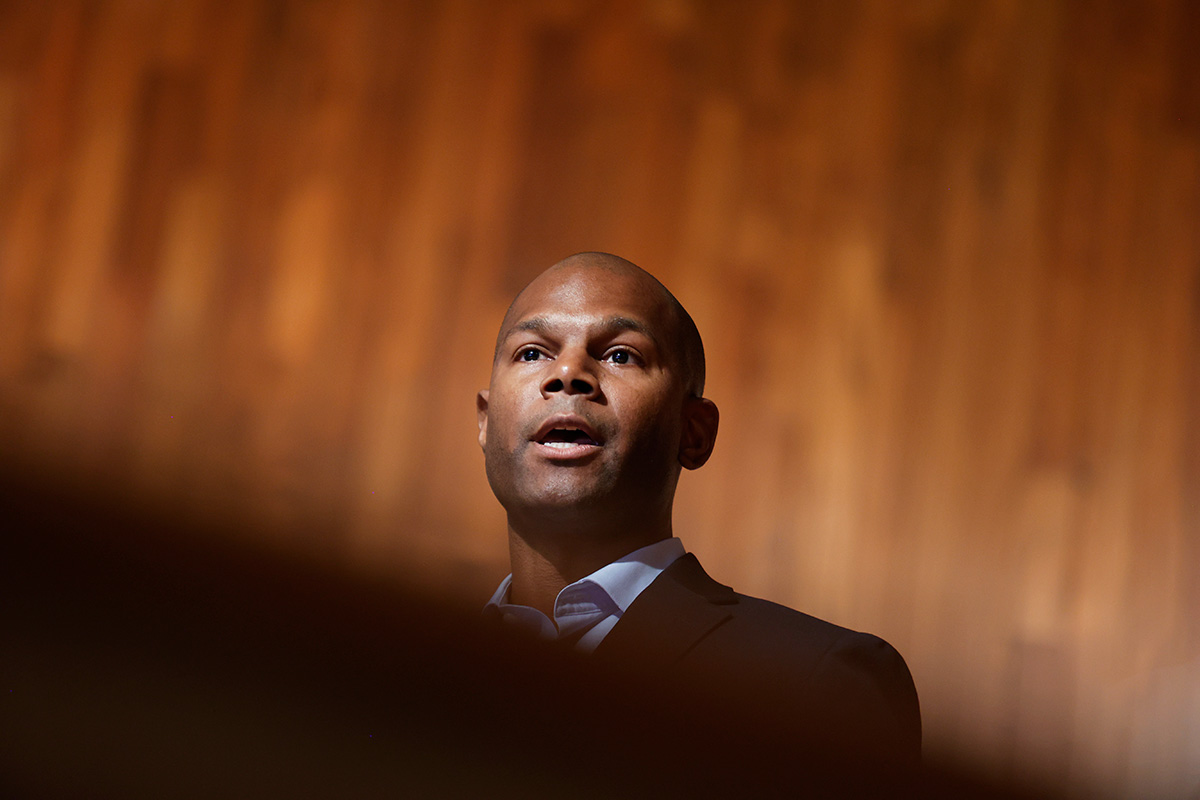
With his latest book, Say the Right Thing: How to Talk About Identity, Diversity and Justice, Kenji Yoshino ’87 aims to give readers the tools they need to navigate these challenging yet crucial conversations. A professor of constitutional law at New York University School of Law, Yoshino is also the faculty director of the school’s Meltzer Center for Diversity, Inclusion, and Belonging. He co-wrote the book with the center’s executive director, David Glasgow.

“We kept hearing from people who wanted to do the right thing but were terrified of getting the words wrong,” Yoshino says. “They feared they would either hurt somebody they cared about, or alternatively just get canceled themselves. That kind of overwhelming fear would stymie them as allies.”

Using real-world examples drawn from the authors’ own experiences and those of their colleagues and friends, as well as from TV appearances, social media posts and other public examples of noninclusive behavior, Say the Right Thing outlines a set of actionable principles that help readers meaningfully engage in difficult conversations. Beginning with how to avoid common conversational traps such as falling silent, deflecting blame or going on the attack, the book moves on to cover topics such as how to take a learning posture when it comes to identity conversations, how to disagree respectfully and how to apologize authentically.

As a gay Asian American man, Yoshino admits to drawing on deep personal experience for the book, including past conversations in which he came out to his loved ones. “We all remember those conversations we’ve had on these core issues of identity that have either gone really well or really poorly,” he says.

He also freely acknowledges how it feels to be on the other side of a difficult conversation about identity, in which he was the one who stumbled. “I have misgendered individuals who are trans, I have confused people of the same ethnic background for each other — everything that you have ever heard of, I have done myself,” Yoshino says. “It’s not a question of whether, it’s a question of when you’ll mess up in one of these identity conversations … and part of [the book] is to ask whether we can set aside this notion of canceling each other with the empathy that comes from the fact that someday this is going to be you.”

Unlike his previous books, which include Speak Now: Marriage Equality on Trial (2015) and A Thousand Times More Fair: What Shakespeare’s Plays Teach Us About Justice (2011), Yoshino emphasizes that Say the Right Thing is not based on a high intellectual concept. “This book is like a screwdriver,” he says. “It’s meant to be super practical, so people feel like they have the tools to have these conversations, and some safeguards on how badly they can go awry.”

In addition to his books and contributions to major academic journals, Yoshino also writes for popular media outlets such as the Los Angeles Times, The New York Times and The Washington Post. Writing has been a constant in his life since his years at Exeter, where he gravitated to the religion department, taking one class after another. “I learned how to write and how to love writing and reading at Exeter,” says Yoshino, who particularly remembers a class he took senior year with English Instructor Charles L. Terry. “I knew even then that he had mentored many great writers in the past, and he was willing to give students that kind of individualized attention.”

Yoshino also gained a guiding principle from one of Exeter’s core values, the need to combine knowledge with goodness. “I’ve always tried to think about how to bring whatever intellectual gifts I have to bear in the service of some moral end,” he says.

After majoring in English at Harvard, Yoshino studied at Oxford on a Rhodes Scholarship and earned his law degree from Yale Law School, where he specialized in civil rights. He was debating his future career path even as the Supreme Court handed down the first in a series of key decisions affirming LGBT rights in Romer v. Evans (1996). “I was writing up a storm and trying to decide whether to go into impact litigation for LGBT rights, or go into the academy,” he recalls. “I ultimately felt the academy would be a better pathway because I’m interested in writing about utopia as much as I am about litigating the real. That pathway was all about writing about LGBT rights and trying to bring the intellectual and the moral imperatives together — and I’ve never looked back.”

Yoshino returned to Yale Law as a professor, then moved to NYU a decade later. His current work with diversity and inclusion began as a result of his first book, Covering: The Hidden Assault on Our Civil RIghts (2006). It combined autobiographical anecdotes with an analysis of the continued discrimination faced by members of marginalized communities who refuse to “cover,” or play down aspects of their identity. “The reason that this form of discrimination has had such a robust life is in part because the law has very little to say about it,” Yoshino says. “I’m not sure the law can provide the solution because these interactions are so infinite and infinitesimal. We don’t want the courts to intervene and tell us what the core of anyone’s identity is.” Instead, the work must be done on the level of communities, organizations and ordinary people — people Yoshino hopes will benefit from the principles set out in his latest book.

Going forward, Yoshino plans to use Say the Right Thing as a text in his Leadership, Diversity, and Inclusion course at NYU Law. Gabriel Delabra ’13, who previously took the class with Yoshino, is co-teaching it. Now an associate at a law firm and an adjunct NYU Law professor, Delabra worked as a research assistant for Say the Right Thing and plans to clerk next year for United States Circuit Judge Guido Calabresi, a longtime Yale professor whom Yoshino also worked for years ago.

Although they only recently learned of their Exeter connection, Delabra recognizes in Yoshino the hallmarks of a good Harkness-style student — and teacher. “Kenji really takes his time with everything, not only in his social interactions, but in his written work,” Delabra says. “He takes everyone’s feedback very seriously and takes his time evaluating what I’ve contributed to the discussion. I think that’s kind of an Exeter contribution: Teachers were always very receptive to the ideas that students bring, and he has very much embraced that.”

Editor’s Note: This article first appeared in the winter 2023 issue of The Exeter Bulletin.

Exeter Deconstructed: The Red Bandits

Wanted: Exeter students. The noisier, the better. Must have school spirit and no aversion to face paint. Lots of red clothing is a plus. Kilts provided.

Exonians with the requisite qualities have been answering this call for decades, serving collectively as the accelerant on the Exeter-Andover fire in their role as Red Bandits. Each time the E/A games roll around, the Bandits rile the crowds and let all within earshot know that “WE ARE E-X-E-T-E-R!”

The Academy officially recognizes the Bandits today, and they are chosen by Student Activities from a pool of applicants. But their origins are less formalized and somewhat murky. A 1988 story about a pre-E/A assembly in The Exonian tells of “not-so-traditional cheerleaders showing their stuff.” Six years later, The Exonian reported “the idea of having Red Bandits started when a nonathletic, somewhat … angry group of guys got together for the purpose of adding more spirit to Exeter.”

Lack of school spirit is a time-honored lament at Exeter. Newspaper editorials dating to the 1890s bemoan a shortage of support for Exeter teams. “It should be unnecessary to again call attention to what is nothing more than a lack of school spirit,” the editors wrote in 1895.

Last fall, with the advent of a pep band and a student fan section called The Big Red Zone, many Exeter varsity teams enjoyed vocal support. And when E/A arrived in November, the Red Bandits were in Andover, the noisiest of them all.

Editor’s note: The article first appeared in the winter 2023 issue of The Exeter Bulletin.

Finis Origine Pendet: Noah's Wife

The dreams came often. When they arrived, spilling over with tangled instructions, Noah held his tape recorder to my mouth and so I woke to the smell of plastic, the heat emanating from his palm, as if he could capture what I saw: bees in hexagonal formation; tidal waves and corpses withering; sapling trees sped up into big oaks; red coral and water on fire.

“These are important, wife,” Noah would say, jotting notes into his big black notebook, charting numbers and lines. He took my temperature, my blood pressure, dilated my eyes. Each morning I woke not to sunlight across my face but his hands hovering near me, as if to pull the word-songs from my speech and hold them tight. He scrawled them down and posted what he discovered on his online forums, the ones making plans for the world ending.

“I think He’s speaking to you,” Noah said, those first mornings when I woke up fumbling with the covers, spilling my glass of water, startled by my own voice as if it was pulled from me.

I preferred not to think of source. There was my nightstand table, the same as ever. Bottle of melatonin. Stacks of paperback books I never read. A layer of dust. A photo of Noah and I, his arms around me at Coney Island. Behind us, bright blue sea.

The night he came home reeking of beer, with lipstick stains slashed across his neck, I decided my sleeplessness. Not sex he wanted but the blurred outlines and instructions, the cubit measurements and Latin names.

“Do we bring the elephants,” he kept asking, but I would not dream an answer. I paced the house, kept the kitchen lights on, opened and closed the fridge door. I poured glasses of milk and spilled them into the sink.

“Please sleep,” Noah begged, though he still had not wiped the lipstick stains off his neck. Noah, who did not or could not remember his dreams, who rocked and prayed for signs and symbols, and got nothing. He tried blue lotus tea and charms under his pillows, drank poppy seed tinctures, saw mediums and oracles — women in Queens with big blond hair who snapped their gum. They said, “Listen, honey, you’ve got to let go, the dreams don’t come to those who cling.” Under their breath, to me, they said, “Let me know if he gives you trouble. I’ve got something for that.”

All I knew about the dreams is that I liked being inside of them. I did not need to know their source. Just that I felt gathered instead of fragmented, watching deers running through forests, dipping my dream hands into humming rivers, even watching the forests burn.

When the dreams showed the destruction, the chaos and the cataclysms, I liked that, too. There was always a small crack in the pain — light pouring through, as if to scoop me up and say, “Even during this, you’ll be safe.”

In my dreams, Noah was nowhere to be found.

Raisa Tolchinsky is the 2022-23 George Bennett Fellow writer-in-residence. This piece is excerpted from the manuscript she is working on this year, about the unnamed women of the Bible.

Editor’s note: This article first appeared in the winter 2023 issue of The Exeter Bulletin.

Big Red track rips up record book

Exeter boys track and field enjoyed a record-setting weekend at the Boston University John Thomas Terrier Invitational. Five school records were shattered as Big Red firmly took its share of the national spotlight.

Oliver Brandes ’23 kicked off the excitement with a school-record time of 1:53.65 in the 800 meters, good enough for the fifth-fastest time in the country. This was the second straight week of strong performances for Brandes, as he qualified for nationals in the 400 and the mile last weekend.

Jaylen Bennett ’25 followed Brandes by setting a pair of school records. Bennett cruised in the 400-meter run with a time of 48.26, the fastest time by an Exonian in indoor or outdoor track, while claiming the fastest time by any 10th grader in the country and seventh-best time overall this season. He followed up his performance in the 400 meters with a record-setting performance in the 200, crossing the finish in 22.05. That was good enough to be the second-fastest by a 10th grader in the nation this year. Bennett’s performance comes a week after crushing the school record in the 300 meters with a time of 35.58.

Byron Grevious ’24 joined the party in the 3,000, breaking his own school record with a time of 8:15.10, the fastest time amongst 11th graders and the second-best time in the country this year. Grevious, who proved to be one of the best high school runners in the country following an outstanding cross country season, has qualified for nationals in the mile and 5,000 meters.

On Sunday, Brandes (1,200 meters), Bennett (400), Max Lacombe ’24 (800) and Grevious teamed up for the men’s distance medley relay, posting a school record and the fastest time in the nation this year with a blistering time of 10:05.35.

Big Red will be back in the William Boyce Thompson Fieldhouse this coming Saturday at 1 p.m.

A message of gratitude

As we begin the new year, it seems a good moment to reflect on some highlights from our fall term. This year we welcomed the first wave of new Exonians admitted under the school’s need-blind admissions policy announced last November. In all, 341 new students sat in the gymnasium for Opening Assembly, which began with a procession of students bearing the flags of the 37 countries of origin represented among our student body. In my remarks that day, I told students what I tell them every year: You can do the work. You will make lifelong friends. Absolutely, you belong here.

This fall, we also saw the opening of New Hall, which provides a home for 60 girls and five faculty families as well as a new academic space for our Health and Human Development Department. The dorm has brought a new liveliness to its corner of campus, and I am especially appreciative of the flexibility the building gives us to renovate other residence halls, starting with Merrill and Langdell and the construction of a new dining center on the site of Wetherell, which will begin this spring. 

At The Goel Center for Theater and Dance, we saw a stunning fall dance performance, “Moments In Time,” featuring original choreography from our students and faculty, and a thought-provoking interactive theater production of “Everybody” by Branden Jacobs-Jenkins. Audiences filled the Forrestal-Bowld Music Center for the start of our 2022–23 concert series, including performances by the Concert Choir and Symphony Orchestra and our fall student soloist concert.

We headed to Andover for E/A Weekend, where the predicted rain held off long enough for a trio of decisive wins by our boys soccer, girls volleyball and football teams, valiant efforts by all of our athletes, and an impressive display of Big Red spirit by our students and all Exeter fans, led by our new Pep Band and the irrepressible Red Bandits. Girls volleyball capped off a perfect 14-0 regular season, while boys cross-country captured a third straight Division I title. 

Being able to welcome visitors to our campus in ways we could not do a year ago added excitement to the fall term. We heard words of inspiration from distinguished alumni on the Assembly Hall stage, including Veronica Juarez ’00, Tomi Suchan ’08, Lt. Cmdr. Jean-Paul Christophe ’00 and Dr. Sasha Kramer ’94, winner of this year’s John and Elizabeth Phillips Award, along with other visiting speakers. Over Exeter Leadership Weekend in September, we welcomed trustees, members of the General Alumni Association and alumni and parent volunteers, all of whom relished the chance to meet in person for the first time in three years, including a Friday night dinner with the senior class. We also had a terrific Family Weekend in October, during which families were thrilled to be able to attend classes with their children again.

These are just a few highlights from the fall term. During the Opening Assembly, I proposed starting the academic year in a spirit of deep appreciation and gratitude for the opportunities and privileges we all enjoy as part of the Exeter community. In that same spirit, I want to say how grateful I am for the support of the alumni, parents and other friends of the Academy who help make it all possible. Thank you.  

Editor’s note: This column first appeared in the winter 2023 issue of The Exeter Bulletin.

Scholarly Endeavors

What is the fellowship program?

Established in 2013, the program provides advanced doctoral students who might not otherwise consider careers in a residential secondary school the opportunity to gain experience in such a community while working on the completion stage of their dissertations.

Who are the 2022-23 fellows?

Dominique Branson is a Ph.D. linguistics student concentrating in sociolinguistics at the University of Pittsburgh. Her dissertation topic, “Sounding Guilty: Criminalization and Black Racialized Speech,” investigates whether speakers who are assessed as “sounding Black” are also criminalized. “In my linguistics courses, I learned about the many ways that African American English (AAE) differs from standardized American English, or what we usually call ‘proper English,’” Branson says. “Since then, I’ve wanted to know whether Black Americans who speak AAE experience negative outcomes in our criminal legal system because of how listeners hear their speech.”

Maya Singhal is a doctoral candidate in anthropology at Harvard University. Singhal teaches courses on anthropological research at Harvard and a writing course on business and labor in fiction and film at New York University. Singhal’s dissertation is a historical and ethnographic study of African American and Chinese American collaborations, solidarities and mutual aid in New York City from about the 1960s to the present. Singhal says, “I’m interested in how criminal and criminalized activities work as sites for a variety of pragmatic collaborations, from the African and Chinese counterfeit designer goods sellers in Chinatown to extralegal community defense patrols working to prevent anti-Asian violence.”

How do the fellows benefit the community?

The fellows teach online seminars and connect on campus with departments and students interested in their fields. They also make themselves available in an informal way to students interested in and student organizations related to their fields.

What do the fellows hope to accomplish?

Branson: “I hope to learn how I can better make my research relevant to youth. …I would also like to know what connections students see between language and justice and how they can use their voices to promote justice. I’m excited to work with diverse students and learn from their perspectives at Phillips Exeter Academy!”

Singhal: “I’m excited to see the really urgent political and social movements we’re faced with, especially since the pandemic, through students’ eyes. It strikes me that a lot of students see their generation as the ones who need to save the world, and I’m excited to think about the histories of social movements and our political issues in the present with people who feel this kind of urgency.”

Editor’s note: This article first appeared in the winter 2023 issue of The Exeter Bulletin.

A lesson in non sibi

Lt. Cmdr. Jean-Paul Christophe ’00 stands on the Assembly Hall stage, recounting his journey since Exeter. He tells of his philosophy classes at Yale University, then his decision to apply to Officer Candidate School; of his inaugural march across a parade deck as a commissioned naval officer and his first pilot training flight over the Oklahoma plains.

His story reaches the coast of Somalia and the cockpit of a Navy Seahawk helicopter hovering 5 feet above the Indian Ocean. Below bobs a tiny lifeboat full of pirates holding the merchant mariner Capt. Richard Phillips at gunpoint.

“Turbines and the rotors screaming, saltwater spray kicking up all around the aircraft,” Christophe says. “It’s like your own little personal hurricane.”

The crowded Assembly Hall is still.

“That lifeboat was making a run for the Somali coast for the territorial waters, and we were doing everything we could to stop it,” he adds. “We were flying so low that I was nearly at eye level with pirates, and I saw out of the corner of my eye them looking right back at me from behind an AK-47.”

Exonians don’t often share such harrowing tales, but Christophe is far from the only member of the Exeter community to serve in the military. To honor those veterans and all who serve, the Academy plays host to Exeter Salutes. Now in its fourth year, Exeter Salutes features a speaker and other events to celebrate those who exemplify the spirit of non sibi through their service and to raise awareness of the effect their service and sacrifice has on our community and beyond.

Christophe’s Navy career has included two dozen postings, from the Arizona desert to the Persian Gulf. Along with his training as a helicopter pilot, he has served in Navy Intelligence. He assumed his current duties as the joint staff deputy director for analysis and warning at the Pentagon in 2020.

He opened his assembly address in November with a disclaimer: “I am here in my personal capacity. … I am here as one of you, as an Exonian. I’m not a recruiter, I’m not a cheerleader. I didn’t even put on my uniform because I didn’t want you to see it. I wanted you to see yourselves.”

> Watch Lt. Cmdr. Christophe’s assembly address

He tried to convey to his student audience why he chose his path and why the concept of non sibi he was taught at Exeter laid the foundation for his views on rights, responsibilities and duty. “Rights are what everybody else owes to you,” he said. “Responsibilities are what you owe to everyone else. You can’t have the first without the second. When people act collectively out of a sense of responsibility and duty to one another, that’s when rights are preserved.”

Christophe closed his remarks by relating the ultimate sacrifice of his service to the lessons his audience encounters daily at Exeter: “It seems to me there’s no greater way to show one’s dedication to anything or anybody than to give blood for it; to give that which supports one’s very life. There is no more potent display of love or any higher sacrifice that a mortal can make.

“In other words, non sibi.”

More than 700 current Exeter alumni, faculty and staff have served or are serving in the U.S. armed forces. Scores more have died in combat or in active service to the country. Please add your military status to Exeter’s official record at www.exonians.exeter.edu/veterans.

Editor’s note: This article first appeared in the winter 2023 issue of The Exeter Bulletin.

Advanced artistry

'Create a new direction': Exeter honors MLK

Exeter students, faculty and staff commemorated Martin Luther King Jr. Day on Monday, the Academy’s annual celebration of the life of the civil rights leader and his enduring message of social progress.

The tribute began with a keynote address by Anthony Davis ’69, a Pulitzer Prize-winning composer of the opera The Central Park Five, and his brother Christopher Davis ’71, a social researcher and educational reformer who worked with Anthony to create the opera X: The Life and Times of Malcolm X.

Principal Bill Rawson ’71; P’08 preceded the Davises to a stage in Love Gymnasium and challenged Exeter to learn something new about King and form a better understanding of his life and legacy.

“I turned 15 the day after Martin Luther King was assassinated,” Rawson told the students. “His words are as powerful and relevant to me today as when they were first spoken more than a half-century ago.

“I urge you to slow down over the next several hours and open your minds and hearts to the words and life of the Rev. Martin Luther King Jr. And together, as a community of students and adults, reflect on the meaning, relevance and importance of his life and legacy to your lives today.”

Exeter’s commemoration, in its 33rd year, included small discussion groups and interactive workshops under the direction of the MLK Committee.

Speaking to the time

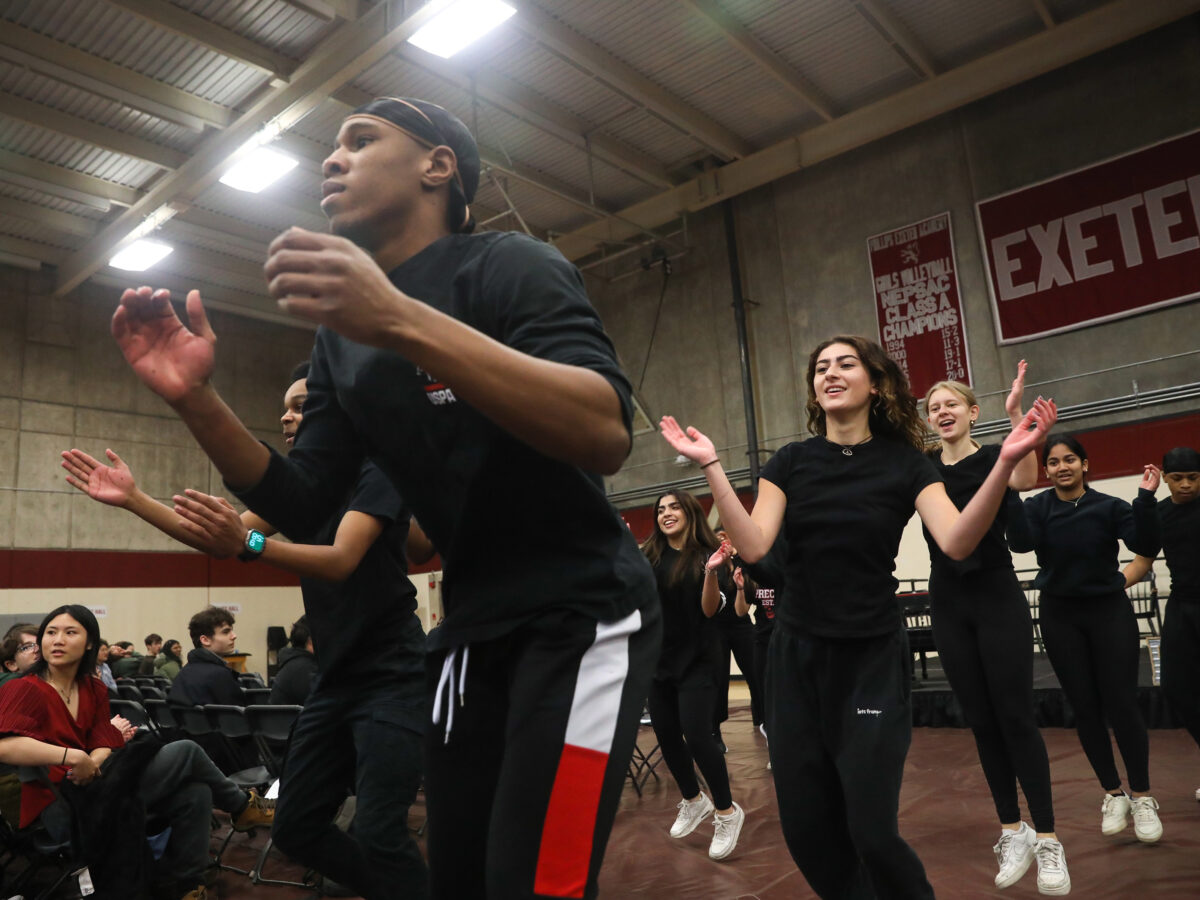
Following a performance by student dance groups Precision and Outkast and a rendition of “Lift Every Voice and Sing,” commonly known as the Black national anthem, by Exeter’s Concert Choir, the Davises delivered a joint keynote. The brothers spoke of their experiences as young Black men at Exeter during the turbulent years spanning 1967 to 1971. From an early age, Anthony Davis channeled his political sensibility into his creative work, starting with a desire to upend the traditional white Western canon of classical music.

“I wanted to find out what my music was, what my music could be in response to the civil rights struggle of the ’60s,” he said. Later, he remembered thinking: “If someone could combine and bring a fusion of the African diaspora and jazz and improvisation with this formal structure of European opera, one could create a completely new form — a dynamic form that would speak to our time.”

The brothers also spoke of their efforts to tell stories through opera, and to re-cast operatic works with Black musicians and performers who were often missing or marginalized in the traditional opera world.

While reading The Autobiography of Malcolm X in college, Christopher recalled, it struck him that “there was a parallel in his evolution from Malcolm Little to Malcolm X to el-Hajj Malik el-Shabazz, to the development of Black music, and jazz in particular, in the ’60s.” He served as a storywriter for X: The Life and Times of Malcolm X, Anthony Davis’ first major opera, which had its world premiere in 1986 at the New York City Opera. Their cousin Thulani Davis, a poet and playwright, wrote the libretto. In November, a revised version of the opera will premiere at the Metropolitan Opera, becoming only the second opera by a Black composer in the Met’s history.

“There’s a whole generation of singers that have heard about this piece, but have never actually heard it or seen it,” Christopher Davis said, after playing an excerpt from a recent recording of X, which has been nominated for a Grammy Award. “When Anthony wrote The Central Park Five, and he won the Pulitzer, and George Floyd was murdered on the streets of Minneapolis, doors that had been closed for over 30 years for this piece reopened.”

Near the end of the keynote, Anthony Davis offered a challenge for current Exeter students in the audience, inspired by his own career breaking barriers in music as well as King’s inimitable legacy.

“I hope you all think about … how you can change the narrative, change the story, [and] make your own path to create a new direction,” he said. “I think that’s what Martin Luther King envisioned for us — that we could have this potential to transform the world through our art, through our actions, through our activism.”

Making change

The MLK Committee’s robust program included workshops like “Looking Toward Paradise: How Do We Get There?,” a discussion on nonviolent protest in the face of white supremacy shepherded by Kelvin Green ’17; and “Writing for Justice: Spoken Word and the Movement,” led by English Instructor Willie Perdomo.

At “The Racial Wealth Gap and Its Impact on Education,” visiting speaker Stephanie Harvey explained to two dozen students on the top floor of the Class of 1945 Library about how systemic and generational disparities in wealth among white and people of color perpetuate inequality.

“So much of this disparity stems from the era of slavery,” said Harvey, a Ph.D candidate at the University of New Hampshire. “I know a lot of people are tired of hearing that … but we have to start there if we want to have an honest discussion.”

Four floors below Harvey, English Instructor Ellee Dean ’01 and Science Instructor Fran Johnson ’82 spoke to students in the workshop “Making Change at Exeter,” using as an example the successful effort to create all-gender housing at the Academy.

Dean acknowledged that inertia prevents change in most places. She said an important moment for her in the all-gender dorm movement came when she stopped “expecting people at the top to do something for me.” She recalled working closely with former colleague Alex Myers ’96 in writing the case statements that eventually were used to turn Kirtland and Williams houses into all-gender housing. “I didn’t have to wait for someone else to do the work.”

The workshop asked students how they may have contributed to promoting change. Advay Nomula ’24 spoke about his ongoing effort to expand the name of Phillips Church to Phillips Church and Multifaith Center to better reflect how the building serves the campus community. “It’s not enough just to call it a church,” Nomula said.

The day student from Dover said he was thrilled to hear Principal Rawson refer to the Multifaith Center in his opening remarks Monday.

“That’s progress,” he said with a smile.

Despair to dedication

Martin Luther King Jr. was assassinated on the evening of April 4, 1968, outside of room 306 of the Lorraine Motel in Memphis, Tennessee. In that moment, the inn on Mulberry Street instantly became connected with one of the most consequential and tragic moments of the civil rights movement. Years later, Memphis-born attorney D’Army Bailey, had a vision to preserve the site, not as a landmark for grief, but as the hub to carry forward MLK’s message.

Monday at Exeter, Bailey’s son Justin shared with students in the Elizabeth Phillips Academy Center Forum, how his late father established National Civil Rights Museum on the exact spot of King’s killing. “My dad thought that the movement shouldn’t die with Dr. King at that site,” he said. “He felt that it was hallowed ground and carried too much significance to just wither away. He envisioned a future of activism from that site.”

The elder Bailey purchased the Lorraine Motel in 1981 and a decade later the museum opened. Since then, millions of visitors, including around 90,000 students annually, have passed through the museum’s rotating exhibits and immersive experiences dedicated to the civil rights movement.

Among the dozens in attendance for Bailey’s talk was Jenny Drevitch ’23. “I took away the fact there was a positive that came out of Martin Luther King’s death and it’s something that continues to benefit the community,” she said.

Fall team awards and NEPSAC honorees announced

The Exeter Athletics department is excited to announce individual team-award winners and those student-athletes who have been honored by the New England Preparatory School Athletic Council (NEPSAC) for their contributions during the fall season.

These student-athletes were impact players on their teams throughout the season. They are highly skilled athletes, dedicated leaders, and have proven to be among the best in New England. Below is the list of Exeter team awards and All-NEPSAC honorees.


Boys Cross Country

Most Valuable Member:
Byron Grevious ‘24

All-NEPSAC:
Byron Grevious (Division I champion)
Max Lacombe ‘24
Oliver Brandes ‘23
Mateo Bango ‘23
Jack Hutchins ‘24
Pearce Covert ‘25

Honorable Mention All-NEPSAC
David Goodall ‘24


Girls Cross Country

Most Valuable Member:
Tenley Nelson ‘24

All-NEPSAC:
Tenley Nelson ‘24
Daria Ivanova ‘24
Annika Finelli ‘24

Honorable Mention All-NEPSAC
Kayla Hyett ‘25
Sophie Zhu ‘26
Sophia Green ‘23


Field Hockey

Kathy N. Nekton Field Hockey Trophy, Most Valuable Member: 
Grace Puchalski ‘23

All-NEPSAC:
Grace Puchalski ‘23

Honorable Mention All-NEPSAC
Eden Welch ‘23


Football

Robert C. Mason Football Trophy, Most Valuable Player:
Xaviah Bascon ‘23

All-NEPSAC
Xaviah Bascon ‘23
Brandon Wong ‘23

Honorable Mention All-NEPSAC
Chris Gill ‘23
Tommy Dunn ‘23


Boys Soccer

Ransom Hooker Soccer Trophy, Most Valuable Player: 
Atticus Ross ‘23

Austin Family Leadership Award. Awarded annually to the player(s) on the boys varsity soccer team, who has demonstrated leadership and selfless play throughout the season:
Cameron Guthrie ‘23
Atticus Ross ‘23

All-NEPSAC
Atticus Ross ‘23
Griffin MacGillivray ‘23

All-NEPSAC Honorable Mention
Clark Pearson ‘23
Cameron Guthrie ‘23


Girls Soccer
Most Valuable Members: 
Ryan Pate ‘23
Samantha Smith ‘23

Austin Family Leadership Award. Awarded annually to the player on the girls varsity soccer team, who has demonstrated leadership and selfless play throughout the season:
Ryan Pate ‘23


Girls Volleyball
Ashley Birkholm Chase ’95 Volleyball Most Valuable Player Award, awarded annually to that player who embodies leadership, team spirit, and excellence in performance:
Sofia Morais ‘23

Tei F. Carpenter ’01 Volleyball Award. Awarded to the girl with at least three years’ experience in the volleyball program and who has contributed to the success and advancement of volleyball at Phillips Exeter Academy:
Jacqueline Wood ‘23

All-NEPSAC:
Sofia Morais ‘23

All-NEPSAC Honorable Mention:
Coco Barton ‘23


Water Polo
Daniel E. Fowler Memorial Award, Most Valuable Team Member: 
James Faulhaber ‘26

All-NEPSAC
James Faulhaber ‘26
Patrick McCann ‘23

Honorable Mention All-NEPSAC
Nate Puchalski ‘23
Charlie Gao ‘23