

Phillips Exeter Academy

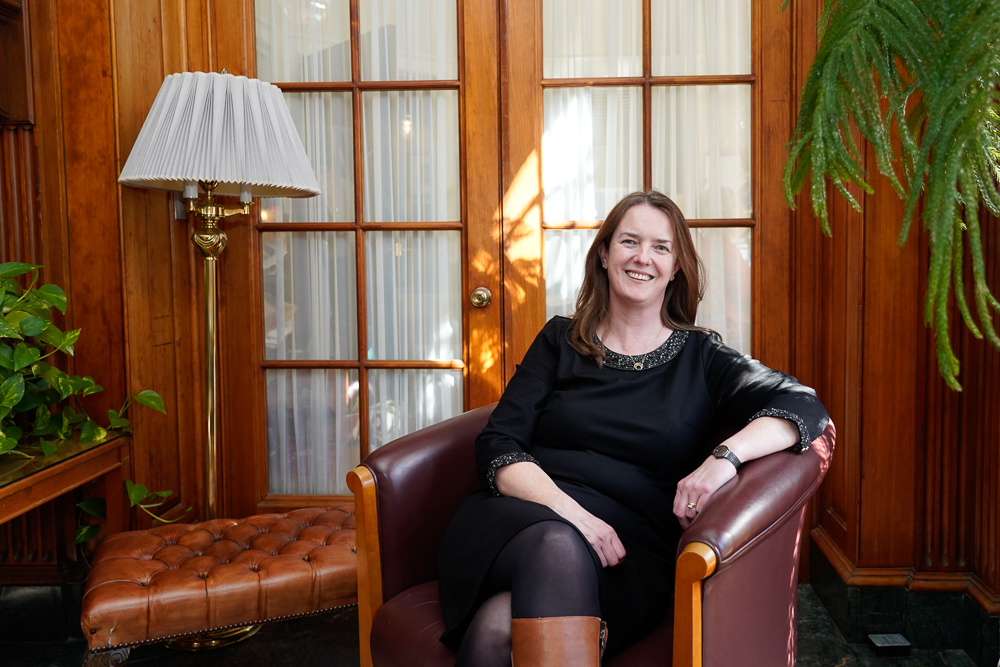
A conversation with Dean of Faculty Eimer Page

Music has been an integral part of Eimer Page’s life since she was a child in Northern Ireland, when she traveled the country playing the viola in youth music ensembles. At the time, the country’s vibrant social music program was the rare space where young people of different religious backgrounds were allowed to interact, and Page got to know her future husband and many of her close friends by playing together. “It absolutely changed the course of my life,” she says of the experience.

Page had another life-changing moment in 2004, when she interviewed for a job teaching English at Exeter and saw the Harkness method in action for the first time. Since earning her doctorate in post-colonial literature from Trinity College Dublin, she had been teaching for four years at a school in England, but was immediately struck by the difference.

“The freedom that both students and adults had to follow the lines of inquiry wherever they chose to take them was just shocking to me,” Page says. “It fit my style as a teacher, but it wasn’t something I had ever seen elsewhere.”

Now a veteran instructor in the English Department, Page also served as Exeter’s first director of Global Initiatives, overseeing the growth of the program over the past decade to its current slate of 31 program destinations in 11 countries around the world. In 2022, Page was named dean of faculty. We caught up with her for a conversation during her first term in her new role.

What do you see as the most important parts of your role as dean of faculty?

I think the most important part of my role is just being there for the faculty. Being aware of how they are being impacted by whatever’s going on, whether it’s a global pandemic, changes to our policies and procedures, or the things that might happen in the life of a faculty member when they’re here with us over decades. Being the person who is able to help someone…if they need a leave or FMLA, and also being there to support and champion them at times when they’ve done something that we should be letting the whole community know about and giving them the honors that they are due.

What are some of your goals and/or focuses, short and long term?

The thing that I’m really trying to work on this year is a sense of belonging and community, after the difficulties and challenges of separation, isolation, and the need to be distant. Figuring out how we come back to be together and trust one another and work together is really important to me this year.

How does the faculty mentorship program help cultivate that sense of belonging?

Each new teaching faculty member is assigned a mentor, and the official relationship is a two-year relationship. Having that mentor assigned as you come means you’ve got a point person you can go to, and they also are involved and informed in the welcome. The first year is very much a supportive relationship where the mentor is visiting the mentees classes very frequently. They’re meeting weekly, talking about the rhythms of the school year, and everything to do with the departmental work. It’s a lot about explaining what we’re doing here, providing resources, and then also possibly being an advocate as needed, if a new colleague is having difficulty figuring out where to go with an issue either in or outside the classroom.

In the second year [the mentors] step back slightly. There’s not quite the same level of expectation for meetings or visits, but it’s still a very strong resource and there are still class visits built into the mentorship program. I think for many of us that relationship lasts long beyond the official two-year program.

Could you talk about the importance of equity and inclusion when it comes to the faculty community?

We have to figure out ways to allow people to really and truly feel that they are seen and valued here, and that we are supporting their specific needs. We also need to make sure that we are truly representing our student body and our faculty. When you have a small number of, say, faculty members of color or faculty members of a particular sexual orientation or whatever, an additional burden falls on those faculty, because students will understandably seek them out and want to talk to them. We need to make sure that the workload is evenly distributed, that it is not falling disproportionately on the shoulders of some of our colleagues and not others.

I’d say this is among the most fundamental work of the dean of faculty. It’s one of the reasons why [Director of Equity and Inclusion] Stephanie Bramlett and I do our hiring interviews together, because that gives a message to our colleagues as they come into this community that this is something that we truly value. We have our school commitments to being an anti-racist institution, and we want to make sure that that’s really at the heart of what we’re doing when we’re hiring and retaining faculty.

You were a longtime dorm head in Dunbar Hall, but you’re not living in the dorm and you’re not teaching any classes right now. How have you maintained connections with students?

I’ve been affiliated with Dunbar since year two here, so I have a lot of knowledge of that dorm’s history. My children [Oscair ’22 and Cormac] grew up in the dorms. We moved out after year 10, so my younger son didn’t live in the dorm all that long, but that’s still their early childhood. That’s what they remember. The thing that for me truly distinguishes working in a boarding school is the residential piece — actually living among the students.

Our interview is happening as I’m just coming off advising time, where I was with my advisees. I think both the fact that I meet them over in the English Department and the fact that they are young people with their own concerns and things going on — it really does help to ground me to still have those interactions with advisees in the dorm community. I miss and will continue to miss the teaching. I love teaching and look forward to a time when I perhaps might be able to roll that back in.

Athletics celebrates college commitments for class of 2023

Exeter Athletics celebrated the first wave of college commitments for the class of 2023 this week, honoring 28 seniors who have received a National Letter of Intent, Likely Letter, or early admittance to their play their respective sports at the collegiate level. The Athletics Department will hold another ceremony as more student’s make official decisions.

“This was a great night to celebrate and honor what has taken years of dedicated training and hard work by our students to reach their ultimate goal of playing their sport at the NCAA level,” Director of Athletics Jason Baseden said. “It was great to see students supporting their classmates with their family, friends and coaches in the crowd. We look forward to celebrating the rest of the senior class later this year.”


The 28 students celebrated this past week will go on to compete at programs in some of the top conferences in the nation, including the Pac-12, Ivy League, ACC and NESCAC. The full list of students is listed below. Click here to watch the ceremony on-demand.

Rollie

Castineyra

Boys Basketball

University of Massachusetts

Michael

Loughnane

Boys Basketball

Davidson College

Weiyi

Huang

Boys Crew

Cornell University

Nico

Berger

Boys Lacrosse

Amherst College

Drew

McClutchy

Boys Lacrosse

Bates College

Ryan

Nagle

Boys Lacrosse

Williams College

Casey

Realini

Boys Lacrosse

Fairfield University

Atticus

Ross

Boys Soccer

Williams College

Henry

Liu

Boys Swimming

Amherst College

Grace

Puchalski

Field Hockey

Amherst College

Uber

Ajongo

Football

Wake Forest University

Dylan

Almeyda

Football

Harvard University

Xaviah

Bascon

Football

Harvard University

Joshua

Johnson

Football

Dartmouth College

Aaron

Morris

Football

Stanford University

Delaney

Miller

Girls Crew

Skidmore College

Kate

Nixon

Girls Crew

University of California at Berkeley

Izzie

Riccardi

Girls Crew

Cornell University

Lassiter

Foregger

Girls Cross Country

Babson College

Shauna

Vadeboncoer

Girls Hockey

Brown University

Samantha

Smith

Girls Lacrosse

Wesleyan University

Eden

Welch

Girls Lacrosse

University of Pennsylvania

Ryan

Pate

Girls Soccer

U.S. Air Force Academy

Amy

Benson

Girls Swimming

Trinity University

Coco

Barton

Girls Volleyball

Colorado College

Morgan

Smith

Golf

Georgetown University

Nate

Puchalski

Wrestling

Johns Hopkins University


Assembly lineup a mix of art, analysis


A blend of artists and analysts will grace Exeter’s Assembly Hall stage during winter term as guest speakers.

Each term, the academy hosts a variety of voices and perspectives to share at all-school assembly. Past speakers have included Nobel laureates, Pulitzer winners and civil rights pioneers. Although this winter’s roster may not feature any one speaker as star-spangled as that, the list promises to engage, entertain and push students past their comfort zones. All Exeter assemblies can be viewed live or on-demand here.

Among this term’s assembly speakers are:

  • Adolphus G. Belk, Jr., a political analyst and professor of political science and African American studies at Winthrop University and a leading researcher of white nationalism in American government and politics. Jan. 13.
  • Safia Elhillo, a Sudanese-American poet known for her written and spoken poetry. She is currently a Wallace Stegner Fellow at Stanford University. Jan. 20.
  • Jane Holl Lute, an American diplomat and national security expert and a former deputy secretary of Homeland Security from 2009 through 2013. Jan. 27.
  • The Whiffenpoofs, Yale University’s famed all-male a cappella group, the world’s oldest. Jan. 31.

Exploration, service highlight fall-break trips

As the school year calendar turned from fall to winter term, dozens of students spent their Thanksgiving breaks scattered across the country for immersive experiences as part of Exeter’s Global Initiatives program. From Philadelphia to Maui, Phoenix and New Orleans, each location provided the perfect backdrop to explore a specific area of study and for hands-on-learning opportunities.

Students in Arizona spent time at a local refugee shelter as part of this community service-centric program. Supplementing the service work, students attended seminars about topics especially important in the region — immigration and sustainability. Highlights from the trip included a stop at the Heard Museum, “the world’s preeminent museum for the presentation, interpretation and advancement of American Indian art”; and a hike through the rugged dessert terrain. “The nature was different from anything else I have ever seen. We saw lots of different kinds of cacti, and other native and exotic plants that can only be found in Arizona,” said Laurie Chung ‘24.

In Philadelphia, the city with the highest incarceration rate of any large jurisdiction in the country, Exonians explored the structure and pitfalls of the American prison system. Throughout the week students learned about demographical disparities of the incarcerated and met with nonprofit organizations working to establish criminal justice and prison reform in Pennsylvania.

“It was inspiring to watch our students grapple with the idea of Justice in American,” said chaperone and Instructor in Physical Education Kerry McBrearty. “They were constantly confronted and in turmoil over two conflicting theories. One, the justice system is working as it is intended to work and needs advocates to in fact break the system and change it. Two, the justice system is broken and needs to be reformed.”

Student pose in Hawaii

Over 2,000 miles from the contiguous United States, eight students spent the week exploring the geography and biodiversity of the Hawaiian island of Maui. The group spent time hiking, snorkeling, visiting cultural sites and studying endangered plant and bird species.

“We all got to learn by talking with native Hawaiians who are fiercely proud of their heritage and wonderfully generous in sharing it with young people. The kindness and hospitality of Hawaiians of all races have made a deep and abiding impression on us,” said chaperone and Instructor in Science Townley Chisolm.

Synonymous with the American South and New Orleans, the roots of jazz and blues music can be traced back through past of slavery and segregation. Students traveled to the “Big Easy” to learn more about these alluring musical genres and their sordid pasts. Accompanied by Instructor in Music Marcus Rabb and Instructor in Modern Languages Diego Ardura, the students took in live performances and saw iconic sites like the National Civil Rights Museum.

5 questions for Lamont Poet A.E. Stallings

Volleyball advances, Boys Soccer falls in NEPSAC playoffs

The undefeated and top-seeded girls volleyball team passed their quarterfinal test with a 3-2 victory over eighth seeded Sacred Heart. With the win, Big Red will move on to the semifinal round and play host to fifth seeded Loomis Chaffee.

Big Red had to manufacture a comeback after dropping the opening set to Sacred Heart, 23-25. Exeter made quick work to even the match at 1-1 with a 25-15 victory in the second set, but Sacred Heart jumped back in front following a thrilling 24-26 third set win. Big Red dug deep and stayed alive with a 25-22 victory in the fourth to force a winner-take-all fifth set where they earned a 15-12 win to stay a perfect 15-0 on the year and advance to the semifinal round. Loomis advanced to the semifinal round following a 3-0 upset over fourth seeded Andover.

Exeter will host Loomis on Saturday at 3:00pm in Love Gym. The match will be streamed live at www.exeter.edu/exeterlive.  

Click here to view the full Class A Girls Volleyball bracket.

Boys soccer saw their successful season come to a close after dropping a 3-1 decision on the road at Milton on Wednesday afternoon. Milton jumped ahead 1-0 with a goal midway through the first half before Atticus Ross tied the match when he knocked in a bouncing ball through the keepers legs to score Exeter’s lone goal of the afternoon. The Mustangs would reclaim a one goal edge just 30 seconds before halftime before adding a third late in the second half. Big Red wraps their season with an 8-4-5 record.


Big Red rolls over rivals in E/A

Championship hardware and the color red swarming Andover; that is how the most anticipated sports weekend on the fall calendar unfolded Saturday.

Exeter cross country continued its run of dominance at the New England Interscholastic Championships, while another chapter in the historic rivalry between Exeter and Andover concluded with a trio of victories for Big Red.

The Exeter boys varsity cross country teams continued its unprecedented run by capturing a third consecutive Division I title — and sixth in the last 10 years — at Interschols at St. Paul’s. Exeter had the first four runners cross the line in a dominating performance. Byron Grevious ‘24 led the way with his second straight individual title with a course-record time of 15 minutes, 35 seconds. Max Lacombe ‘24 (16:30), Oliver Brandes ‘23 (16:33), and Mateo Bango ‘23 (16:36) followed for Big Red.

The boys JV cross country team extended its own dominant streak and captured its seventh straight JV championship. Owen Dudley ’23 (17:55) and Michael Zhu ’24 (17:50) placed second and third, respectively, while Big Red had six others finish inside the top 10.

The girls varsity cross country team also enjoyed a great day of success and placed second overall. Tenley Nelson ’24 claimed third place overall with a time of 19:36. Daria Ivanova ‘24 (20:02) placed sixth, while Annika Finelli ’24 (21:21) also earned All-New England status with a 16th place finish.

The girls JV program put together a top performance and earned its second straight JV championship. Hawley Dick ‘25 earned individual champion honors with a time of 22:14 while Emerson Seymour ‘26 (22:25), Tiffany Sun ’26 (22:28) and Leta Griffith ’24 (22:31) joined her in the top five.

In other Interschol action, boys varsity water polo earned a 14-11 victory over Williston in the opening round before falling to Greenwich Country Day, 13-9. Exeter will compete in the third-place match on Sunday morning.

Back in Andover, Big Red girls volleyball capped a perfect 14-0 regular season with a 3-1 (25-9, 25-14, 23-25, 25-22) victory over the Blue. Exeter jumped out to a quick 2-0 match lead before Andover earned a hard-fought third set. Exeter staved off a late Andover push in the fourth to cap the win with a 25-22 fourth-set victory. Sofia Morais ’23 and Coco Barton ’23 were solid for Big Red, who will await their postseason opponent for a Wednesday matchup.

On the pitch, it was the Blue who capitalized on their scoring chances by potting one in the first half and three in the second to take a 4-0 girls varsity soccer win. Bridgette Martin ’23 made several saves in goal for Big Red; Esme Shields ’24 was strong in the middle of the field.

Andover struck first in field hockey with a goal in the opening five minutes. Exeter would even the score at 1-1 when Eloise Goedkoop ’23 found the back of the net. Andover would take a 2-1 edge into halftime after capitalizing on a corner before adding a pair in the second half to earn a 4-1 win.

Big Red boys soccer scored the lone goal of the game in the first half when Thaniel Illuzzi ’23 headed in a beautiful cross from Jaylen Bennett ’25 to earn a 1-0 victory. Trevor Piltch ’23 was outstanding in goal, making several key stops including a diving stop with just three minutes to play.

Football capped E/A weekend in emphatic fashion, earning its second straight victory over the Blue by a score of 42-7 in the 138th meeting between the foes.

Andover held a 7-6 lead and was driving in the final minute of the first half before Tommy Dunn ’23 picked off a pass and ran it back to the 20 yard line. Big Red would take advantage of the field position and reclaim a lead they would never give back when Tristan Aboud ’23 scored on a quarterback keeper to give Exeter a 14-6 lead at the break.

The second half was all Exeter, as it scored 28 unanswered points. Running back Xaviah Bascon ’23 scored four touchdowns for Big Red, while Aboud ran for one and threw another to Dylan Almeyda ’23.

The victory capped a 7-1 season for Big Red, who closed the deficit in the all-time series against Andover to 55-73-10.

Artists share joy for discovery

Exeter artists and modern language learners alike were the beneficiaries of artists in residences in October when Japanese artists Takuya and Minami Yoshida visited campus.

The duo spent time with art students in visits to painting, drawing and ceramics classes as well as students studying Japanese language and culture.

Their appearance was sponsored by the Michael Clark Rockefeller Class of 1956 Visiting Artist Fund. The fund provides opportunities for Exeter art students to interact with significant, contemporary artists and create unique works of art in a master-class environment.

Takuya Yoshida, is a painter who uses expressionistic qualities and bright, inventive colors that are derived from the raw beauty of the natural world. He started studying art in New Hampshire at Plymouth State University and received a bachelor’s in fine arts, and then went on to graduate school at New York Studio School and received a master’s in painting.

Minami Yoshida is a sculptor. Her works celebrate the essence of models whom she knows and sculpts. Her figurative forms are abstracted by simplifying the details and textures. These abstractions tend to exude more humanistic and emotional qualities. She is heavily influenced by the Superflat Art Movement and artists such as Yoshimoto Nara and the ancient ceramics has been showing her artwork all around Japan since then. She received her undergraduate degree at Tokyo Zokei University in 2016.

Neuroscientist addresses assembly

Any process of transformation — from social change movements to new approaches in medicine — begins with agitation, neuroscience researcher Khalid Shah told students in the Assembly Hall on Friday. “If you want to bring a change, you need to be agitated in your mind, which will lead to the innovation,” Shah said. “That innovation will ultimately be the change.”

As the vice chair of research for the department of neurosurgery and director of The Center for Stem Cell and Translational Immunotherapy at Brigham and Women’s Hospital, Shah leads a team that is pioneering targeted, cell-based therapies for brain cancers. He is also a professor at Harvard Medical School.

Townley Chisholm, instructor in the Science Department, introduced Shah in assembly and welcomed him for a visit to his BIO510: Advanced Biology class earlier on Friday morning. “For over 10 years, [Dr. Shah] has invited groups of students from PEA to visit his lab in Boston and to talk with his researchers…who come from all over the world for the chance to work in his lab on paradigm-shifting ways to use the newest technologies to cure otherwise untreatable cancer.”

About seven or eight years ago, Shah explained in his assembly talk, he and his team began questioning the way doctors were treating glioblastoma, a lethal form of brain cancer. For the past 20 years, the treatment options have remained the same: Patients get surgery to remove the tumor, followed by chemotherapy, radiation or both.

“Although we’ve had a number of clinical trials with different drugs…nothing really has changed,” Shah said. He added that the blood-brain barrier, an additional layer of protective coating on the blood vessels in the brain, also make it more difficult for drugs used to treat cancer to get inside the brain to work effectively.

To challenge the status quo, Shah and his team looked to medical innovations from the past, notably the insights that led to the first safe vaccines to treat previously deadly diseases like smallpox in the 18th century. “It started with something really basic: that we use disease to kill disease,” Shah said.

By design, cancer cells leave the original tumor en masse and metastasize to other parts of the body. But they also tend to migrate back to the original tumor — a feature that is key to Shah’s team’s experimental therapy. Using the powerful gene-editing technology known as CRISPR (Clustered Regularly Interspaced Short Palindromic Repeats), they engineered repurposed cancer cells that seek out and attack cells in the original tumor.

“You make them therapy resistant and then you actually also put a kill switch in it, and it kills the original cell,” Shah said. He used images of vivid red and green cells resembling abstract paintings to illustrate the process on the Assembly Hall stage.

The treatment, known as therapeutic tumor cells (ThTCs) has so far been tested on mice, with positive results. “We see a huge survival benefit in animals, and hopefully in humans in coming years,” Shah said. He and his team have more recently been working on engineering the tumor cells to also include cells that spur an immune response, increasing their disease-fighting potential.  

“Once the tumor is gone, you’re vaccinated from further tumors to come — that’s the big picture,” Shah said near the end of his talk, adding that the gut microbiome also plays an important role in the effectiveness of immunotherapy in cancer treatment.

In addition to sharing the thought processes behind his pathbreaking work, Shah offered words of advice — and encouragement — to future scientists in the Assembly Hall audience. He emphasized the value of collaboration, both inside the lab and with scientists of different disciplines: “You need one or two good innovative ideas to make the difference, but…if you don’t have a structure, anything you bring in that is unique [is] not going to go that far.”

“In all of us, there is an innovator lying somewhere,” Shah concluded. “You just have to figure out which domain excites you the most.” 

Feeling at home

I remember well the day I moved into Dunbar Hall as a new lower in 1968, with not much more than a single duffel bag and a lacrosse stick in my hands. I had never lived away from home, so naturally I found myself wondering what the other students would be like and how I would fit in. My room was sparsely furnished, and my few possessions did not do much to fill it up, nor take long to unpack. Then I was on my own.

I could not have been happier. I was at Exeter. Friendships quickly formed, and with the support of the proctors and faculty who lived there, Dunbar soon became my home away from home. Sure, the seniors looked impossibly old to me, and I wasn’t ready to join the fierce four square battles that played out in front of the dorm each evening, but I found my friends among the other new lowers, and felt that I could not have been assigned to a better dorm. In fact, like most students, I was certain I was in the best dorm on campus.

Fast-forward 50-plus years, and I now have the privilege of doing dorm duty in Wentworth Hall, and the pleasure of seeing firsthand how the important work of faculty, proctors and student listeners continues to foster community today. The day student affiliate program extends this sense of dorm pride and belonging to non-boarders, integrating them into the school more completely, including as proctors in our dorms.

At Exeter, all four classes live together, and most students remain in the same dorm for their entire time at the Academy. Proctors and student listeners return to campus early each fall to be trained for their responsibilities, and the mentoring that occurs between older and younger students is important to the personal development of both. A strong sense of belonging for every student in the dorm is central to creating a strong sense of belonging to the school as a whole, and it is not surprising that our alumni typically identify first with their class year, and second with their dorm.

This fall, we celebrate the opening of the first new dorm on campus since 1969. It’s a multipurpose building that houses 60 students and five resident faculty, as well as an academic space with four Harkness classrooms and a department meeting room for our Health and Human Development Department. The building also frames a spacious lawn with two other dorms, creating an exciting new community space on campus.

To ensure the best possible residential experience for our students, and to attract and retain the finest faculty, it is essential that we continually renovate our dorms in line with the latest principles of accessibility and sustainable construction. Outfitted with geothermal heating and cooling, the new dorm is a testament to that commitment. It will be used to house students from Merrill and Langdell Halls as we embark on the renewal of those historic dorms and the construction of an expansive new dining complex on the site of Wetherell Dining Hall.

In the opening paragraph of our Deed of Gift, John and Elizabeth Phillips expressed their belief that “the time of youth is the important period.” Indeed, it is a time to learn about one’s self and develop a sense of purpose and identity, and to consider one’s place in the larger whole. Our residential programs are an essential component of this process at Exeter, and they are critical to our mission to unite goodness and knowledge and inspire youth from every quarter to lead purposeful lives.

Editor’s Note: This article first appeared in the fall 2022 issue of The Exeter Bulletin.