Spring break trip provides reflection and reverence
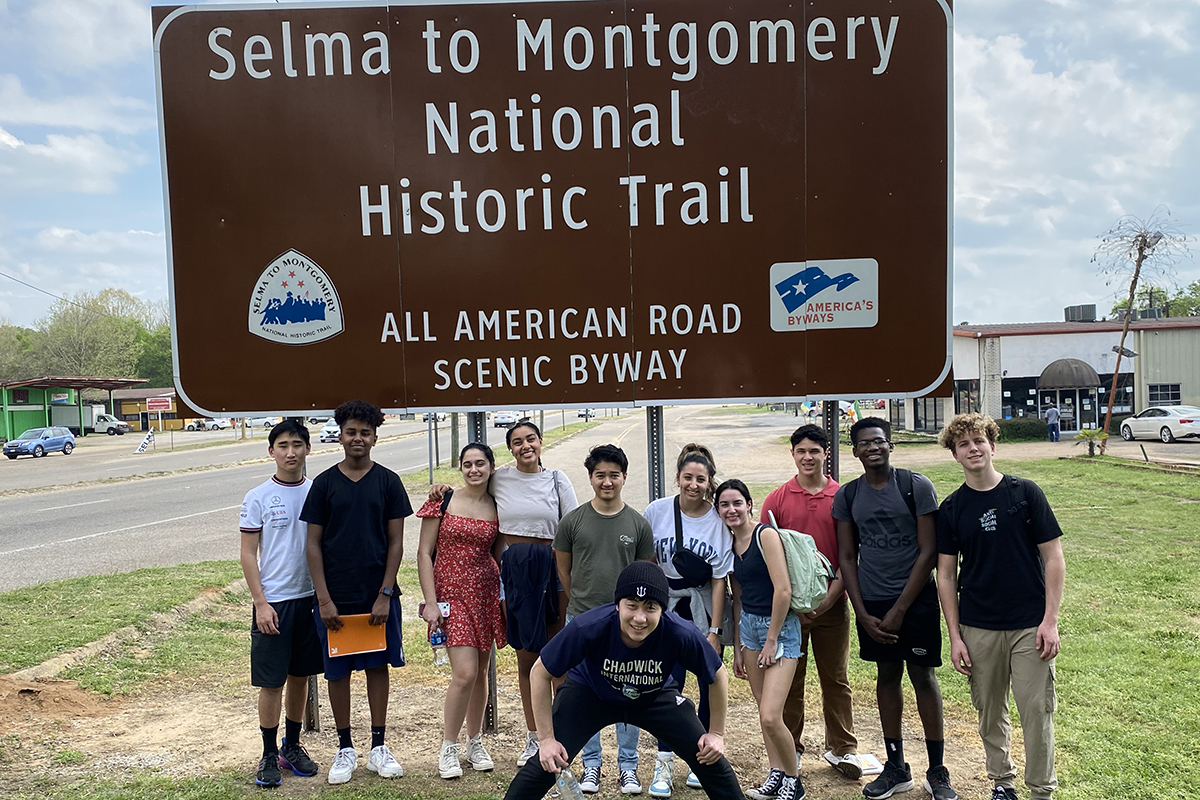
In a tradition that’s become synonymous with the March break, Exeter’s spring travel programs once again hit the road for experiential learning opportunities. From backpacking in Utah to performing music in Puerto Rico and preseason athletics training in Florida, students fanned out across the country for enrichment opportunities away from campus.
Eleven Exonians traveled south to Alabama to participate in a civil rights-centric program for the first time since the start of the pandemic. Students toured national landmarks throughout the state and spent time at social justice activist and Exeter’s 2019 Bragdon Fellow Brian Stevenson’s Equal Justice Initiative.
Among the stops were tours of the 16th St. Baptist Church, Martin Luther King’s former residence, the Legacy Museum and the Southern Poverty Law Center.
“[We] felt a sense of reverence for the place where such important work was done and a sense of gratitude for the sacrifices made by King and his family,” said a combined reflection from Peter Lee ’26, Chaemin Lee ’26 and Abesolam Webb ’26 on their time spent at the King family home.
View more photos from trip below and on Instagram.
Students walk the Edmund Pettus Bridge in Selma.
The group poses for a photo in front of the Legacy Museum in Montgomery.
Students stop to sample southern treat Moon Pies.
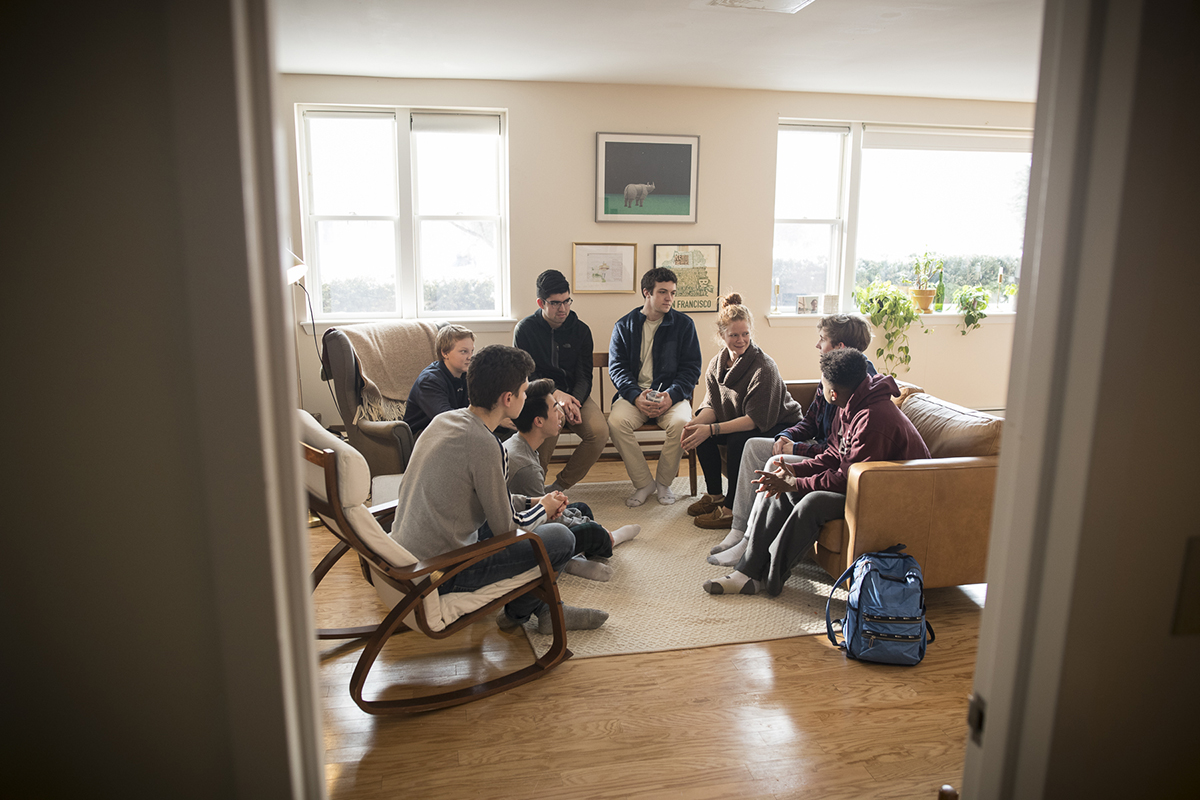
Hear how from community members as they discuss how being connected with one dorm for your entire time at Exeter makes dorm living unique, inclusive and fun.
Dorm heads develop a safe and welcoming living environment for their residents. They work closely with dorm faculty and student proctors to create dorm-based programming and plan activities for their students.
Ms. Soucy, McConnell Hall“The way that our dorm team works together, and the different skills that each of us has, fits together like a puzzle and creates an environment that helps support our students.”
A leadership position for seniors, proctors work with dorm heads and dorm faculty to plan activities. Proctors also provide guidance and advice for younger students in the dorm.
Tucker, Senior, Ewald Hall“Every student benefits from a caring and welcoming dorm community. As a proctor, I do my best to create and further that spirit.”
Student listeners provide peer-based support within each dorm. They receive training on how to engage with dorm mates and the types of resources available should a student wish to continue the conversation with a professional.
Nataly, Upper, Wheelwright Hall“I make an active effort to build relationships with my dormmates to create a home away from home for them. My dorm is my comfort spot on campus, and I want my dormmates to feel that way too.”
From the structured to the spontaneous, dorm fun comes in many forms. Whether it’s planned outings like ice skating in Portsmouth or a night in watching a movie with friends, there are plenty of ways to enjoy free time with dorm mates.
Masaki, Lower, Knight House“Whether it’s trips to the beach, hanging out playing cards or just simply some alone time, there’s always a place for everyone. Anyone can fit in and there’s no real social pressure.”
Students remain in the same dorm for the duration of their time at Exeter. Younger students benefit from the presence of older students who have grown into leadership roles. As dorm affiliates, day students are encouraged to participate in residential life.
Ava, Prep, Wheelwright Hall“When I first arrived at Exeter, older students in my dorm helped me get settled. They are so approachable and I always feel comfortable going to them for guidance.”
“Since prep year, my dorm, Abbot Hall, has always been the cornerstone of my Exeter experience. On the last night of my first year, I remember listening to the upperclassmen’s reflections on their hard but worthwhile time at PEA. We relived the memories from the past year and then did our dorm tradition of running to Dunkin Donuts at 5 a.m. To be an Abbotteer or, more generally, an Exonian, not only means being a part of a supportive community but it also means being able to embrace your true self with the help of many trusted, best friends.“
“I really felt like I belonged at Exeter from the very beginning, during my first week of prep fall. The moment I knew I’d be fine and happy at Exeter was at opening assembly. I loved how the teachers walk in rows down the aisles and everyone was cheering so loudly for them. I had chills in that moment and thought, ‘Wow, I’m really part of something special.'”
— Anjali
“I don’t remember a feeling of not belonging at Exeter. What’s so special is that there’s a home here for everybody. I found a home in music. There’s always a place here to return to that helps you feel like you belong, whether it’s a friend’s arms, your dorm, a club or a teacher.”
— Meili
“I remember a conversation I had with my friends one night as we were walking through the quad spring term of my prep year. Lots of people were playing Spikeball, and we were just getting back from dinner. We finally felt like Exonians. We felt like we grew up a lot and had become much more capable. We understood how the school worked and the campus started to actually feel small.”
“I was nervous going into tryouts … but when I came into preseason a lot of weight was lifted off my shoulders just because everyone was so nice and so supportive. Instead of a tryout it felt more like fun.”
The Exeter girls varsity swim team pulled away from a talented, 12-team field to win the New England Division I Championship.
Big Red outpointed 11 rivals with an impressive 92.5 points separating them from the runner-up, Andover.
First place has been a familiar spot for girls swimming. In the 50 years of girls competing in the New England Prep School Swimming Association, Exeter has won at least a share of the New England title 17 times. This year marks Big Red’s first title since a trio of championships from 2010 to 2012.
Big Red boys swimming, who claimed fourth overall at the championships, continued a run of excellence of their own. The Exeter boys have posted a top-four finish in at least 31 of the past 32 seasons, dating back to 1991. The boys program has won 15 titles.
“I’m so proud of our team,” said girls head coach Nicole Benson. “What a remarkable team experience in what was a remarkable year. Many kudos to our seniors, Claire Fu ’23, Amy Benson ’23 and Nat Kpodonu ’23 for building a team and building a legacy, and for leaving our program better than when they arrived — a true mark of non sibi.”
Mena Boardman ’26 helped lead the way. The prep star set a school record in the 50 free with a time of 22.67 while also claiming first in the 100 free with a time of 50.37.
Brianna Cong ’25 claimed a New England title in the 100 butterfly with a time of 54.97 while finishing second overall in the 100 backstroke, touching the wall at 55.52.
Audrey Zhang ’24 broke the oldest mark left on the Exeter record board when she finished the 100 breaststroke in 1:05.57, good enough for third place overall. The previous school record was set by Malindi Davies ’94 in 1993. Zhang also earned a third-place finish in the 200 individual medley with a time of 2:07.26.
Big Red also proved to be a dominant force in relays, winning the 200 medley relay, 200 free relay and 400 free relay. The 400 free team of Sophie Phelps ’25, Cong, Amy Benson and Boardman shaved two seconds off their record-setting performance at Easterns and closed the meet with a school-best mark of 3:25.72.
Boardman, Zhang, Cong and Vedika Amin ’24 won the 200 medley relay with a time of 1:45.01 in the first event of the day while Amin, Chloe Bosma ’26, Phelps, and Amy Benson teamed up to capture the 200 free relay with a time of 1:37.52.
On the boys side, Ethan Guo ’25 claimed a New England title in the 100 backstroke with a time of 49.80. Guo also finished second in the 200 free when he touched at 1:40.09.
After placing second in Saturday’s prelims, Henry Liu ’23 swam to a New England title in the 100 breaststroke with a time of 55.08.
Guo, Liu, Lang Gou ’25 and Rudd Day ’25 earned third place in the 200 medley relay, finishing at 1:33.32. The 200 free relay team of Day, Michael Yang ’24, Andrew Van De Water ’23 and Patrick McCann ’23 claimed fourth overall with a time of 1:25.59 while Guo, Van De Water, Liu, and Zach Quitkin ’23 swam to third in the 400 free relay.
Powered by a couple thousand of Exeter’s and Andover’s noisiest and most supportive students, families and alumni, the season-ending clash of Big Red and Blue on Saturday lived up to the rivalry’s long tradition.
Exeter picked up victories in boys varsity basketball, boys JV basketball, girls JV basketball, and girls JV hockey, while Andover outlasted Big Red in the other five contests on the day.
The boys varsity basketball game was one for the ages in a series more than a century old. Exeter grabbed control early and kept a three-point lead at the break. A back-and-forth affair throughout the second half saw the two teams exchange the lead several times in the final four minutes of regulation. Defense was the driver to overtime, as both Exeter and Andover made stops in the final minute to force an extra period knotted at 48-48.
Exeter held a 51-50 lead with 90 seconds left in overtime when Mike Loughnane ‘23 found Tristan Zhang ‘25, who buried a clutch 3-pointer from the wing to extend the Big Red cushion to four points. It wouldn’t stick. Andover answered with its own 3-pointer and a pair of free throws to nose in front 55-54 wit 18 seconds left.
After a timeout, Loughnane drove to the hoop and drew a foul with under five seconds remaining and knocked down both free throws in front of the raucous crowd to give Exeter its lead back, 56-55. Andover’s heave at the buzzer failed to connect, and Big Red had its fifth straight victory in the season-ending series.
Loughnane hit five 3-pointers and was a perfect 6-for-6 at the free throw line on his way to a game-high 27 points. Fellow seniors Rollie Castineyra ‘23 and Aidan Burke ‘23, added 13 points and 10 points, respectively, for the hosts.
Girls varsity basketball nearly put together a comeback that would have lived famously in the annals of the rivalry. A sluggish start saw Big Red trail by 14 points at the end of the first quarter. Exeter woke up in the second and clawed their way back. Laurie Chung ’24 led the charge as she poured in all 10 of her points just before halftime, building Exeter some momentum. That energy carried into the second half as Exeter cut the Andover lead down to seven heading into the fourth quarter. Big Red continued to battle and brought themselves back to within two points when Stacy Chen ’24 connected for a layup through traffic with just 32 seconds to go. That was as close as Big Red would get, however, as Andover drained a free throw and played tough defense to close the game out, 42-39.
Jac Doucette ’23 powered the Exeter offense with a team-high 18 points. The two-year senior also connected for the 1,000th point of her high school career.
On the ice, it was Andover girls varsity who broke a scoreless tie with three minutes remaining in the opening period on a power play when they buried a puck that careened off the cross bar and to the open side of the net to stake a 1-0 edge. The Blue took advantage of another power play opportunity early in the second to double up their lead, 2-0, and would hang on for the two-goal victory. Exeter senior Sami Smith ’23 was strong in net for Big Red against and Andover club that improved to 22-2-1.
On the boys side, the Red and Blue played a scoreless first period before Andover scored in the opening minute of the second to go up, 1-0. Big Red had an opportunity to even the game with an odd-man rush during a penalty kill, but the Andover netminder made an athletic save to his left to preserve a 1-0 lead. Andover was able to corral the puck and capitalize with a rush of its own to extend the lead to 2-0. The Blue would add another early in the third before scoring an empty-netter to seal a 4-0 victory.
In addition to the games, the crowd was treated to some sensational performances from Exeter dance groups POMS and ABS, while the Big Red Pep Band had the gym rocking, making the atmosphere inside Love Gym electric.
General Alumni Association President, Trustee and Awards Committee Chair Betsy Fleming ’86 has announced the selection of Richard S. Aaronian ’76, ’78, ’97 (Hon.); P’94, P’97 as this year’s recipient of the Founders’ Day Award.
Conceived by Principal Stephen G. Kurtz and established by the Trustees in 1976, the Founders’ Day Award is given annually by the GAA in recognition of exceptional service to the Academy. The legendary Hammy Bissell ’29 was given the first Founders’ Day Award, and an Academy who’s who has followed.
Aaronian joined the faculty in 1971 as an instructor in science. Named the Harlan Page Amen Professor of Science in 1999, he is credited with introducing ornithology and marine biology into Exeter’s science curriculum, along with a place-based field trip program. He has led educational travel programs for students and alumni in locations as far flung as Costa Rica and Plum Island, Massachusetts.
In addition to serving as dorm head for three dorms — Amen and Bancroft halls and Williams House — Aaronian coached boys JV hockey for 26 years and served as an assistant coach for JV baseball for 17 years. He was a member of numerous major committees and was Chair of the Science Department from 1991 to 1995.
When he retired in 2020, Aaronian was the Exeter faculty’s longest-serving member, having logged 49 years of devoted service. His exceptional teaching has also been recognized with the Rupert Radford Faculty Fellowship Award, the Brown Family Faculty Award and the George S. Heyer Award.
Aaronian will receive the Founders’ Day Award and speak during assembly May 19.
“Today we’re starting to grapple with Rita Dove,” says Duncan Holcomb, instructor in English, on a recent Friday morning in Phillips Hall. Immediately, the chatter around the Harkness table in Holcomb’s English 420 class quiets down, as the students turn to excerpts from the award-winning poet’s latest work, Playlist for the Apocalypse.
On Wednesday, Dove will give a reading in Assembly Hall as part of the Lamont Poetry Series. She is the latest in a long line of distinguished poets invited to Exeter’s campus to give readings and attend English classes thanks to the support of the Lamont Fund, established in 1982 by Corliss Lamont, Class of 1920, and Jacquelyn Thomas, former Academy Librarian.
Even among these distinguished ranks, Dove’s achievements as a poet, novelist, essayist, playwright and educator stand out. In addition to winning the Pulitzer Prize for Poetry in 1987 for Thomas and Beulah, she served as U.S. poet laureate from 1993 to 1995. A longtime creative writing professor at the University of Virginia, she is the first poet to receive both the National Humanities Medal and the National Medal of Arts, and more recently won the 2022 Rebekah Johnson Bobbitt National Prize for Poetry, an award for lifetime achievement from the Library of Congress.
Holcomb is one of several English instructors reading Dove’s work with his students in anticipation of her visit. During this particular class meeting, he asks the students to talk amongst themselves about which of the assigned poems they’d most like to discuss. The students’ overlapping voices fill the room again, as they point out favorite passages to each other and ask questions about perspective and theme.
The first poem they choose to discuss, “Woman, Aflame,” is one of a series that Dove originally wrote for A Standing Witness, an operatic song cycle composed by Richard Danielpour that bears witness to the past five decades of U.S. history. Subtitled “Fifth Testimony: Roe v. Wade,” the poem begins:
“She was a mother. She was a girl who dreamed of becoming
a mother someday. She was either a tease or a tramp, a lover
or a wife — still she had to do the counting…”
“I think the line breaks are pretty interesting,” says Michael Goodall ’24. “Like the first line: ‘She was a girl who dreamed of becoming,’ and then the next line skips to ‘a mother someday.’ I feel like this shows the lack of opportunity, and how this optimism is kind of simmered down with other factors.”
“One thing that stood out to me is at first you would think this is all talking about one woman,” Aliyana Koch-Manzur ’24 responds. “But I think it’s kind of encompassing many women’s experiences… . By using one pronoun to describe all women, it’s saying that this is something all woman could be affected by.”
The next poem, “Declaration of Interdependence,” contains two alternating narrative voices, and Holcomb asks two students to read the poem aloud together. The students quickly identify the two voices — one belonging to a Jewish person, the other to a Black person — and discuss how the poem deals with some of the stereotypes that are often applied to each.
“What is the ‘interdependence’ in the title?” Holcomb asks. “It’s the opposite of independence, right?”
“It’s to show how both these groups have similarities in their mistreatment,” says Nafees Abdullah ’24. “Fight’s not the right word, but it’s the one that comes to mind — why fight over that when you can come together and support each other?”
“I wonder if, like the Declaration of Independence is a way for America to have freedom from the British, this declaration of interdependence through unity of minority groups is finding freedom from these stereotypes,” says Corinne Wingate ’24. “They’re not seen as having those commonalities, but by asserting how similar they are, it’s like having freedom as a wider group.”
The group concludes by briefly discussing a third poem, “From the Sidelines,” before the class period ends. “We can come back to that,” Holcomb says. “Make sure to schedule your conferences with me by Wednesday — which is when Rita Dove gets here.”
In addition to her reading and book signing at 7:30 p.m. Wednesday, Dove will hold a Q&A in the Assembly Hall the following day
Every Exeter student appreciates how the Harkness approach emphasizes learning through discussion and collaboration. But every once in a while, you just want to go it alone.
Senior projects allow students in their final year of study to explore a topic of their choice, working largely independently with guidance from a faculty-mentor. The program allows Exeter students to study areas of interest that fall outside traditional course descriptions and develop their own curriculum.
This winter, five members of the class of 2023 took advantage of the opportunity to dig into projects in the arts and sciences:
Alysha Lai, “The Plane Play: An Audience Interactive Comedy”
In The Plane Play, written and directed by Alysha, the audience chooses a flight and journey for each performance. The passengers on the flight are a collection of characters: a scared lady, a young couple, a criminal (or two), etc. Every performance is a staged reading and has the potential for a different ending.
Rodrigo Spinola e Castro, “Building a Magnetometer for Space Weather Studies”
In this project, Rodrigo built a magnetometer to measure changes in the local magnetic field caused by solar phenomena.
Eric Zhang, “Exploring the Effectiveness of Basic Genetic Experiments for Learning”
Eric spent the term working to create a 90-minute genetic curriculum where students learned about basic techniques and concepts like DNA extraction and the structure of DNA.
Chloe Becker, “Away”
Chloe’s presentation shares three songs from her album “Away”, which tells the story of an astronaut who crashes into a planet that seems to appear out of nowhere when traveling through space. The full album will be performed live in spring term.
Aisha Janus, “Fragrance: Consumer Preference and Formulation”
Aisha has worked on the analysis of perfume notes and ingredients in order to find those with a correlation to a perfume’s success with American consumers. My project culminates with a formulation of such an optimal perfume.
Exeter swimming delivered quite a performance at the Eastern Interscholastic Swimming & Diving Championships at Franklin & Marshall College in Lancaster, Pennsylvania, this past weekend. Big Red girls claimed fifth place overall and the boys finished sixth, while Exeter’s combined score of 777 points placed them fourth overall against some of the top competition from around the country.
“Easterns is the premier prep school meet in the country,” said girls head coach Nicole Benson. “This is a great way to kick off our championship season and provide opportunities to our swimmers to compete amongst the best.”
“The energy at Easterns always bring out the best in our swimmers, and the entire experience brings us closer as a team,” continued boys head coach Don Mills. “The meet was full of exceptional swims from all of our athletes.”
Big Red got to work re-setting the record books immediately on the first day of competition. Mena Boardman ’26, Audrey Zhang ‘24, Brianna Cong ’25 and Sophie Phelps ’25 teamed up to post a school record while earning All-American status in the 200 medley relay with a time of 1:43.66.
Boardman then went on to claim first overall in the 50 freestyle, posting a school record and earning All-American status in the process with a time of 22.94.
Brianna Cong made a splash and finished second overall in the 100 butterfly with a time of 55.02.
On the boys side, Ethan Guo ‘25, Henry Liu ‘23, Lang Gou ‘25 and Rudd Day ‘25 placed fifth in the medley relay with an All-American time of 1:32.62 before Andrew Van De Water ‘23, Zach Quitkin ‘23, Michael Yang ‘24 and Patrick McCann ‘23 took fifth place in the 200 free relay with a time of 1:28.15.
Guo earned a seventh-place finish in the 200 freestyle with a time of 1:42.16, while Day swam to an eighth-place finish in the 50 free with a time of 21.55. Gou wrapped up day one with a seventh-place swim in the 100 butterfly with a time of 50.71.
Day 2 of competition was much of the same as Boardman kicked off the day with a school record swim and third-place finish in the 100 freestyle with a time of 50.42.
Sophie Phelps followed by breaking her own school record in the 500 freestyle when she touched the wall at 4:58.61, claiming fourth place overall. Cong also broke one of her own school records in the 100 backstroke with a time of 55.84, good enough for fifth place.
The girls wrapped up the competition with one more record-breaking performance as Phelps, Cong, Zhang and Boardman teamed up to set a school mark in the 400 freestyle, claiming second place with a time of 3:27.59.
Guo led the efforts on the boys side on Day 2, winning the 100 backstroke with a time of 49.75. Henry Liu added a second-place finish in the 100 breaststroke, coming in at 55.53.
Big Red has two big meets left on their 2022-23 campaign as they will travel to battle Andover on Feb. 22 before competing at the New England Championships on March 4-5.
Hundreds of Exeter parents walked in the shoes of college admissions officers over the weekend to learn about the art and the science of choosing an incoming class.
The mock admissions workshops, in which parents and admissions professionals meet, discuss and ultimately choose from among three imagined candidates, were part of the College Admissions Weekend program. The event, hosted annually by Exeter’s College Counseling Office for parents of 11th-graders, offers a peek behind the curtain at what goes into those decisions and shares critical knowledge to make the admissions process as painless as possible.
A highlight of the weekend was the keynote address by Dr. Anthony Jack, an assistant professor of education at the Harvard Graduate School of Education who has researched how class and culture shape how undergraduates navigate college. Jack’s book The Privileged Poor: How Elite Colleges Are Failing Disadvantaged Students, digs into the stratification of lower-income students: Those he calls the “privileged poor,” who matriculate from boarding and private schools, and the “doubly disadvantaged,” those who arrive at college from local, typically distressed public schools.
Jack notes how elite American universities take pride in enrolling an increasing number of students of color and more students from low-income families, but many among those number are the “privileged poor,” hailing from elite secondary institutions. Those students already are familiar with the culture of private schools and know how to take advantage of the resources and the systems of support available to them. Meanwhile, those who go straight to selective colleges from “forgotten neighborhoods and neglected schools” don’t take advantage of the resources because they have never benefitted from them. That, in turn, puts them at a distinct disadvantage to thrive.
Jack’s research shows that although first generation and lower-income students make up roughly 50% of the students at four-year schools, just 14 percent of undergraduates at the most competitive colleges come from the bottom half of income distribution. Thirty-eight U.S. colleges — those considered among the most selective in the country — have more students in the richest 1 percent of the population than the bottom 60 percent, he notes.
The mock admissions workshops on Saturday morning deployed 11 college admissions officers from schools such as Dartmouth, Princeton and Carnegie Mellon to lead Harkness discussions about potential “candidates.” Each of the three fictional student profiles told a story of an exceptional student with good grades, a variety of extra-curricular interests and strong recommendations from their instructors and advisers.
The parents at each table had to come to a consensus on one student to enroll, one student to put on a waitlist and one student to turn down. Those hard decisions exemplify what college admissions officers face each spring while considering thousands of applicants for placement.