Phillips Exeter Academy

Blown away

When Claire Ashley’s colorful, in-your-space inflatables — some topping 25 feet across — blew up on campus this fall, they demanded attention. And that was the point. 

“I prefer that they are out in the world being irreverent, obnoxious beings rather than being polite and sitting on the wall in a calm way,” says Ashley, an artist based in Chicago. 
“I’m hoping the kids are like, ‘Whoa, what is that?’ That question allows them to enter a conversation about contemporary art that may be a different lens than they might think of when they enter a museum. It’s an experience-driven entry point.”

The “Claire Ashley: Radiant Beasts” exhibition included more than 30 works fashioned from PVC-coated canvas tarpaulin, Tyvek, expandable foam, spray paint and small blower fans, and installed in iconic and surprising spaces from the Lamont Gallery to a squash court in Love Gym.

“My vision for what I wanted to bring to the community was a sense of chaos,” Ashley says. “Really awakening students to these parallels, these intersections between things that they’re studying and contemporary art. And thinking about how the work is living amongst them, whether they’re coming to the gym to work out or to Phillips Church for meditation or prayer.”

Throughout the term, the gallery team also installed short-term, pop-up “interventions” of Ashley’s artwork in previously undisclosed locations. Each pop-up lasted for four days and students were encouraged to take pictures and share their thoughts on social media. “Inflatables are this perfect form because everybody recognizes them as either a bouncy house, a cuddly toy, or something they can hug,” Ashley says, “which I think is really important in terms of making people feel comfortable about looking at or talking about art. Whereas, for a lot of people, when they enter a gallery they feel like they’re either less than or, don’t quite understand what they’re seeing. I’m trying to make art as open and available to people as possible.”

Ashley’s work has been exhibited nationally and internationally in galleries, museums, site-specific installations, performances and collaborations. During her stay, she led an artist talk and met with Exeter students. Her visit was programmed through the Lamont Gallery and supported in part by the Michael C. Rockefeller ’56 Visiting Artist Fund.  

This article first appeared in the Fall 2023 issue of The Exeter Bulletin.

Working vacation: Exonians pair learning, fun on fall break

As cooler temperatures mark the end of the fall term at Exeter, dozens of students will head to warmer climes for hands-on-learning opportunities in New Orleans, Costa Rica, Miami and California. The week-long Global Initiatives programs will focus on various topics of study, like the history of indigenous Filipinos in the United States and environmental sustainability in many forms.

Ten students will head to “The Big Easy” to immerse themselves in the culture of New Orleans. The program is highlighted by service projects where participants will work restoring wetlands and supporting neighborhood revitalization projects alongside members of the local community.

Over a thousand miles to the south, 15 students will travel into the rain forest of Costa Rica to learn about the country’s commitment to protecting its natural resources and how it’s become the model for sustainable tourism. Here Exonians will interface with local scientists and farmers to learn about the delicate balance of preserving Costa Rica’s ecological beauty while welcoming nearly two million visitors each year.

Back stateside, 12 students will partake in a program studying a similar topic in South Florida. Participants will examine Miami’s plant and animal life and the tenuous ecosystem of one of the United States’ most popular vacation destinations. Students will tour the University of Miami Rosenstiel School of Marine and Atmospheric Science and visit Everglades National Park.

In the late 16th century, the first recorded landing of Filipinos in North America occurred along California’s central coast. Nine students will travel to the area to study the impact of indigenous Filipino culture to the fabric of American history. The trip will include time in San Francisco, Morro Bay and Los Angeles where participants will meet with historians and visit Filipino cultural centers.

Exeter’s Global Initiatives programs are considered an extension of the Harkness table, offering students lessons in global citizenship through experiential immersion. Last year, more than 400 students and 51 faculty members participated in over two dozen travel and learning opportunities.

Big Red to host NEPSAC football bowl game

With an emphatic 47-20 victory over Andover in the 142nd meeting between to two schools last weekend, Exeter football wrapped up the Northeast Prep Football Conference outright championship and will host Choate Rosemary Hall this Saturday in the New England Preparatory School Athletic Council (NEPSAC) Leon Modeste Bowl for the New England Football Championship.

Exeter, which finished the regular season with a 7-1 record, is a winner of six straight games and will playing its first bowl game since the 2012 season. Choate enters the Modeste Bowl as winners of the Founders League title with an 8-0 record.

Both sides are explosive when they have possession of the ball. Exeter features an offense that has scored 34 points per game; Choate has put up an average of 43 points on the scoreboard each week.

Here’s what you need to know:

Kickoff: The Leon Modeste Championship Bowl will be played at Phelps Stadium at 1 p.m. Saturday.

Getting to campus: Search 3 Chadwick Lane, Exeter, NH into your GPS to navigate to Phelps Stadium. Parking is available in the garage below the William Boyce Thompson Field House and in lots 2-6 on Chadwick Lane. There will be limited parking available along Hammy’s Way, the dirt road adjacent to Lovshin Outdoor Track. Please walk over Hill Bridge to Phelps Stadium. Restrooms are available at the stadium.

Watch it live: The game will be streamed on Exeter Live.

Click here to view all of the NEPSAC Bowl matchups.

Championship hardware, E/A rivalry wraps up fall season

The most anticipated athletic event of the year: Exeter/Andover Weekend. A bright, sunny, Saturday with a chill in the air set the perfect setting for the 142nd clash of Red and Blue. The promise of talent, sportsmanship, and school pride shined through as thousands descended on the Exeter campus to celebrate the oldest rivalry in high school sports.

In addition to a celebratory day on campus, Big Red had plenty to cheer about on the road, as the dominance of Exeter cross country teams continued. The Big Red boys captured their fourth consecutive New England title, while and the Big Red girls claimed their fourth New England championship in the past five seasons. The boys followed the lead of Byron Grevious ’24, who claimed his third straight individual title. Grevious, the third-ranked cross country runner in the nation in the latest Dyestat rankings, set a new Loomis Chaffee course record and came in at a blistering 14:56. Max Lacombe ’24 (4th overall, 15:41), Pearce Covert ‘25 (8th, 16:14), Jack Hutchins ’24 (9th, 16:19), and Austin Desisto ’24 (12th, 16:22) followed Grevious to help lift Big Red to the win.

The Big Red girls followed the lead of Tenley Nelson ’24 and Daria Ivanova ’24 en route to their title. Nelson cruised to a time of 18:21 to place second overall while Ivanova followed at 18:30 to capture third place. Julia Malysa ’26 (9th, 20:18), Leta Griffith (21st, 20:19), and Melani Dowling (22nd, 20:21) each put forth strong races for Exeter. Big Red accounted for 67 total points, edging Andover by one to secure the win. Just last week, Andover beat Exeter by one at the E/A dual meet at Andover.

The boys JV cross country team continued their own impressive dominant streak, capturing their eighth straight JV title while the girls JV team place second overall.

The third-seeded boys varsity water polo also enjoyed an exciting Saturday as they bested second-seeded Hamden Hall, 10-6, in the semifinal round of the New England Championship Tournament. Big Red, who avenged a loss to Hamden in their lone matchup of the regular season, will travel to Andover tomorrow to square off with top-seeded Brunswick School for the New England title.

Back on campus, it was the girls volleyball team who ignited the day in front of a loud and raucous crowd with a 3-1 victory, to sweep the season series with the Blue. Ellie Ocampo ’25 was outstanding for the hosts, powering an explosive offensive attack that led to Big Red’s 20-25, 25-19, 25-15, 25-12 set victories. Exeter, which finishes their regular season with an 11-3 record, will await announcement of their postseason opponent. The NEPSAC Class A Tournament opens on Wednesday.

Andover boys soccer scored first midway through the first half before doubling up their lead with some tic-tac-toe passing with three minutes to go before the break. The score would remain the same in the final 45 minutes as the Blue earned the 2-0 victory. Dieder Wagner ’24 and Aaron Park ’24 were strong on the back line for Big Red.

Andover girls soccer bested Big Red by a score of 4-0. Morgan Mayer ’24 and Morgan Signore ’26 played well for Big Red, creating several chances throughout the day, while Esme Shields ’24 was strong in the middle of the field for the hosts.

A hotly contested match on Hatch Field saw Andover field hockey outlast Exeter and hang on for a 4-3 overtime win. The Blue held a 1-0 lead at the half, but Big Red was able to even the score early in the third period when Clare Stewart-Selvan ‘25 capitalized off a corner opportunity. The even score would not last for long, however, as Andover scored a pair over the next three minutes to reclaim a 3-1 edge. Exeter continued to battle and cut the deficit to one midway through the fourth when Natalia Ulbin ’24 found the back of the net. Ulbin would strike again four minutes later to even the score once again with three minutes to play in regulation and force overtime. Exeter had the first scoring chance in the extra period, but a stingy Andover defense cleared Big Red’s corner opportunity and quickly turned defense into offense and netted the game-winner on a breakaway chance.    

In the 142nd matchup on the gridiron, Exeter capped an exciting day with a 47-20 victory over Andover. The win marks the third straight for Big Red in the series while also earning the Northeast Prep Football Conference outright championship. Exeter (7-1) will await to hear the possibility of a NEPSAC bowl game this week.

Exeter got on the board first when Zion Simmons ’24 took a reverse for 20 yards and into the end zone for the lone score of the opening quarter. Andover would stake a 7-6 lead early in the second quarter on a 25-yard scoring scamper of their own, but from there it was all Big Red. Simmons broke away for a 58-yard touchdown run before Kai Honda ’24 plunged in from four yards. Isaiah Reese ’25 then took a screen pass 50 yards, breaking multiple tackles en route to the end zone as Exeter broke the game open with a 26-7 lead at the half.

Johnny Getman ’24 hauled in a four-yard touchdown pass from Eddie Buehler ’24 before Big Red hit the ground running once again, as Reese exploded for a 51 yard score and Buehler added a touchdown on a keeper from six yards to secure the 47-20 victory.

Exeter/Andover Weekend returns to campus

Big Red will renew acquaintances with Big Blue in the latest rendition of Exeter/Andover Weekend this Saturday on the Exeter campus. The two schools first squared off 145 years ago, in 1878, and have battled on the field ever since, making it the oldest high school rivalry in the nation.

Our rivalry is truly special and historic, and filled with excitement, camaraderie and spirited competition. Whether you wear red or blue, this is a great opportunity to celebrate our students, our history, and add a new series of memories alongside a storied lineage of Exonians and Phillipians. 

The E/A program is in your pocket!

This year you can access all of the necessary information needed to navigate a fun Exeter/Andover from the Exeter Events app on your phone! View campus maps, team rosters, dining information, parking directions, and more by going to https://guidebook.com/g/eaweekend or by using the QR code below.


E/A game schedule

11 a.m.: Girls volleyball – Love Gym
Noon: Boys soccer – Phelps Stadium
2 p.m.: Girls soccer – Phelps West
3 p.m.: Field hockey – Hatch Field
4:15 p.m.: Football – Phelps Stadium


Stream live

Can’t make it to campus? Be sure to tune in and follow the action of each game on Exeter Live.

Watch parties

Can’t make it to campus — AND don’t want to watch alone. Find a watch party near you.

New England championships schedule

Exeter boys and girls cross country will compete for a Division I title on the campus of Loomis Chaffee on Saturday.
1:15 p.m. – Girls varsity race
2 p.m. – Boys varsity race

2 p.m. – Girls JV race
3:25 p.m. – Boys JV race


Exeter boys water polo will also be competing for a New England championship this weekend as they compete in the Liquid 4 Tournament on the Andover campus.

Saturday

11:30 a.m. – Game 1 – #GCDS vs. # Choate

3 p.m. – Game 2 – #2 Hamden Hall vs. #3 Exeter

4:30 p.m. – Game 3 – #1 Brunswick vs. Winner Game 1


Sunday

9:30 a.m. – Game 4 – 3rd Place Match – Loser Game 2 vs. Loser Game 3

11 a.m. – Game 5 – Championship – Winner Game 2 vs. Winner Game 3


General assures Exeter 'we're on the road to awesome'

Retired Army Lt. Gen Charles Luckey ’73 wants Exeter students to know that, despite all the challenges and injustices the world may present to them, they are on “the road to awesome.”

Luckey’s upbeat message, delivered with zeal to the full student body in Assembly Hall as part of the school’s fifth “Exeter Salutes” celebration, urged his audience to trust that the lessons they learn at the Academy today will make a very real difference tomorrow.

“This institution, this room, your lives — all of you — represent not just the future, but future promise. The things you are learning here, whether you know it or not, are powerful. Powerful.”

The Exeter Salutes program intends to honor and celebrate those who exemplify the Exeter spirit of non sibi through their military service and to raise awareness of the impact their sacrifice has on our community. Luckey is a worthy choice to represent that service and sacrifice. His 43-year Army career began with his commissioning as a second lieutenant when he graduated from the University of Virginia in 1977. He commanded forces at every Army echelon, including in operations in Panama and Iraq. His final military assignment was leading the U.S. Army Reserve Command, a force of over 200,000 soldiers and civilians spanning 20 time zones. He retired with three stars.

But the war stories Luckey brought to Exeter related not to his decades as a soldier but to his four years as an Exonian. He pointed to the balcony seat he remembers sitting in as a prep the day after four American college students were killed by National Guard troops in Ohio during a protest of the Vietnam War. And just as students today worry about the world they are about to inherit, Luckey says he and his peers felt “a little bit of fear, a lot of concern, a lot of worry.”

“Now, I’m going to give you the good news: I didn’t know it then, but I know it now. We were and we are on the road to awesome,” Luckey said. “It didn’t feel like it then. I suspect, because I share the concern, I suspect there are students and faculty who are worried now.” But, Luckey said, the lessons of resilience, curiosity, humility and empathy he learned as an Exeter student and has carried ever since remain core values taught at the Academy today. That, he says, explains his optimism.

“You have the ability in this place, in this time, to develop and grow the intellectual confidence to lose a conversation, to lose a discussion, to be wrong a little bit and in so doing make a new friend, build a new team,” he said. “Driving positive change is about building teams, collaborating, sharing a vision and sharing a commitment to your teammates.”

He left his audience with a request to celebrate Veterans Day and honor veterans’ service by treating gratitude as a verb.

“Be the force that validates the sacrifice. Make it count. Earn it.”

Alum shares message of gratitude with assembly

The preteen Manny Vega ‘04 was a “conundrum.” A bright, driven student growing up in Manhattan’s Washington Heights neighborhood, Vega was just as likely to be recognized for his academic accomplishments as he was to be sent to detention for altercations with bullies.

That’s why on a fateful day some two decades ago, after hearing his name echoing throughout the school over the loudspeaker, he tepidly reported to the principal’s office, unclear what he’d been summoned for.

“I remember my sweaty palms and racing heartbeat as I walked to his office, and as I got closer, I saw the back of his chair face the entryway,” Vega told assembly. “He slowly turned his chair and he gripped a piece of paper leaning in. As I leaned back, he said, ‘have you ever considered attending a boarding school?’”

That defining moment would set the course for Vega’s immediate and distant future.

A visit to Exeter and acceptance to the Academy soon followed. Vega explained the weight of his decision to leave home and his family.

“At the young age of 12, I understood why it was difficult for my parents to allow their eldest child to leave. Who’s going to pick up my younger siblings from school or translate letters that came in the mail and help with errands around the house while they were at work?”

At Exeter, Vega found, and created, the opportunities not previously available. He was a multisport athlete, devoted member of numerous clubs including ALES, a participant in the Washington Intern Program and the founder of Los Salseros, a Latinx dance group.

After graduating from Wesleyan, Vega’s made numerous professional stops, but has never lost sight of the power of an opportunity, like the one given him more than 20 years ago.

“As I navigated the job market, I kept thinking back to my time at Exeter and how transformational it was for me.”

By day, Vega works as the director of admissions at The Waldorf School of Garden City on Long Island. He is also the program director of CitySquash, which uses the sport to make low-income students in New York City aware of private high school and college opportunities.

Vega encouraged current students to take stock of the opportunity at Exeter and someday, pay it forward.

“Become a mentor, volunteer for class roles, attend regional events, come to reunions, donate what you can and do so each year. Every action is an investment in Exeter.”

Strength and character

Steeped in the Academy’s history is a remarkable football tradition dating to 1878. It is widely known that Exeter shares the country’s longest continuing high school foot-ball rivalry with Andover, beginning 145 years ago. It is less well known, however, that Exeter has more alumni in the College Football Hall of Fame than any other high school in the nation. Among them is Amos Alonzo Stagg, class of 1885, dubbed the “Grand Old Man of Football,” who helped establish the game over his 70-year coaching career.

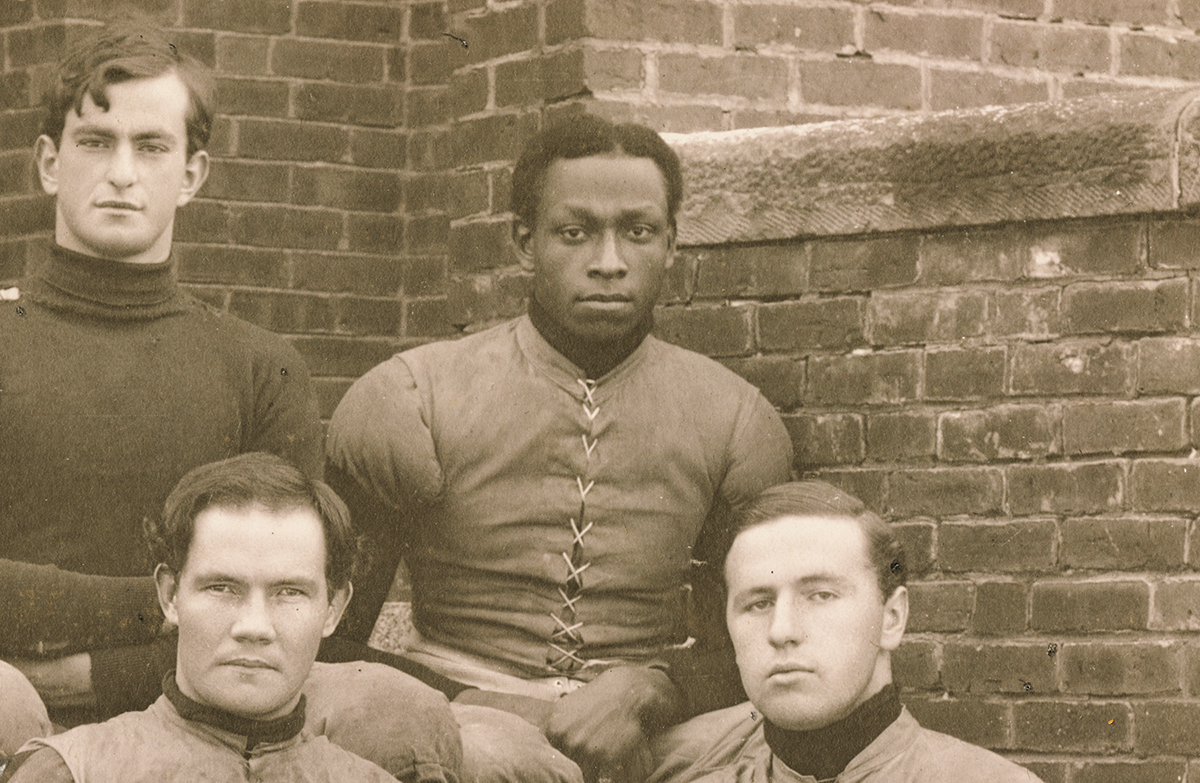
Stagg also headlines an impressive list of Exonians who have served as the head football coach at one of at least 41 colleges around the U.S. Included in that roster is Ernest J. Marshall, who entered football lore when he was named the first Black captain of a Phillips Exeter sports team in 1903. Marshall, who graduated from Exeter in 1904, later made a significant impact as a coach and educator at Howard University. But his story before and after his time at Howard is equally notable. He was a passionate leader, student, athlete, outdoorsman, coach, professor and physician.

Born to humble beginnings in Baltimore, Maryland, in the post- Reconstruction era, Marshall left home in 1897 to spend three years at the famed Hampton Institute. A precursor to Hampton University, the institute was founded in 1868 to educate formerly enslaved people. The Virginia Museum of History and Culture notes that it trained an “army of Black educators,” including Booker T. Washington.

At Hampton, Marshall was mentored by the Institute’s president, Hollis B. Frissell, an Andover graduate. After graduating from Hampton in 1900, Marshall trekked to Boston where he worked for a year to raise funds for his education. In a December 1900 letter to Frissell, Marshall expressed having experienced racial challenges in the north while also laying out his goals: “During the few months I have been here I see [the] value [of your warnings] a great deal more than ever before. This I think is due to experience. … As I have told you before … Next year, I expect to go in some school and after I finish, I shall then go in the South to do the best I can.”

Marshall arrived at Exeter with minimal resources as a 10th grader in 1901 to prepare for college. In Marshall’s time, Black students encountered a difficult social experience at the Academy. For instance, one of Marshall’s housemates, the Black poet Charles Frederick White, a member of the class of 1907 for a short time, later wrote that despite being “exceptionally well and brotherly treated by the faculty [and] other non-Negro-hating boys,” he was met with “southern prejudice,” by a particular group of threatening students, which cued his departure prior to graduation.

Indeed, during the 1902 spring track season, Marshall and another Black member of the team were not welcome to eat at the training table with their white teammates, provoking them to withdraw from the team. The Boston Globe reported that while many in town supported the protest, “In student circles … feeling against them [was] very bitter, and in the march of the school from the campus after the [track] meet, they were treated with contumely.”

The Globe contended that Marshall’s treatment was “in direct variance with the Exeter spirit,” given that in previous years Black athletes had typically eaten at team training tables.

Others who lived with Marshall in the segregated J.W. Field’s House succeeded at Exeter, leading to impressive careers. Marshall’s housemates included two members of the class of 1904: his lifelong friend Eugene Clark of Washington, D.C., a preeminent educator in Black schools, and Newlyn Cashin, a distinguished physician in his native Alabama. In addition, Fenwick Watkins, class of 1905, from Burlington, Vermont, who starred in football, basketball and baseball at the University of Vermont, had a successful career in coaching and real estate in North Dakota; and Benjamin Seldon, class of 1907, from New Jersey, was an early promoter of Pan-Africanism and a regular collaborator with W.E.B. Du Bois. Seldon conveyed lifelong gratitude to the Academy for helping him become a trailblazing educator.

Marshall persevered during his time at Exeter. A strong student, he became one of the top athletes in the school and served on the PEA Athletic Association, the student voice for athletics at the time. In competition, Marshall rejoined the track team and found renown on campus for his exploits, becoming the school record-holder in both the shot put and discus in 1903. Further, Marshall was a standout on the football team, earning a spot on the “Academy Eleven” for all three of his years at Exeter, the only player to do so during his time.

During the spring of 1903, the team met to determine its captain and Marshall emerged as the top choice. Marshall’s selection was monumental for the Academy as well as the American sports scene of the time because Black players were a rarity on major athletic teams. Though Black players began playing on the Exeter football team as early as 1893, none had ascended to the role of captain before Marshall, moving news agencies around the country to pick up the story. “Colored Man Elected Head of Exeter Football Eleven — He is Popular Here,” The Boston Globe reported on June 6, 1903. The following day The New York Times wrote, “Ernest J. Marshall, ’04, of Baltimore … is the only colored boy to be honored with a captaincy of an athletic team at Exeter,” and The Trenton Evening Times declared, “Negro Boy Captains Exeter.”

The headline of Marshall’s hometown Baltimore American read: “Colored Lad Captain of Football Team: Ernest J. Marshall, of This City, to Head the Crack Eleven of Phillips Exeter.” The article continued: “He has been one of the most popular students at the school and stands high in his studies, as well as in athletics. Although personally well liked, there was dissatisfaction when his name was first suggested [for] the captaincy of the school football team, but this appears to have died away and his election was unanimous.” The Cleveland Gazette added, “He was the only logical candidate for the captaincy.”

In 1903, the Academy hired noted coach Eddie N. Robinson, who had previously been the head coach at the University of Nebraska (1896-97) before a legendary run at Brown University (1898-1901, 1904-07, 1910-25), where he coached the school’s first Black player, Hall of Famer Fritz Pollard, in 1915 and 1916. At Exeter, Robinson took over a program that had struggled to a 2-4-3 record in the previous season, including a demoralizing 29-17 loss to Andover.

Roughly 60 players returned to campus vying for a spot on the Academy Eleven. The roster featured a “who’s who” of football greats including future college All-Americans, Ivy League team captains, prominent head football coaches and three members of the College Football Hall of Fame. That Marshall captained this distinguished group was an inspirational undertaking given the racial climate of segregation in America at the time.

The 1903 schedule featured daunting competition against college varsity teams including the University of New Hampshire, Tufts, Bates and Bowdoin. Exeter had, in fact, defeated the Boston College varsity during Marshall’s lower and upper years. Coach Robinson and captain Marshall guided the Academy to an 8-0-2 record, including eight shutouts, while outscoring opponents, 134-16.

Prior to the Andover game, Robinson commented in The Exonian, “Marshall, captain and left tackle … is a hard worker, and sets the team a good example in this respect.” The Boston Journal reported: “Up in the Granite State Exeter will meet its greatest rival, Andover. … Andover will undoubtedly be the favorite … No matter what … Capt. Ernest Marshall, the colored leader at Exeter, will be surrounded with a team up to the standard.”

In a 14-11 triumph, Marshall ushered his team to victory by opening holes on offense and making a timely fumble recovery to secure the game and undefeated season. The Exonian headline read: “A GREAT VICTORY FOR CAPTAIN MARSHALL AND HIS MEN.” In short, despite the racial challenges, Marshall’s captaincy proved to be exceptionally successful. His 1903 unit was the greatest Exeter football team to that point and remains one of the best in Academy history.

Less than a month after that win over Andover, Marshall announced his college plans. The opening page of the December 1, 1903, Boston Journal sports section reported, “Ernest J. Marshall, the colored lad who successfully brought the Exeter team to victory in the annual game with Andover, intends [on] entering Williams College next year.”

Upon arriving in Williamstown, Massachusetts, Marshall excelled in the classroom and for the football and track teams. He and his Exeter classmate Eugene Clark were among only four Black students on campus. Marshall set a new standard for the track team by smashing the school record in the shot put in 1906, while earning six letters in football and track. Alumni notes remembered Marshall as “a star athlete at Williams who rated the highest honors” in his studies.

Marshall left Williams after three years to complete his bachelor’s degree at the University of Michigan. Afterwards, he spent the summer of 1908 preparing for Yale Graduate School but was unable to afford the move and began graduate school at Michigan. Writing to the Hampton Alumni Office, he said: “I did not have a very successful summer [earning wages] so I came back to Michigan because it is cheaper.”

Marshall’s student experience spawned his desire to remain in education: “I finally decided to devote my time to the study of foods, both from the chemical and bacteriological sides. … [There’s] a good chance to get a position at some school to teach this branch of chemistry. If necessary, I shall be perfectly willing to teach the foundation subjects such as Elementary Chemistry, Hygiene, and Biology.”

In fact, shortly into his graduate school stint in Ann Arbor, Marshall accepted a post at Howard University in Washington, D.C. At Howard, from 1909-21, he held numerous roles, including assistant professor in chemistry, instructor in English, director of athletics and head football coach.

In eight seasons as head football coach, Marshall accumulated an impressive record of 31-4-4, including four straight seasons (1909-12) in which his team was undefeated and unscored upon. One student at Howard remarked, “Coach Marshall knows the game of football from the ground up.”

Indeed, Marshall’s leadership profoundly changed the nature of Howard’s athletic program. In December 1911 the Howard University Journal noted, “From the very time that Coach Marshall came here, athletics took on a new life in our University, and a new spirit was shown by the student body.”

Marshall affirmed, “As long as I am here the [Howard] colors will never trail in the dust.” But his team did not have the opportunity to play against the nation’s top white teams, at which several of his Exeter breth-ren were playing or coaching. The Howard faithful voiced strong opinions in the Journal: “There is no doubt, but that Howard has one of the best all-around elevens in the country. All of this is due to Coach Marshall’s untiring and conscientious work with his men … From the beginning he thrust himself, full of vigor [and] spirit, into his work, and has brought athletics to the high point it has never before reached.” One player said, “In Coach Marshall we have one of the best coaches in the country, a man whose judgment of men cannot be doubted.”

Always a passionate advocate for his players, Marshall pushed the university administration to raise money for a new athletic facility, and the community rallied behind him. In December 1913, the Journal wrote, “Coach Marshall has done excellent work for Howard, as everyone testifies; coming to us in 1909 when our team needed a strong guiding hand, he soon established our record in football by a string of unbroken victories.”

In his final season as coach in 1916, the Journal reflected on Marshall’s effect on the program: “The greatest asset to the football squad is Coach Marshall. He has certainly done his share in developing a strong and powerful Howard machine … That he has succeeded can easily be attested by the large gate receipts … The men hold him in the greatest esteem, and never refuse to obey his orders or heed his calls.”

Marshall remains the greatest coach in Howard’s history. After stepping down as football coach in 1916, he remained at Howard as a chemistry professor through the 1920-21 academic year. In 1916, one student reflected, “The fact that much of his time must of necessity be spent in the classroom has not in the least caused him to lose a single morning’s practice, or to show any sign of indifference to his pedagogic work,” and asserted that the professor and coach “is doing the work of three men.” The spirit of Marshall’s Exeter education — faithfully adhering to his non sibi principles — is evident in these statements from his students at Howard.

Marshall’s influence extended to other historically Black colleges and universities. He co-founded the Colored Interscholastic Athletic Association, now known as the Central Interscholastic Athletic Association, an NCAA conference member. Marshall was a pioneer for HBCU football, spearheading the growth of Black athletic programs across the mid-Atlantic and Southeast. The trophy given to the winner of the football game between Howard and Morehouse College was co-named for Marshall, and the CIAA inducted Marshall into its Hall of Fame in 1985.

The pursuit of his life’s passion to be a physician prompted his move to graduate school at the University of Chicago. He took the requisite courses during the 1921-22 academic year to prepare for admission to Northwestern Medical School, where he completed his degree in 1927.

Marshall overcame significant adversity to become one of Northwestern’s early Black medical school graduates. To pay tuition, he took a job at the Chicago Post Office. The school’s registrar, C.W. Patterson, wrote a letter of concern to the postmaster regarding Marshall’s shift hours stating, “It appears that [Marshall] has been depending on earning a part of his expenses by outside employment … [occupying] his time from 11 o’clock in the evening to 7:30 in the morning. I have told him that it was out of the question to carry the medical course, giving so much time to outside employment.”

The postmaster, however, was unyielding and did not shift Marshall’s hours.

Patterson felt strongly that Marshall should receive the opportunity to continue his studies with a more convenient work schedule: “Mr. Marshall is a high-class colored man, a graduate of the University of Michigan and a graduate student of the University of Chicago. He has made a good beginning with us.” Northwestern eventually hired Marshall as a night guard and as a laborer for campus renovation projects so he could remain a full-time student. He also worked four hours a day at Chicago’s Wesley Memorial Hospital to receive room and board there.

Marshall continued searching for creative ways to pay his tuition. With Patterson’s help, during his third year at the school, he forged a relationship with Julius Rosenwald, the Chicago philanthropist and co-owner of Sears, Roebuck and Co. Rosenwald had supported numerous African American causes, notably, Black education and the growth of Black YMCAs across the country. The registrar wrote to Rosenwald that Marshall “has carried his schoolwork very well under rather serious financial handicaps. … On account of his record I would wish to do everything possible to help him.”

At the time, Marshall was in arrears for the two previous semesters and his future at the school was in peril. Rosenwald came to his aid, covering the two semesters of debt and paying future costs, to which the registrar replied, “I am very glad indeed to learn that Mr. Marshall is to receive this assistance and I have every reason to believe that he is deserving.”

Likewise, Rosenwald’s secretary, William Graves, was happy to learn that Marshall’s studies would not be interrupted: “[He] has been under considerable pressure to support himself, and I [offer] a personal endorsement in addition to what Mr. Rosenwald is advancing.”

When Marshall completed his studies, Graves observed, “Mr. Rosenwald shares the satisfaction … that Mr. Marshall was able to complete his work satisfactorily and to finish the course with his class.”

Shortly after departing Chicago, Marshall wrote an emotional letter of appreciation to Patterson, the Northwestern registrar: “Please let me thank you for the many kind things you did for me while there. Without your help I never could have made it, and I shall ever be grateful to you.”

Marshall spent the following year completing a residency at Kansas City General Hospital in Missouri. He practiced medicine in Kansas City for the rest of his life. Keeping an office as a general practitioner for over 30 years, Marshall was also a member of the staff at Wheatley-Provident Hospital and General Hospital while being active in the Kansas City Medical Society, Missouri Pan-Medical Society and Alpha Phi Alpha, a historically African American fraternity. In addition to being a respected member of Kansas City society, Marshall maintained his enthusiasm for sports and the outdoors until he died in 1959. He was survived by his wife; a son, who also became a physician; and three grandchildren.

Throughout his life, Marshall understood what was important in education, not only to him, but also to students. Shortly before his death, he wrote: “If you learn only what’s in a book, then one school is about as good as another. But when a student comes in contact with [a transformational teacher] he gets something he never forgets and is even thankful for having known such men — they make the [school].”

Marshall’s career as an educator embodied this ideal. As one of his Howard students stated, “The deepest and most profound respect exists between [Coach Marshall] and his men.” This sentiment is akin to that of the Academy’s Deed of Gift, which states, “above all, it is expected that the attention of instructors to the disposition of the minds and morals of the youth under their charge will exceed every other care.”

Marshall stayed intellectually active deep into his life. He maintained a concern for world affairs with an eye toward the future. In 1958 he wrote: “We have come through two major wars, a depression and a police action. How much has been learned — very little I fear except improving the fine art of killing. I wonder where it will end. If world leaders can’t or won’t agree, I fear the great masses of humanity will get out of control and we know what the end will be.” Marshall’s compassion and empathy, developed through his vast experiences, were evident until the very end.

When Marshall died, Eugene Clark, his lifelong friend from Exeter and Williams, wrote: “We will remember Ernest as a great athlete and a fine guy. His successful struggle to get an education without any financial backing revealed his strength of character.”

Indeed, Marshall needed immense strength of character to live an impactful and extraordinary life when racial integration was far from commonplace in America. And he was proud to credit the foundation he received during his time at the Academy.

In a 1958 letter to the Williams Alumni Office, he wrote, “I prepped at Exeter, the greatest in the world.”

Panos Voulgaris is in his third year at Exeter as head football coach and an instructor in physical education. Prior to joining PEA, he led three different football programs to championship seasons and taught history for 15 years. In 2022, he guided Exeter to a 7-1 season, the team’s best record in the last decade.

This story was originally published in the Fall 2023 issue of The Exeter Bulletin.

Exonians in the College Football Hall of Fame 

Exeter’s contributions to the growth and development of football at the turn of the 20th century are well remembered in the annals of the College Football Hall of Fame.

Name

Amos Alonzo Stagg

PEA

1885

Colleges

Yale/Springfield/Chicago/Pacific

Year inducted

1951

Lee McClung 1888 Yale 1963
Marshall Newell 1890 Harvard 1957
James Hogan 1901 Yale 1954
Jim McCormick 1904 Princeton 1954
Howard Jones 1905 Syracuse/Yale/Ohio State/Iowa/Duke/Southern California 1951
T.A.D. Jones 1905 Syracuse/Yale 1958
Ed Hart 1907 Princeton 1954
Eddie Casey 1915 Harvard 1968
Donold Lourie 1918 Princeton 1974

The power of ‘youth from every quarter’

Our Deed of Gift, signed by John and Elizabeth Phillips in 1781, states that Exeter “shall ever be equally open to youth of requisite qualifications from every quarter.” 

Since the decision to become a coeducational school in the fall of 1970, my senior year, Exeter has been a leader among secondary schools in building a more diverse and inclusive community. We seek students of promising academic ability and strong character from a wide range of backgrounds, experiences and identities, and we admit students without regard to their family’s ability to pay tuition. The rich diversity of students that results creates a powerful learning environment and is one of the defining strengths of our school.

This year we have 1,078 students from 39 countries and 45 states and territories. Almost half are recipients of financial aid. They bring an impressive diversity of talents and interests. Students drive their learning at Exeter, inside and outside the classroom, and we look forward to seeing all that they will accomplish this year in academics, the arts, athletics, extracurricular activities, student leadership roles, community service, and in so many other ways. It will be exciting to see them grow in ways they never could have imagined before coming here. It has been nothing short of wonderful the first few days of the fall term to see how excited all our students, new and returning alike, are to be here, and how quickly new friendships form at the beginning of each year.

At Opening Assembly, I reminded our students that to realize fully the promise of our diverse community of learners, and to make the most of the opportunities through Harkness to learn with and from each other, we must be fully committed to diversity of thought and free expression. Robust debate and free intellectual inquiry are fundamental to our educational method and mission, just as freedom of expression is a pillar of a healthy democracy. I told our students we must learn to be comfortable being uncomfortable, and understand that we should expect a diversity of viewpoints on almost every subject worth exploring. Learning in this way propels our growth as individuals and as a community. It is how we prepare our students to be the citizens and leaders that our world needs.  

I also spoke to our students about the gratitude we all should feel for the privileges we enjoy as members of this very special school community. Our gratitude extends to prior generations of Exonians who have helped make Exeter what it is today, and to all adults here and at home who will support our students and our school this year. We show our gratitude by how we make the most of the opportunities that are given to us, by how we strive for excellence in all that we do, and by how we incorporate the spirit of non sibi in our daily lives.

So, as we begin the 243rd year in the history of our school, I express gratitude to all alumni, families and friends of the Academy for your belief in the mission of our school and for your steadfast support. 

This story was originally published in the Fall 2023 issue of The Exeter Bulletin.

Chatbots in class?

Throughout my time at Exeter, history classes and essay writing have been inseparable.

My own public school history class assessments mostly consisted of multiple-choice exams, memorizing facts and circling the correct answer, occasionally compiling them in a string of sentences that passed as an essay. But at Exeter, we strive to teach history as a means for developing critical thinking skills, emphasizing use of evidence, engaging narration, and close reading of sources. And while there are many ways to hone these skills, writing has been a crucial one; it’s hard to imagine teaching history at Exeter without having a stack of essays to grade at some point each term. But last year, ChatGPT threatened to upend everything.

An acronym for Chat Generative Pre-trained Transformer, ChatGPT is perhaps the most infamous version of a number of new artificial intelligence chatbots that can converse using “humanlike conversational dialogue.” According to one tech website, “the language model can respond to questions and compose various written content, including articles, social media posts, essays, code and emails.” Basically, ask ChatGPT a question, and it will give you an answer, sometimes a lengthy one. Shortly after it was released last November, I decided to try it out by asking it to write the essay my students were currently working on. I typed in the essay question, and in a matter of seconds, the interface produced what seemed to be, at first, a well-organized and cogent three-page essay.

I’ll be honest that I had a moment of alarm. Was it possible that every student in my class could simply spend two minutes using ChatGPT and come away with a submittable essay? But, as I read the piece more carefully, I became less impressed. The analysis was general, vague, and lacked specific examples. When I prompted the interface to provide more specifics, problems arose. Scenarios and page numbers were inaccurate, and the writing did not clearly link examples to analysis. We now know these problems to be widespread; one lawyer submitted a ChatGPT-written brief that cited imaginary court cases, and librarians have received bibliographies of sources that do not exist.

Feeling confident that the essay assignment was secure, I decided to go bold: I walked into class and projected ChatGPT for the students to see. “I know you’ve heard about this, but I just want to show you why it’s no good,” I explained as I entered the essay prompt. As the screen started writing, though, the reaction of my students was not what I wanted.

“This is amazing!” several students said. “I’m never going to write an essay again,” one student remarked. (Perhaps my boldness rubbed off on them.) Even as I tried to point out the vagueness, generalizations and analytical flaws, the students remained captivated. The best I could do was to remind them of our new history department policy that using AI was simply not allowed, but I left the class wondering if they had gotten the message.

Despite my chagrin in that moment, I still have hope for the longevity of human-written essays, and I plan to continue assigning them. After all, I have high standards for my students: to distinguish evidence from generalizations; to support their analysis with strong, specific evidence; and to inspect the texts they read for these details, too. I haven’t yet seen evidence that AI can do this type of analysis well; AI-generated text seems to specialize in writing the generalizations that make me comment in the margins, “What evidence supports this claim?”

Most importantly, I want my students to write about history with accuracy and nuance. “Accurate” is the first category on the rubric I give my students, and I weight it twice as much as any other category when I grade essays. And despite the promises that technologies will improve over time, the “bugs” of inaccuracy I have described seem to be “features” of AI-generated text that works through prediction. But even if AI-generated text is accurate, I want my students to be able to explain how we know it’s accurate, and that requires attention to sources, inspecting them for trustworthiness and limitations. Arguably, in an era where “information” (accurate or not) is just at our fingertips, evidence-based essay writing using credible sources is more important than ever. Until we can trust the accuracy of AI, its uses for history essays will remain limited.

As a history teacher, I’m also skeptical about the use of AI for deeper historical analysis, for a simple reason: Humans are not algorithms. Despite what many nonhistorians believe, human behavior is not easily predictable. Indeed, that’s what makes the study of history so interesting; humans over time have made surprising, impressive, disappointing, maddening and fascinating decisions, some of which parallel the actions of their predecessors and some of which are unique. I want my students to study these people of the past closely, dig into the details of their decisions, and understand how the world around them shaped their actions; it’s not clear to me that a predictive algorithm can inspect the specifics of the past with this level of rigor.

This does not mean that I plan to forever ban AI from the classroom; like any technology tool, it has its uses. I’ve found that it provides good basic descriptions of historical events, for example, not unlike an encyclopedia (or Wikipedia, for that matter). But just like our math teachers who still insist that certain assessments are “no calculators allowed,” I want my students to recognize the errors and flaws that can occur if one is not using the technology carefully. I’d love to see my students annotate a ChatGPT-written essay, for example, using the margins to add evidence or critique its claims. While it’s important to learn how to use the technology, it’s just as important to develop the analytical skills to recognize when the technology is incorrect, the same way students might punch the wrong numbers into a calculator but know enough math to realize they made an error.

My most important goal as a teacher is to get my students to think, and I’ll keep striving to create assessments and provide feedback to sharpen their thinking, so that when they use AI technology, they can use it well and avoid its pitfalls. Even if that means I’ll still have that stack of essays to grade.

Betty Luther-Hillman is the Lewis Perry Professor in the Humanities and an instructor in history. She has taught at Exeter since 2011 after earning a Ph.D. in history from Yale University.

This essay was first published in the Fall 2023 issue of The Exeter Bulletin.