Phillips Exeter Academy

The power of ‘youth from every quarter’

Our Deed of Gift, signed by John and Elizabeth Phillips in 1781, states that Exeter “shall ever be equally open to youth of requisite qualifications from every quarter.” 

Since the decision to become a coeducational school in the fall of 1970, my senior year, Exeter has been a leader among secondary schools in building a more diverse and inclusive community. We seek students of promising academic ability and strong character from a wide range of backgrounds, experiences and identities, and we admit students without regard to their family’s ability to pay tuition. The rich diversity of students that results creates a powerful learning environment and is one of the defining strengths of our school.

This year we have 1,078 students from 39 countries and 45 states and territories. Almost half are recipients of financial aid. They bring an impressive diversity of talents and interests. Students drive their learning at Exeter, inside and outside the classroom, and we look forward to seeing all that they will accomplish this year in academics, the arts, athletics, extracurricular activities, student leadership roles, community service, and in so many other ways. It will be exciting to see them grow in ways they never could have imagined before coming here. It has been nothing short of wonderful the first few days of the fall term to see how excited all our students, new and returning alike, are to be here, and how quickly new friendships form at the beginning of each year.

At Opening Assembly, I reminded our students that to realize fully the promise of our diverse community of learners, and to make the most of the opportunities through Harkness to learn with and from each other, we must be fully committed to diversity of thought and free expression. Robust debate and free intellectual inquiry are fundamental to our educational method and mission, just as freedom of expression is a pillar of a healthy democracy. I told our students we must learn to be comfortable being uncomfortable, and understand that we should expect a diversity of viewpoints on almost every subject worth exploring. Learning in this way propels our growth as individuals and as a community. It is how we prepare our students to be the citizens and leaders that our world needs.  

I also spoke to our students about the gratitude we all should feel for the privileges we enjoy as members of this very special school community. Our gratitude extends to prior generations of Exonians who have helped make Exeter what it is today, and to all adults here and at home who will support our students and our school this year. We show our gratitude by how we make the most of the opportunities that are given to us, by how we strive for excellence in all that we do, and by how we incorporate the spirit of non sibi in our daily lives.

So, as we begin the 243rd year in the history of our school, I express gratitude to all alumni, families and friends of the Academy for your belief in the mission of our school and for your steadfast support. 

This story was originally published in the Fall 2023 issue of The Exeter Bulletin.
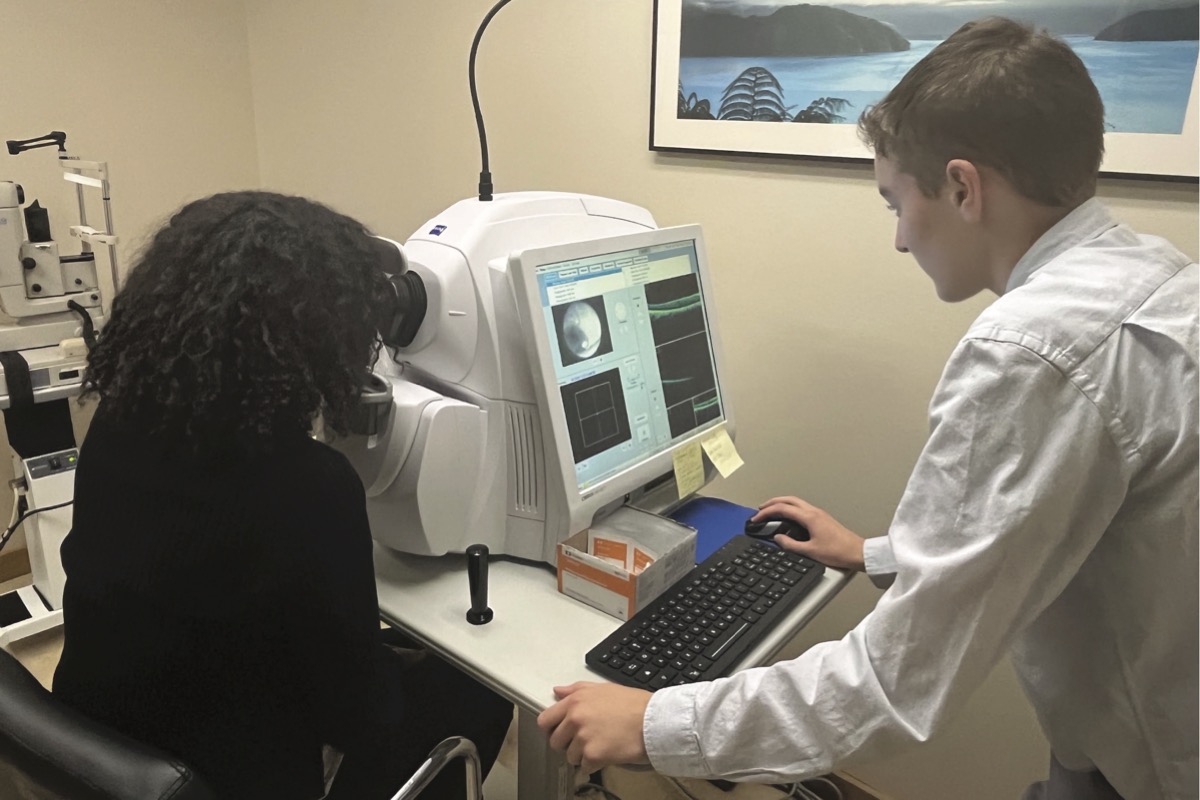
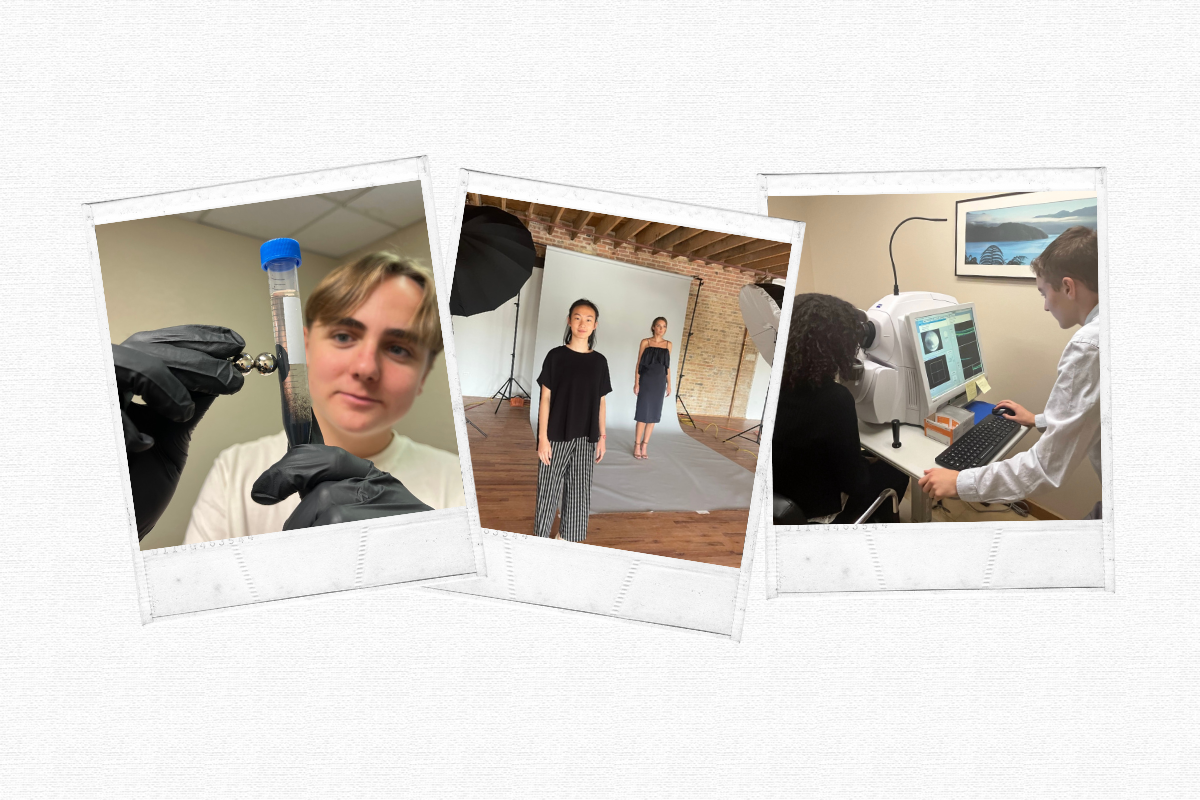
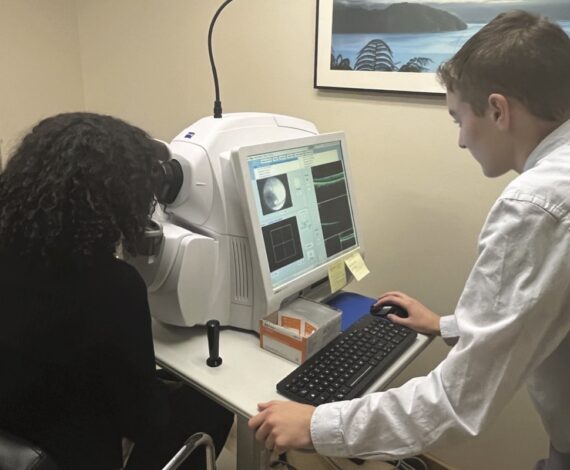
Follow me: Exploring clinical medicine

Exeter Deconstructed: Grill

For more than a century, Grill has been the go-to spot on campus for grabbing a snack between classes, fueling up for late-night study sessions, avoiding dining hall — or all of the above.

The first Academy Grill opened in late 1920 in an old schoolhouse behind Peabody Hall, opposite Hoyt Hall. When that building was torn down in 1941, Grill relocated to the basement of Alumni Hall, now part of the Frederick R. Mayer Art Center. The new space seated 125 and, like the original Grill, resembled a diner, with a counter lined with stools, and tables and chairs.

At “Senior Grill,” a long-running tradition that kicked off in 1957, Exeter’s oldest students headed to Grill on Tuesday and Friday nights to watch television, play cards and smoke — at least until smoking was banned on campus in the late 1980s. By that time, Grill had moved to the basement of the remodeled Lamont Gallery and featured a jukebox, purchased with funds raised by the Student Council.

Grill moved again in 2006, finding its present home in the newly constructed Academy Center, now known as the Elizabeth Phillips Academy Center. In addition to a convenience store stocked with cold drinks, freezer items and snack foods, hot food is available to order, and there’s seating for 85 people.

Students pack the place during midmorning break times, especially right after assembly, says Scott Jeffco, Grill’s manager. Among the top-selling items are the popular Grill cookies, baked in-house and priced at 50 cents apiece. Grill sells around 200 of these oversize chocolate chip treats every schoolday.

Just remember: Don’t call it the Grill. The article fell out of favor somewhere around the move to the Academy Center. “It’s just Grill,” Jeffco says. “I made the mistake of saying ‘the Grill’ once and a student let me know, ‘You are wrong.’”

This article first appeared in the Fall 2023 issue of The Exeter Bulletin.

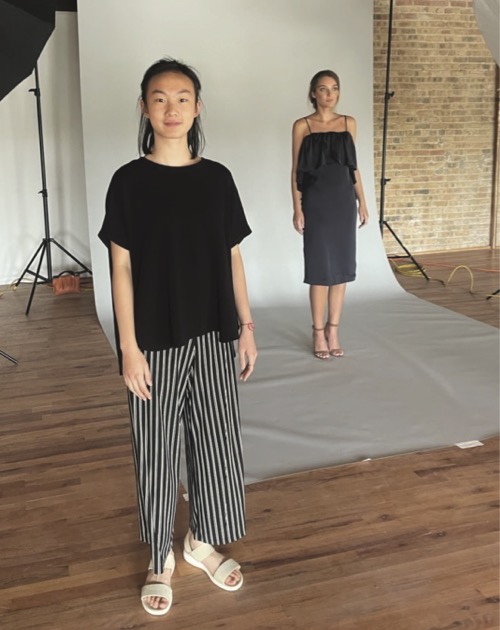
Follow me: Exploring sustainable fashion

Student stands in front of photoshoot backdrop with clothing model in background

Imagining our future

More than 200 Exeter alumni, guests, faculty, staff and trustees convened on campus for a weekend in October to celebrate 55 years of the Afro-Latinx Exonian Society, or A.L.E.S. Founded in 1968 as the Afro-Exonian Society, A.L.E.S. has served ever since as a vital place to support and share the culture and history of Exeter’s Black and Latinx students.

The anniversary programming kicked off with a welcome from the event’s hosts, Academy Trustees Wole Coaxum ’88; P’24 and Paulina Jerez ’91; P’21, in the Class of 1945 Library. Principal Bill Rawson ’71; P’08 offered opening remarks, followed by Academy Trustee Eric Logan ’92 and Magee Lawhorn, Exeter’s head of Archives & Special Collections.

“I submit to you that on Monday Exeter will not be the same school it was yesterday,” Rawson said. “You will be responsible for how we are learning, growing and changing as an educational institution this weekend by being together, telling and hearing your stories, celebrating and reflecting on where we have been, what we have become, and imagining our future.”

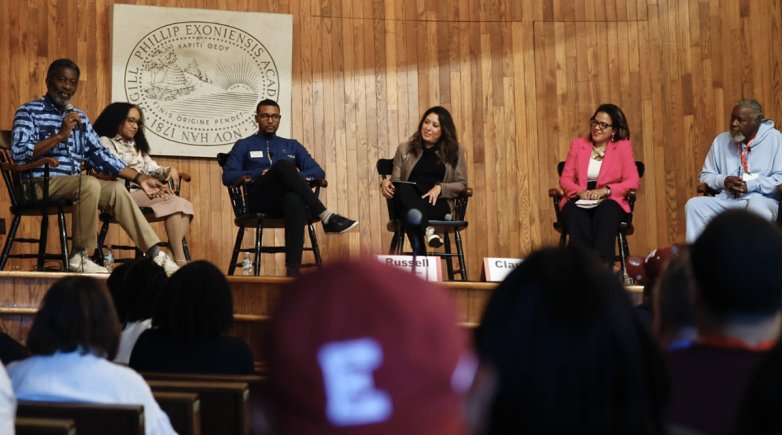
Saturday’s panel discussion was a program highlight. Moderated by Dean of Students Russell Weatherspoon ’01, ’03, ’08, ’11 (Hon.); P’92, P’95, P’97, P’01, the panel brought together current students and five alumni spanning five decades with professional expertise in the fields of journalism, medicine, law, venture capital and public policy. The conversation centered on how core values such as knowledge, goodness, truth and justice can be channeled to address the enduring and thorny challenges involving race in our society. A consistent theme emerged: the importance of people of color in general, and Exeter alumni in particular, reaching across generations to support each other.

“When we think about knowledge and access and goodness…it’s complicated to break through those silos, to break through those attitudes, to break through those beliefs,” said Stephanie Neal-Johnson ’85; P’19, COO of the Massachusetts Department of Labor. “But at the end of the day, having those conversations as we are today [is] really what will make the difference.”

Panelist Veronica Juarez ’00, a Houston-based social enterprise investor, spoke of forming her own venture capital firm to invest in companies headed by Latinx founders. “It’s critical for us — being a part of the game, playing the game, getting into this asset class of investing,” Juarez said. “Typically those opportunities have not even been presented to us because they’re private… . You would only access this via your friends who tell you in a closed-door meeting. So, this is our closed-door meeting.”

Claudia Cruz ’96, director of internships and experiential learning at the University of Nevada’s Reynolds School of Journalism, said: “Journalism is important, but we’re not always conveying all the information or all the truths to all the right people. If we did that, could we balance the scales a bit?”

Dr. Leroy Sims, ’97, head of medical operations for the National Basketball Association, spoke of the need for people of color to seek out — and to become — sponsors, rather than mentors.  “A sponsor has to know what your motivations are, what your capabilities are in order to be able to advocate and to be able to say, ‘I’m going to bring you along,’” he said. “It’s just not an invitation… . You need to feel like you belong in that room.”

Mark McClain ’74; P’08, a Baptist minister and attorney from East Cleveland, added, “We can put our minds together and we can really find out what truth is, what justice is. All of these things we talk about as ideas or ideals — we can bring them to reality.”

Upper Sophie Goldman ’25 shared her gratitude and impressions of the event, eliciting applause and visible emotion from the panelists and many in the audience. “I’ve never been in a room where people who looked like me were able to speak these hard truths,” Goldman said. “I want to connect with the alumni in this room because it’s important that…we can make sure the truth changes for the next generation and we’re able to see our own truth.”  

Coaxum offered a touching tribute to Weatherspoon, who is set to retire at the end of this school year after 37 years of service to the Academy. “For many of us, Mr. Weatherspoon played an essential role in our lives as students and continues as we navigate the world as an adult,” Coaxum said. 

To round out the weekend’s programming, attendees and current students enjoyed several appearances by John Forté ’93, the Grammy-nominated recording artist, songwriter, activist and filmmaker. 

At the celebration’s closing dinner in William Boyce Thompson Field House, physician-scientist Dr. Emery Brown ’74, recipient of the 2020 John and Elizabeth Phillips Award, offered some keynote remarks based on his own academic and career journey. “Exeter got me on the road…so I could have a seat at the table. It started that process for me and I’m totally grateful for that,” Brown said. “I think another part of the good fortune I’ve had has been bringing up ideas, or thinking out of the box. What I’ve noticed in problem solving is people will try to solve problems [by] extending what is already being done, as opposed to standing back for a minute and saying, what is it that we really need?”

Amid this packed slate of events, visiting alumni enjoyed some free time to attend sporting events, an A.L.E.S. club meeting and a Morning of Remembrance in the Forrestal-Bowld Music Center, officiated by Bryan Contreras ’91; P’24, to honor those who have touched the lives of the A.L.E.S. and the greater Exeter community.

Before departing campus, alumni and students shared a community-building brunch with Stephanie Bramlett, director of equity and inclusion; and Kevin Pajaro-Mariñez, assistant director of equity and inclusion. 


Celebrating 55 Years of A.L.E.S

Alumni across generations gather to celebrate the enduring impact of the Afro-Latinx Exonian Society.  

>> See more from the weekend

Follow me: Exploring synthetic chemistry

Mentor: Manuel Montori ’12, biotech engineer
Student: Nora Sharma, Charles Potje

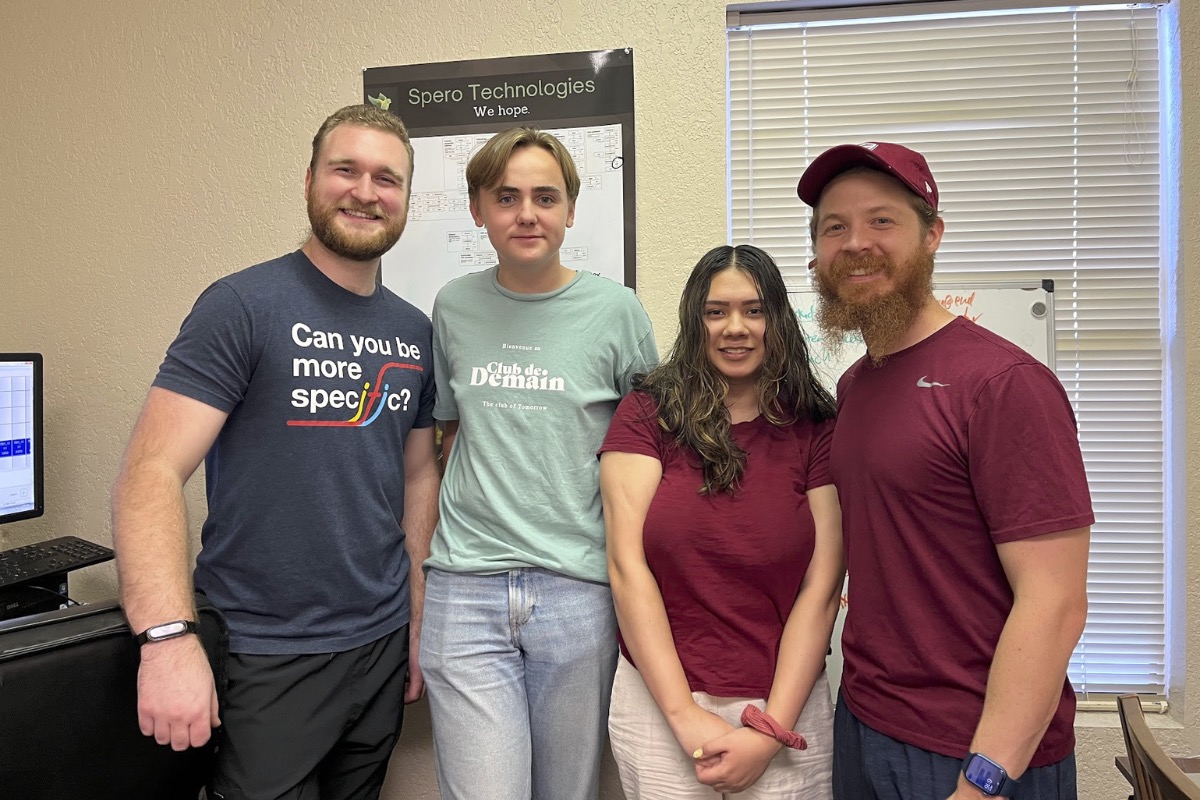
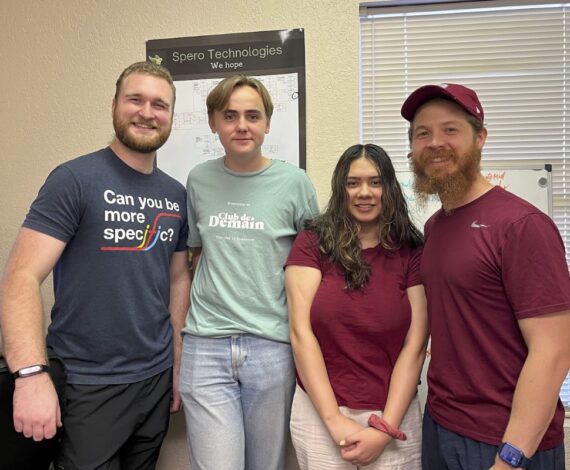
Nora Sharma ’24 and Charles Potjer ’24 worked alongside Manuel Montori ’12 in the lab at his Austin, Texas, startup, Spero Technologies. Montori and his co-founder are conducting research to benefit biological manufacturing technology, using a system based on recombinant enzymes to produce compounds like pigments, vitamins and aromatics.

Sharma and Potjer familiarized themselves with Spero’s research and the academic literature supporting it, then moved on to tasks in the lab. Sharma streamlined the lab’s process of growing Physarum enzyme in a bioreactor. Potjer replicated a process called chitin-binding, or immobilizing enzymes, making it easier for them to be purified and increasing their life span.

From the left: Nora Sharma ’24, Charles Potjer ’24

Potjer was impressed by the autonomy he was granted. “I worked one-on-one every day with the company founders and worked independently, helping with lab work, designing experiments and reading through copious amounts of papers,” he says. “I felt like my voice mattered. I got to think creatively, take risks and operate with a level of independence I don’t think I could have in many other spaces. It certainly wasn’t a traditional lab research experience — which is why I loved it!”

Montori lauded the students, saying: “We were impressed by Nora and Charles’ ability to dive into some pretty complex and specialized science, both reading literature and executing experiments in the lab. It was a privilege to work with them. We hope to keep fostering a great relationship with Exeter.”

This story was originally published in the Fall 2023 issue of The Exeter Bulletin.

Read more alumni mentor stories 

Exonians in review: Fall 2023

Alumni are encouraged to advise the Bulletin editor (bulletin@exeter.edu) of their own publications, recordings, films, etc., in any field, and those of their classmates, for inclusion in future Exonians in Review columns. Please send a review copy of your published work to the editor to be considered for an extended profile in future issues. Works can be sent to: Phillips Exeter Academy, The Exeter Bulletin, 20 Main Street, Exeter, NH 03833.

ALUMNI
1956—William Peace. Nebrodi Mountains: The Billionaire and the Mafia. (Strategic Book Publishing, 2022)
1968—Anthony Gantner. The City Dionysia. (Norfolk Press, 2023)
1968—John Gentry. Neutering the CIA: Why US Intelligence Versus Trump Has Long-Term Consequences. (Armin Lear Press, 2023)
1969—Richard Maurer. The Woman in the Moon: How Margaret Hamilton Helped Fly the First Astronauts to the Moon. (Roaring Brook Press, 2023)
1971—Dan Hunter. Learning and Teaching Creativity: You Can Only Imagine. (Radio Ranch Press, 2023)
1972—W. Drake McFeely. Books That Live: Norton’s First One Hundred Years. (W.W. Norton & Company, 2023)
1981—Claudia Putnam. Seconds: A Novella. (Neutral Zones Press, 2023)
1982—Judd Kruger Levingston. A Moral Case for Play in K-12 Schools: The Urgency of Advancing Moral Ecologies of Play. (Lexington Books, 2023)
1982—Julie Phillips. The Baby on the Fire Escape: Creativity, Mothering, and the Mind-Baby Problem. (W.W. Norton & Company, 2022)
1991—Sean Mahoney. “Factory Girls,” a rock musical that played at the University of New Hampshire in October.
2001—Mackenzie Hawkins, with Wonchull Park. Nowflow Breath, Movement & Mind: A Living Practice of 3 Nowflow Qualities from 3 Physics Flow Natures. (Thru Publishing, 2023)
2001—Katie Farris. Standing in the Forest of Being Alive, poetry collection. (Alice James Books, 2023)
2008—Amanda Kim, director. Nam June Paik: Moon Is the Oldest TV premiered at the Sundance Film Festival in January 2023.
2015—Lindsey Palmer, assistant. Heart of Stone, film. (Netflix, 2023)
2019—Kristen Richards. as if to return myself to the sea, poetry collection. (Indie Earth Publishing, 2023)

FACULTY
Ralph Sneeden, emeritus English instructor. The Legible Element: Essays. (EastOver Press, 2023)
Chelsea Woodard. At the Lepidopterist’s House. (Southern Indiana Review Press, 2023)

Celebrated writer and social commentator honored with Phillips Award

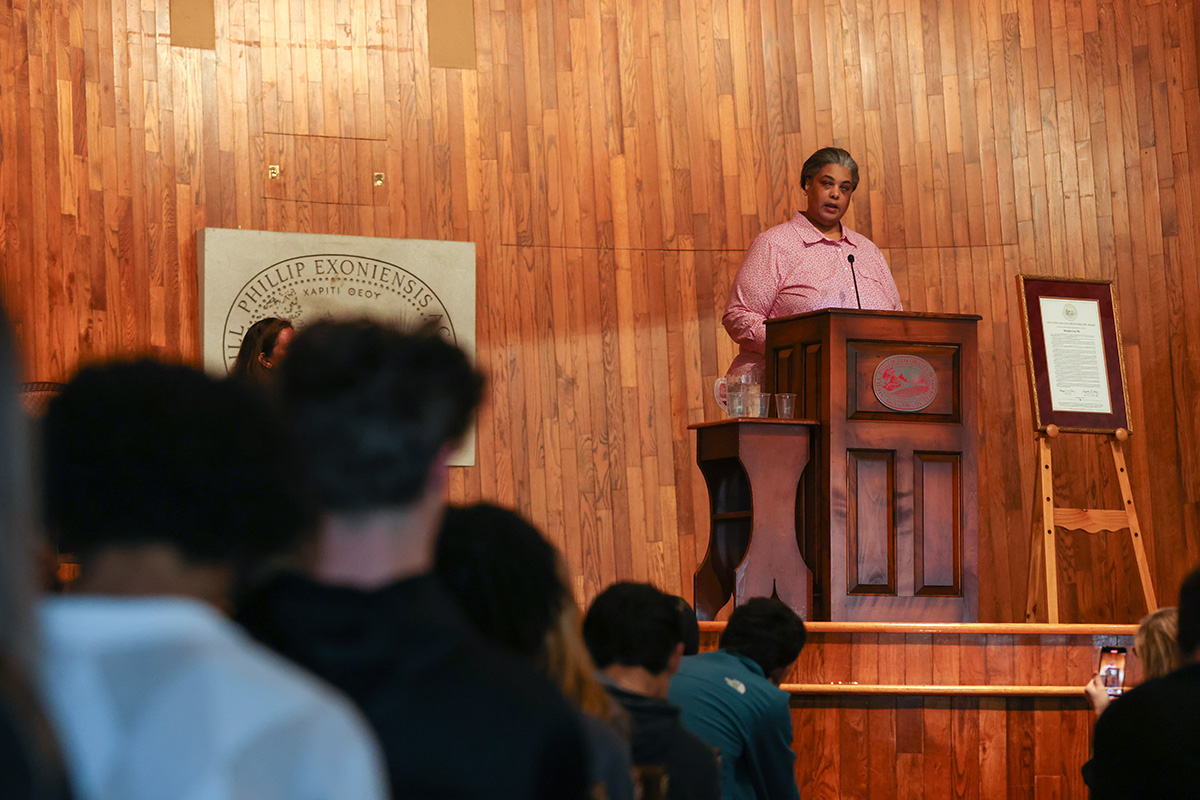
From her op-ed pieces in The New York Times to her bestselling 2017 memoir Hunger, Roxane Gay ’92 is known for writing with radical honesty, courage and compassion about some of our society’s most difficult and divisive issues. On Friday, she returned to campus to accept the John and Elizabeth Phillips Award, which recognizes an Exonian who has contributed significantly to the welfare of community, country or humanity in their life and work.

“As an author, editor and professor known for your exploration of complex questions surrounding race, class, gender and sexuality, you have become one of the leading social commentators of our time,” said Trustee and General Alumni Association Vice President Una Basak ’90, who delivered Gay’s award citation before an audience of students, faculty, staff and visiting Trustees in the Assembly Hall. “You have earned this distinction by writing about subjects that matter deeply to you, in a way that resonates with millions of readers.”

In addition to accepting the Phillips Award, the Academy’s highest honor for its alumni, Gay visited several classes during her visit to campus. Immediately following the assembly, she sat in on a combined session of REL450: Social Ethics and REL592: An Interdisciplinary Approach to Epistemology held in the Latin Study, in which students read and discussed material from her newly published essay collection, Opinions: A Decade of Arguments, Criticism, and Minding Other People’s Business.

The gift of family support

Addressing the Assembly Hall audience, which included several members of her family, Gay dedicated many of her remarks to her parents, whom she says “saw the power of possibility” in her when they made the investment in her Exeter education. “They saw what I personally would not see for decades, honestly — that I have a powerful voice and something to say.”

She spoke of her time at Exeter as “formative, in ways both good and bad.” There was her English teacher, the late Rex McGuinn, who saw something in her “very bad teenage writing” and encouraged her to take herself seriously as a writer. But she also spoke of experiencing microaggressions, and of being often underestimated by adults and peers alike.

After Exeter, Gay went on to earn her master’s and Ph.D. and began teaching at the college level, all with the goal of supporting her writing career. She published her first book, the short story collection Ayiti, in 2011. She was also blogging regularly at the time; writing articles on race, gender and culture for Salon, The Rumpus, The Nation and TIME, among other outlets; and building a reputation for sharp commentary on Twitter, then a relatively new social network.

Building a career

In 2014, Gay was on the tenure track at Purdue University when the success of her essay collection Bad Feminist launched her to a new level of fame. She published her debut novel, An Untamed State, that same year.

“I’m a writer who has achieved some measure of success because I dared to believe that I had the right as a queer black woman to articulate my understanding of the world,” Gay told the assembly audience. “From an early age, I watched my mother confidently expressing her opinions with wit and intellect… . My mother didn’t necessarily know it at the time, but she consistently modeled for me what it means to have convictions and the confidence to express them.”

Writing for a purpose

Gay spoke of the “massive social upheaval” our culture has experienced over the course of her career, including a global pandemic, a divisive political landscape, rampant misinformation, proliferating anti-LGBTQ policies, book-banning efforts and multiple wars around the world. “The climate into which I write is incredibly fraught, but I do write, nonetheless,” Gay said. “I write to express outrage or to bear witness or express admiration. I write knowing many people will disagree with me for one reason or another.”

In addition to her own writing, Gay has worked throughout her career to amplify the voices of those who are underrepresented in publishing, particularly younger authors of color. She regularly publishes essays by emerging writers in her newsletter The Audacity, which boasts more than 80,000 subscribers. In partnership with Grove Atlantic, Gay recently launched her own publishing imprint, Roxane Gay Books, with three titles in print by the end of 2023.

“People often call me an activist, but truly, I am just a writer,” Gay said near the end of her remarks. “I am fortunate enough to bring attention to the things that matter most to me. I’m able to advocate for vulnerable communities. I do all of this because 35 years ago, my parents had a big, bold vision for myself that started right here.”

The power of discovery

CERN, the European Organization for Nuclear Research, is home to the world’s largest particle accelerator and only antimatter factory, and, for two weeks in September, eight extremely excited Exonians.

In the final months of 2022, our Myriad Magnets team — Daniel Jeon ’23, William Lu ’24, Peter Morand ’25, Achyuta Rajaram ’24, William Soh ’24, Isabella Vesely ’23, Ishaan Vohra ’24 (our team lead) and Aubrey Zhang ’23 — met regularly to develop a research proposal for CERN’s Beamline for Schools competition. Our 14-page submission presented a design for an original and modular mechanical setup to replace the high-energy-consuming electromagnets used in all accelerators.

CERN is a major consumer of electricity. A massive portion of this consumption comes from powering all the electromagnets, which bend and focus the particle beams, needed to run the massive accelerator complex.

Our proposal sought to instead use permanent magnets in special geometric formations — no electricity needed.

In July, our plan was one of three winning entries chosen from hundreds of submissions from student groups in over 60 countries. We were invited to test our proposal at the global epicenter of physics among some of the best scientists in the world.

Three-quarters of the way through our stay in Switzerland, our team trickled into our morning meeting room. Some arrived after team breakfast, others after waking up from eventful late nights of work. We started our day together in hybrid fashion with our support scientists and the other two winning teams, Pakistan’s Particular Perspective at CERN, and the Netherlands’ Wire Wizards working at DESY, Germany’s largest accelerator center. After checking in with everyone, we dived in: How is our physics going? What’s going well? What setbacks is everyone facing? Not a single day had passed without an answer to this final question. We discussed and brainstormed as one big team before setting plans for the day. With only three more days of access to the beam, we had zero time to waste.

A short time later we settled into our shifts across the CERN campus. For the rest of the day, subteams rotated to allow each team member to fully explore all parts of the experiment.
Members from the Exeter and Pakistani teams rushed to the test beam control room to check the overnight data and prepare the day’s experiments. We were lucky: Particles came through as expected, and our complex setup with numerous particle physics-specific detectors suffered from no major errors (a true rarity). The calmer aura of this morning was mildly misleading — it was a major development from the beam shifts of the days prior. Since our first day, those assigned to beam shift could expect two hours of intense problem-solving led by our support scientists. From fixing data collection and software concerns to examining mechanical components and detectors that randomly stopped working, each shift was a unique experience at the center of computer, electrical and mechanical engineering in physics.

A few buildings over, a group of students headed to a data analysis session. There we learned the ins and outs of CERN’s data analysis library, called ROOT, from CERN scientists and engineers. Some of our mentor scientists prepared physics and data analysis-specific programming exercises, often using real data from older runs, while other mentors stayed throughout the day to help debug, answer our many questions and offer new ideas to ponder. Ready to start putting our new techniques to the test, we began analyzing our own data. All of our team’s analysis sessions that day consisted of translating numbers into useful methods of understanding our magnet arrays’ effectiveness.

At Exeter, our physics club often looks to show how physics is fun in unconventional ways. CERN’s Markus Joos, our program’s technical coordinator, has perfected a similar pedagogy. In “playground” sessions, he shared his decades of experience working on some of CERN’s largest experiments. Amid CERN stories and general experiment questions and answers, we explored the inner workings of the detectors and computer systems that underlie our own and CERN’s most elaborate experiments. We worked as a team to create a cosmic muon detector, using scintillator detectors to expose the fundamental subatomic particles raining down on us from cosmic radiation.

Our time in the playground enhanced our understanding of the inner mechanisms of our experiment and even inspired new ideas — including a new magnetic mangle design and the possibility of a detector to measure the random positively charged beta particle emission of bananas (a project shaping up to become a senior project for Achyuta Rajaram and William Lu)!

Throughout the week, we attended special lectures from CERN experts. We even had the chance to meet Bathsheba Nell Crocker, the U.S. ambassador to the United Nations office in Geneva, and give her a personal tour of our experiment! Taking full advantage of our location, we also toured CERN’s historic first particle accelerator from 1957 (where we realized we had studied its exact physics principles in Exeter’s advanced physics sequence!), the antimatter factory, and the extensive engineering facilities. To cap off a fully immersive experience, we explored the historic and cultural aspects of Geneva, making sure to practice our French even when trying Swiss chocolates.

As the trip ended, we wrapped up our data collection and presented our conclusions to the CERN and DESY labs. Our initial results, using our magnetic mangle in a dipole configuration, showed that a radially and rotationally adjustable magnetic mangle is indeed possible for meaningful particle deflection. In other words: Our design worked! We also confirmed that stationary arrays of magnets in the dipole Halbach configuration can deflect the beam. But after boarding the plane home, our particle physics adventure had only just begun to accelerate. From across the Atlantic, we will stay in contact with CERN, completing our data analysis and exploring the impacts our results may unlock.

This article first appeared in the Fall 2023 issue of The Exeter Bulletin.

Follow me

A look at a few of the new internships
Follow me: Exploring clinical medicine

Alumni mentors share their workplace and knowledge with rising seniors

image for Follow me: Exploring clinical medicine
Follow me: Exploring synthetic chemistry

Alumni mentors share their workplace and knowledge with rising seniors

image for Follow me: Exploring synthetic chemistry
Follow me: Exploring sustainable fashion

Alumni mentors share their workplace and knowledge with rising seniors

image for Follow me: Exploring sustainable fashion