Phillips Exeter Academy

Fostering diplomacy

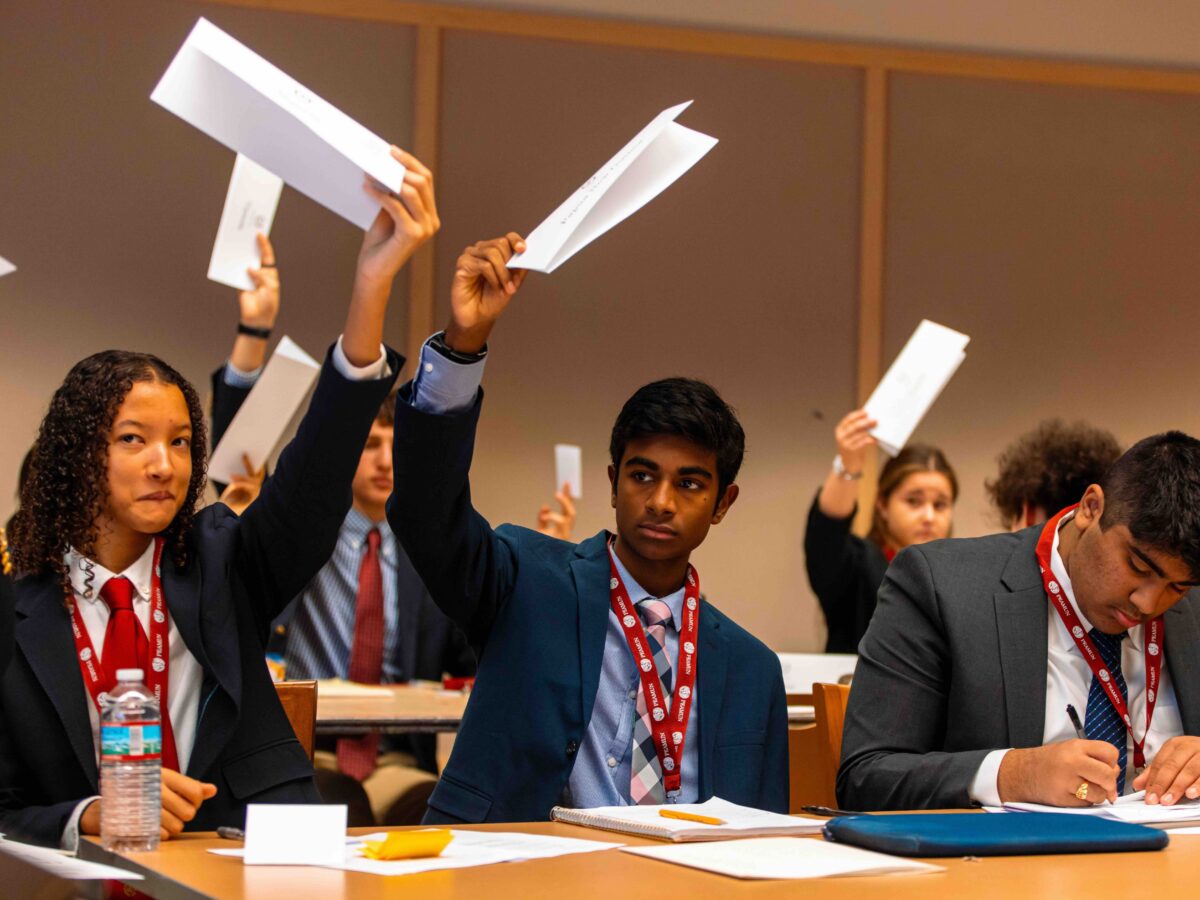
What does it take to be a change-maker on the global stage? More than 400 students from 30 schools across the United States visited campus in November to find out during Exeter’s flagship Model UN conference, PEAMUN XV.

Career diplomat Jorge Ryder Torres-Pereira, who has served as Portugal’s ambassador to seven countries including France, China and Thailand, kicked off the weekend gathering with a lively keynote address that offered students rarefied insights on world politics.

“It was a fascinating speech about what life is like as a diplomat,” says Alex Rosen ’24, a director general for PEAMUN XV, who had lunch with Torres-Pereira following his remarks.”

He spoke about the severity of the issues he has dealt with, such as helping to broker ‘secret pacts’ between Portugal and China, and about problems like world hunger and how many of them are caused by polarization and extremism. … I found it particularly interesting how he’s spent time representing Portugal in both Tel Aviv, Israel, and Ramallah, in the West Bank. … His speech was also humorous, ending with a wholesome picture of him holding a panda, which he joked might serve as encouragement for us to become diplomats.”

Career diplomat Jorge Ryder Torres-Pereira offered key insights on world politics during his keynote address.

Inspired by Torres-Pereira’s words, students assumed their roles as mock delegates to the United Nations, each representing a nation and its policies. This year’s meeting featured 11 committees on such hot-button topics as cyber espionage, the Haymarket Affair and environmentalism in the Amazon rainforest. At each turn, the students offered their creative point of view while honing their public speaking, negotiating and collaboration skills.

“I have been involved in MUN since my freshman year, and it is truly one of my favorite clubs on campus,” says Natalie Welling ’24, who was a chair of the Haymarket Affair Committee. “I am really passionate about political engagement.”

More than 400 students from across the country gathered on Exeter’s campus to participate in PEAMUN XV.

PEAMUN is especially meaningful as it is developed and run by students. “My experience participating in MUN comes solely from Exeter,” Patrick Snyder ’25 says. “My first conference was at PEAMUN 2022, and I instantly fell in love with the debate and strategic arguments.” This year, Snyder transitioned from delegate to vice chair in general assemblies to further expand his Model UN knowledge and responsibilities.

Next up: The Model UN Club will be taking their skills to Harvard MUN at the end of January, MIT MUN in early February and Cornell MUN in April.

Editor’s note: This article first appeared in the Winter 2024 issue of The Exeter Bulletin.

Exeter Deconstructed: the Amen cupola

Perched high above campus, on the roof of a dormitory named after one of Exeter’s esteemed graduates and principals, Harlan P. Amen (class of 1875), sits a cupola. Constructed alongside Wentworth and Cilley halls in 1925, Amen Hall was part of a transformative era for Exeter that increased residential capacity by 193 students. 

In October 1929, the dorm’s vacant cupola became the center of an ambitious wireless communication project led by licensed student operators Fred H. Gilbert ’30, Robert Langmuir ’31 and Malcolm G. Moses ’32. With support from Exeter resident Henry S. Shaw, equipment for a shortwave wireless station operating under Gilbert’s call number was placed in the Amen cupola. A month later, the station received its own call letters, WICOW. It relayed radiograms — free to Exeter students and teachers — on Wednesdays and Saturdays with a nearly 60% success rate. The station connected Exonians with others across the U.S. and in countries like Sweden, England and Belgium. One reached as far as Navy Admiral Richard E. Byrd in the Antarctic.

As technology advanced, the cupola’s role evolved. The radio station eventually fell silent, and the cupola, once a bustling communication center, became a quiet observer of the changing campus land-scape. Though no longer sending or receiv-ing radio signals, its presence remains a tangible link to the past — a reminder of an era when airwaves were the gateway to the world, connecting people in ways previously unimaginable.  

Editor’s note: This article first appeared in the Winter 2024 issue of The Exeter Bulletin.

Finis Origine Pendet: African Burying Ground

“a mote it is to trouble the mind’s eye”

When you planted me and mine

out of sight, so out of mind

it might have been a wilderness —

the frontiers of your consciousness

with chattel, paupers, criminals,

where wolves weave midnight hymnals

all winter with the howling waste —

circumscribed, you little guessed

how I would in time become

the center. I resemble Him,

the God you taught my kind to fear,

Whose radius is everywhere.

Very like a Master’s hand,

discriminating soil from sand:

men and what you would have called

mine. I doubt we have evolved.

Doubt we’ve ever left the cave.

What I was in life I have

remained: an inconvenience.

(But what’s the end of patience?)

When you lay your sewer line

up against my knuckled spine

needling my sleep, I rise

with voodoo in my eyeless eyes

troubling your theology.

And you will have to deal with me.


Editor’s Note: This poem is part of At This Point, a commemorative piece commissioned for the city of Portsmouth’s 400th anniversary celebration. The work, which premiered at the Music Hall in November 2023, featured a musical composition by Gregory Brown ’93, poetry by English Instructor L. Todd Hearon and narration by Dean of Students Russell Weatherspoon.

Garden of the forking paths

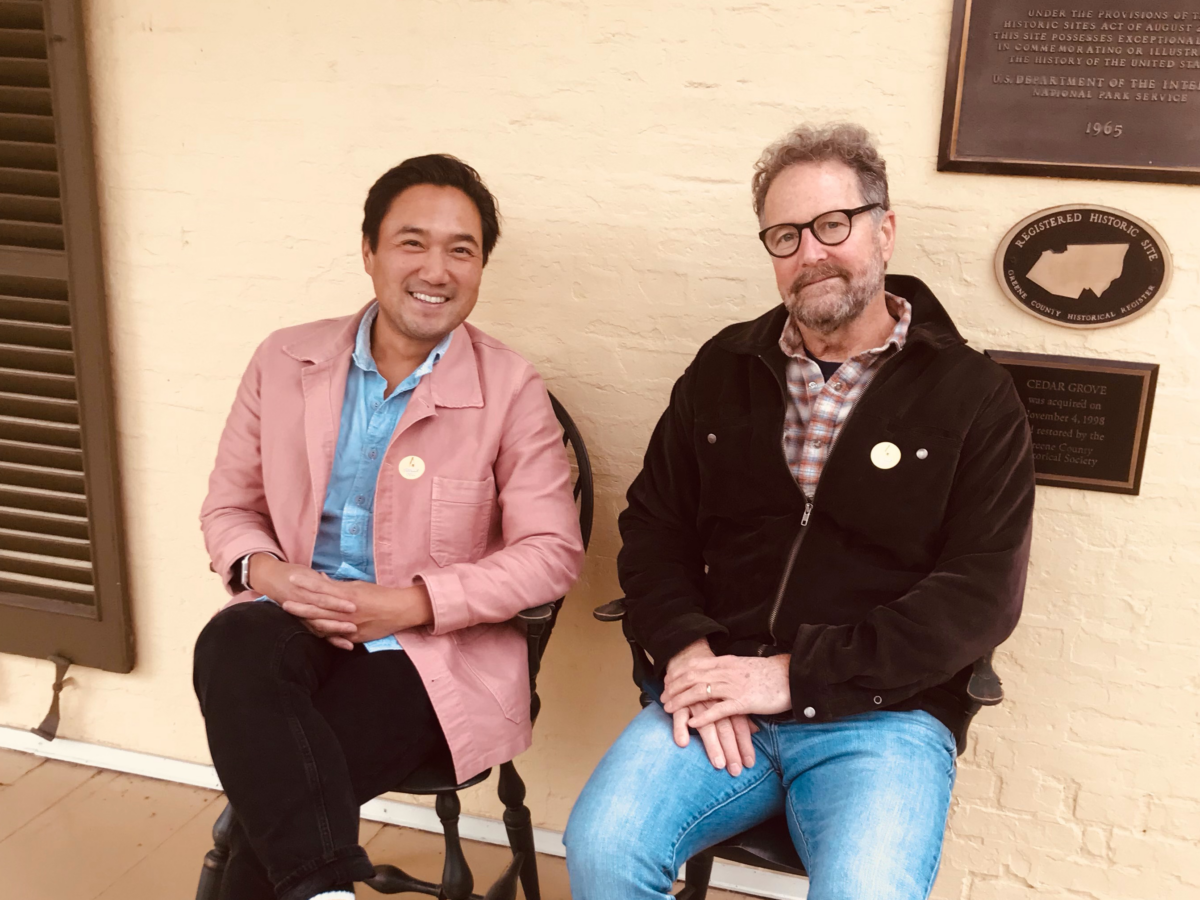
In the fall of ’97 Paul Yoon was a student in my senior English 410 class, and I can’t remember if, in his writing back then, he ever really tackled the core requirement of the English curriculum: the personal narrative. What I do remember, however, other than his hunger to read, was his short fiction. One story, in particular. For his final assignment, he handed in “La Guitarrista” instead of a personal essay or autobiographical narrative. The story ended up in the student journal Pendulum that year. True, Paul played guitar and sang, but the piece’s imaginative trajectory, pathos and sudden violence were rendered so confidently that any experience the author might have had with music was only a point of departure. The story deflected the teacher’s/reader’s attempts to sift the author’s presence from the plot. It was a real story, not a personal narrative dressed up like a story.

Over the subsequent years, we’ve kept in close contact, become friends, even colleagues, one might say, especially since I’ve been able to spend more time writing and he is descending deeper into his role as a teacher. Last March I had the opportunity to interview him in front of a live audience at The American School in London, where he was the Bergeron Fellow/writer-in-residence. I’d been awarded the same honor in 2008, so it was a beguiling crossroads in both our careers, a juncture where we could both take stock of the separate roads we’d chosen, but where our writing and teaching seem to keep intertwining, as if in some Borgesian “garden of the forking paths.”

Paul’s last appearance in The Exeter Bulletin came after his first book, Once the Shore, was released by Sarabande Books in 2009. The achievements he’s compressed into the following “micro-decade” have been remarkable: two novels and two more story collections, along with a trove of awards (New York Public Library Young Lions Award), fellowships (Guggenheim), publication in the commercial literary triumvirate (Harper’s, The Atlantic, The NewYorker), not to mention an appearance on Late Night with Seth Meyers.

Before I retired from Exeter, I’d regularly invite Paul to visit my classes and do readings. He has been generous with his time, though I was always worried that his art might seduce students away from the sacred Personal Narrative. I caught up with Paul just as his latest collection, The Hive and the Honey, was placed on Time magazine’s list of “100 Must-Read Books of 2023.”

Sneeden: Since your time at Exeter as a student, you’ve put so many terrific authors on my radar: Benjamín Labatut, Jenny Erpenbeck, Esther Kinsky, Hernan Diaz, John Williams, to name a few. You have also been instrumental in helping me find venues for my work. And you’ve encouraged me, kept me writing when my energy and confidence were flagging. What do you make of this role reversal/turning of the tables, when a student becomes a teacher, a mentor?

Yoon: Well, first of all, let’s get something straight here: There’s only one teacher/mentor in this two-person party, and it’s not me. I’m only engaging with what you gave me (and to so many other former students who are reading this) and keep giving me: love of literature, love of art, generosity of spirit, discipline, engagement. I can’t count how many times you gave me a book “off the books” to read (much to the detriment of my PEA grades) or how many conversations we had about film, music, painting. The thing about Exeter is that Harkness lives beyond the table, continuously, along all the paths of the campus, in dorm rooms, in dining rooms, in the air. That’s the magic of it. I just see us keeping these conversations going, 25 years later. You are writing, and I am writing, and we’re both reading, and we’re still talking the way we always did. Except maybe I’m a bit more mature these days … maybe.

I’d really like to hear more about your evolving relationship with teaching — your ongoing position as a senior lecturer at Harvard, stints at Bennington and the University of Texas (Austin) for the Michener Fellowship. I know that writing is at the center of what drives you as an artist, but has teaching shifted your aesthetic at all, your relationship to reading, or even how you approach your own craft?

I don’t know if you feel this, Ralph, but I feel like as the years go on, the less I know. That is, I feel more of a student these days, and that my students are teaching me. And I kind of find this exhilarating. I am very upfront that I hold no answers to how one should go about writing good fiction. I also think what is deemed good fiction is constantly changing. But I find being in the classroom with some really smart, kind, empathetic people to be a soul balm these days, especially as the world feels more and more grim. I love the hope of words. And I think it’s given me that extra boost to read more widely, to pick up something that I normally wouldn’t, a book students are really inspired by. Maybe what I’m trying to say here is that being a “teacher” has helped me realize that I don’t really want to be alone — writing is at its core a solitary art, but being in the classroom has helped me understand that it doesn’t always have to be.

Writer David Means offered some compelling back-cover insight for your new book, describing your signature demographic of characters who are “… far from home, longing for home, finding ways to reconcile and embrace complex new landscapes.” You grew up in Poughkeepsie (and maybe PEA?), but you’ve recently moved back to New York. Given that so many of your characters are diasporic, displaced searchers, wanderers, exiles, can you describe what it has been like, after your own wanderings, to return to your “heimat” in the Hudson Valley?

I didn’t realize how much I longed to go back to a “home” until the pandemic and lockdown, when I was “stuck” in a place (sigh, Florida) that was really far from places I hold dear and people (like you) I hold dear. It was like I had turned into one of my characters, as far away as possible from anything familiar. I ached. I yearned. I think also I was doing some hardcore wandering before then, moving from place to place, following the money, and maybe that all caught up with me too. This is a weird thing for a writer to say, but I couldn’t be happier. I think this means I won’t write again, because I’m too happy … thankfully, I wrote a book I’m proud of, before pure happiness does me in.

The purity of your fiction guarantees imaginative gambles, whether you’re writing about refugees from 1960s Laos or samurai in 17th-century Japan. I think this is heroic, even with the deep and respectful research that you engage in. Given all the chatter about the unofficial, societal limits placed on art these days (i.e., who is qualified to write about what, etc.), do you ever embark tentatively on your projects? Ever worry if the territory you’re exploring is forbidden, dangerous?

When I was starting to write, I was drawn to reading fictions that felt borderless — the books written by writers who seemed to be able to go anywhere. I’m thinking here of writers like Michael Ondaatje and Kazuo Ishiguro. In a lot of ways, I was an outsider. I wasn’t going into writing with any kind of formal education, aka a graduate degree, and I didn’t know a lot of writers then, especially ones who came from a Korean immigrant family. So, I read, in part, to feel free and powerful and feel like I had agency in my life — that I could make choices, and be encouraged, and to be confident, explore and learn about the world. I write first and foremost as a response to the books I fell in love with and continue to fall in love with. And those books were the ones that gave me a passport to explore the world, which makes me want to keep exploring.

We’ve often talked about our shared obsession with the New York Review of Books Classics, probably because many of those novels try to apprehend the darkness, especially when it comes to modern warfare, at the heart of the 20th century. One of these is Claude Simone’s The Flanders Road, set in 1940 as the German army approaches Paris. There’s a compelling riff in the publisher’s description: “… the question that must be urgently asked even as it remains unanswerable, is whether fiction can confront and respond to the traumas of history.” How would you begin to answer this question, given the thematic concerns of so much of your work?

I’m not sure if this is a good answer, but I think I’m, book by book, responding to the traumas my father and his family endured before and during the Korean War. That’s my baseline. I can explore different eras, countries, cultures, stories, but I think in some deeper underlying way, I’m always engaging with these unimaginable things my family endured and survived. That’s the beating heart that runs through it all. You pan out and my father is just one tiny, minuscule story in a billion stories, from ones we’ve forgotten to ones that we are witnessing, quite literally, unfold now, across the world. But maybe if I focus deeply and creatively on my family’s stories, I can engage with the stories of other families. I hope that’s a way to keep learning and to keep having conversations. A way to live and a way to be human.

Ralph Sneeden taught English at Exeter from 1995 to 2022, held the B. Rodney Marriott Chair of the Humanities, and is a co-founder of the Exeter Humanities Institute. His most recent book of poems, Surface Fugue (2021), won the Poetry Society of New Hampshire’s Best Book of the Year award, and The Legible Element, his collection of water-related essays, was released this year by EastOver Press.

The Booklist

Works by Paul Yoon


Editor’s note: This article first appeared in the winter 2024 issue of The Exeter Bulletin.

Andrew Yang: ‘What are you willing to fail for?’

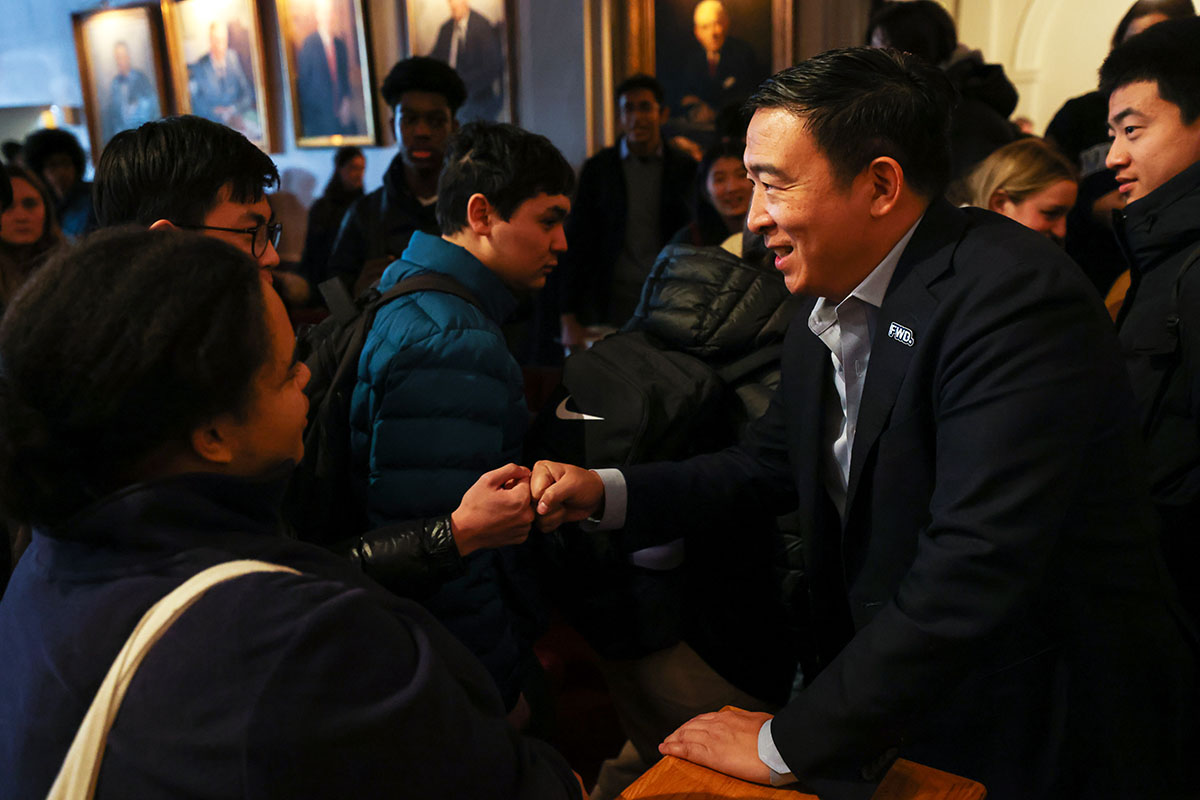
The last time Andrew Yang ’92 was on the Assembly Hall stage, he was positioning himself for a long-shot run at the White House as the 2020 Democratic nominee — a pursuit that would ultimately end in defeat. Five years later, Yang returned to address assembly and explain how failure can ultimately lead to progress.

“I did not expect to be president … it wasn’t like I was delusional,” he said about his campaign. “I’m going to mainstream a set of policies that I think are going to be vital to help keep our country strong and whole. That will be my mission, and if I totally fall on my face and fail, then that’s okay.”

Yang cited a series of professional missteps that prepared him to be fearless in the face of the likely outcome in his bid for the presidency.

“One of the reasons why I could undertake that journey was because I failed when I was 25. I failed when I was 27, failed again when I was 29. This time I was 43 and said, OK, I can actually accept failing again. What I wouldn’t accept was just shrugging and letting the world head towards what I thought was disaster,” Yang said. “It’s that set of failures that ended up turning me into someone who could do something that might be meaningful and impactful.”

Standing on the front of the stage, under a projection of himself as a 17-year-old Exeter student, Yang praised the audience before challenging them.

“Some of the most talented people of your generation are in this room today,” he said. “What are you willing to fail for?”

Glennon returns to helm of boys lacrosse program

The Exeter Athletics Department is excited to announce the return of Bill Glennon as the head coach of the boys varsity lacrosse program. Glennon, who served as head coach from 2014 to 2022 after spending the 23 previous seasons as an assistant with the program, returns to the helm of the team after spending the 2022 and 2023 seasons as an assistant under Matt Callahan ’09. Callahan departed the Academy to pursue other professional interests this past summer.

“Bill Glennon is one of the best coaches of young athletes in the country and, while he never left, we are thrilled to see him return as the head coach of the boys lacrosse program,” said Director of Athletics Jason Baseden. “We were grateful to him for serving as a mentor to his former player, Matt Callahan, for the past couple of seasons, and are eager for him to continue to build Exeter lacrosse as one of the premier programs in the nation.”

“I am very excited to return as the head coach of the boys lacrosse program and am looking forward to coaching this terrific group of student-athletes,” said Glennon.

Glennon has helped mentor hundreds of Big Red lacrosse student-athletes both on and off the field during his 30 years on campus. On the field, he has coached dozens of All-Americans, Academic All-Americans and over a hundred All-New England selections. Coach Glennon has also been voted NEPSAC Lacrosse “Man of the Year” and “Assistant Coach of the Year” on several occasions throughout his career and is a pillar of the lacrosse community.

In addition to coaching lacrosse, Glennon served as head coach of the Big Red football program from 1991-2012 and 2019-2021 and currently serves as an assistant coach with the program. While at the helm of the football team, Glennon guided the team to four appearances in the NEPSAC Class A Tournament, winning two New England Championships in the process. He was elected to the NEPSFCA Hall of Fame and currently has a championship bowl game named in his honor.

Prior to Exeter, Coach Glennon served as the head lacrosse coach at Rochester Institute of Technology and Hampden Sydney College, and guided those programs to four NCAA Division III Final Four appearances. During that time, Coach Glennon was a finalist for NCAA Division III Lacrosse Coach of the year as well as voted ICAC/ECAC Lacrosse coach of the year. Coach Glennon is active in many youth lacrosse programs and has coached for the highly respected 3-D and 4 Leaf Lacrosse programs throughout the country.

Glennon is a proud parent of three Exeter graduates (Ryan ’00, Lindsey ’02, and Travis ’05). Travis Glennon will return to the Big Red sidelines as one of the assistant coaches with the lacrosse program in 2024.

Exeter commemorates the lasting legacy of MLK

Exeter students, faculty and staff took part in a packed slate of speaking events, panels and workshops on Monday as the campus community celebrated the life and enduring legacy of the Rev. Dr. Martin Luther King Jr.

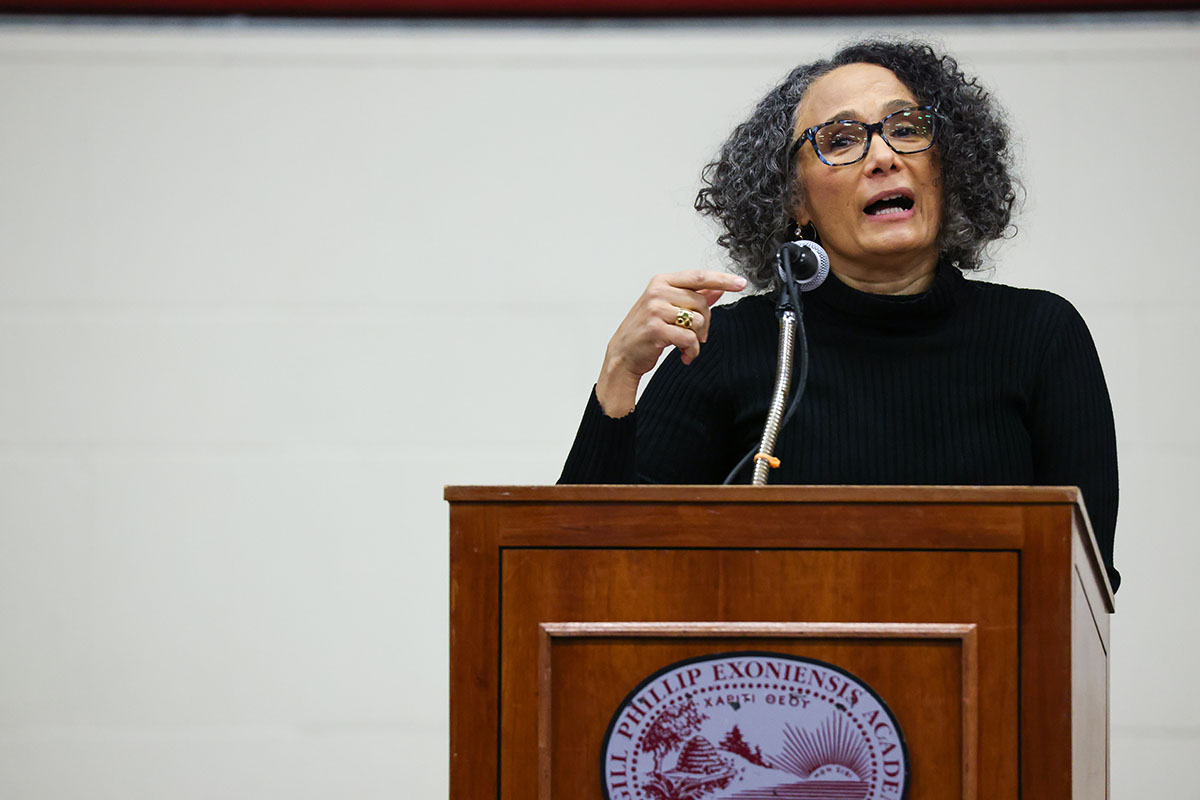
“This is a very complicated day,” keynote speaker Dr. Tricia Rose told the assembled crowd in Love Gymnasium. “It sounds like a very simple day for many people, the way we celebrate King, but it’s much more complicated than that.”

Rose, a professor of Africana Studies and director of the Center for the Study of Race and Ethnicity in America at Brown University, spoke about her view of King as a teenager who had grown up in Harlem and the Bronx. At the time, she resented the way many people celebrated King’s life and words as if the outcomes he was fighting for had already been achieved.

“How could it be that we still had profoundly deep levels of systemic inequality that was not just random, that was not just left over from the past, but in fact being manufactured all the time, while we were celebrating [King’s] victories and our collective victory as the country?” Rose asked.

Some of King’s most famous statements, Rose pointed out, had been co-opted to endorse views that contradicted his true message, such as the need for color blindness or accusations of reverse discrimination against white people. “There was a twisted effort to invalidate the meanings of his works and words so that we could not have a claim,” she said. In fact, King did not shy away from pointing out the systemic nature of racism, and the ways in which white Americans have benefited from governmental policies in ways that their Black counterparts had no access to.

“Everyone can love and create a love that would help Black people, but you have to know what folks have been through,” Rose said at the conclusion of her remarks, which the audience rewarded with a standing ovation. “If you don’t know that, then love actually becomes a capacity and a way to ask us to be quiet and to accept the suffering and the erasure of the love that will actually heal us.”

Rose’s speech was preceded by a performance by the student dance groups Precision and Outkast. The Academy’s Concert Choir, directed by Music Instructor Jerome Walker, sang “Hymn to Freedom,” an ode to the civil rights movement written by Oscar Peterson in 1963, with words by Harriette Hamilton.

“To this day, Dr. King remains a very powerful force in my life,” said Principal Bill Rawson ’71; P’08, in brief opening remarks offered before Rose’s introduction. “I want to express a hope for all of you that through all of the programs that we offer, all the ways that we celebrate and reflect on the life and legacy of Dr. King … that you come to know more and that he comes to have in your lives the important influence that he’s had in mine.”

Featured “Black Entrepreneurs” panel

Following Rose’s keynote, students had the opportunity to engage in various workshops organized by the MLK Day Committee and facilitated by both Exeter faculty and staff as well as visiting speakers and alumni. As part of a featured panel in Love Gym, three Black entrepreneurs with businesses in Exeter and the surrounding region sat down with student moderators to answer questions about their respective business journeys and the challenges they’ve faced along the way.

Oneta Modern, owner of The Office Lounge, an upscale neighborhood restaurant and lounge in Dover, New Hampshire, spoke to the student audience of finding inspiration in the example of her mother, a native of South Korea who met her American-born father when he was serving in the military there. When Modern’s father later died in a car accident, her mother learned English in order to support her family on her own.

“She started her own business; she had a little candy store in the mall,” Modern recalled. “She became an entrepreneur herself. I watched my mom do this thing to feed my family, and that’s who I became.”

Modern and her fellow panelists spoke of how they sought out and found support as business owners of color in the largely white communities of seacoast New Hampshire, and how they dealt with the prejudice they had encountered over the course of their careers.

“I have a string of failures behind me,” said panelist Daryl Browne, who is the co-owner of Soleil’s Salt Cave, a wellness sanctuary and spa in downtown Exeter, and a former Exeter select board member. “I’m a technologist by trade … and I’ve done a bunch of tech startups and gone to the highest levels of Google, Apple, Amazon with technology that I created. Each time the door was opened to look at the tech and then they looked at me, like, this couldn’t come from you.”

“In the antiques business, 95% of the people don’t look like me,” said Lionel Loveless, owner of Officially Knotted Bowties, a business specializing in custom-designed bow ties made from upcycled materials, as well as two antique shops in the area. “I’ll get people who come in and say, I need to speak to the owner. I’m like, yes, how can I help you?”

Such prejudice was difficult for Loveless to confront, and he even considered leaving New Hampshire altogether. But at a certain point, he came to the realization that there were enough good people who came into his shop to make up for those who questioned his success or refused to sell antiques to him based on his skin tone. “[Now] I just laugh it off and say, you know what? We have the best shops in the Seacoast, and possibly all of New Hampshire. If you don’t want to shop here, that’s your loss. Deal with it.”

Workshops across campus

Students also participated in a wide range of workshops held in locations all over campus. The thumping beat of African music and the rhythm of pounding feet filled the third-floor dance studio in the Goel Center for a workshop called “Spirit Moves.” Taught by Ethel Calhoun, a teaching artist for Ailey Arts in Education & Community Programs, it explored how music and dance has played a role in uniting Black communities in Africa as well as the African diaspora, including the Caribbean and Latin America.

Over in the Class of 1945 Library, students gathered in the ground floor Commons area to explore “5 Steps to Becoming a Climate Justice Superhero” with Inemesit Williams, a longtime educator and adviser for In Good Company, a climate justice-centered nonprofit. Williams spoke to the students about the course of King’s career, and the shift he made to expand the battle for Black civil rights to campaign against poverty as well.

“The main thing with climate justice is just acknowledging the fact that climate change is not impacting everybody the same,” Williams told the students. “It’s often impacting poor people. It’s often impacting people of color more.” After Williams spoke, she had students take time to brainstorm 10 ways they could think about climate action, while considering the intersection of three key questions: “What are you good at?” “What problems need to be solved?” and “What brings you joy?”

Meanwhile, the warm smells of butter and vanilla wafted through the basement of the Elizabeth Phillips Academy Center as English Instructor Courtney Marshall held a workshop on “Food and the Civil Rights Movement.” Students baked pound cake based on the recipe of Georgia Gilmore, who organized a group of women who cooked and baked to support participants in the bus boycotts in Montgomery, Alabama, in 1955–56, as Marshall discussed such topics as segregated restaurants, sit-ins and the “shoebox lunches” that Black passengers carried on trains in an era when they were not allowed to enter the segregated dining cars.

These workshops were just a few of the many offerings attended by Exeter students over the course of the jam-packed MLK Day celebration. During the previous weekend, the campus community also enjoyed several related events, beginning with a special concert, “A Musical Tribute to Dr. Martin Luther King, Jr.” on Sunday in the Forrestall-Bowld Music Center, featuring Symphonia, Concert Choir, Band and the Jazz Ensemble. That evening saw the school’s annual production of UnSilenced, Exeter’s student-run social justice showcase, which energized the crowd in the Goel Center’s Main Stage with a wide range of mediums including song, rap, dance, spoken word, film and poetry.

Athletics celebrates class of 2024 college commitments

Family, classmates and friends joined to celebrate 25 members of the class of 2024 who have received a National Letter of Intent, Likely Letter, or early admittance to play their respective sports at the collegiate level. This was the first of two celebratory ceremonies that will take place this year, the next taking place during the spring.

“Nights like this are a great way to celebrate our students and their families,” said Director of Athletics Jason Baseden. “We are lucky to have such a supportive environment on our campus, seeing many peers support and cheer for one another in the crowd. These students put forth years of effort and training to be able to go on and play at the collegiate level, it is really nice to be able to honor that and we’re looking forward to doing the same again this spring.

The students will go on to compete at some of the top programs in the nation at the Division I and Division III levels. Click here to watch the ceremony on-demand.

Name Sport School
Will Cooke Baseball Bowdoin College
Landon Penney Baseball Catholic University
Owen Tahnk Baseball Harvard University
Henry Bickford Boys Basketball New York University
Michael Goodall Boys Crew Cornell University
Rohan Radhakeesoon Boys Crew Yale University
Parker Seymour Boys Crew Hamilton College
Graham Harris Boys Lacrosse Denison University
Dieder Wagner Boys Soccer Trinity College
Sally Hunter Field Hockey Bucknell University
Kate Rose Field Hockey Colgate University
Johnny Getman Football Tufts University
Nihaal Rana Football Harvard University
Brendan Logan Football/Lacrosse Middlebury College
Jamie Reidy Girls Crew Harvard University
Amelia Byerly Girls Lacrosse University of Colorado at Boulder
Esme Shields Girls Lacrosse University of Denver
Caroline Shu Girls Lacrosse Brown University
Audrey Zhang Girls Swimming University of Chicago
Tanner Boulden Track & Field Yale University
Austin Desisto Track & Field / CC University of Maryland
Byron Grevious Track & Field / CC Stanford University
Jack Hutchins Track & Field / CC Trinity College
Anna Kim Track & Field / CC Bowdoin College
Max Lacombe Track & Field / CC University of Chicago
Tenley Nelson Track & Field / CC Cornell University

Changing lives, one summer at a time

By listening to a single song — Tracy Chapman’s “Fast Car” perhaps, or U2’s “With or Without You” — Debbie Norris can picture herself at 16 years old, living away from home for the first time and attending the Exeter Summer program.

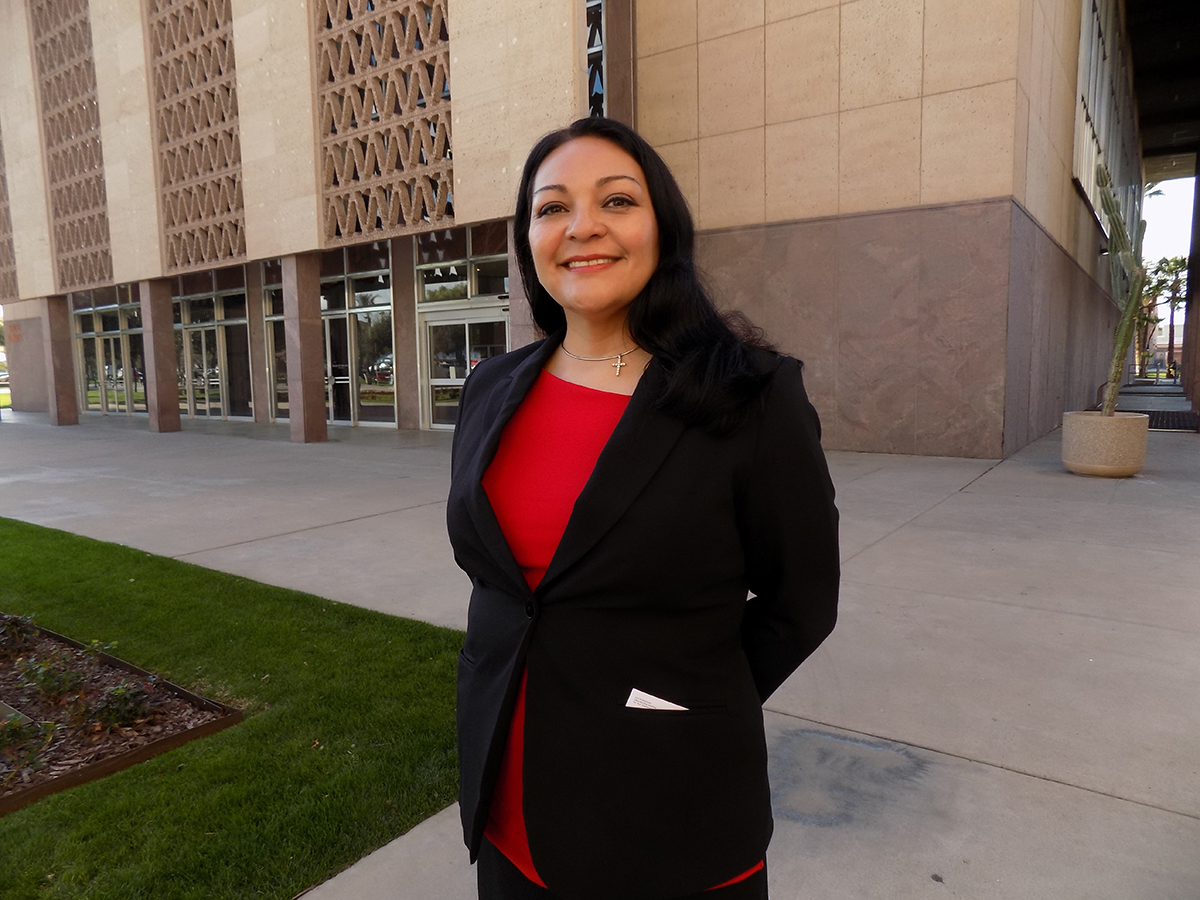
Norris is Navajo, and she grew up on the Tohono O’odham reservation in southern Arizona. During the summer of 1988, she sampled lobster for the first time, at a restaurant in Maine. She also took classes in Russian and history, and met fellow students from New York City and Puerto Rico, Japan and Korea.

“It was the first time I interacted with people from different countries,” Norris says. “Ironically, it was also the first time I met members from other [Native American] tribes — the first time I’d gone to school with Hopi students, students from San Carlos Apache and Laguna Pueblo.”

Norris learned about Exeter Summer from her brother, who had attended a year earlier. “We had traveled a little bit as youngsters but spent most of our time growing up in Arizona,” she recalls. “So it was a real eyeopener for him and then for me.”

In addition to the friends she made, some of whom she’s still close with today, Norris has also kept in touch with teachers she studied with that summer. She credits them with encouraging her to challenge herself intellectually. “I knew that I was intelligent, but nobody had ever really pushed me to see how far I could take that,” Norris says. “[Exeter Summer] really changed the trajectory of my life.” 

Norris would go on to major in history at Stanford University and attend a study abroad program at Oxford. After graduation, she embarked on a career focused on education in her home state. During a decade spent working in the Arizona Department of Education, Norris served as the state’s Indian Education Director as well as a deputy associate superintendent. “Having a broad knowledge of what it’s like to be a student in so many different types of schools made me a very effective Indian education leader for the state of Arizona, because I had so many different experiences in my background,” Norris says.

Earlier in her career, Norris served three terms in the Arizona state legislature, helping to pass education and school capital finance laws that impacted various learning environments and students across the state, including in tribal nations. In her current position as a compliance and policy project manager with the state’s Department of Administration, she is working to improve education from a different angle.

“I focus on creating policy, not legislation,” Norris explains. “One of the things I’m most proud of is that I worked for an administration that figured out a way to certify Native American language teachers in a state where there was no professional exam available for 22 languages that were Native American or Indigenous. Today, we have more than 120 Native American language teachers in the state of Arizona — I’m one of them.”

Norris hasn’t forgotten the role Exeter Summer played in her learning journey, and she has worked consistently over the years to help recruit Native American students for the program. Her efforts have been especially important as Exeter Summer seeks to rebuild attendance after the COVID-19 pandemic. “I encourage young people to look at the program, to put themselves out there and try some classes that they don’t have back at home,” Norris says.

Nathan Poocha of Flagstaff, Arizona, remembers his family connecting with Norris before he attended Exeter Summer’s Access program as a rising ninth grader in 2023. It was his first time traveling to the East Coast, and his first time living away from home. “I don’t think I’ve ever met people of such cultural diversity,” Poocha says. “I’ve met people from the United Arab Emirates, China, Poland.”

As a student in the Classics: Exploring the Ancient World cluster, Poocha got an introduction to both Latin and Greek and read excerpts from Homer’s The Odyssey and Ovid’s Metamorphoses. He and his classmates took a field trip to Boston, where they viewed ancient Greek pottery and statuary at the Museum of Fine Arts. “I didn’t really know what Classics was,” Poocha says. “My school only has Spanish and French, and I thought it would be a good thing to learn. I’ve really enjoyed it, and I would definitely recommend [Exeter Summer] to other people.”

For Norris, seeing students like Poocha explore new subjects and experiences is evidence that her efforts are paying off. “Exeter has a long-term commitment to our students in Arizona,” Norris says. “I’m just a part of that, but I’m very proud to play whatever role I can. For me, it’s been a lifelong relationship with educators, and with Exeter.”

Grevious finishes 11th overall at Nike Cross Nationals

Byron Grevious ’24 concluded his Exeter cross country career in emphathic fashion, running to an 11th place overall finish at Nike Cross Nationals with a time of 15:28.0. Grevious was running with the lead pack throughout the rain-soaked, 5 kilometer course and jostled for position late, kicking to an exciting and crowded finish line that featured many of the top-ranked runners in the country.

“With these national championships and bringing all of the best guys from around the nation, just having this competition really excites me,” Grevious said in a pre-race interview with Runnerspace.com. “All these times I get to race to represent my school and the people that support me is what makes me most excited just to see what I can do. Its high school cross country, I’m having fun with it.”

Grevious wraps his fall career as one of the best to ever wear an Exeter uniform. He finishes his cross country career as a three-time New England team and individual champion, a Nike Cross Regional champion (2023) and runner-up (2022), while posting a 11th place (2023) and 12th place (2022) finish at Nike Cross Nationals while winning virtually every regular season race on the Big Red schedule.

His performance at Nationals this week follows a championship run last weekend when he placed first overall at Nike Cross Regionals on a challenging course at Bowdoin Park in Wappinger Falls, New York. Grevious cruised to a time of 15:32.8, a whopping 17 seconds ahead of the second place finisher, to pace the Exeter boys cross country pack to a fifth-place overall finish out of a field of 33 elite teams at the Northeast Regional.

Grevious will now turn his attention to the indoor circuit this winter. An on-demand broadcast of Nike Cross Nationals is available on RunnerSpace with a +PLUS account. Full results will be available on Athletictiming.net.