Phillips Exeter Academy

Exeter girls swim & dive repeats as New England champ

The Exeter girls varsity swim and dive team was crowned the New England champion for the second straight year and capped an undefeated season at the Division I Championships this past weekend. Big Red sat atop the standings by a 50-point margin to runner-up Andover amongst a talented 12-team field. This marks the 18th New England title for the girls program.

Exeter boys swimming also capped an outstanding season, finishing 8-1 on the year and claiming second place overall at the Division I Championships. The boys kept an impressive streak of their own alive as they have now placed in the top four in 32 of the past 33 New England championship meets. Ethan Guo ’25 earned a share of the annual Babcock Award, an award voted on by coaches to outstanding student-athletes who best exemplify the values of New England Prep School Swimming and Diving. He is the first Big Red student-athlete to win the award since Andrew Benson ’20 in 2020.

“People often don’t realize what a team sport high school swimming and diving is,” said Exeter head coach Don Mills. “It’s the collective effort from the team that wins meets — our divers, our relays, our kids that make it to B finals and move up two spots. It’s the camaraderie and encouragement you see every day in practice. We are fortunate to have kids that are fast and buy into our program.”

Sunday’s finals got off to a spectacular start for Big Red as Mena Boardman ’26, Audrey Zhang ’24, Brianna Cong ’25 and Sophie Phelps ’25 set a pool and meet record in the 200 medley relay with an All-American time of 1:42.81 in the first event of the day.

Boardman would help guide Big Red to their second straight title, following the medley relay win with a trio of dominant, record-setting swims. Boardman set a pool, meet and New England record in the 50 freestyle with a time of 22.22, dusting her opponents by 1.5 seconds before breaking her own pool, meet, and New England record she set during Saturday’s prelims in the 100 butterfly when she touched the wall at 51.62, nearly three seconds ahead of the second-place finisher.

Boardman finished off her day by teaming up with Cong, Phelps and Chloe Meyer-Blohm ’27 to set another pool, meet and New England record in the 400 freestyle relay with an All-American time of 3:24.70, besting the heat by an incredible seven seconds.

While Boardman was outstanding, Big Red received contributions from everyone on the roster. Brianna Cong ’25 earned a pair of second-place finishes in the 100 butterfly (54.23) and 100 backstroke (56.34), while Sophie Phelps ’25 added a second-place finish in the 100 freestyle (51.58) and earned a third-place finish in the 200 individual medley (2:05.05).

Gene Sunthornrangsri ’26 added a second place in the 200 freestyle (1:54.57) and swam to a third-place finish in the 500 freestyle (5:01.82). Chloe Meyer-Blohm ’27 claimed third in the 50 freestyle (24.03) and fourth in the 100 freestyle (52.56). The 200 freestyle relay team of Meyer-Blohm, Sunthornrangsri, Vedika Amin ’24 and Audrey Zhang ’24 posted a third-place finish in the 200 freestyle relay with a time of 3:09.26.  

On the boys side, Nick Limoli ’26 got Big Red off on the right foot as he earned first place and New England Diving Champion honors in the diving portion of the meet, which was held on Wednesday.

On Sunday, it was Guo who led the way. Guo earned a first-place finish in the 200 freestyle, touching the wall at 1:37.23, while also finishing first overall in the 100 backstroke with an All-American time of 49.07. Guo also teamed up with Michael Yang ’24, Lang Gou ’25 and Rudd Day ’25 to earn a second-place finish in the 200 medley relay, swimming to an All-American time of 1:31.62. He also rallied with Winston Wang ’25, Wayne Zheng ’26 and Day to turn in a third-place finish with an All American time of 1:23.38 in the 200 freestyle relay.

Day added a second-place finish in the 500 freestyle (20.52) and a fourth-place finish in the 100 freestyle (46.05) while Michael Yang ’24 swam to a fourth-place finish in the 100 yard breaststroke, touching at 57.70. Zheng, Gou, Yang and Wang closed out the championship weekend with a third-place finish in the 400 freestyle relay, posting a time of 3:09.26.

Big Red travels to Andover as rivals reunite

With throngs of Exeter’s and Andover’s most passionate and supportive students, alumni, family and friends lining the sidelines, the 2024 winter edition of Big Red vs. Big Blue took place on the Andover campus Saturday. Record-setting performances in the pool were the highlight of the day for Big Red, while the results on the ice and on the hardwood tilted in Andover’s favor.

Exeter girls varsity swimming capped an 8-0 regular season, topping Andover 97-89, while the girls JV squad also picked up a win over the hosts, 88-82. The girls varsity 200 freestyle relay team of Chloe Meyer-Blohm ‘27, Sophie Phelps ’25, Brianna Cong ‘25 and Mena Boardman ‘26 turned in a pool- and meet-record time of 1:36.64, while Cong, Audrey Zhang ‘24, Boardman and Phelps teamed up to break a meet record in the medley relay, touching the wall at 1:44.93.

On the boys side, Ethan Guo ‘25, Winston Wang ‘25, Wayne Zhang ‘26 and Rudd Day ‘25 broke the meet record and the Exeter school record in the 200 freestyle relay, coming in at 1:23.68. The previous school record was set in 2012. Despite their record-breaking efforts, Andover’s boys varsity topped Exeter 105-78 while also earning the victory in the JV meet, 109-58.

The Red and Blue faithful were treated to two tightly contested matchups in the gym. Trailing by eight with under four minutes to play in the boys varsity basketball game, Exeter went on a 6-0 spurt powered by a Tyler Bike ’25 steal and score before Ryder Frost ’25 was fouled on a 3-point attempt and converted all three free throws to cut the deficit down to two, 57-55. Andover answered with a deep 3-pointer that ignited a 7-0 run of its own, closing out the game with a 64-58 decision. Frost finished with a team-high 19 points. Bike and Isaiah Reese ’25, who knocked down three triples in the second half, each finished with 14. Despite the setback, Big Red has punched their ticket to the Class A playoffs, which tip off Wednesday.

On the girls side, a flurry of answered points in the waning minutes of the first half gave Andover a double-digit edge at the break. Big Red started to chip away in the third quarter thanks to some hot shooting from Laurie Chung ’24 before a three-point play by Cassie Beste ’25 cut the deficit to five midway through the fourth quarter. Big Blue answered the call, however, scoring six straight to roll to the 52-44 win. Beste poured in a team-best 15 points, while Chung added 11. Amelia Byerly ’24 finished with 10 points for the visitors.

On the ice, it was the hosts who controlled much of the play in both the girls and boys games. Girls hockey opened up the rivalry day in a fast-paced opening period. Big Blue opened the scoring four minutes into the game before adding a trio of goals in the second period on their way to a 6-0 win. Despite the loss, girls hockey has qualified for the postseason for the first time since 2009 and will travel to play Dexter Southfield on Wednesday in first-round action.

After falling behind 1-0 in the first, Big Red boys hockey nearly evened the score on a pair of power play chances early in the second period before being turned away by the Andover goalie. Big Blue then turned defense into offense, potting a shorthanded goal and following with another tally just one minute later to stake a 3-0 advantage. Andover closed out the game with a 4-0 decision.

Former trustee honored with Founders’ Day Award

General Alumni Association President, Trustee and Awards Committee Chair Betsy Fleming ’86 has announced the selection of Peter Aldrich ’62; P’99, P’03 as the recipient of the 2024 Founders’ Day Award.

Since 1976, the GAA has given the Founders’ Day Award annually to an individual who has demonstrated exceptional service to the Academy over many years. Aldrich launched his long record of volunteer service as chair of the Long Step Forward campaign, which raised $25 million for the Academy from 1967 to 1971. Over the years, he has served as class correspondent, reunion committee member and 50th reunion gift committee and attendance committee chair for the Class of 1962.

Most memorably, Aldrich served on Exeter’s Board of Trustees from 1987 to 1997. As chair of the Buildings and Grounds Committee from 1989 to 1991, he steered the Trustees toward a new commitment to preserving and maintaining Exeter’s buildings and other facilities at the highest level possible. Through his clear dedication and commitment to Exeter, he helped shape the school’s fiscal — and physical — future.

Aldrich is the founder and retired chair of AEW Capital Management, one of the nation’s oldest real estate investment advisories, as well as a former chair of the investment holding company AEGIS, LLC, and a former faculty chair of the Research Council on Global Investment of the Conference Board.

In retirement, Aldrich has followed his passion for oil painting, and displays his artwork near his home in Little Compton, Rhode Island, and elsewhere. He and his wife, Widgie, are “distinguished benefactors” of the Boston Museum of Fine Arts, where he is also a trustee. Two of their four children, Charley Aldrich ’99 and Amanda Hastings ’03, attended Exeter.

Aldrich will accept the Founders’ Day Award and speak during assembly on Friday, May 17.

Grevious repeats as Gatorade Player of the Year

Exeter senior Byron Grevious ’24 earned yet added another recognition to his remarkable collection as he was named New Hampshire Gatorade Player of the Year for his successful cross-country season this past fall.

The Gatorade Player of the Year award honors the nation’s most elite high school athletes for excellence on the field, in the classroom and in the community. In addition to his high standards he has set for himself on the trails and in the classroom, Grevious also volunteered for the Special Olympics and an organization serving at-risk youth in his home state of Connecticut while also working for WPEA, Exeter’s student-run radio station.

“State champ, regional champ and All-American: It’d be hard to ask much more of Byron Grevious in 2023,” said Rich Gonzalez of PrepCalTrack in the Gatorade press release. “He also broke the meet record at the Manchester Invitational for good measure and seems destined to make a name for himself on the left coast at Stanford next season.”

This is the third Gatorade Player of the Year honor Grevious has received in his career, also earning the recognition following the 2022 cross-country season and the 2023 track and field season.

Grevious placed first in each regular-season race he ran, including at the always competitive Manchester Invitational and Black Bear Invitational. His postseason performance was just as impressive as he earned his third straight New England individual and team title at Loomis Chaffee before running to a Nike Cross Regional championship at Bowdoin Park in Wappinger Falls, New York, where he crossed 17 seconds ahead of the rest of the field, leading Big Red to a fifth-place finish overall. He capped his season and his high school cross-country career with a strong performance at Nike Cross Nationals in Eugene, Oregon, where he placed 11th overall in a field stacked with the best runners from around the country.

Focus on Filipino history

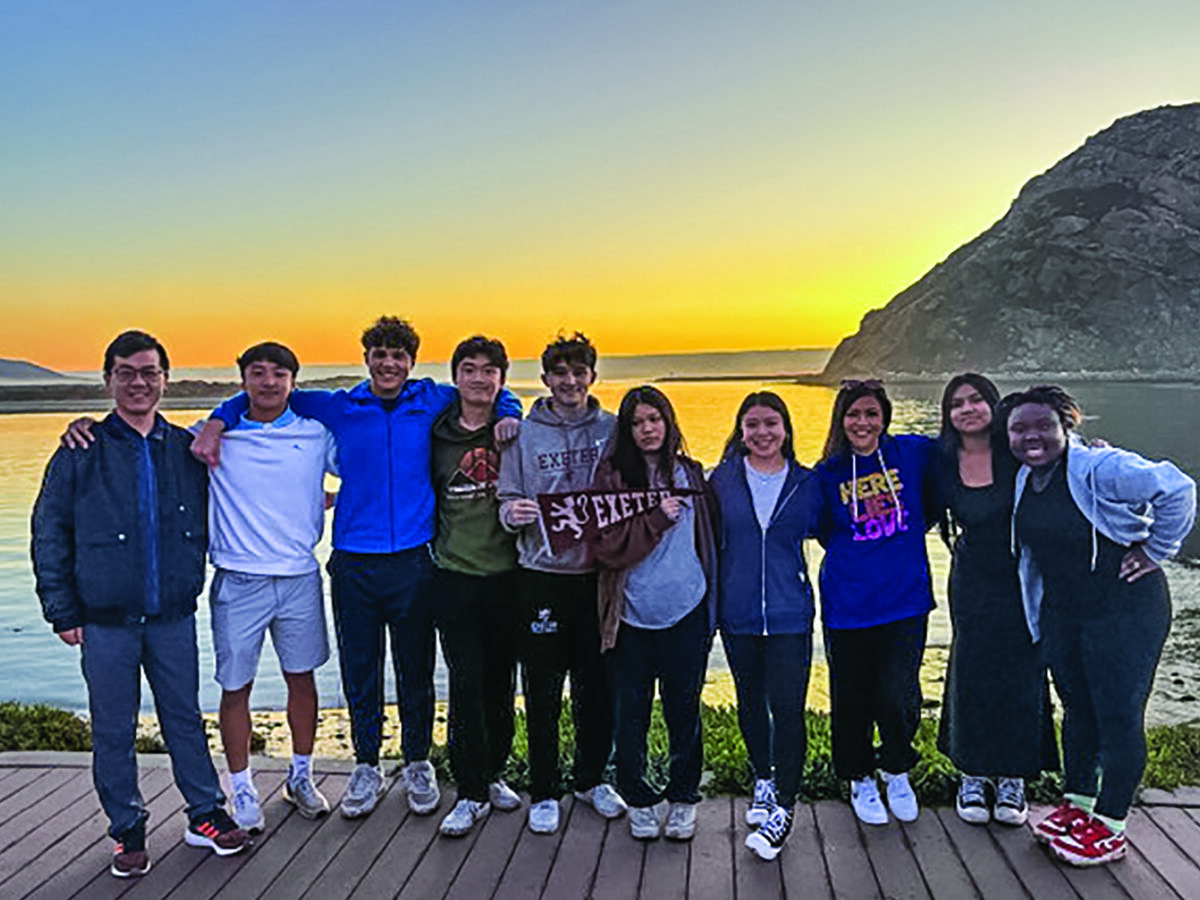
After more than two years of planning, the Academy led its first travel-and-learning trip focused on Indigenous Filipino history in the U.S. The 10-day Balikbayan Program to California in November supported nine students and three chaperones, including me.

As the adviser of the Exeter Pinoy Society, the dean of Multicultural Affairs, and a person born and raised in Manila, Philippines, I feel privileged and honored to be a part of a project that has been professionally and personally affirming.

The idea for this cultural trip took root in 2021 when the Pinoy Society co-heads at the time — Grace Nivera ’23, Gretl Baghdadi ’22, Elijah Porras ’22 and Aaron Venzon ’22 — dreamt of bringing the club to the Philippines as a way of “coming home.” Balikbayan is the Tagalog word for “returning home” for someone who has been away for some time.

The Philippines still had COVID travel restrictions, so we pivoted to a domestic trip. We researched cities that had significance to the Filipino American experience, including St. Malo, Louisiana, the first settlement of Filipinos in the U.S.; and St. Louis, Missouri, home of the 1904 World’s Fair, where 2,000 Filipinos, many of whom were Indigenous, were displayed in a human zoo. We decided to visit Morro Bay, California, where the first Filipinos landed on U.S. soil on Oct. 18, 1587.

After submitting the club’s trip proposal to the Academy, the students had the opportunity to talk about the project at the People of Color Conference in San Antonio, Texas, and the Asian American Footsteps Conference ’22 at St. Paul’s School. Shortly thereafter, we received confirmation that the proposal was approved and that Exeter would support our dream.

Our journey began in San Francisco where we visited the SOMA Pilipinas cultural neighborhood. Our tour guide led us through the San Francisco Filipino Cultural Heritage District and showed us the impact of gentrification on the Filipino communities that were displaced. One of the students reflected: “It is easy to sympathize with the city workers and their wish to ‘clean up’ the city and make it more ‘presentable’ by modernizing roads and buildings. Yet this point of view completely ignores deeply important cultural and social values imbued in these spaces that ‘need modernizing.’”

After four days in San Francisco, we made our way south to Morro Bay, where we visited the Landing of the First Filipinos. One student said, “One of my highlights was visiting the Morro Bay Rock and reading about the first landing of the Filipinos in America … being able to crane our necks at the towering rocks and watch the sunset while journaling was truly a breathtaking experience.”

In Los Angeles, we visited Historic Filipinotown, spending time at Unidad Park which has a mural that outlines over 2,000 years of Filipino history. We also met with Anthony Christian Ocampo, a sociology professor and author of The Latinos of Asia: How Filipino Americans Break the Rules of Race. He was generous with his time and the students appreciated the meaningful exchange.

In the end, one student summarized her experience with gratitude: “We learned on this trip that Filipinos often feel the need to assimilate, and thus try to distance themselves from the culture. Now that I have clearly seen this and learned about it, I feel more compelled to learn more about the other 50 percent of me that I feel I have neglected for a very long time. This trip has taught me so much about who I am, and I am sincerely grateful for it.”

Editor’s note: This feature first appeared in the Winter 2024 issue of The Exeter Bulletin.

The vocabulary of illness

The following is an excerpt from Body Songs, the hybrid-nonfiction book Emma Zimmerman is working on during her fellowship year at the Academy. The manuscript considers the epidemic of long COVID, blending Zimmerman’s own experience with other patients’ stories, alongside themes of mortality, communal suffering and solidarity. “This project is both emotionally rigorous and time-consuming, as it requires research and reporting on top of narrative and craft considerations,” Zimmerman says. “I am immensely grateful to Phillips Exeter Academy for granting me this precious gift: time and space to work on a project so important to me.”

“Look how beautiful the water is. Look how beautiful it all is” — my sister’s words, like cupped hands before me. A beg. Midsummer had returned for the first weekend in September. Lake Michigan, aqua and crystalline.

Before us, suburban parents with sunscreen backs stood watch over the surf. Their children ran, sand-bucket fists or empty palms, along the shore. To carry oneself with such freedom — I hardly remembered. I watched an old man with sun-spotted skin plod wearily into the water, body tensing in the waves, then relaxing again. Many decades his junior, and I could hardly weather the waves. My limbs, too weak. I could hardly carry myself the two blocks from door to sand.

I could, however, climb out of bed this morning. And it struck me that I should be grateful for this pittance — a day with lighter symptoms; a tease of summer; the earth, grainy between my toes.

“There will be more days like this,” my sister pleaded.

“You must be around to see them.” She was my older sister and had known me before I knew this world. The two of us in our youth, all wide eyes, and matching dresses. Bruised knees and grass-stained jeans. Limbs like newborn calves. So bemused we had been by the simplest of abilities. To reach, to grab. To run and climb. She had watched me discover hands. Watched me make a mess of them — sweet potatoes, mashed peas. In a video from my first year, I sit in a highchair. My cheeks, rouged with something orange. Suddenly, a little girl’s voice, tinny in the background, “I think I’ll call her the messy woman,” she shrieks.

And now, here we were, visiting our parents on the shore of Lake Michigan, some 26 years later. Women, yes. Messy, but not in the way she had meant.

She had watched me discover hands and here I was, too fatigued to use them. My fingers, too weak to plant a beach umbrella. Too numb to cut with fork and knife. I had been debilitated by long COVID for six months by then. On bad days, confined to bed. On better days, sedentary beside my loved ones. Trying, fumbling. Failing to translate into words how it felt to exist in my body.

“What did it feel like?” I ask recovered patients. “The brain fog?” As if the world were a video game, they tell me. Like a new dimension. Like stepping into a separate realm.

“What did it feel like?” I ask. “The fatigue?” Like being weighed down by sandbags. Like being pummeled by gravity and starved of oxygen, too.

“What did it feel like? The worst days?” Like being poisoned. As if an alien were inside of me, gripping my intestines with the strength of another world.

A new realm, an alien, a poison, a body laden with sandbags and starved of oxygen, too. Metaphors, all of these. But in illness, I wanted none of them.

A litany of great writers tells us we should not make a metaphor of illness. No poem, no imagery. No flowers to color the margins of this despair. One could trace this lineage to Susan Sontag — her blatant eschewal of metaphor in illness literature:

“My point is that illness is not a metaphor. And that the most truthful way of regarding illness — and the healthiest way of being ill — is one most purified of, most resistant to, metaphoric thinking,” she writes in her 1977 essay “Illness as Metaphor.”

When Sontag wrote those words, she had just finished three years of treatment for stage 4 breast cancer. A radical mastectomy, extensive radiation, and 30 months of chemotherapy. To list cancer treatments alongside Sontag’s name — something uncanny, if not disturbing, about this affiliation. For the very vocabulary of illness narrows a person. It streamlines complex being into generalized body. One sees the word “chemotherapy” and imagines a port, a vein, or a shaved head. The word “mastectomy” and a breast or a surgical instrument. In cancer, and in all illnesses, a person is reduced to simpler forms. To body parts and their associated instruments.

One can hardly imagine Sontag — all black everything (“the dark prince,” recalls writer Judith Grossman in The New Yorker), her gray streak in black hair. A stoic, thinking expression on her face. This revered woman of letters, this woman so emblematic of a life of the mind — now, a body.

In the early months of illness, I too saw illness as void. Illness as pain, pure and unanesthetized. Illness, emptied of any meaning we otherwise seek to weather this place, this life. Illness, isolated from anything touched by the well.

I clung to the words of Sontag and her successors. After all, whom else might I trust? Who else clutched, in their hands, the white sheet of the ghost they had once been? Who else knew what it meant to lose the person they thought they were — beneath the skin and blood they thought they knew?

The purpose of the George Bennett Fellowship is to provide time and freedom from material considerations to a person seriously contemplating or pursuing a career as a writer. As Writer in Residence, the Fellow lives in Exeter and makes him- or herself and talents available in an informal way to students interested in writing. >>> Learn more about the George Bennett Fellowship

Editors Note: This article was first published in the Winter 2024 issue of The Exeter Bulletin.

Journey to purpose

At the heart of the Academy’s mission is to unite goodness and knowledge and inspire youth to lead purposeful lives. Not only does living with purpose often uplift others, research shows that people driven by purpose — whether in work, family, spiritual practice, creative endeavors or something else — experience greater life satisfaction, have fewer health problems and even live longer. In the spirit of one of our institution’s core pursuits, we share the stories of three alumni from three decades — an attorney and law professor, a documentary filmmaker and an Episcopal priest with a military background — who, shaped by their experience at Exeter, find true meaning and fulfillment in their work and life.

Justice & Change

James E. Coleman Jr. ’66; P ’16

Growing up in segregated Charlotte, North Carolina, James Coleman ’66 witnessed injustice and discrimination — and was moved to fight it. During his senior year in high school, Coleman worked for local civil rights lawyer Julius LeVonne Chambers, who successfully litigated a case forcing the Charlotte public schools to desegregate. “His office and home were bombed,” Coleman says. “To me, that meant he was threatening the status quo, and that being a lawyer was a way to do that.”

Coleman has carried the lessons learned that year through his long career as an attorney, both in private practice and government service. As a professor at Duke University School of Law and director of the school’s Wrongful Convictions Clinic, he helps students champion the wrongly accused. “Trying to remedy a miscarriage of justice is one of the highest callings we have as lawyers,” he says.

The summer before interning with Chambers, Coleman attended Exeter for a five-week academic enrichment program. It was a summer of firsts: his first experience living away from home; his first classes with white students and teachers; his first discussions around a Harkness table. Drawn by the educational opportunities Exeter afforded, he returned for a postgraduate year in 1965.

In an essay entitled “Living in the Shadow of American Racism,” published in 2022 in Duke’s Law and Contemporary Problems journal, Coleman recalls writing English essays at Exeter about growing up in a segregated country. A classmate, the grandson of a U.S. president, wrote about traveling with his grandfather. “Such diversity was not the purpose of my admission to Exeter,” he wrote, “but it was a natural consequence … facilitated by the Harkness method, where we were all equal around the table.

After graduating from Harvard University and Columbia Law School, Coleman worked in various positions in the public sector, including deputy general counsel for the U.S. Department of Education. He later joined Wilmer, Cutler & Pickering, a law firm specializing in federal court and administrative legislation. Active in the firm’s pro bono program, he advised civil rights organizations and represented clients in discrimination cases.

In his most high-profile pro bono case, Coleman drew heavy criticism for representing convicted serial killer Ted Bundy in Bundy’s final death penalty appeal. “My job is to protect my client’s constitutional rights,” Coleman told the Orlando Sentinel at the time. He went on to campaign against the death penalty, and says he saw the Bundy case as a way to draw attention to the potential for public opinion to exert influence in capital cases.

In another case with intense media coverage, Coleman chaired an internal committee investigating accusations of rape against several members of the Duke University men’s lacrosse team in 2006. Again, he focused on the need to not rush to judgment. “We wanted to make sure the facts were accurate,” Coleman says. “It’s easy to convict an innocent person, and, in a sexual assault case, it’s particularly hard to prove after a conviction that the perpetrator is innocent.” Charges against the team members were ultimately dropped because of inconsistencies in the accuser’s testimony and ethical violations by the district attorney.

Coleman now devotes himself to teaching and working with law students seeking to overturn wrongful convictions, like that of Charles Ray Finch, a North Carolina man accused of killing a gas station owner in 1976. Coleman and his students worked for 18 years on Finch’s case, litigating it in state and federal courts. Finch was finally released in 2019.

“If there’s merit to a client’s claim of innocence and we can pursue the claim, we don’t get rid of the case because it gets difficult,” Coleman says. One of his students on the case became involved in restorative justice work as a prosecutor and was recently named a North Carolina district court judge. “Her career reflects what I hope for my students: that they’ll stay involved in criminal justice issues,” Coleman says.

He describes himself as a “happy warrior,” finding passion in his work but not taking himself too seriously. “It’s the most realistic way to approach difficult litigation,” he says. “To have a sense of humor and not lose sight of the work’s human element.”

 – Debbie Kane

Storytelling & Commentary

Julie Dunfey ’76

In February 2020, Julie Dunfey found herself in the Galapagos Islands, mulling over whether to produce another documentary with her longtime collaborator, Ken Burns, before retiring. The proposed film would tell the story of the American buffalo, or bison: its significance to Indigenous people of the Great Plains, the devastating impact of European-American settlement and efforts to bring the species back from the brink.

“I was in some tiny museum, looking at evidence of tortoises that had gone extinct,” Dunfey recalls of her time in the Galapagos. “When you’re in a place like that, you’re so aware of biology, animal evolution, this whole notion of extinction. I thought, [the story of the bison] is such an American tale of de-extinction. It’s about our relationship to the natural world, which we ignore at our peril… but it’s also about our relationship to each other, as humans.” Drawn to the idea of sharing one more uniquely American story with millions of public television viewers, Dunfey put her retirement on hold, and signed on to produce the film.

Since she was a child, Dunfey has been fascinated by the American story. At Exeter, where she was one of only 10 girls in the prep class in 1972, she took every history course she could. “What Exeter really taught me was how to think and how to write,” Dunfey says. “It was the defining educational experience of my life.”

Just before starting her master’s degree in history at Stanford University, Dunfey interned at WGBH, Boston’s public television station. Working on a series about the Vietnam War showed her she could tell important stories about history in a more collaborative way, and in a way that could potentially reach more people than the scholarly work she had envisioned for herself. She cold-called Burns, a New Hampshire filmmaker whose work had begun to gain notice at the time. Although he didn’t immediately have a job for her, the phone call led to a nearly 40-year collaboration, with Dunfey moving back to her home state after grad school to produce for Burns’ company, Florentine Films.

Dunfey won her first Emmy Award as co-producer of The Civil War (1990), a nine-part documentary that attracted some 40 million viewers — a public television record that still stands. By the time that series aired, she had embarked on starting a family. “Ken and I jokingly say I took a 16-year maternity leave,” Dunfey says. During that “leave,” she had three children, consulted on film projects and served as an Exeter trustee for 11 years, including four as vice president.

She returned to work full time in 2006, helping produce acclaimed miniseries like The National Parks: America’s Best Idea (2009), The Dust Bowl (2012) and Country Music (2019), all of which drew viewership numbers in the tens of millions. With each project, Dunfey traveled around the country meeting people of all ages and backgrounds; mined libraries and personal photo collections; and worked with cinematographers to capture images that breathed life into different chapters of the American story. “I love going into archives … finding all the things we need, and sometimes finding things that people haven’t seen before,” Dunfey says.

Of all the films Dunfey has produced, she feels especially connected to The Dust Bowl, for which she interviewed many people in their 80s and 90s — around the same age as her parents at the time — knowing she and her colleagues might be the last ones to capture their stories. “That was very meaningful,” she recalls. “These were all people who grew up not knowing how and when the Depression would end, or how World War II would turn out.”

Dunfey celebrated her retirement shortly before The American Buffalo aired on PBS in October. She plans to channel her knowledge and connections made during the filmmaking process into volunteer efforts on behalf of bison rehabilitation.

“My hope is that I can contribute in some hands-on way because I believe very strongly that we need to rewild this animal,” Dunfey says. “It’s one thing to save it from extinction; it’s another to restore its ecological habitat and make it wild again. That’s something that is of great interest to me, and it feels like it might be a good moment.

– Sarah Pruitt ’95

Faith & Service

Leslie Nuñez Steffensen ’85

In September, the Rev. Canon Leslie Nuñez Steffensen ’85 joined tens of thousands of people headed to Burning Man, the annual gathering of artists, makers and others exploring community and creative self-expression in Nevada’s Black Rock Desert. After 11 years as an Episcopal priest, she says, “My hope was to get back to the basics of priesting and the essence of chaplaincy — meeting people where they are and loving them as they are.” 

Decked out in bright pink hair extensions, matching sunglasses and a “Holy Chic” T-shirt, Steffensen welcomed all those interested in conversation, connection and prayer to her “camp.” As an offering to the Burning Man community, she and her husband, Kirk, had designed and built a labyrinth for visitors to navigate. “I thought the experience would ‘burn the burnout’ from my system,” Steffensen says. “It did!”

A desire to find and build community is what led Steffensen to the priesthood. Like her Burning Man maze, her path was circuitous. She is one of five members of her immediate family to attend Exeter, including her father, Charles Nuñez ’57; brothers Varrick ’77, a retired U.S. Naval officer and librarian, and Timothy ’79, an Episcopal priest; and sister Libby ’93, a teacher.

Service is part of her family legacy. “My parents were very involved in the Episcopal Church,” she says. “We Nuñezes all have a very strong faith and are dedicated to community service.”

Exeter expanded Steffensen’s mind intellectually and its lessons around non sibi equipped her for ministry and public service. “I graduated in the ’80s, when many careers were about money,” she says. “I could’ve had a lovely life simply doing something adventurous. Exeter gave me a sense of a larger purpose.”

Steffensen graduated from Johns Hopkins University in three years, then joined the U.S. Navy. After emerging from Officer Candidate School, she became an aviation intelligence officer. “I chased Soviet submarines,” she says. She met her husband, also a naval officer, while serving in the military and ultimately left to help raise their three children.

While pregnant with her second child, Steffensen reconnected with the Episcopal Church through talks about faith with a local priest. “My faith came through community involvement,” she says. As the Navy moved them to different locations, she volunteered with her local church and held various positions in church leadership, then pursued a master’s degree in theology at Virginia Theological Seminary.

In the mid-2000s, she embarked on a church mission in Dodoma, Tanzania, teaching theology and biblical studies at Msalato Theological College. It was a trip she was well-prepared for. “[Spending] my Exeter upper year abroad in Barcelona gave me this extreme bravery and an opportunity to meet others who were different from me,” Steffensen says. In Africa, she discovered a love for teaching, as well as a facility for translating theology into a different culture, as she helped train Tanzanian students in Anglican ministry.

Once she returned stateside, Steffensen pursued a second master’s degree in divinity and became ordained a priest in 2012. As assistant to the rector at Grace Episcopal Church in Alexandria, Virginia, she ministered to the church’s Latino congregation, La Gracia, helping them develop their sense of leadership and mission in the parish and wider community.
Steffensen’s most recent role drew on her military experience, her commitment to faith and her dedication to serving others. As Episcopal Church canon to the bishop suffragan for armed forces and federal ministries, she provided support to Episcopal chaplains who minister to service members and their families. “It was sometimes difficult work,” she says, noting that military chaplains are under enormous stress, coping with deployments, social upheaval and, more recently, the COVID pandemic. “Mental health issues can affect your work in the military, and I wanted to create a safe space for chaplains.”

Her future plans include returning to Burning Man in 2024. “There’s so much to explore and experience in life,” she says. “Becoming intentionally uncomfortable pushes you into new growth, personally, spiritually and professionally.

– Debbie Kane

This article first appeared in the Winter 2024 issue of The Exeter Bulletin.

Exonians in review: Winter 2024

Alumni are encouraged to advise the Bulletin editor (bulletin@exeter.edu) of their own publications, recordings, films, etc., in any field, and those of their classmates, for inclusion in future Exonians in Review columns. Please send a review copy of your published work to the editor to be considered for an extended profile in future issues. Works can be sent to: Phillips Exeter Academy, The Exeter Bulletin, 20 Main Street, Exeter, NH 03833.

ALUMNI

1953—David Mumford. Numbers and the World: Essays on Math and Beyond. (American Mathematical Society, 2023)

1955—Richard Maltby, director. The Country Wife. The musical played at the Red Bull Theater in New York in December.

1959—Daniel C. Dennett. I’ve Been Thinking. (W. W. Norton & Company, 2023)

1966—Alfred “Kirby” LaMotte. Strangers & Pilgrims. (Saint Julian Press, Inc., 2023)

1969—Anthony Davis, composer. X: The Life and Times of Malcolm X. The reimagined 1986 opera premiered at the Metropolitan Opera on Nov. 3.

1969—Charles Trueheart. Diplomats at War: Friendship and Betrayal on the Brink of the Vietnam Conflict. (University of Virginia Press, 2024)

1969—Daniel Wolff. How to Become an American: A History of Immigration, Assimilation, and Loneliness. (The University of South Carolina Press, 2022)

1971—Christopher “Kip” Davis, story author. X: The Life and Times of Malcolm X. The reimagined 1986 opera premiered at the Metropolitan Opera on Nov. 3.

1972—Rob Dinerman. A History of Squash at Trinity College. (Millennium Printing Corp., 2023)

1973—Owen Brown, artist. “Myriorama,” exhibition at the Veronique Wantz Gallery in Minneapolis in October. The cover of the accompanying catalog was designed by George Mattingly ’68 and includes an essay by Ulysses Grant Dietz ’73.

1981—Claudia Putnam. “Thoughts on Crossing to Safety,” prose. (Passengers Journal, Volume 4, Issue 3, September 2023)

1982—Kim McLarin. Everyday Something Has Tried to Kill Me and Has Failed: Notes From Periracial America. (Ig Publishing, 2023)

1982—Shalini Amerasinghe Ganendra. Veins of Influence: Colonial Sri Lanka (Ceylon) in Early Photographs and Collections. (Neptune Publishing Pvt Ltd., 2023)

1990—Jon Bonné. The New French Wine: Redefining the World’s Greatest Wine Culture. (Ten Speed Press, 2023)

1992—Meghan Riordan Jarvis. End of the Hour: A Therapist’s Memoir. (Zibby Books, 2023)

FACULTY

Todd Hearon. Yodelady. This 2023 album is available for download on all digital platforms.

Matt Miller. “In the Clover,” poem. (Pleiades: Literature in Context, Volume 43, Number 2, Fall 2023)

—“Far Away,” poem. (Academy of American Poets, Poem-a-Day, November 15, 2023)

Science in motion

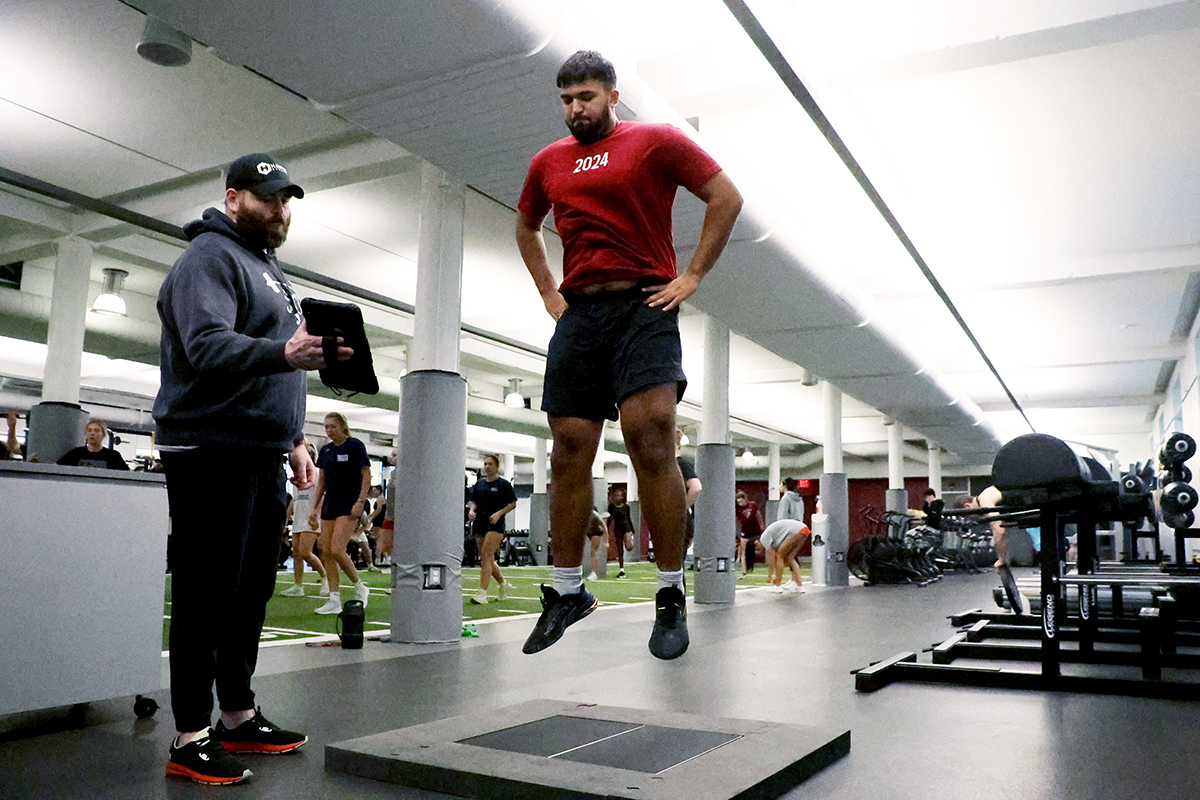
Football co-captain Nihaal Rana ’24 enters the Downer Family Fitness Center for an off-season workout after a full day of classes. He warms up quickly to the fast-paced rhythms pumping through the facility sound system, then greets head strength and conditioning coach Shaun Fishel, aligns his feet on the left and right side of a force plate deck, and gets ready to jump. Fishel pulls up Rana’s profile on an iPad and prepares a countdown for him to complete a series of countermovement jumps.

Rana stands with his hands on his hips, then squats and jumps as high as he can. As he leaps, a three-dimensional, full-body assessment camera captures his movements and more than 70 data points, including body weight, jump height and peak propulsive force. That data will help shape Rana’s workout program for peak performance.

Although force plates are new to Exeter, they are a staple in collegiate and professional strength and sports medicine facilities and have become part of medical testing at the NFL Scouting Combine.

“It is interesting to be able to track my progress,” Rana says. “Coaches want to know your weight and how much force you can create, so it is cool to be able to have this in our gym on campus.”

The data is also used to individualize strategies for injury prevention and rehabilitation. Fishel says the software includes an automatic flagging system that identifies potential body mechanic problems. For example, lower-limb asymmetries could alert trainers that a student is favoring one side because of tightness, injury or natural body development. Not all asymmetries need to be fixed, but the data identifies a student’s baseline.

The body assessment camera also notes potential body compensations that would raise a student’s risk of injury. Capturing a baseline measure of function offers a guide to any rehab program necessary for a student to return to play.

“This has been a game changer,” Director of Athletic Training Adam Hernandez says. “Having objective data that we can point to so we’re not guessing on how a student feels has allowed us to return students back from injury in a safer manner and has decreased the amount of time a student has a recurrence of an injury. We can look at the data and know how close they are to their normal.”

The jump tests can also create a motivational bond among teammates who use the technology during their scheduled in-season lifts.

“Whenever our team gets on the force plates, it’s a good chance to get everyone hyped up,” says Kate Rose ’24, co-captain of the varsity field hockey team. “We all yell and cheer each other on. It can be fun. We use the data to compete a little bit against each other, too.”

Although the programming, data and use of this equipment is supervised by the strength and conditioning staff, once students are trained they can test themselves and track their progress. The ability to view results in real time and notice developments, fatigue or other variances in their personalized data gives students ownership and responsibility for their training.

“Our students bring in exactly what they bring into the classroom with a sense of agency and a sense of wonder,” Hernandez says. “They want to see the data and want to understand what the data means. It gives us another opportunity to educate our students. We are arming them with data to ask good health questions, be stewards of their own health-care, and prepare them to be lifelong healthy individuals.”

Athletes are not the only beneficiaries. As Fishel says: “No matter what sport they play, or even if they do not play a sport, this technology offers data that we can look at to keep all students healthy.”

Editors Note: This article first appeared in the winter 2024 issue of The Exeter Bulletin.

A culture of gratitude

Exeter was founded as a free school in 1781, at a time when there was no system of free public schools. Today, Exeter is a private school with a public purpose — expressed in our mission statement — to “unite goodness and knowledge and inspire youth from every quarter to lead purposeful lives.” 

We enroll students of promising academic ability and strong character from a wide range of backgrounds, identities and experiences, and we admit them without regard to their family’s ability to pay tuition. We strive to create a strong sense of belonging in every student, and to instill in each student a belief that their time here matters. We tell them they are not special merely because they are here, but that because they are here, they have the opportunity to accomplish special things together.

We urge our students to focus on learning and growth, rather than a narrow definition of success, and to embrace fully the opportunities to learn with and from students whose backgrounds and experiences differ from their own. This requires that we learn to be comfortable being uncomfortable, and that we expect — indeed welcome — a diversity of viewpoints on nearly every subject worth exploring in our Harkness classrooms. 

We also seek to create a culture of gratitude. We understand that an Exeter education is an extraordinary gift, and attending Exeter is a great privilege. With that privilege comes opportunity, and with opportunity comes responsibility. In accordance with our core value of non sibi, we seek to graduate students “whose ambitions and actions are inspired by their interest in others and the world around them.” 

I too am privileged to be a part of this community, and to be able to observe firsthand the joy our students have in their learning, witness how they care for each other, and see all the special things they accomplish together and the fun they have doing it. It also is deeply meaningful to see all that our teachers and all other adults in our school do to make these student experiences possible, and to hear parents express time and again their deep gratitude for the growth they see in their children during their time here.

I have said before that human connection is at the foundation of all that we do and all that we can hope to accomplish of significance in our lives. A few weeks ago, I wrote to our school community that we must work every day to create a world where the dignity and equal worth of every human life is understood and respected by all.

We do this work, like everything we do at Exeter, with a deep sense of purpose. We see the fulfillment of that purpose in how our students contribute to the life of the school while they are here, as well as in how they contribute to the greater good, and lead their own purposeful lives, after they leave.

Editor’s note: This column first appeared in the winter 2024 issue of The Exeter Bulletin.