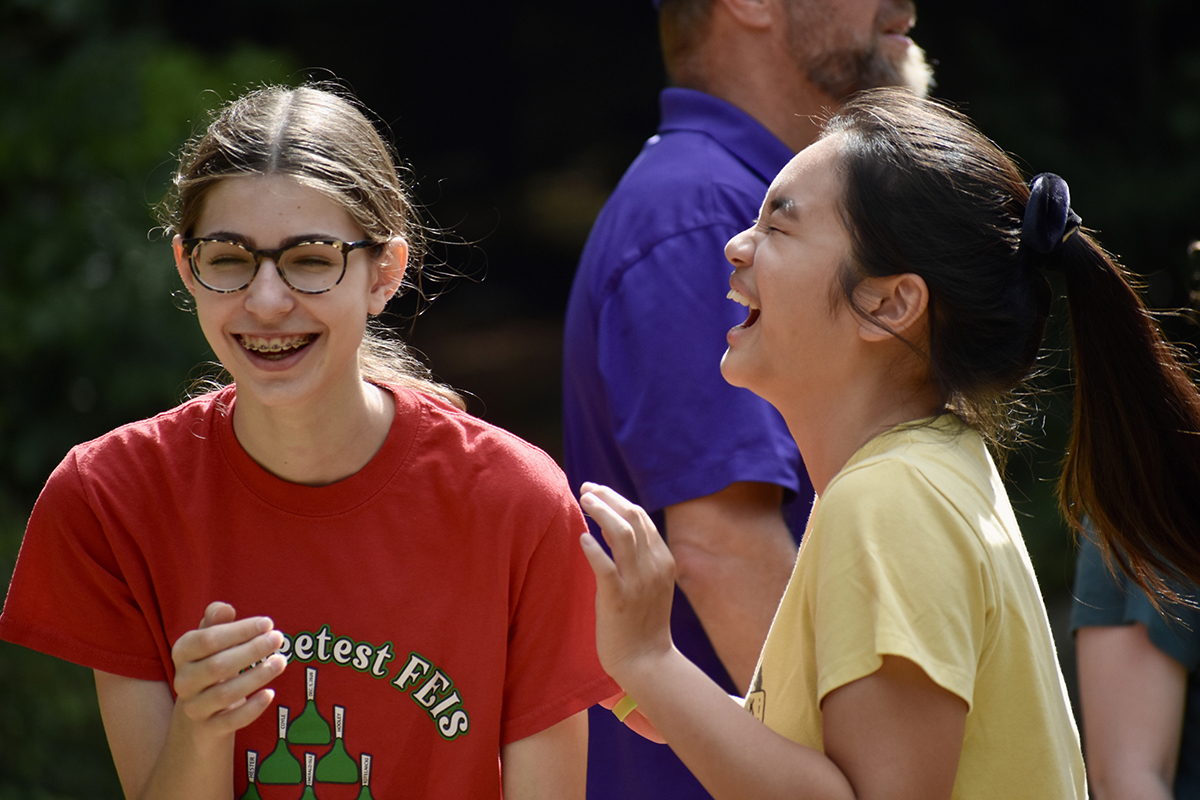
 trust each other to literally stay safe.”
In addition to their coursework and their trip to the Browne Center, students in both Hamm Leadership Programs visited the Edward M. Kennedy Institute for the U.S. Senate in Boston, where they participated in a mock debate over voting rights legislation. While they were in the city, the students also toured a series of giant murals created by artists in association with the organization Sea Walls to bring awareness to issues of environmentalism, especially protecting the ocean.
Each ACCESS student teams with their older counterparts for a capstone project, through which they aim to make a meaningful impact on the Exeter Summer community in some way. Lu and his capstone group created a peer-to-peer tutoring program for fellow Exeter Summer students, while Garima Biyani, a rising ninth grader from Bellevue, Washington, worked with her group to plant seeds in Exeter’s community garden.
Learning to listen
Irene Hamm, who earned her master’s degree in special education from Columbia University, spent 32 years teaching students from preschool through high school ages. After watching the Hamm Leadership Program’s success in the UPPER SCHOOL, she’s excited to see it extended to the younger group.

“I think [the program is] about teaching the students how to work with other people instead of just going their own way,” Irene notes. “Having taught seventh and eighth graders, I think they have to learn to listen to other people and yet still have their opinions, and when they approach others, approach them with thoughtfulness — and with facts.”
For Charles Hamm, whose namesake UPPER SCHOOL program recently celebrated its 14th year, his initial inspiration to create it still holds true. “The combination of good leadership and good followership has always, and increasingly, struck me as being critical to life on earth,” Charles says. “If we can jumpstart a sense of thinking, considering and approaching an understanding of what leadership might be — even if you don’t become a leader — it will enhance your ability to be a responsible follower.”
As the five-week program draws to a close, Jack Lu has taken the message to heart. “Through this experience, I’ve fully come to realize that leaders may be the ones who get most of the fame and most of the attention,” Lu says. “But without the followers, they really can’t achieve anything. The followers are equally — if not more — important than the leaders.”

 When I first came to Exeter as a prep, I was very lonely. In a country where everyone is different, I felt, more than ever, the particularity of my being. I wanted to fit in, wanted to be accepted, wanted to have someone to talk to who could understand me and tell me that I was not alone. It was then that I found Jean-Christophe. It is a novel recording the life trajectory of a fictional German musician (who ultimately inspired me to learn piano at Exeter). In Jean-Christophe I saw myself: sometimes confused, sometimes passionate, always changing. We had the same struggles, same questions, same doubts and fears. In a time where I was learning how to live by myself, it was my motivation and my comfort.
 “These books all paint a portrait of what it means to be human. They are all centered on and driven by their characters, characters who shimmer with life, characters with depth and complexity and truth to them. When you’re a kid, you’re often seeking a character who is ‘relatable,’ who thinks like you or cares about the same things or shares some piece of your identity and experience. I think that’s an important part of figuring out who you are — it certainly was for me. But each of the books contributed to something even more powerful than that for me: the ability to see myself in characters who were not necessarily like me in their identity or experience or even thinking, but who share in the most real way the beating heart of what it is to be human. That is what books are for.”



 “Illusions of Immortality: U.S. Public Health Authorities and the Spanish Flu Pandemic, 1918-1919” — Diana Gentry ’01

