







Flip through the pages of Look Magazine from 1948
Finis Origine Pendet: A Look Back
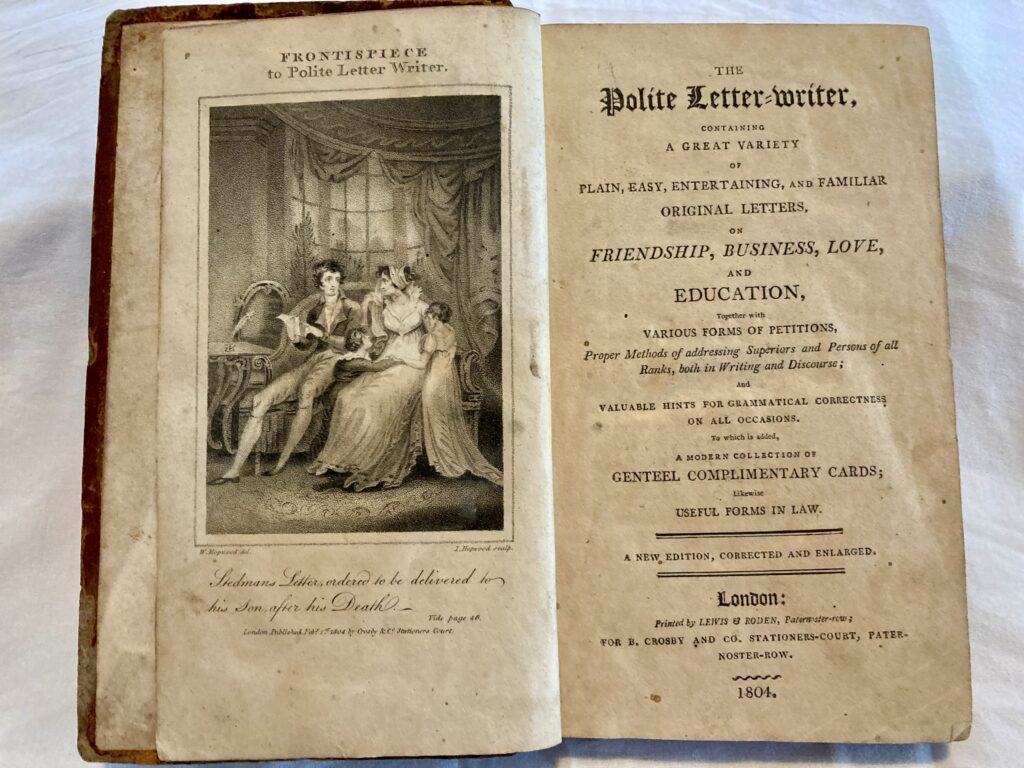
Rich Calvert ’50 recently sent his class correspondents a copy of his Look magazine from January 6, 1948, highlighting an article titled “Exeter Drops the Old School Tie: The 116-Year-Old Boys School Has a Tradition of Democracy.” We felt it was worth sharing with a wider audience.
In words and pictures of classrooms, debate meetings, sports practices and pillow fights, the article provides an intimate snapshot of the school at a time when the world at large was concerned with the Cold War, the Nuremberg trials and Gary Cooper.
Look also printed a poll taken among 659 students, including Calvert. Here are a couple of the questions and the responses: Do you think religious training is an essential part of your education?” Yes: 502. No: 184. Which is most important in your future — money, fame or the respect of your community? Money: 87. Fame: 44. Community respect: 534.
“Students’ opinions are conservative,” it declares.
Flip through the pages of Look Magazine from 1948
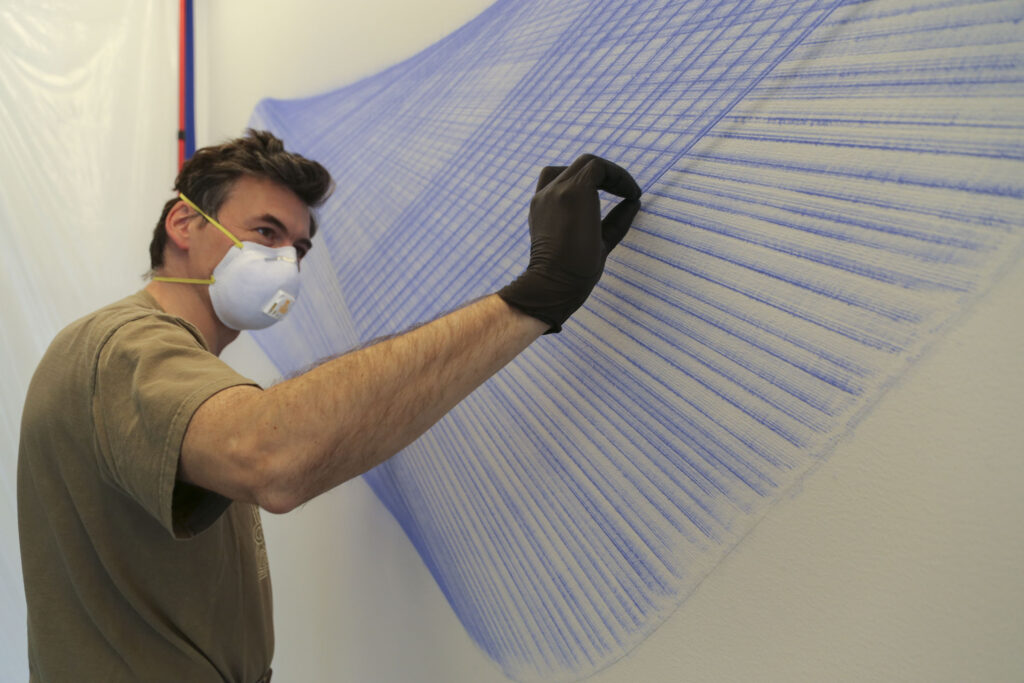
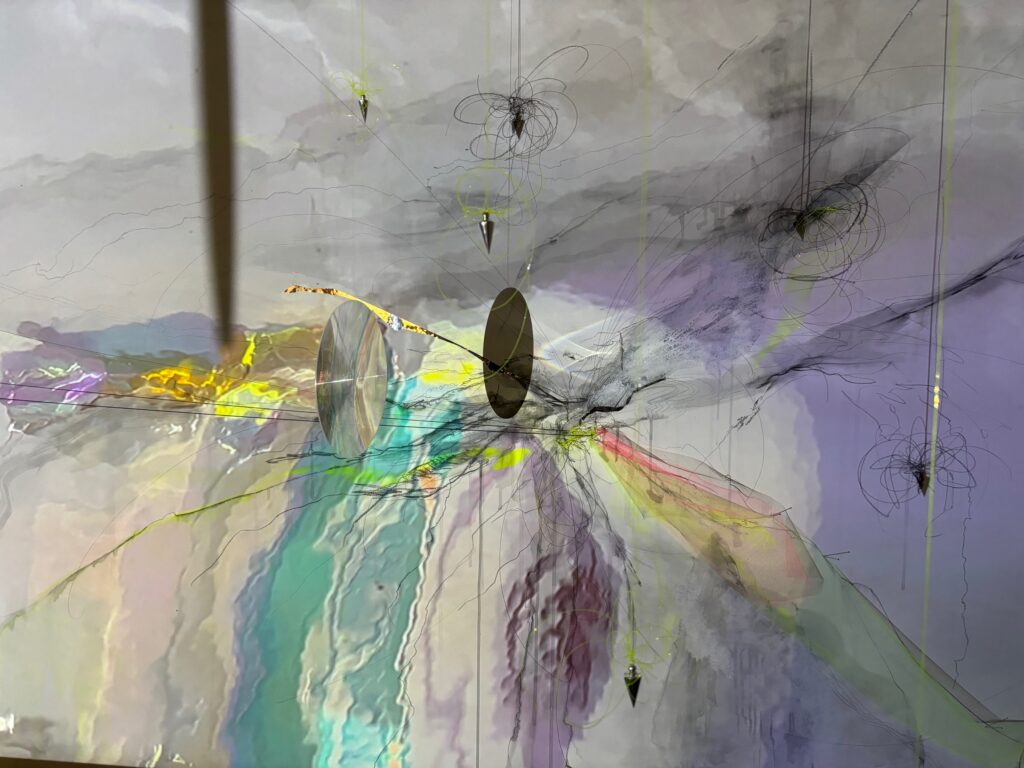
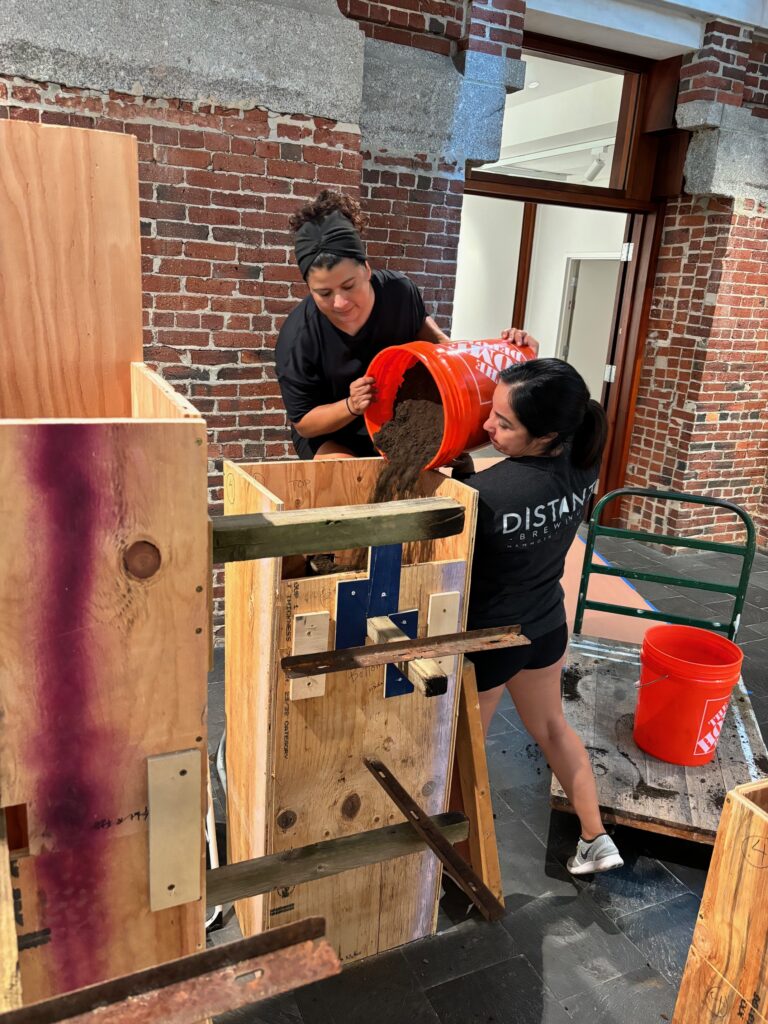
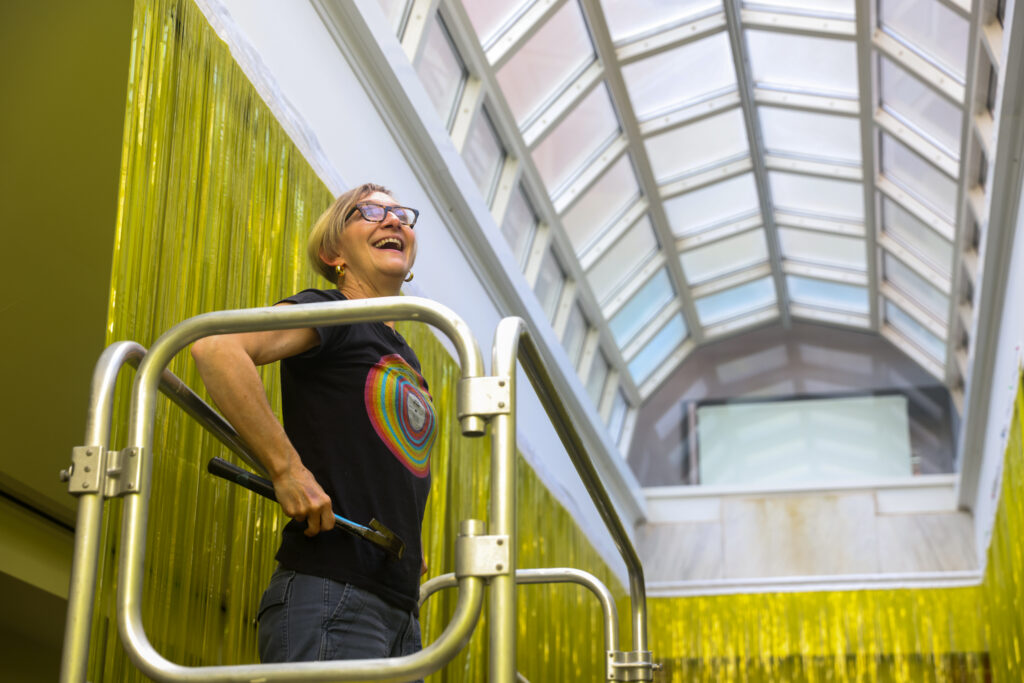
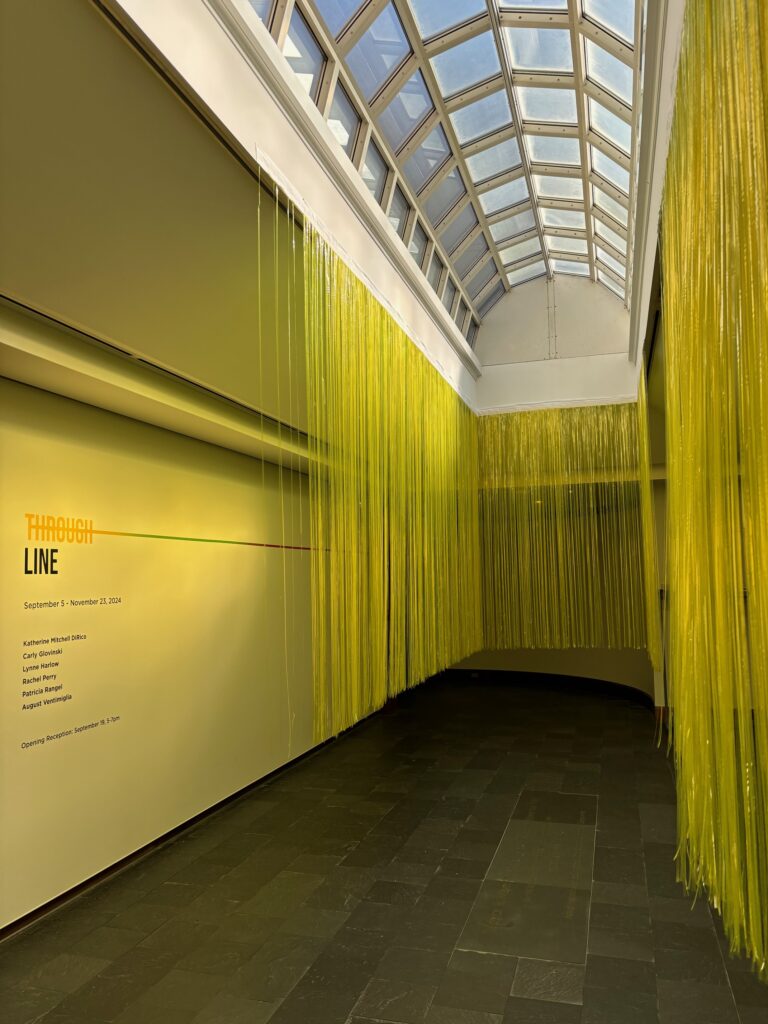
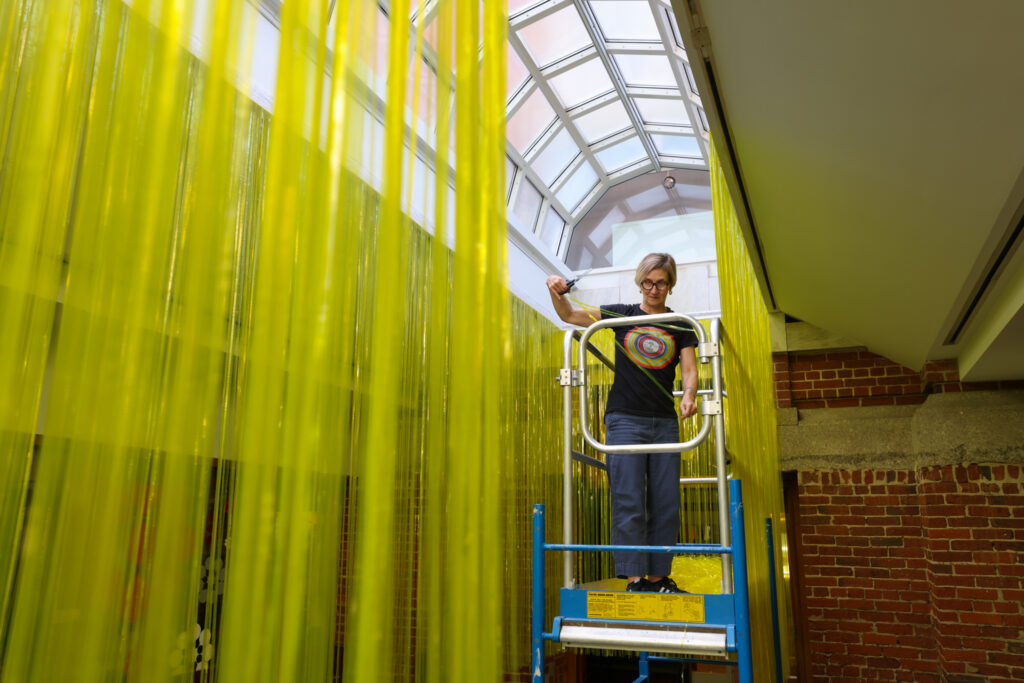
Making your mark takes on new meaning at the Lamont Gallery with this fall’s exhibition “Through Line.” In it, five of the six artists visited the Academy to create temporary installations on site — at times marking directly on the surface of the gallery’s walls. The materials included markers, snap chalk, string, streamers and even 80 bags of dirt shoveled from the campus grounds.
“While their mediums are vast and divergent,” Lamont Gallery Director and Curator Pam Meadows says, “each artist enters the conversation through painstakingly repetitious, modest and slow gestures. They amass into vibrant works that arrest the viewer just as quickly as they entice them to slow down and look more closely.”
Artists included in Fall Exhibit include August Ventimiglia, Lynne Harlow, Carly Glovinski, Rachel Perry, Katherine Mitchell DiRico and Patricia Rangel.
The process of creating it really is a conversation between the two people. The process unfolds over days. I have to trust the other person on the end of the line. It’s like having a dance partner.
August Ventimiglia
Inspiration August Ventimiglia took inspiration for his large wall mural from the Gulf of Maine — its coastal shape, sea life and ocean water data, like wave height, over time. “Those silhouettes of fish are the alewives schooling, and they’re all pointed radially to Portsmouth Harbor, which is the ocean entrance to the Exeter River,” Ventimiglia says. “The great dam on the Exeter River was taken down in 2016 and the alewives started to come back.” Alewife are small fish that migrate between fresh and saltwater.
Execution The 20-foot-long drawing is made with a snap line and a chalk reel, which is used in construction sites to lay a straight line over a long distance. “There’s one person at one side of the string and one person at the other side of the string, and the string is pulled taut,” Ventimiglia says. “Then you pluck it like a string of a big double bass, and it snaps the line against the wall. … The process of creating it really is a conversation between the two people. The process unfolds over days. I have to trust the other person on the end of the line. It’s like having a dance partner. [Exhibitions and Collections Manager Dustin Schuetz] and I started snapping on Monday. It took maybe 16 hours, just the snapping.”
Contradictions “The idea of using a dry medium to represent a liquid form is one of those contradictions I’m interested in,” Ventimiglia says. “And then playing with the idea of a construction tool to evoke a natural phenomenon is also a contradiction. The contradiction isn’t a bad thing. It’s something to ponder.”
Teaching Moment “I think of this [mural] not just as a teaching tool in the Art Department, but it can also be used as a backdrop for a conversation about ecology, science, about social and environmental responsibility. It’s more than just an abstract art form; it tells a story, in a broader critique of human activity.”
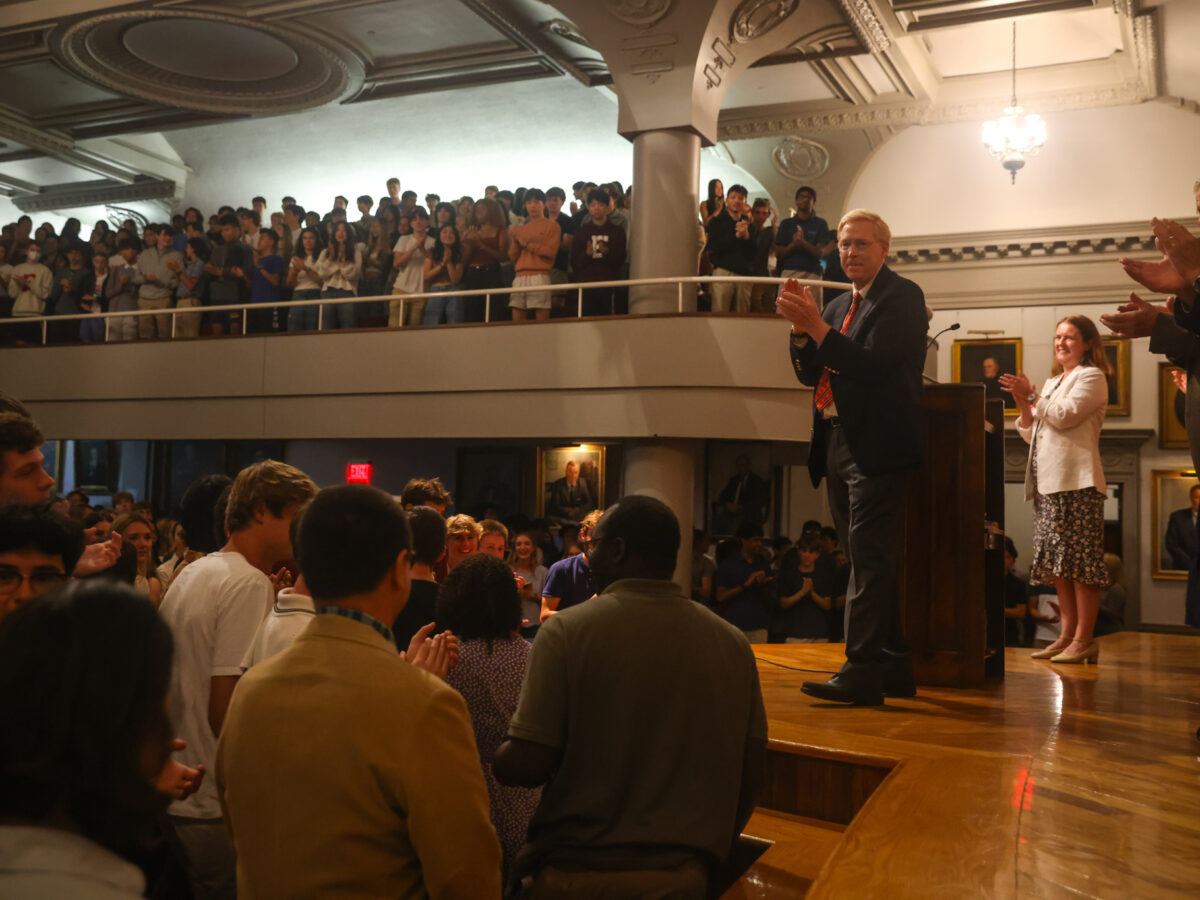
Good morning, Exeter.
Thank you, Dean Page, for welcoming and recognizing our emeriti faculty this morning, and for introducing our new faculty. It has been a great pleasure getting to know our new faculty over the past couple of weeks.
I would like to extend a special, warm welcome to all our new students. You are 369 in number and come from 31 states and 28 countries. You bring a wonderful diversity of backgrounds, experiences, talents and interests to our school. We are delighted that you are here, ready to begin your Exeter journey.
Many of you know that I too once sat in this assembly hall as a new student. I was a financial aid student, as roughly half of you are. I worked hard, played sports, had fun, and made lifelong friends. Attending Exeter was a transformative experience for me.
But sitting in this assembly hall for the first time as a new Lower, many years ago, I was a bit nervous. I felt uncertain. I had questions. Would I fit in? Did I really belong at Exeter? Would I be able to do the work?
I like to tell our new students what I would have appreciated hearing as a new Lower. Returning students know this well because they have heard it before:
A few of you – 43 to be exact – are living off campus in a hotel for a couple of weeks while we complete the renovation of Langdell Hall. We appreciate your patience and understanding. You will be settled into a newly renovated dorm very soon. In the meantime, we will have a surprise or two for you along the way to make the wait a little more enjoyable.
The new dining hall will be completed near the end of fall term. Until then, we have the tent outside Elm and we have added serving lines and adjusted our daily schedule to even out the flow a bit. As you go through the lines, please let the dining staff know how much you appreciate all their efforts on your behalf, and please show your appreciation by clearing your tables properly. The new dining hall is going to be terrific and well worth the wait.
It is our tradition at Opening Assembly to revisit the Academy’s Deed of Gift and reflect on the mission of our school. The Deed of Gift was signed by John and Elizabeth Phillips in 1781, seven years before the State of New Hampshire became the ninth state to ratify the U.S. Constitution. Our Deed of Gift is a remarkable document.
It states that Phillips Exeter Academy “shall ever be equally open to youth of requisite qualifications from every quarter.”
It also states,
“Above all, it is expected that the attention of instructors to the disposition of the minds and morals of the youth under their charge will exceed every other care; well considering that though goodness without knowledge is weak and feeble, yet knowledge without goodness is dangerous, and that both, united, form the noblest character, and lay the surest foundation of usefulness to mankind.”
From these passages, we derive our mission statement. Our mission is to unite goodness and knowledge and inspire youth from every quarter to lead purposeful lives.
In the very first paragraph of the Deed of Gift, our Founders also wrote, “the time of youth is the important period, on the improvement or neglect of which depend the most weighty consequences, to individuals themselves and the community.” In essence, John and Elizabeth Phillips were saying that your time here matters. It matters to your personal development as human beings, and it matters to the world, because the education you receive here will provide the foundation for your purposeful lives.
We give expression to these ideas on our school seal with the Latin words finis origine pendet, which translated mean “the end depends upon the beginning.” These words express our belief that what you will accomplish in life, and how you will make a difference in the world, will be shaped by what you learn and how you grow here at Exeter. Graduates return to campus every year and tell us that the education they received at Exeter made the greatest difference in their lives. Time and again they say it all started here.
The Latin words “non sibi,” which mean “not for oneself,” also appear on our school seal and signify our belief that the education gained here should be used for the benefit of others as well as for oneself. Our core value of non sibi proclaims that we “seek to graduate students whose ambitions and actions are inspired by their interest in others and the world around them.” Non sibi represents the very spirit and ethos of our school.
With these thoughts in mind, I would like to share three goals that I have for you and for our school this academic year.
My first goal is that you have fun. This might not seem like something special, since we have fun every year, but it is still a good place to start. I want you to have fun and find joy in your classes, dorms, clubs, co-curricular and extra-curricular activities, performances, teams, ensembles, affinity groups – everything you do and everywhere you go.
I want you to find joy in knowing that you belong here, in discovering that there are other students here with similar interests and passions, and in building lasting friendships with students who initially might seem very different from you.
Without a doubt you will grow academically, thrive in the arts, compete hard athletically, and excel in various clubs and activities, as students do every year. You will earn some honors and likely win a few competitions and championships. But the fun and joy do not depend on winning. The fun and joy are in the doing, in the learning and growth that occurs, and in the friendships that you make along the way.
To have fun and find joy in these various ways, you need to be healthy. To be healthy, you need to eat well and get your sleep. Please eat well and maintain good, consistent sleep habits. You do not have to do everything. Please do not try to do too much.
But do try new things. An Exeter alum rowed in the Olympics just a few weeks ago. I saw her say on Instagram that she first learned how to row at Exeter. She tried something new and ended up in the Olympics. That might not happen very often, but every year Exonians graduate with passions that they discovered here. I encourage you to try new things.
Having fun does not mean you will not work hard. You have come here to be challenged, and with challenge comes hard work. As you rise to the challenges that come your way, you will begin to understand your capacity to meet those challenges. You will grow in confidence. You will develop self-belief. I hope that too will give you joy.
Lastly, on this point, please keep in mind that we have many kinds of support here – formal and informal. When you do face challenges, you will not be alone. We have these supports – counselors, advisers, learning centers, peer tutors, student listeners, and more — because we all need support from time to time. Using them will propel your growth and increase your joy.
My second hope for the year is that you embrace fully our commitment at Exeter to seeking complex truths.
Academic excellence is a defining strength and core value of our school, and one of the reasons why you chose to come here. Our statement of that core value states, “In every discipline, and at every level within our curriculum, we seek to inspire students to develop critical thinking skills and seek complex truths.”
Our goal is to teach you how to think, not what to think.
We are committed to helping you learn how to seek complex truths that take into consideration all relevant facts and that respect the dignity and equal worth of all human beings equally. So how do we do that? How do you do that?
The learning we seek at Exeter starts with being open to different points of view. It starts with being curious why people from different backgrounds and experiences, or maybe similar backgrounds and experiences, might think differently. It requires listening to other perspectives with empathy, humility and respect, and with the understanding that learning at Exeter is a collaborative process, a communal effort.
This kind of learning requires a certain measure of resilience. It requires understanding the difference between being uncomfortable and being unsafe. At Exeter, we want you to learn how to be comfortable with being uncomfortable. This will enable you to engage with facts and perspectives that might not seem to fit your worldview. It will enable you to plumb the depths of an issue and seek complex truths. This is what we mean by “rigorous inquiry and thoughtful discourse” in our core value statement of academic excellence.
Listening with curiosity, empathy and humility; being resilient; being open to different points of view; being comfortable engaging with facts that challenge your thinking – these are all skills. Skills that you can develop and practice. You might call them Harkness skills. Or goodness and knowledge skills. These skills are essential to your learning at Exeter and will provide a foundation for everything you do and everything you achieve in life.
The learning that we seek to encourage extends beyond the classroom. When you leave an assembly during the course of the year, rather than comparing reactions with students with whom you might expect to agree, seek students with whom you might disagree. Share your thinking not to persuade but to understand, and thereby deepen the bonds of respect and friendship that come from learning together.
Importantly, our diversity at Exeter – our commitment to youth from every quarter – also is a defining strength of our school that propels our learning. We celebrate our diversity across all dimensions and cherish the rich learning environment that it creates.
We delight in our diverse identities, but we are not defined by them. We are defined by how we think, how we act, what we do, and by our qualities as human beings.
I am reminded of a passage in A Wrinkle In Time by Madeleine L’Engle. In this passage, aliens who don’t have eyes and cannot see find it unhelpful when earthlings try to give a visual description of other beings. The aliens say, “Think about what they are. This look doesn’t help us at all.”
This last point is critical, because there is a large body of literature that tells us that we sometimes tend to have less empathy for persons whom we perceive as different. That is the opposite of what we should be striving for, because our learning and growth are not advanced by engaging with persons who think just like us. Our learning and growth are advanced by engaging with persons who think differently.
We understand that the promise of our diverse community is realized fully only when we commit ourselves to rigorous inquiry and thoughtful discourse in this way.
By contrast, anything that narrows our thinking, or closes our mind to different points of view, will inhibit our learning as individuals and as a community. When we stop being curious, we stop learning.
I said earlier that learning at Exeter is a collaborative process, a communal effort. Interestingly, the word “competition” is derived from the Latin word competere, which means to strive together. Even when we think we are competing against our archrival to the south, in reality we are competing with them. Here at Exeter, in the classroom, in the dorm, on team buses, in the theater, at Grill, you are learning and striving together. You are learning with and from each other, and together pursuing a common goal to prepare yourselves to lead purposeful lives.
I would like to close this morning with a few words about gratitude. Gratitude is a common theme at graduations, but it is important to start the year with some of the same thoughts in mind. My third goal for the year is that you nurture a culture of gratitude, grounded in our core value of non sibi, and share your gratitude with those around you.
It is an extraordinary privilege to be a part of this community. We know this, but in the pressure of our daily business, and in moments of disappointment, we can sometimes forget and take things for granted. When we do that, we disrespect the privileges that we all enjoy as members of this community, and we disrespect the sacrifices of all those persons who have made our time here possible.
I hope you will always be grateful to your teachers and all the other adults, here and at home, who support you during your time at Exeter. I hope your gratitude will extend to prior generations of teachers and students who have helped create and shape the Exeter of today, and who have thereby made your experiences possible.
I am very excited about the year ahead. Walking about the campus these last few days, it has been great fun seeing the energy and joy that you all bring to a new school year. It certainly will be exciting to see all that you will do and accomplish this year. It will be fun to watch you carry on old traditions and perhaps start new ones. It will be fun simply seeing the many ways you have fun.
Lastly, remember, you are all Exonians. One way we recognize this is to hand out a new school shirt each year following Opening Assembly. This is another way we welcome new students, and a reminder to all students that you all belong here. Your shirts await you in the Academic Quad. Please take a shirt with your class year on the front.
By tradition, we end all assemblies with the words “Senior Class.” At Opening Assembly, all who are not seniors keep their seats while we allow seniors to leave the assembly hall first.
Senior class!
Ship ahoy!
Exonians for a century have peeked anxiously toward the Academy Building’s bell-tower clock as they’ve scurried to get to class on time. And for just as long, the Sidney S. has sailed quietly above the fray.
The triple-masted ship perched atop the bell tower has served as the Academy’s weather vane since the school’s fourth and current Academy Building was completed in 1915. Given by an anonymous donor, the ship bears the name “Sidney S,” a reference to Sanford Sidney Smith, class of 1866, who was the president of the Trustees at the time.
Why a ship? According to Myron Williams, in his 1957 book, The Story of Philips Exeter, the ship is an homage to the great seal of the State of New Hampshire, which features the Raleigh, one of the original 13 warships commissioned by the Continental Congress for a new American navy, built in 1776 in Portsmouth. The weather vane is also believed to be recognition of the town of Exeter’s once-vibrant role as a mercantile seaport and shipbuilding center.
In 2000, the weather vane received a fresh gilding with 23-karat gold leaf when the clock and bell were restored. The Sidney S. sails on, more than a century after her maiden voyage.
Architect Billie Tsien taps a key on her laptop and a single photograph of an amethyst geode appears on the boardroom wall. There’s no accompanying 3D, balsa-wood building model or life-size posters recounting her firm’s architectural awards, although they have won many.
She’s focusing her audience’s attention on the geode. The rock is bumpy and fairly plain on the outside. Inside, it’s dazzling. Thousands of sparkling crystals erupt in all directions, exuding a deep purple glow. “That’s adolescence,” Tsien says.
It is also her parti, or conceptual big idea. For the next hour, she and partner Tod Williams explain their vision for a new performing arts center at Exeter that, like a geode, will feature a quiet exterior and a dynamic interior that encourage the free expression of another, more hidden sense of self.
Tsien’s elegantly simple presentation resonates with the Academy trustees, faculty, alumni and administration in attendance. “We left that meeting and I think it took us about 45 minutes to make a decision,” recalls Theater and Dance Instructor Sarah Ream ’75; P’09, P’11 of the New York City meetup back in 2014. “It was not difficult to decide that they were the people we wanted to go with for this project.”
Fast-forward four years, and The David E. and Stacey L. Goel Center for Theater and Dance officially opens to the first students. True to concept, the stark, modern cube, clad in muted gray brick, houses vibrant, highly sophisticated interior spaces where Exonians can take creative risks, refine their craft, and collaborate in formerly impossible ways.
Aesthetically and functionally, the Goel Center fits the husband-and-wife team’s body of institutional work — including the Barack Obama Presidential Center in Chicago and the U.S. Embassy complex in Mexico City — which puts a building’s users above architectural whimsy. Despite having two performing arts centers on their architectural CV, for their firm, TWBTA, there’s no such thing as a generic theater building; each one tells its own story. The Goel Center tells a uniquely Exeter story. It’s one of optimism, of the power of Harkness, and of the belief that the arts play a critical role in education.
The ethos of the Exeter community is inherent in the scale, the geometry and the technical capabilities of the Goel Center, says consultant Martin Vinik, brought on in the early days of the project to help configure the building’s theatrical requirements. “It’s not loud, it’s not self-congratulatory,” Vinik explains. “It emphasizes depth, quality and that approach to teaching at Exeter that is both intimate and collaborative.”
Fitting the Exeter experience into a 143-foot-by-143-foot cube was a high-stakes game of Tetris. Vinik, the architects, former Director of Facilities Roger Wakeman and members of the theater and dance faculty all shared thoughts on how to place the necessary blocks of performance, teaching, rehearsal, technical and public spaces inside the building’s box.
“We knew that the theaters, due to their sheer size, would be the rulers of space,” Williams says. Spanning all four levels and seating 350, the mainstage theater fills the bulk of the 63,130-square-foot building and is large enough to host complex productions in theater or dance. Appointed with the latest high-tech machinery, it also provides the flexibility, versatility and ease of operation required for Exonians to perform as their most imaginative selves. Students can manipulate an intricate web of LED lights to produce limitless color combinations from the theater’s control room or take to the catwalks to make above-stage adjustments. There’s also a movable orchestra pit for musicians and advanced rigging hoists for the stage crew to fly curtains, lights or scenery.
For limited-cast productions with simple sets, solo shows, or multidisciplinary collaborations that would be dwarfed on the mainstage, students can premier work in the smaller thrust stage theater. With seats for 150 and a rectangular forestage that extends into the audience on three sides, the interaction between performer and spectator is palpable. “It’s reminiscent of Fisher Theater in that way,” says Theater and Dance Chair Rob Richards, “because the action comes right to the audience.” The additional performance venue also means that two productions can happen simultaneously — one on the mainstage and one on the thrust stage.
And finally, the Goel Center is home to the Academy’s very first performance space designed specifically for dancers’ needs. Up until 2017, dance classes were taught on the second floor of the former Davis library, and before that in the basement of Thompson Gym. The new studio stars a classic three-layer basket-weave sprung floor with heat-sealed seams and Marley-finish surfaces; appropriate sightlines for choreography; and a ceiling-mounted projector to add video or animation to the show.
This wide variety of venue type and size offers all students — from the most focused and talented to the casual neophyte — a place to explore and perform. “The theaters themselves are meant to be laboratories in which all sorts of work, new and old, realistic, formalistic, presentational or otherwise, can be produced,” Vinik says.
The size differential is aspirational as well. “Depending on your level of comfort, you can decide where you want to perform,” says John Skillern, TWBTA’s on-site project manager. “I think a lot of kids will look at the mainstage and think it’s phenomenal, it’s a big deal. Just knowing there is that stage, that they can at some point step onto, I think that’s very inspiring.”
Of course, every on-stage performance is the result of an ensemble’s effort. And much of that work happens before the curtain ever goes up on opening night. “It was really important to us, as an educational institution,” Ream says, “that half the building’s real estate belonged to all of the other work that happens off stage — thinking, rehearsing, costuming and set design.”
The architects responded, providing ample area for stagecraft, or the technical aspects of theatrical production, including a workroom to build scenery, a sewing room for garment design and a video-editing suite. “The difference between a Broadway theater and this teaching facility,” Williams says, “is that you’re actually building your sets here, not out in Staten Island. … The teaching occurs in the shop just as well as it occurs in the classroom or on the stage.”
These well-equipped back-of-house spaces enhance the scope and quality of classes for students, bolstering and broadening the Academy’s existing curriculum of 23 dance and theater courses. They also support an alternative framework for understanding and appreciating the arts. “We wanted to make sure that this world is a world that’s balanced between the hand, the mind, the individual and the technology,” Williams says.
Bringing the mind into the building in a very literal way meant the installation of actual Harkness tables (albeit with a slightly more modern design). There are now two Harkness classrooms devoted to theater and dance — a first for the Academy. This spring, Dance Instructor Allison Duke will teach her first hybrid theory and practice course, Dance in Society. Examining movement in a sociocultural context, Duke will have students write an analytical paper and choreograph a dance. “The students will be thinking critically while they are rehearsing and improving their technique,” she says, “but also writing papers and using a completely different part of their brain.”
Positioning these Harkness classrooms close to the performance and rehearsal spaces was a guiding principle of the architectural design. Teachers now can easily do intensive textual work at the table one minute and quickly transition to kinesthetic work the next, without hoofing it across campus. Convenient, yes. But more importantly, it meets students where they are in terms of their style of learning. “There are students who just can’t get Shakespeare at all if they’re sitting around reading it,” Ream says. “But if you let them get up and on their feet, then you see that ‘Aha!’ moment when suddenly it begins to make sense to them.”
The circulation of people and things is very clearly thought out in the Goel Center. “You need to be able to move things around in this box,” Williams says, “which takes a lot of planning. You need to be able to build a set and take it right onto the stage, then straight to storage or out to the dumpster.” The center’s scenery production shop is located directly behind the mainstage — placement that makes practical sense — especially when ferrying large-scale props to and fro.
In the same way, the first-floor dramatic rehearsal studio matches the exact footprint of the mainstage (minus the wing space) and includes similar, but scaled-down technical AV instruments. This mirroring means that performers can move seamlessly from rehearsal to the performance space without missing a step, and that a production’s different constituents — actors, stage crew, dancers — can work concurrently.
Plus, the building’s connective tissue, its unfettered passageways — behind the stage, over the stage on the catwalks, up to the control room — all allow straightforward access from one area to the next. “I think that flow, that’s an important thing to communicate to the students,” Skillern says. “They have access to it all.” A building-wide paging and communication system reinforces the interplay between spaces by making conversations among the tech crew, faculty and performers a button push away. “There is visual connectivity and a physical connectivity in all aspects of the design,” Skillern adds.
Connecting not just the people and parts of a theatrical production process together, but the theater department to the dance department, drove the architectural design as well. “When Billie and I started to think about these components going together,” Williams says, “we thought you could have them connect, they could have this vertical relationship.” Hence, the central staircase in the main lobby, which is a physical link from the theater performance spaces on the main floor to the dance performance space on the third floor. This key form offers landing points, views and access to all levels of the performing arts. Each program fits in the same shell but retains its own identity, affording interdisciplinary collaboration. “The stair connects you to the dance level but the dance also has its own world,” Skillern says.
The Goel Center not only provides an unmatched, professional-grade experience for every student, its very existence is a visible recognition of the value of the arts as a rigorous academic pursuit at Exeter. “I think there has been a major shift among educators,” Ream says, “from seeing the arts as a charming addition to the curriculum, to seeing it as part of the bedrock of an ideal education.” Indeed, the importance of arts training in adolescent development is reinforced by current educational theory and brain research.
That’s not to say that the arts haven’t been valued at Exeter for centuries. In fact, from the earliest days of the school’s founding in 1781, “Musick” and “the Art of Speaking” were listed among the “Liberal Arts and Sciences” that the Academy would promote. It is just that student participation was constrained by the limits of the school’s facilities. There are now three separate departments devoted to the arts, including studio art, music, and theater and dance. More than half the student body is involved in a dozen dance clubs, drama clubs that perform weekly productions, and formal music ensembles.
“I’m really hoping that some of the traffic from the gym — the people who think the last thing in the world they would ever do is anything to do with theater — are going to find themselves kind of wandering over and hanging out and getting involved,” Ream says. It appears to be working. Twice the number of students, compared to last year, auditioned for this fall’s production, A Midsummer Night’s Dream.
On a crisp September day, backpacks and kicked-off shoes line the hallways of the Goel Center. Faculty and staff breeze through the building, chattering and lounging on the comfy red chairs scattered about the lobby. Among the passersby are architects Williams and Tsien. “I love seeing kids in the space,” Tsien says. The bustle, apparently, is the one thing you can never simulate in renderings. This is their first visit since the academic year began. They walk into each room, inspect each wall, outlet, fixture — no detail goes unnoticed. “I’m thinking like a dancer,” Williams says, dressed in signature black, as he enters the dance rehearsal space. He eyes the pop of gray paint on an interior window frame. He wonders out loud if, perhaps, it should be painted white. Shouldn’t the whole room be white, ethereal, he muses, to make the dancers feel freer to explore creatively? Tsien shares her thoughts. Williams listens. The conversation continues. They’re thinking and talking about the students and how they’ll inhabit and occupy this space they’ve created. It’s the architecture of Harkness.
Editor’s note: This article first appeared in the fall 2018 issue of The Exeter Bulletin.

Test test test Test test test Test test test Test test test Test test test Test test test Test test test Test test test Test test test Test test test Test test test Test test test Test test test Test test test Test test test Test test test Test test test Test test test Test test test Test test test Test test test Test test test Test test test Test test test Test test test Test test test Test test test Test test test Test test test Test test test Test test test Test test test Test test test Test test test
The picturesque Vermont city of Vergennes sits along the banks of Otter Creek, some seven miles upstream from where it empties into Lake Champlain. On a sunny day in late spring, a visitor can spend a pleasant while exploring the historic town center, with its refurbished Victorian-era opera house, nationally recognized ice cream shop and small but verdant City Park, among other attractions. Take a short drive down Main Street and across the creek and you come to a modest three-story building painted white. You’ve arrived — ideally thirsty — at the headquarters of Lost Lantern Whiskey, a leader among the growing number of independent bottlers of whiskey in the United States.
Started in 2020 by Vermont native Nora Ganley-Roper ’04 and her husband, Adam Polonski, Lost Lantern picks up on the Scottish tradition of independent bottling and reinterprets it in a distinctly American style. The company buys barrels of whiskey from different distilleries to resell under its own label, either as single-cask offerings or as blends.
“We want to bring this model to the U.S. in a really definitive way,” Ganley-Roper says while standing at the warm blond wood bar in the tasting room at the front of Lost Lantern; the production facility is at the back. Behind the bar, bottles filled with liquor in hues ranging from light maple syrup to deep amber reflect the sunlight. “There are other people starting to do it,” she adds, “but we want to be on the forefront of defining what the independent bottling tradition looks like here.”
Co-founder of Lost Lantern Whiskey in Vergennes, Vermont.
Ganley-Roper grew up just 13 miles from Vergennes, in Middlebury. She came to Exeter as a new lower, fulfilling what had become something of a family tradition. Her mother, Barbara Ganley ’74, was one of the first four-year female students to graduate from Exeter; her maternal grandfather, Al Ganley, taught history at the Academy from 1964 to 1986. At Exeter, Ganley-Roper played violin in the orchestra and studied dance with longtime instructor Linda Luca. She also took every physics class offered. “In my very advanced physics classes, I was average, but then you realize later, once you leave, that average for Exeter is actually exceptional,” Ganley-Roper says.
After graduating from Barnard, she worked in finance for several years before parlaying her love of wine into a job at the premier New York City retailer Astor Wines & Spirits, where she rose to become a sales manager. Later, she honed her business acumen working at two start-ups in New York City. “I love building,” she says. “I love the process of creating processes and efficiencies, hiring people and all of that.” In 2018, Ganley-Roper and Polonski, a journalist and senior whiskey specialist at Whisky Advocate magazine, packed their belongings into storage and embarked on an eight-month road trip around the country. They visited more than 100 distilleries in a bid to explore the full landscape of American whiskey before founding their brand.
A key to the independent bottling tradition is transparency: The name and location of each distillery is listed on every bottle. Though good whiskey — particularly bourbon, a uniquely American spirit — has traditionally been associated with Kentucky and Tennessee, today roughly 2,600 U.S. whiskey distilleries stretch coast to coast, including Virginia, Colorado and California. Lost Lantern’s mission is to shine a light on the ones they believe are deserving of wider notice. The company works with more than 30 distilleries from about 20 states and is always looking for what’s new and noteworthy. “Good whiskey is just the baseline of what we do,” Ganley-Roper says. “We also want to be able to talk about the people that make the whiskey, the climate where it’s made, the processes they use that might be unique to what they’re doing.”
Among Exonians, Ganley-Roper is not alone in making her name as an entrepreneur in the nation’s growing craft alcoholic beverage industry. Whiskey in particular is enjoying a surge in popularity, with sales of American whiskey reaching $5.3 billion in 2023, according to the Distilled Spirits Council of the United States.
These are also boom times for smaller makers of wine, beer and other craft spirits. In such a crowded field, the most compelling entrepreneurs are those who focus on creating high-quality products that reflect who they are and what they value. They also succeed in blending an independent spirit with a deep connection to a community, and in creating — and articulating — strong visions and authentic stories behind their brands.
For Fritz Hatton ’72, the story behind his family-owned wine label, Arietta, combines his lifelong love of classical music with his pursuit of the heightened sensory experience and fellowship that sharing a great wine can bring. The brand’s name comes from the Arietta movement of Beethoven’s Piano Sonata No. 32 in C minor, Opus 111. “It starts with a very serene arietta, or little song, which is followed by four variations of increasing layering and complexity,” Hatton explains. “Finally, the last variation takes the arietta heavenward. … It’s almost nirvana, in the Tibetan sense of a place of expanded consciousness and enlightened pleasure.”
Fritz Hatton ’72 and his partner, Caren, in a Napa vineyard
At Exeter, Hatton played the piano and the French horn; among his fondest memories are performing with the New Hampshire Symphony in front of his fellow students in Assembly Hall and conducting the Richard Rodgers musical The Boy Friend in one of the school’s first coed drama productions. While in college, Hatton got a summer job helping a family friend open a wine and cheese shop in his hometown, Grand Haven, Michigan. He experienced a “wine epiphany” one humid night that summer, sitting on a porch overlooking Spring Lake and drinking a 1966 Corton Clos du Roi.
“It’s that moment of great discovery, which is not just the sense of the wine itself, but the sense of the socialization that it provides of bringing you together with people,” Hatton says. “Over the years, of course, one seeks to re-create that experience throughout life.”
In 1980, Hatton made the jump from wine retail to working at Christie’s, where he helped to establish the U.S. branch of its commercial wine auction program. As he rose in the management ranks, he also trained and worked as an auctioneer, eventually focusing exclusively on wine. By the late 1990s, he was one of the country’s premier wine auctioneers for both Christie’s and Zachys.
Through his friendship with John Kongsgaard, a longtime Napa winemaker and co-director of the Napa Valley Chamber Music series, Hatton got an opportunity he couldn’t pass up: the chance to create and bottle wine from a block of Cabernet Franc grapes on the Hudson Ranch, situated in the rolling hills and cooler climate of Napa’s Carneros District. Since that first vintage was bottled in 1996, Arietta has become known for producing Bordeaux-inspired wines in the heart of one of California’s most prestigious winemaking regions.
“I grew up drinking mostly French wine for the first 20 years of my legal drinking … so my palate is tuned to European examples,” Hatton says. “We try to make the wines a little bit brighter, more food friendly, not too massive, and that’s our style.”
Hatton and his partner, Caren, purchase fruit from the finest vineyard blocks in Napa to make their Arietta wines. They have remained what Hatton calls “asset light” by not buying their own vineyards. “We’ve kept production to 3,000 cases, so it’s small and very personal,” he says. “We make wines to our taste, and we just have to find enough people who agree with our taste to buy the wine that we can’t drink.”
They’re in good company: Of the more than 11,000 wineries in the United States, 81% produce less than 5,000 cases annually, according to the nonprofit Craft Wine Association. This small scale has allowed Arietta to find its niche, especially thanks to recent legislation meant to benefit smaller craft makers and businesses.
“It’s not easy,” Hatton acknowledges. “Family brands are largely disappearing in Napa because the costs are so high and the channels of distribution are shrinking. We’ve really been saved by the gradual changes in the laws of permitting direct-to-consumer sales in most of the states.”
In addition to its flagship red blend, H Block, Arietta’s portfolio has four other red wines — Merlot Hudson Vineyards, Cabernet Sauvignon, Quartet and Variation One — and one white, On the White Keys. The names, as well as the labels, reflect Hatton’s twin passions and help tell the authentic story behind the brand.
“If you know wine, you’ll pay up to a certain amount,” Hatton says. “Above that, it’s all about the romance, the story, the people and the experience you had enjoying that bottle.”
Rich Doyle ’78 knows the effect that authenticity — and the willingness to take risks — can have in starting a successful brand. In 1986, he co-founded Harpoon Brewery in Boston with two friends from college and business school at Harvard. It was inspired by the drinking spots they had visited during summer travels in Europe.
“Communities really feel pride in and rally around their local breweries there,” Doyle says. “I got the idea of trying to start a brewery that would mean something to the local community, that people would come and visit and be part of.”
Although craft brewing is now a huge industry in the United States, Doyle had hit on something relatively new at the time, especially in New England: Harpoon received Brewing Permit #001 in the Commonwealth of Massachusetts. After producing its original Harpoon Ale in 1987, the brewery was soon introducing innovations such as the Winter Warmer, spiced with cinnamon and nutmeg, and the region’s first India Pale Ale, or IPA, which is now a staple of the craft beer industry.
Harpoon Brewery in Boston and its founders Rich Doyle ’78 (left) and Dan Kenary
Harpoon’s first Octoberfest in 1990 drew some 2,000 people to their brewery. Since then, the crowds have only grown, displaying the community spirit Doyle envisioned. “At our beer hall in Boston, we used to get 2,100 people on Saturdays, and there was a line to get in,” Doyle recalls. “It became more than I ever thought it would, and it was a great experience.”
Doyle stepped down as Harpoon’s CEO in 2014 as the company, at the time the 12th-largest craft brewer in the United States, transferred to employee ownership. After more than 28 years, he was ready for a new adventure. “I did 25 Octoberfests, and we did five events a year,” Doyle says. “I just thought, is the 39th going to mean that much to me? When you ask yourself questions like that, it’s time to go.”
His next venture, Enjoy Beer, aimed to partner with local craft brewing brands (like Abita, based in New Orleans) to consolidate costs and nurture their growth. The craft beer business had exploded: The Brewers Association estimates that as of 2023, 9,761 craft breweries were operating in the United States, representing about 24% of the U.S. beer market. With the knowledge gained from building a small regional brand like Harpoon into a national contender, Doyle knew he could help shepherd other independent brands through the growth process.
“There were all these small breweries popping up, and the big [beer brands] were starting to compete more heavily in the craft area,” Doyle recalls. “The idea was if you had a confederation of regional breweries, they could better defend themselves and prosper.”

Doyle worked on Enjoy Beer for a couple of years, but it ultimately proved difficult to build momentum. “The pricing got so bid up, we couldn’t conglomerate” other brands, he says. He’s now an investor in six companies, including Hero95, a beer company, and No Sleep Beverage, a holding company in the spirits and wine industry, in which he is also active. In addition, he teaches at the University of Canterbury in Christchurch, New Zealand, where he spends a month or two in the winter as an Entrepreneur in Residence.
Doyle’s advice to the brands he’s involved with now reflects his years of experience in an ever-expanding, ever-changing industry. “One thing that invariably comes up is focus,” he says. “Don’t be mile wide, inch deep. Don’t go everywhere and not be significant.”
He credits Exeter for instilling the internal clock that allows him to continue to be as effective as he was in founding and running businesses. A four-year senior and varsity athlete and captain in soccer, basketball and lacrosse, he also learned a lot about teamwork, collaboration and competition. “What I always said to people in the beer business — we had a lot of athletes who worked at our place — is that it’s very much like a sport, except there’s no clock,” Doyle recalls. “Game’s on all the time.”
Back in Vergennes, Nora Ganley-Roper is behind the bar guiding a novice through an Intro to Whiskey Flight that showcases four types of single-cask whiskey: a Kentucky straight bourbon, a California straight rye and two types of single malt.
“The idea is that if someone walks in here and says, ‘I don’t know anything about whiskey,’ then they can walk out and be like, ‘I really like bourbon,’” Ganley-Roper says. “There are rarely opportunities to taste different styles of whiskey that are very classic next to each other.”
As the flight progresses from the classic rich flavor of the bourbon through the bracing tang of rye and on to the single malts, Ganley-Roper offers a dropper with some water to adjust the whiskey to taste. McCarthy’s Oregon Single Malt lingers the longest, with its distinctive smoky flavor from the peat used to malt the barley. By way of contrast, a blend of single malt whiskies from Whiskey Del Bac in Arizona and Santa Fe Spirits in New Mexico substitutes mesquite wood for peat. The result, called Flame, was named the best American blended malt at the 2024 World Whiskies Awards.
Ganley-Roper and Polonski opened the first bottle of Lost Lantern whiskey at their pandemic-delayed wedding in 2020, a small ceremony in the backyard of her parents’ house in Weybridge, Vermont. Since then, as the company has grown, they’ve taken their production facilities and bottling in-house and work with retailers that can ship to customers’ doors in 40 states. At the tasting room, whiskey aficionados and newbies alike can choose from some 50 varieties.
Adam Polonski, co-founder (with Nora Ganley-Roper ’04) of Lost Lantern Whiskey in Vergennes, Vermont
After capturing numerous awards for individual whiskies, Lost Lantern won its biggest accolade in 2023, when it was named Independent Bottler of the Year at the global Icons of Whisky Awards, given by Whisky Magazine. Ganley-Roper traveled to London to accept the award at a gala celebration, taking her place alongside leading whiskey makers from Scotland, England, France, Japan and other countries.
At that very British occasion — the dress code was “lounge suit” — Ganley-Roper stood out. “I’m excited to be one of the few women because I think there is a lot of opportunity to bring in women to drinking whiskey,” she says. “I take a lot of pride in trying to be visible, and just have it be more normal that a woman owns or runs a whiskey company.”
Beyond offering great taste, expertise and a passion for the product, any successful independent maker of whiskey, wine or beer must find an authentic way to connect with consumers and create a community. Near the end of the tasting, Ganley-Roper offers one simple reason she believes Lost Lantern has been able to attract attention in a crowded craft spirit market.
“People buy our whiskey because they trust us,” she says. “I think that deep understanding of the place and the people and the process has been so much a part of building that trust.”
Editor’s Note: This article was originally published in the Summer 2024 issue of The Exeter Bulletin.
Of the estimated 5 million students who graduated this spring, just 161 were named Presidential Scholars. Pippa Pflaum’24 was one of them. The Presidential Scholars Program was established in 1964 by President Lyndon B. Johnson to recognize some of the nation’s top-performing high school seniors for their academic success, artistic excellence, technical expertise and commitment to service and leadership.
During her three years at Exeter, Pflaum was a student representative on the Community Conduct Committee, the head of accounting on The Exonian Business Board, co-head of the Exeter Student Service Organization Microfinance Club and captain of the field hockey team, among other endeavors.
What was your favorite class?
Physics 500 was a favorite despite being my most challenging class at Exeter. As a STEM focused student, I’m generally drawn to the kind of thinking and problem-solving physics engages. However, it was my teacher, Mr. DiCarlo, not the subject, that made the class an academic turning point. I learned physics, of course, but I also learned about myself as a learner. I discovered how much curiosity fuels my academic drive and that peeling back layers for discovery is where I tend to shine. Mr. DiCarlo consistently indulged my “why?” queries. He explored tangentially related topics with me, both deepening my understanding of the subject and encouraging me to keep asking, “How high is up?” His class gave me confidence to ask trickier questions and explore new ways of learning, including in other subjects.
How have you grown as a student/person?
Harkness had an outsized impact on me both as a student and more broadly as a community member. Every class had a dual benefit; I learned the subject and I learned how to quickly formulate my ideas then sort out the most effective way to express them. Harkness also enhanced my ability as an effective listener — and highlighted the value in continuing to grow as a listener. The better listener I became, the more I learned and ironically, the more I had to say about or question the subject at hand. All this moved me forward as a student, but it also moved me forward as a more engaged, conscientious and valued community member. Becoming a better listener, thinker and contributor is one of the indelible marks Exeter has left on me.
As a Presidential Scholar, you were offered the opportunity to honor your most influential teacher with a personal letter from the Secretary of Education. Whom did you name?
I chose to honor my upper year English teacher, Ms. Dean. This is a bit ironic because I have always felt most comfortable with, got most excited about, and excelled most in math and sciences. However, Ms. Dean’s class shifted how I view myself as a student. She helped me become more comfortable as a writer, pushing me to take risks with both style and content. When she noted I often use humor in my writing, she suggested I explore this with new techniques. She encouraged me to try things like extensive footnotes, switching to second-person narration and (yikes!) using run-on sentences as a stylistic tool. At first, overhauling my writing style overwhelmed me. The process was tricky and uncomfortable. But after seeing how these techniques let me experiment with my humor, even when writing about something serious, I embraced them. My writing improved, but most importantly, Ms. Dean helped me discover that the joy of creative problem-solving for me is not limited to math and sciences.
This spring, 67 seniors each submitted a short list of books to recommend to other readers as part of the library’s annual Senior Bookmark program. The colorful bookmarks featured enticing titles — including “I Paused My Game to Read These,” “Grey Morals, Grey Skies” and “Metamorphosis” — and were prominently displayed in Rockefeller Hall in the Class of 1945 Library. “I had to get creative to put all the bookmarks out because we had way more students this year than usual,” Metadata Librarian Abby Payeur says. “And we make sure we own or purchase all the seniors’ recommendations if we are able. This year, seniors recommended 500 books, 100 of which we don’t own already and will be adding to our circulating collection.
We asked Aliyana Koch-Manzur ’24 to share the inspiration behind the books that made her list, “(This Is What It Means) to Grow.” “My process for creating the bookmark was simple,” she says. “I sat in front of my bookshelves and wrote down the names of every book that either had a lasting impact on me or simply told a story good enough that I wanted to share it. As I began to narrow down my list, a theme emerged on its own — a theme of growth, of the end of youth, of discovering yourself.
“The bookmark ultimately describes what it means to grow. Some titles, like A Tree Grows in Brooklyn, are quintessential coming-of-age stories that I believe will resonate with everyone. Others, like Imogen, Obviously and The Egg are less universal but are pieces of my personal exploration of identity and faith that I wanted to share. I hope this bookmark is able to convey the messiness of growing up, but also the excitement of discovering who you are and who you want to become. “I am so grateful to the librarians for creating and maintaining this tradition!”
This story was originally published in the summer 2024 issue of The Exeter Bulletin.
Few high school sports programs boast a tradition of success matching that of Exeter girls crew. Over the last 30 years, its athletes have powered through the waters and have become synonymous with excellence in New England and nationally. This spring, Exeter bid farewell to Sally Morris and Becky Moore, two coaches who helped build and guide the program for decades. Morris, who arrived at Exeter in 2005, stepped down as the girls varsity coach after 18 outstanding seasons. Moore, who joined the program in 1990, retired from coaching and teaching English.
Sally Morris (left) and Becky Moore (right).
The coaches excelled, in part, because their relationship started well before joining forces at Exeter. They first connected on the campus of Brooks School, where partnering on 5 a.m. workouts and bonding over starting families and careers were the foundation of their close friendship.
“Our relationship is really seamless,” Morris says. “We are two tough women who have the highest level of respect for each other. Our connection at Brooks tied us as friends before coaching together, but our relationship allowed us to really dive in and focus on doing what we love to do: work with and develop young people and really build this program.”
On paper, they might not seem like a perfect match. Morris was a high school athlete who excelled in field hockey, basketball and softball, and she thrived in the physicality of those sports. Moore excelled as a dancer and sang in the choir throughout her childhood.
“Crew is like dancing on the water,” Morris says. “Once you are in the boat, all of your connection is spiritual. There is a grace, beauty, physicality and connectivity to the whole thing. You have to have incredible strength, balance and rhythm to make it work.”
An accomplished whitewater canoeist and kayaker, Morris might never have stepped into a crew shell if not for a broken toe that interrupted her freshman field hockey season at Trinity College. Moore, too, found rowing in college, joining the team at Radcliffe College to fill open time in her schedule, then fell in love with the sport.
“Sally and Becky are best friends and they worked well together,” says Albert Léger, chair of the Science Department and boys varsity crew coach since 2012. “Sally is a masterful technician who helped her crews use their bodies effectively and powerfully. Becky is methodical, patient and goal-oriented. She transformed students and knew how to empower girls into believing in themselves as confident athletes.”
Although the goals for the varsity and junior varsity boats might differ, Morris and Moore complemented each other to reach a balance and rhythm for the program.
“Sally has an unwavering focus on everything that goes into speed,” Moore says. “She would look for these small, but major, adjustments on the varsity boats, finding the perfect combination of rowers to jell in a boat — she could always find that.”
“Becky really prepared our students to be athletes,” Morris says. “By the time they were ‘graduating’ to a varsity boat, it was the foundation of her teaching that allowed me to focus on the technical proficiency.”
The early-morning workouts that began at Brooks continued when the two reunited at Exeter, and coaching and teaching prep naturally became part of their exercise routine.
“We would build the workouts for the team and then go through them ourselves so we could know what the kids were going through,” Morris says. “We’d hop on the erg and mimic technical mistakes we were seeing and workshop strategies and verbiage on how we could help fix it. It was fun, and it helped us prepare both ourselves and our students better.”
Morris and Moore welcomed hundreds of students into the William G. Saltonstall Boathouse and prepared them for competition on the water that often extended well beyond Exeter.
“The boathouse and the team were my home away from home and a place where I felt encouraged to be unapologetically myself,” Molly Reckford ’11 says. She learned to row on New Hampshire’s Squamscott River, enjoyed a decorated career at Dartmouth College and is preparing for her second Olympics, the Paris Games this summer. “Coach Morris and Coach Moore held us all to a very high standard of integrity and self-management,” Reckford says, “and made it clear that diligent and consistent effort would pay off.”
While this spring season was one of change — new varsity coach, Peter Cathey, led the top two boats — the team’s successful results were familiar as they etched yet another mark of history into the record books.
The girls top eight boat (Ava Cathey ’25, Evie Gaylord ’25, Sophia Turner ’25, Ellie Ana Sperantsas ’24, Sophia Slosek ’25, Chloe Bosma ’26, Edie Fisher ’24, Amelia Post ’26, and cox Jane Park ’24) raced to a New England title and a top-10 finish at the U.S. Rowing Youth National Championships.
Big Red finished first in the grand final of the New England Interscholastic Rowing Association (NEIRA) Championships on Lake Quinsigamond in Massachusetts. The winning time, 5 minutes, 14.02 seconds, topped second-place finisher Deerfield Academy by three seconds. This was the 12th New England title for Exeter’s top boat since 1994, three more than any other school over the last three decades.
The victory at NEIRAs gave Big Red an automatic bid to the U.S. Rowing Youth National Championships in Sarasota, Florida. After a strong performance through time trials and the semifinal round, Exeter finished second overall in the B Final with a time of 6:53.27 to claim tenth overall and was the second fastest high school eight in the nation.
“Sally certainly created an expectation of success for the program and I am fortunate that the girls love to row and want to go fast,” Cathey says.
Another tradition that was carried forth was the annual team celebration on the eve of the NEIRA championships. “The results were going to be the results,” Moore says. “This was a true celebration of team and everything that goes into building one. Each athlete would draw a name and toast that person about what made them special. Over the years there were poems and songs written, even some sculptures from time to time. Those nights hold a lot of proud memories.”
“I remember those pre-NEIRA dinners with a lot of fondness,” Reckford says. “We would all get dressed up and it was a night that was about encouraging and celebrating each other.”
“Coaches Moore and Morris are Exeter Girls Crew,” Ellie Ana Sperantsas ’24 says. “When I think about the program, from the time I started as a prep until the day I graduated, no one embodies the spirit as much as they do. EGC is a sisterhood I feel honored to have been a part of and help lead as a captain. The bond is truly special and connects from the top boat down, across generations of rowers who understand each other.”