Phillips Exeter Academy

Exonians in review: Summer 2023

Alumni are encouraged to advise the Bulletin editor (bulletin@exeter.edu) of their own publications, recordings, films, etc., in any field, and those of their classmates, for inclusion in future Exonians in Review columns. Please send a review copy of your published work to the editor to be considered for an extended profile in future issues. Works can be sent to: Phillips Exeter Academy, The Exeter Bulletin, 20 Main Street, Exeter, NH 03833.                             


ALUMNI

1953—Luigi Einaudi. Learning Diplomacy: An Oral History. (Xlibris, 2023)

1959—Don Burnes, with Kevin F. Adler. When We Walk By: Forgotten Humanity, Broken Systems, and the Role We Can Each Play in Ending Homelessness in America. (North Atlantic Books, 2023)

1962—George Berger. Chasing Justice: A Legal Thriller. (Acorn Publishing, 2022)

1965—Ridge Kennedy. The Rules: Money Management for the 21st Century. (Self-published, 2022)

1966—Tom Archer, editor. Obstetric Anesthesia: A Case-Based and Visual Approach. (Springer, 2020)

1970—Andrew Laszlo. Footnote to History: From Hungary to America, The Memoir of a Holocaust Survivor. (Outskirts Press, 2023)

1981—Claudia Putnam. “Firebirds” and “5 Earthquake,” poems. (Good River Review, Issue 5, spring 2023)

1983—Doug Mayer. The Race That Changed Running: The Inside Story of UTMB. (Helvetiq, 2023)

1984—Scott Schang, coeditor. Governing for Sustainability. (Environmental Law Institute, 2023)

1987—Katherine Dauge-Roth, co-editor. Stigma: Marks on Skin in the Early Modern World. (Pennsylvania State University Press, 2023)

1989—Jason Fulman, with Persi Diaconis. The Mathematics of Shuffling Cards. (American Mathematical Society, 2023)

1991—Dorn Cox, with Courtney White. The Great Regeneration:  Ecological Agriculture, Open-Source Technology, and a Radical Vision of Hope. (Chelsea Green Publishing, 2023)

1993—Aomawa Shields. Life on Other Planets: A Memoir of Finding My Place in the Universe. (Viking Books, 2023)

1994—Debby Herbenick. Yes, Your Kid: What Parents Need to Know About Today’s Teens and Sex. (BenBella Books, 2023)

1996—Eirene Donohue, writer. A Tourist’s Guide to Love, movie. (Netflix, 2023)

2007—Kelly Hoffer. Undershore: Poems. (Lightscatter Press, 2023)

FACULTY

Matt W. Miller. “Plodding Through,” poem. (Rhino Poetry, 2023)

—“An Act of the Mind,” poem. (Five Points: A Journal of Literature & Art, 2023)

—“Graduated,” poem. (Narrative, 2023)

Forever connected

Strike up a conversation with Exeter alumni about their time at the  Academy, and they’ll most likely tell you about at least one person who made their experience truly meaningful. It could be the teacher who sparked their lifelong passion for ornithology, Arabic or economics, or the adviser who helped them get their grades back on track. Maybe it was a roommate, dorm proctor or classmate with whom they bonded over late-night pizzas and study sessions. Or the coach who saw their potential and drew out their best performances on the field, court, river or rink.

Exeter is a place where lifelong relationships are forged and nurtured; where teachers become mentors, colleagues and friends; where alumni from different generations find common ground; and where the formative experiences of four years — or even a single year — can be recalled as easily as if they happened yesterday.

This summer, we celebrate the enduring power and positive impact of  these connections made at Exeter and sustained through geographical separation, busy lives and careers and the passage of time.

Did you form a lasting connection with someone through Exeter? Tell us about it! Share your story at bulletin@exeter.edu.

Sarah Odell ’06 and Becky Moore, instructor in English and crew coach

Sarah Odell ’06 first met Becky Moore ’77 (Hon.); P’03, P’05, P’08 when Sarah joined the junior varsity crew team her lower year. As Odell embarked on her own teaching career, Moore became a valued mentor, offering advice and support for her work in the classroom. Now the director of the Center for Gender and Ethical Leadership in Society at The Hewitt School in New York City, Odell counts Moore as a trusted colleague and an inspiration for her research in gender studies and educational leadership.

ODELL: Initially, I was intimidated by [coach Moore]. It was clear she was incredibly smart, loved teaching and loved getting up early to speak through her bullhorn on the river. As I got to know her better, I realized we were similar in a lot of ways. We’re both direct, we both love the life of the mind, and we see teaching as an intellectual pursuit. I came to the Exeter Humanities Institute when I started teaching in 2013, and she was one of my instructors. I used to call her when I was teaching English, and she always had a deeply thought-out answer that showed her abiding passion for what she does as a teacher.

When I did my doctorate in educational leadership at the University of Wisconsin-Madison, I spoke to Becky constantly about what I was reading and thinking about. I study the K-12 leadership pipeline and how gender impacts individuals as they navigate it. I think of how many other women like her may be out there who weren’t given an opportunity to steward our schools and our profession. She sustains my research by keeping me going — just as she did once upon a time as a crew coach.

MOORE: Sarah invited me to work with the English Department at Miss Porter’s School when she was teaching there. It was the sort of invitation that Sarah is so good at — getting people to come together and talk about education, gender and leadership. I visited Sarah’s classes and gave her some observations about the ways I saw her and the students using discussion. She often cites that class visit as a pivotal part of her growth as a teacher and an observer of teachers.

Sarah has been a cheerleader of my career, suggesting me for leadership positions and, in turn, I have recommended her for jobs, workshops and general connections. To mark the 50th year of coeducation at Exeter in 2020-21, we teamed up with Alex Myers ’96 to create a collection of readings and speakers. I remember enjoying planning meetings — in the pit of the pandemic — with Sarah thinking of scholars and readings from her capacious graduate work. To have a former student work to keep up the connection and invite conversation and collaboration has helped switch our initial power imbalance of student and teacher to mentee and mentor, and later to colleague and colleague.

James Johnson-Piett ’97 and Sunil Narayan ’97

When James Johnson-Piett ’97 was looking to expand his team at Urbane, the economic development consultancy he founded in 2008, he called on his longtime friend Sunil Narayan ’97, whom he met when both were preps living on the fourth floor of Cilley Hall. Drawing on decades of shared history and mutual trust, Johnson-Piett and Narayan, now Urbane’s national strategy lead, have joined forces to channel the spirit of non sibi into the company’s work fostering business and community development in historically  disinvested communities.

JOHNSON-PIETT: Sunil dressed kind of like me — think Fresh Prince 1993 — so it was a natural connection point around hip-hop/urban fashion that was an initial bond [at Exeter]. Every so often, kids would order pizza or a chicken finger sub from Romeo’s after check-in to share. It was always awkward to pretend I didn’t want any or I wasn’t a starving 15-year-old at 10 p.m. I think Sunil picked up on it and just started covering me, no questions asked. A dollar investment forged a brotherhood over a slice.

After college, I had many career and entrepreneurial twists and turns. I was a one-man show at Urbane for a little while, but eventually work started flowing and I needed help. Sunil had an interesting mix of skills between corporate HR, teaching high schoolers, and leveraging his math major [to do quantitative analysis]. Most importantly, I knew him, and I trusted him. He’ll always push to make sure strategy is sound and that we’re not getting ahead of our skis, so to speak.

NARAYAN: I felt adrift the first few months at Exeter — a bizarro world of L.L. Bean and J.Crew and New England-isms that was completely foreign to the child of immigrant South Indians from small-town West Virginia. Maybe James sensed how lost and alone I was, or admired my Adidas track suit game, but suddenly he was my friend, and by proxy, his circle of friends and then the entire Afro-Latino Exonian Society. A simple act of kindness from a 13-year-old kid from North Philly changed the trajectory of my life. We roomed together during the Washington Intern Program as seniors and again as summer interns during college. We zipped around on Chinatown buses to hang out and James even humored my transition to a pierced, platinum blond D.C. raver and N.Y.C. party boy.

When he reached out to explain his vision [for Urbane] and inquire if I had an interest in linking up, it was a no-brainer. Balancing a longstanding friendship with the fact that he’s my boss can be a delicate dance at times, but it has been a net positive. We remind each other to eat when we’re cranky, get geeked out with Harkness-y style conversations around community wealth building, and indulge each other’s esoteric tangents. Not many people get the chance to work with someone they’ve known and grown with since they were 13.

Caitlin Corner-Dolloff ’03 and Chris Matlack, instructor in science 

After taking accelerated biology with Chris Matlack her prep year, Caitlin Corner-Dolloff ’03 was so impressed with his humor and hands-on teaching style that she asked him to be her adviser. Matlack’s support buoyed her through Exeter and beyond, while his ability to engage and inspire in the classroom helped launch her on a career path in ecology and environmental change management. During her senior year at Cornell, she won a Merrill Presidential Scholarship that allowed her to invite her most influential high school teacher to campus for the ceremony. Corner-Dolloff immediately thought of Matlack. Today, she is senior policy adviser for climate and agriculture in USAID’s Bureau for Resilience and Food Security.

CORNER-DOLLOFF: During prep bio, we had to set up an experiment with a partner, and while our proposal required complex supplies and monitoring, [Mr. Matlack] didn’t hesitate to make sure we had everything we needed. It’s so vivid in my mind — the memory of feeling for the first time at Exeter that I had a teacher completely in my corner, wanting me to succeed and encouraging me to explore and follow my own areas of interest.

Like everyone at Exeter, I held myself to super-high standards. He helped me remember to find balance and focus on my own path toward what I wanted to achieve. I was thankful, but not surprised, when he supported my decision to defer college a year and engage in experiential learning in New Zealand and work as a naturalist aboard a tall ship in Seattle. He truly believed I had it in me to accomplish my goals and reach beyond them, and that confidence helped me in proposing an independent major at Cornell. Chris remains an important mentor, and I feel I owe much of my success and interest in biology and natural resources to him.

MATLACK: Caitlin was a very good student who prepared extremely thorough answers to every question I asked, whether it was on the homework or an assessment. She had no middle ground: If her name was going on the paper, her best work was as well. After her lower year, she joined my advisee group, which at the time was made up of all boys. It quickly grew to a mixed group, and Caitlin was an integral member for the remainder of her time at Exeter.

During the event at Cornell, Caitlin was able to tour me through her favorite areas, including the school’s ornithology labs at Sapsucker Woods. This was the only time I attended an event for a former student like this at a college, and I was very honored that she selected me. Caitlin always contacts me when she visits campus and periodically sends long emails about her current work. I’ve enjoyed following her varied international career and always look forward to hearing from her.

Gordon Smith ’74 and Paul Outlaw ’74

As teenagers, Gordon Smith ’74 and Paul Outlaw ’74 bonded while listening to records by “prog rock” bands and hanging out in the basement of their dorm, Webster North. These late-night conversations set the foundation for more than 50 years of friendship, strengthened by a mutual passion for music and a shared experience of embracing their LGBTQ+ identity post-Exeter.

SMITH: Anyone who’s lived long enough knows how important it is to have great friends who “knew you then.” Paul and I started hanging out in the Webster North butt room, and our little group grew to include some girls from one of the new girls dorms. We eventually started dating those girls. I knew from experience that it would be impossible to be gay at Exeter, so I suppressed it and tried being “normal,” not knowing that Paul was doing the same.

In 1978, I moved to the New York City area. I had just come out as gay, and when I told [another friend from Exeter] this, he said that Paul was gay and living in N.Y.C. I happily reconnected with Paul, and he introduced me to my first gay bar in Manhattan, the Ninth Circle. I attribute my love of Stevie Wonder and Prince to Paul. We have so many interests in common: Aside from his acting, he wrote and recorded some very original songs with electronic instrumentation, my own specialty. Paul and I attended each other’s weddings to our long-term partners and have continued to play an important role in each other’s lives. He’s probably the most relentlessly positive person I’ve ever known, [and] he always manages to pull me out of myself with his incredible enthusiasm and creative drive.

OUTLAW: I remember Gordon from my prep year as a shy, quiet person who was academically and artistically gifted. I may have found out that year that he and I shared an appreciation (putting it mildly) for the music of the Supremes and Elton John — code for queerness that neither of us consciously understood at the time. Before I left Harvard in the summer of 1976 to transfer to N.Y.U., I remember a long-haired, bespectacled Gordon Smith visiting me and disco dancing to Donna Summer with my friends at dorm parties.

Living in New York City in the early 1980s, I became an unofficial groupie of Gordon’s two bands, and Gordon came to see me perform in downtown theater productions. During a decade living in Berlin, my performing arts practice expanded to include music, as a frontman and lyricist in various bands and a singer-songwriter of my own material. I can’t help but think that I was influenced in some way by Gordon’s commitment to his music and our shared love of the electronic music of the ’70s and ’80s. Gordon’s serenity and undiminished youthfulness have been an inspiration to me throughout our friendship.

Mike McCarthy ’95 and Rob Morris, instructor in health and human development and football coach

When Mike McCarthy ’95 and Rob Morris showed up for preseason football in August 1992, they were both new to Exeter. Over many hours spent together on the field and in Webster North over the next three years, they developed a connection that would endure past McCarthy’s graduation, evolving from a relationship between a coach and an athlete to that of close friends. McCarthy returns to campus regularly to visit Morris and his family and says he thinks of Morris as a second father.

MCCARTHY: Coach’s whole idea was: When you see somebody on the paths walking between dorms, you always say hello, you always nod, you always smile, you say good morning. He was all about being respectful to everybody, even the people you didn’t know. His point was: Don’t just be a typical jock. Be way more than that.

He and I love the same music. He’s a diehard Jimmy Buffett and Bruce Springsteen fan, and those are two of my favorites. We would sit in the dorm and he would play records and we would just talk about life. Exeter was a wonderful experience for me in general, but he certainly enhanced it, that’s for sure.

Rob and his wife, Cindy, have been super close to me from the minute I got to know them, from me babysitting their kids when they would go to Jimmy Buffett concerts to Rob coming up to Vermont and watching me play polo or come to football matches when he could. I’ve visited him and the family at least two or three times a year, and last year he came down and visited me for five or six days in South Carolina, which was great.

MORRIS: When I met Mike, I was a 25-year-old, first-year, part-time health teacher and football coach. At the conclusion of preseason, when the football players moved into their permanent dorms, Mike moved into Webster North, where I had recently moved with my wife, Cindy. In addition to coaching Mike over the next three years, he was also my advisee. I became dorm head in my second year, and Mike served as one of my proctors during his senior year. We navigated together the usual ups and downs of boarding school life. Many days felt like a TV sitcom, with most episodes entitled: “What have you gotten yourself into this time, Mike?”

We kept in touch during Mike’s college years, and we talked often about our respective football seasons. One of my greatest memories as head football coach at Exeter is having Mike return each preseason as a volunteer coach on my staff. We’ve leaned on each other more than a few times over the years when facing life challenges, and he’s one of my closest friends. Thirty years later, he still has the same qualities he had when he was a new lower: outgoing, friendly and an intense competitor on the field, as well as a strong work ethic, curiosity, kindness and a great sense of humor.

Editor’s note: This article first appeared in the summer 2023 issue of The Exeter Bulletin.

A conversation with Patty Burke Hickey, director of Global Initiatives

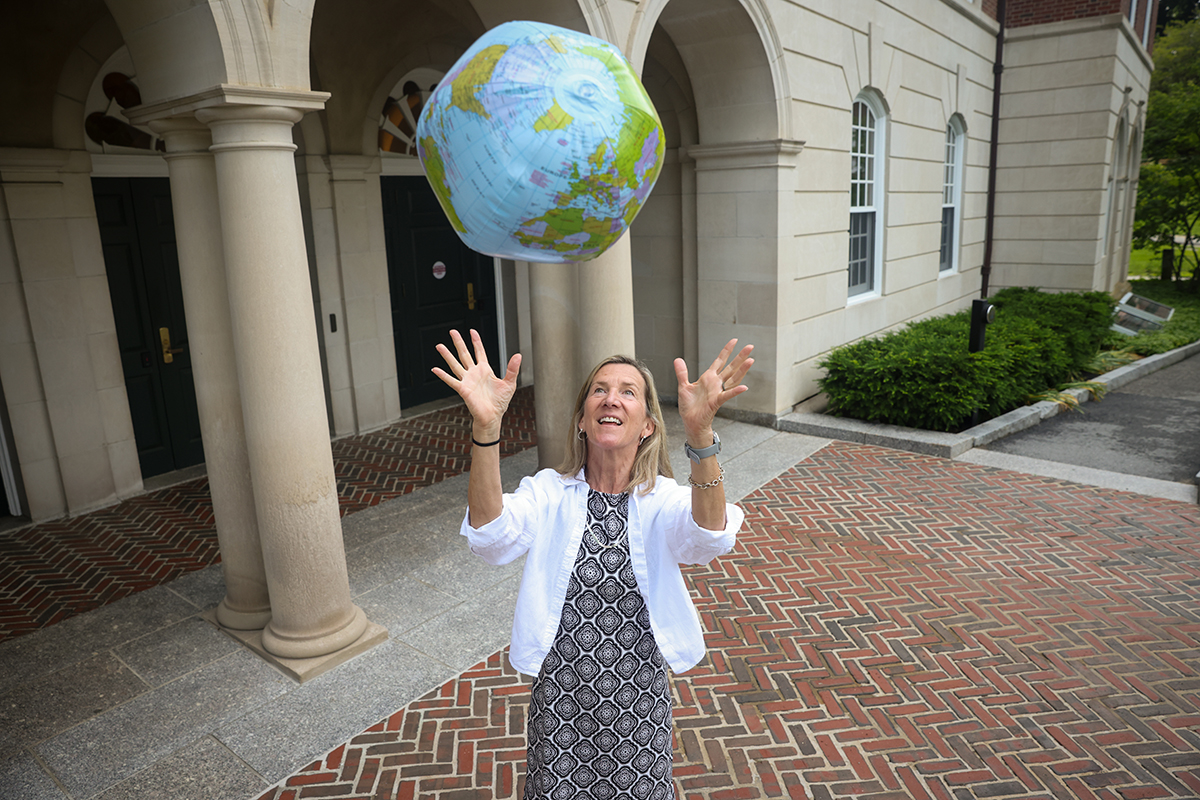
Patty Burke Hickey throws inflatable globe in the air standing in front of Phillips Hall

Patty Burke Hickey fell in love with travel early in her life, when her parents would pile their six children into the family station wagon and take off for a camping trip in one of the awe-inspiring national parks located across the United States. Later, while teaching at the American International School in Vienna, she relished meeting students and colleagues from all over the world and took full advantage of cheap air and train fares to travel throughout Europe.

As a member of Exeter’s English Department since 1996, and a full-time instructor since 2013, Burke has continued to nurture her passion for exploration. Through Exeter’s Global Initiatives program, launched in 2012, she chaperoned student trips to China and South Africa. In 2022, Burke became only the second director of Global Initiatives, embracing the chance to build on the work of her predecessor, Eimer Page, a fellow English instructor who is now dean of faculty.

“I love to travel myself, and I loved the idea of helping to create meaningful experiences for students,” Burke says. “Eimer built this office and put so many important structures in place, and I feel fortunate to be able to continue to help the office and our programs grow.”

Burke was also a longtime coach of JV and varsity cycling, served as dorm head in Langdell Hall and has been affiliated with Amen Hall, Gould House and Dunbar Hall. We spoke to her about her early experiences with experiential education, her travel bucket list and what cycling has to do with running the Global Initiatives program. 

Could you talk a bit about the early travel experiences that have had an impact on your life?

We were a family of eight, and my parents just took us everywhere. I don’t even think they ever went on a vacation by themselves. During my senior year in college, I studied in Alicante, Spain and loved it. I had enough AP credits to graduate early, and I ended up going to London with a work visa and one bag. I remember just getting off the plane and thinking — I don’t even know where I’m staying tonight. I worked in London for a while, and then ended up working on a tall ship up in the North Sea.

After graduate school [at the University of Colorado] I ended up at the Colorado Rocky Mountain School. I think that’s where my passion for experiential education came from, and the idea that so much of learning takes place outside the classroom. I was taking kids out into the wilderness and teaching them leadership skills and outdoor skills and how to help them navigate new situations and feel supported doing it. There’s incredible value to everything that happens inside the classroom, and then there’s this rich landscape of learning that we as educators can help students navigate outside the classroom.

What do you see as the most important part of your role as director of Global Initiatives?

The most important part is making sure all the parts work together. I coached cycling for a while, and I love to ride. When you have a spoke that’s out of true, your wheel starts to bend, and you don’t have a smooth ride. In this position, all the spokes are important. Risk management and safety, all the planning and logistics, training chaperones, orienting students so that they know where they’re going and what they’re doing and the expectations — all these things work together, because you want everyone to have a safe and successful experience.

One of the things I love about this position is the collaboration with so many different people both on campus and our off-campus partners. I also want to give a shout-out to [Assistant Director of Global Initiatives] Chelsea Davidson, who does so much of the behind-the-scenes work and is so essential to the day-to-day functioning of this office.

Where do you see non sibi and other sort of core Exeter values in the Global Initiatives program?

We can think about non sibi a couple of different ways. When you’re a part of a group that’s traveling, you have to put the needs of the group above your own. You have to communicate your own needs, but you have to understand that the choices that you make impact the group.

There’s that kind of non sibi that helps develop that community of travelers, and then there’s the non sibi when we go places. Not just — we went in and we built a house and then we left and we felt good about ourselves. Instead, it’s about community partnerships — how can I go into a community and try to listen and understand what’s happening there? How can students learn from community leaders about a problem, what the community is doing, what kind of resources the community has or doesn’t have, and how the students might contribute, participate in change, and learn. It may be a project that they work on, but they understand the roots about how this project came to be and the origins of the problem.

What are some of your goals for Global Initiatives going forward?

We’re expanding on our entrepreneurship programs, led by [History Instructor] Aykut Kilinc. There’s a lot of interest in business and innovation; we started in Berlin and now we’ve expanded to Singapore as well.

We’re also thinking about our programs through the lens of sustainability — being very intentional about why we travel, where we travel and what we do when we travel, and offering opportunities for students to learn about sustainability and climate change outside of the classroom. This November, we’re offering a program in Costa Rica on ecotourism, sustainability and community partnerships. We’re also offering a program in New Orleans with a sustainability focus.

I’m also working with [Science Instructor and Bates-Russell Distinguished Faculty Professor] Anne Rankin on developing our student internship program, which offers experiences in a different way than our programs with groups and chaperones and itineraries.

Another important thing is looking at our programs through a DEIB [diversity, equity, inclusion and belonging] lens. For example, climate change in New Orleans and the impact of weather — how does it disproportionately affect certain communities, and how did those communities end up in sort of the below sea level or sea level areas? What’s the relationship between climate change and socioeconomics and race?

What have been some of your all-time favorite travel destinations?

Vietnam and the Torres del Paine National Park in southern Chile.

Any places on your wish list for future travel?

Australia and New Zealand — but I feel like I would need a month. I’d like to go to Madagascar just because I like the sound of it. And I would love to go to Egypt. I could probably name a hundred places.

Four alums assume Trustee roles

Four Exeter alumni with a history of giving back to the Academy have joined the ranks of the institution’s Trustees, beginning a five-year term July 1.

Bradford “Brad” Briner ’95; P’25

Chapel Hill, North Carolina, and New York, New York

Brad Briner entered Exeter as a prep from Dallas, Texas, and lived in Wentworth Hall. He participated in football, winter and spring track, and Student Council, and served as a dorm proctor and volunteer guide. He holds a B.A. in economics from the University of North Carolina at Chapel Hill (Morehead Scholar) and an MBA from Harvard Business School. Brad is a co-chief investment officer of Willett Advisors L.L.C., which manages the philanthropic assets of Michael Bloomberg. He previously was a co-founder of Morgan Creek Capital Management and worked for the University of North Carolina’s endowment. Brad is an associate member of Exeter’s Investment Committee. Additionally, he serves on the board of directors for Boston Omaha Corporation and is a member of the Debt Affordability Advisory Committee for the State of North Carolina.


Christine M. Robson Weaver ’99

San Jose, California

Christine Robson Weaver entered Exeter as a prep in Bancroft Hall, where she helped get the first Exeter students onto the internet and email. During her tenure, she was coxswain for the crew team, head photographer for PEAN, and was involved in the math, science and computer clubs. She also participated in the Japan Abroad Program and was a dorm proctor. Christine received degrees in mathematics, electrical engineering and computer science from MIT, and a Ph.D. in computer science from the University of California, Berkeley, while working at IBM Research on artificial intelligence and related fields. In 2012, she joined Google Research to lead product management for machine learning. She is currently head of product for Google Search Quality. Christine has served as class secretary for 20 years and is a member of the Women’s Leadership Circle.


Leroy Sims ’97

San Mateo, California

Leroy Sims entered Exeter as an upper from the Providence St. Mel School in Chicago. He lived in Ewald South, was a dorm proctor and participated in the Afro-Latinx Exonian Society, student listeners, WPEA, basketball, and spring track and field. He holds a B.S. and an M.Sc. in biological sciences from Stanford University and an M.D. from Stanford University School of Medicine. He is board-certified in emergency medicine and primary care sports medicine. He is senior vice president and head of medical operations for the National Basketball Association. In 2020, Leroy was heavily involved in the creation and execution of the stringent COVID-19 medical protocols the NBA implemented in 2020 during the restart of its season at Walt Disney World Resort, also known as the NBA Bubble. Leroy was a team physician for USA Basketball at the 2020 Summer Olympic Games in Tokyo, team physician for the U.S. track and field team at the 2016 Summer Olympic Games in Rio de Janeiro, and medical director and team physician for the NBA’s Golden State Warriors. He has served on the board of trustees for the Boys and Girls Clubs of America.

Belinda A. Tate ’90

Kalamazoo, Michigan

Belinda Tate lived in Merrill Hall and was president of the Afro-Exonian Society, a dorm proctor and founder of the Diversity Council. She also participated in Exeter’s Community Support Group, gospel choir and spring track. She earned a B.A. in art history from Yale University and an M.A. in liberal studies from Wake Forest University. Belinda currently serves as the executive director of the Kalamazoo Institute of Arts, home to the Kirk Newman Art School and one of the leading museums in the Midwest. For more than 15 years, she was the director of Diggs Gallery at Winston-Salem State University, one of North Carolina’s largest exhibition spaces dedicated to the art of Africa and the African diaspora. Additionally, she was appointed an at-large commissioner of African American heritage for the state of North Carolina. Belinda is a member of the board of trustees of the American Federation of Arts and a former board member of the Reynold a House Museum of American Art in Winston-Salem and the Association of Art Museum Directors

Brain gain: Exeter Summer welcomes 600 learners

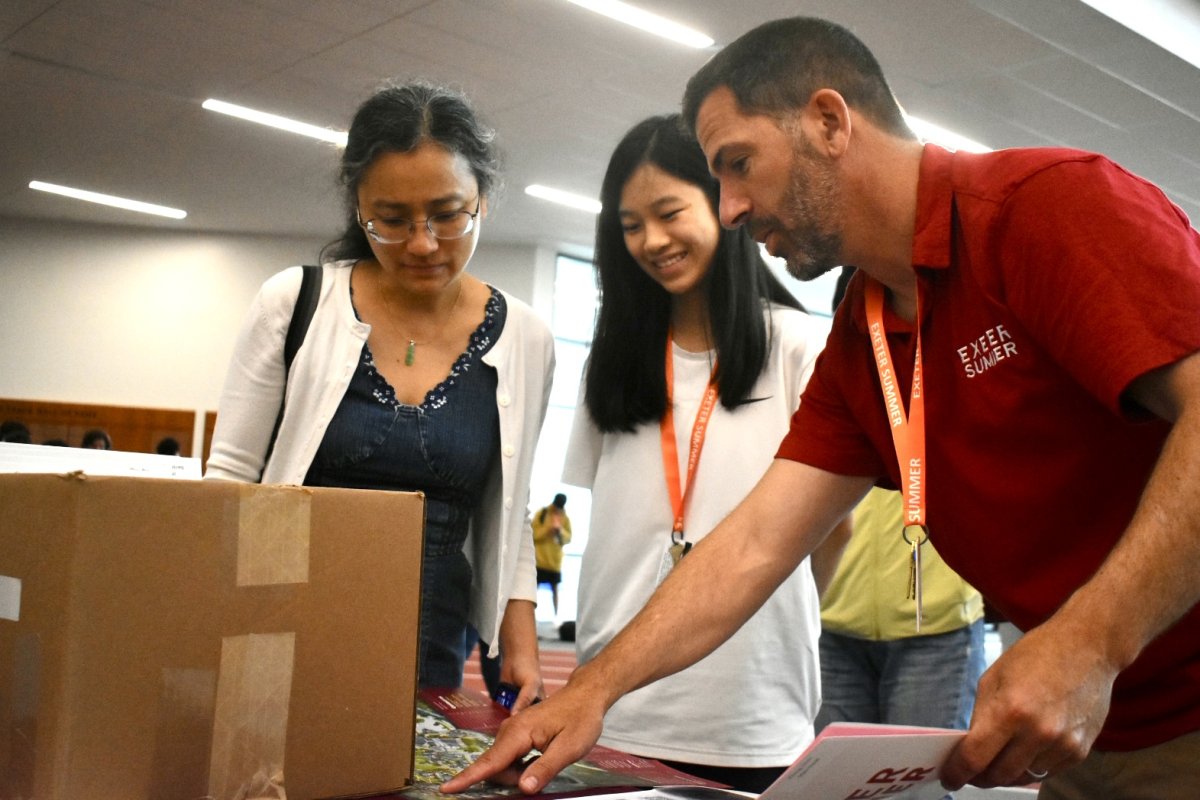
A slumbering Academy campus stirred back to life Monday with the arrival of hundreds of eager learners and the beginning of the 105th session of Exeter Summer.

For the next five weeks, students ranging between the eighth and 12th grades will gather around Harkness tables and explore the New Hampshire seacoast in a stress-free learning environment filled with almost everything but grades.

What began in 1919 as remedial instruction for deficient Exonians — replete with five levels of Latin — today is a summer smorgasbord of discovery through more than a hundred courses available to its high school-aged students and 10 pre-designed academic “clusters” for its middle school learners. The course catalogs bulge with offerings with names like “Entrepreneurship: Moral Money Making,” “Basic Principles of Criminal Justice” and “Understanding War and Peace.” Latin is still in the curriculum, but students also can study French, Chinese, German, Italian and Spanish, as well as Japanese through anime.

Nearly 600 students arrived Monday. They hail from 37 states and 46 countries — not dissimilar to PEA’s cosmopolitan regular-session enrollment that left campus in early June for summer break. In fact, history shows that dozens of these Exeter Summer students will evolve into Exonians after deciding to apply to the Academy once their summer session ends. The summer mix, however, is far more multinational than its regular-session cousin: Nearly half of the summer attendees come from outside the U.S.

They will be taught and supported by 125 faculty — a balance of PEA instructors and educators from across the country, many of whom return year after year — and myriad staff. Most of the community will dwell on campus in Academy dorms.

Exeter Summer runs through Aug. 4.

Exonians win trip to physics' global epicenter

An experiment proposal from members of Exeter’s Physics Club has been selected as one of three winners in the 2023 CERN Beamline for Schools competition, earning eight Exonians a trip to Switzerland to put their hypothesis to the test.

Known as “Myriad Magnets,” the team consisting of recent graduates Isabella Vesely ’23, Aubrey Zhang ’23, and Daniel Jeon ’23 and current students Ishaan Vohra ’24, Achyuta Rajaram ’24, William Lu ’24, William Soh ’24 and Peter Morand ’25 will be invited to Geneva for a two-week stay in September to use one of the European Organization for Nuclear Research’s (CERN) particle accelerators. CERN operates the largest particle physics laboratory in the world.

The group’s proposal involved building an adjustable arrangement of permanent magnets for steering and focusing a beam of high-energy particles, which are traveling at nearly the speed of light.

“We sought to investigate alternative, more sustainable technologies, for bending and focusing beams. Our design uses only permanent magnets, thus requiring no electricity to operate,” Vohra said. “The design would serve as a proof of concept for future multi-functional and environmentally friendly electromagnet alternatives in particle accelerators.”

The 10th edition of the annual competition, put on by CERN and the German Electron Synchotron (DESY), received 379 entries from secondary schools in 63 countries. One team from the Netherlands, and another from Pakistan joined Exeter as winners of the competition. The winners were selected by a committee of CERN and DESY scientists.

“Beamline for Schools supported us to directly explore and apply new skills, particularly in the intersection of physics and engineering,” said Vesely. “We are excited to put our design to the test in CERN’s cutting-edge facilities and, most of all, work with and learn from some of the world’s best physicists and engineers.”

The team from Exeter built on last year’s experience, when they finished as a runner-up, and worked for months, consulting with experts both on-campus and afar, to design an even more ambitious proposal. Science instructors Jim DiCarlo and Scott Saltman mentored the club members through the process.

“Mr. DiCarlo and Mr. Saltman provided invaluable advice that helped us refine our magnet design and experimental setup, and we also sought advice from external physicists and engineers at the Fermi National Accelerator Laboratory, the Denmark Technical University, and the University of Liverpool,” Vohra said.

A century at Exeter

Philip Loughlin III ’57; ’76 (Hon.) sits behind a desk in the study of his Massachusetts home. Bookcases filled with books and keepsakes frame him. Together with plaques, certificates, and photographs, they detail a family legacy that spans a century at the Academy. This includes Thomas Loughlin, Phil’s son, who graduated from Exeter in 1987.

Phil recently welcomed visitors from the Academy to his home to discuss these items and Exeter’s impact on his family. To recognize his 65th reunion and honor what would have been the 100th reunion of his father, Philip Loughlin Jr. ’22, he made a gift to support financial aid at Exeter. When asked why he donated to recognize his father’s milestone, Phil explained, “I have so much for which to thank him.”

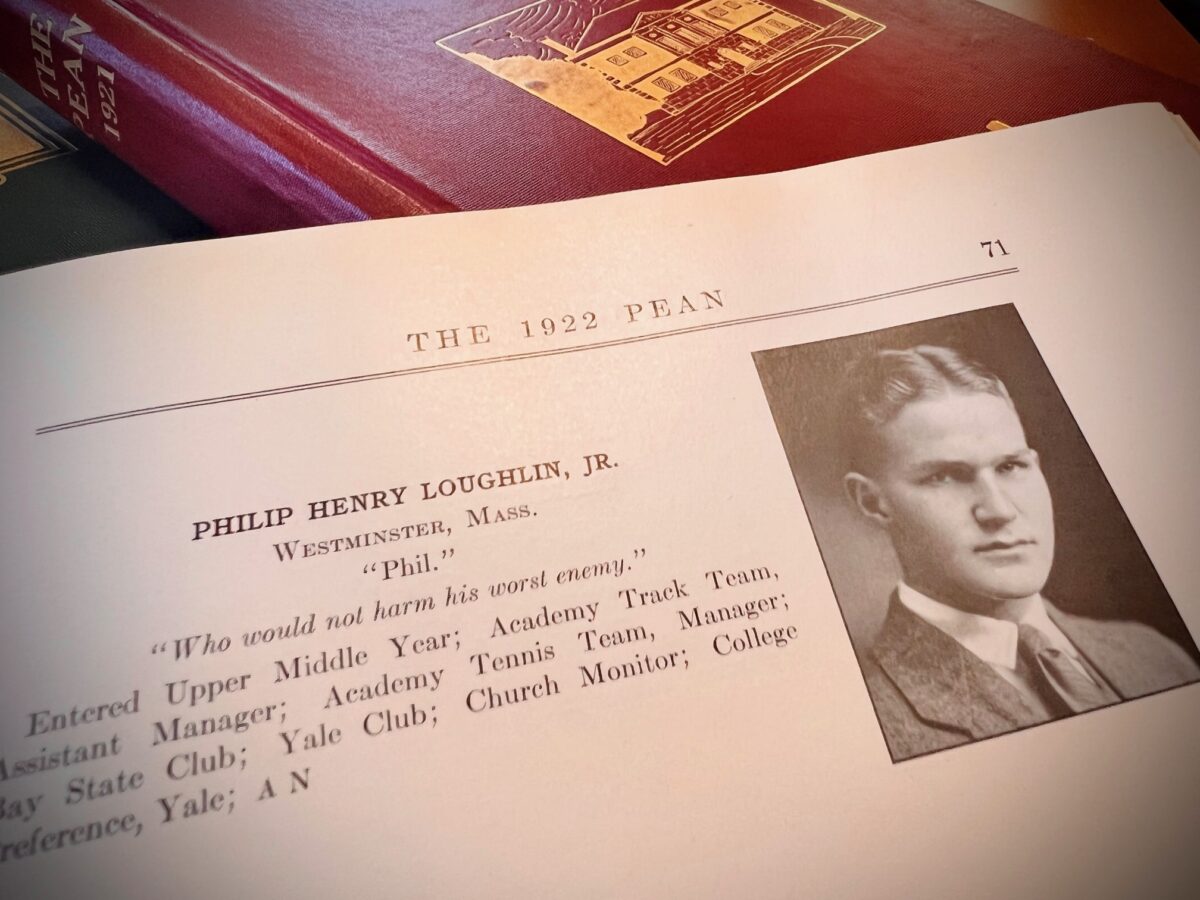
Philip Loughlin Jr. started his family’s long-standing relationship with Exeter. He came to the Academy as an upper in 1920, residing in Soule Hall and serving as a manager for the track and tennis teams and as a church monitor. After Exeter, Philip Loughlin Jr. enrolled at Yale University. He later married Adelaide Jackson; their sons were Philip III and John.

Phil followed his father to Exeter and entered during the summer session of 1953. He has a formal photograph of the students that summer framed and hung on the wall near his 1957 diploma.

Phil attended Cornell after Exeter, earning a bachelor’s degree in economics and later an MBA. However, he says the most important thing about Cornell is there he met his wife-to-be, Caroline Keller.

They married after graduation. Phil was commissioned as an officer in the U.S. Navy Medical Service Corps and served a three-year tour of duty. Phil and Caroline next appear in St. Louis. He had a civilian job for a few years but left that to earn a doctorate in business from Saint Louis University. He entered academia in 1976 and taught courses in economics and finance at Maryville University for 23 years.

Phil and Caroline, who passed away in 2013, liked to read, though with different methods of completing books. Phil, a slow reader, enjoyed collecting books to own and eventually read, whereas Caroline would burn through books and donate them. Phil finally told her, “Just give me all the books you finish!”

His legacy as an Exeter alumnus includes six years as an Academy Trustee, the 1996 Founder’s Day Award, and longtime financial support for the Class of 1945 Library. In 2019, to honor his friend and late Academy instructor Polly MacMullen, Phil established a permanent fund in her memory: the Priscilla (Polly) MacMullen, Class of 1976, Library Fund.

Now, he has reinforced his family’s bond with the Academy with a gift to honor his father.

Roxane Gay '92 to receive John and Elizabeth Phillips Award

General Alumni Association President, Trustee and Awards Committee Chair Betsy Fleming ’86 has announced that Roxane Gay ’92 will receive the 2023 John and Elizabeth Phillips Award, which recognizes an Exonian who has contributed significantly to the welfare of community, country or humanity.

As a writer, editor, and cultural critic, Gay has built a reputation as one of the preeminent commentators on contemporary society and its most pressing issues. Her books, including her bestselling essay collection Bad Feminist and her searing memoir Hunger, have earned international acclaim, and she made history by becoming the first Black woman to write a Marvel comic book (the Black Panther companion series World of Wakanda). Gay was awarded a Guggenheim fellowship in 2018 and has been the recipient of numerous literary awards. More recently, she has partnered with Grove Atlantic to launch Roxane Gay Books, a publishing imprint that focuses on underrepresented voices.

Gay has taught creative writing at Occidental College, Eastern Illinois University, Purdue University and Yale University, among other institutions. She currently holds the Gloria Steinem Endowed Chair in Media, Culture, and Feminist Studies at Rutgers University.

Roxane Gay will receive the John and Elizabeth Phillips Award and speak during assembly on October 27.

Byron Grevious '24 runs to national championship

Byron Grevious ’24 put an exclamation point on his upper-year campaign over the weekend, claiming the national title in the boys 5,000 meters at Nike Outdoor Nationals on historic Hayward Field at the University of Oregon. Grevious ran away from the pack early and was all by himself for the final 3,200 meters before crossing with a time of 14:24.04, 18 seconds faster than the second-place finisher.

The top-seeded runner in the event’s elite 50-runner field, Grevious ran with the lead pack for the opening lap before jumping into the first position. He remained at the head of the pack and started to push his pace at the one-mile mark and quickly built separation from the crowd and won with an unprecedented lead.

“This was the first time at a national level race where I was the top seed in an event,” said Grevious. “All these guys proved that they can race on a national stage, they are all fast, and you can’t become content. Running at Hayward Field can be overwhelming, but the atmosphere was really cool. When I ran last year, it felt so big. This year I was a bit more prepared for it. They let fans down on the track in lanes six and seven, they were ringing cowbells. The last lap felt a little bit like a victory lap which was really nice. Coming down the final straightaway was so amazing.”

“We’re so happy for Byron,” said Hilary Hall, head coach of Exeter track and field. “There is so much that goes into reaching an accomplishment like this, and he is so deserving. His teammates were down on the track in the final straightaway ringing cowbells and cheering him on the entire race. Winning a national championship is a rarity and we all just want him to savor the moment.”

His runaway performance comes just two weeks after he broke a 48-year-old New England record in the 5,000 meters when he competed at the New Balance Battle Road Twilight series and crossed the finish at 14:04.44. Grevious’ record, which was timed with video Full Automatic Timing (FAT) — a standard today at competitive meets — tops the record of former Olympian Alberto Salazar, who ran a hand-timed 14:04 in 1975. His time also broke the Age-16 national record of 14:12 set by another former Olympian, Craig Virgin, in 1972.   

“I was not totally expecting the caliber of athletes that I was racing against at Battle Road,” Grevious said of the several college runners in the field. “When we went through 2,000 meters I heard the announcer say we were at 14:05 pace, so then that was goal for the day. The pacer was starting to fall off a bit, so I decided to go around him and make it my own race. With 200 meters to go, I had a guy on my shoulder and had to battle it out and really push. When I crossed the finish, I didn’t really realize what I had just run.”  

Grevious has been building towards this milestone with a crescendo of high stakes performances in the past few seasons. He led Exeter to a Division I New England prep outdoor championship this spring, earning MVP honors while snapping a 39-year-old record in the 1,500 (3:53.95) and his own record in the 3,000 (8:32.72) in the process.

“Byron has a history of showing up in big moments and running big in those moments,” Hall said. “Byron has a skill set that he has developed of how to handle emotions in big races and he is as skilled at that as he is at running. He is at an advanced level of being present and executing his plan. He was deeply in focus prior to the start of the race. He did not appear nervous; he looked prepared. He seeks out top competition and wants to put himself up against the best.”  

This past winter, Grevious was a three-time All-American at the New Balance Indoor Nationals with a sixth-place finish in the two mile (8:51.00) and a pair of fourth-place finishes in the distance medley (10:11.63) and 4×800 (7:47.45) relay’s, while also finishing sixth overall in the one mile (4:12.95) at the historic Millrose Games. This came after a second straight New England team and individual cross country title, a second-place finish at Nike Cross Country Regionals, and a 12th-place finish at Nike Cross Country Nationals. Last spring at Hayward Field, he claimed fifth overall in the 5,000 (14:36.14) and 12th overall in the two mile (9:04.02).

Exeter had an unprecedented 28 students qualify for national competition following a season in which the boys captured a New England title while the girls nabbed second place. Nike Outdoor Nationals hosts timed qualifying sections for both Emerging Elite sections and Championship sections of racing. Qualification for either section requires top level performance rated against track athletes from around the country.  

Tanner Boulden ’24 earned All-American status and finished sixth overall in the javelin at New Balance Nationals with a heave of 187 feet, 1 inch. Jaylen Bennett ’25 raced to a 14th-place finish in the championship’s 400 meters with a time of 48.65 while taking a 25th place in the 100 meters (11.01) and 27th place in the 200 meters (22.10). Oliver Brandes ’23 competed in championship sections of the 800 meters (1:54.72) and one mile (4:18.86), while Max Lacombe ’24 competed in the Emerging Elite section of the one mile (4:29.65). Edward Hawkson ’23 finished 10th overall in the Emerging Elite 100 meters (11.07) and placed 21st in the Emerging Elite 200 meters (22.40).

On the girls side, Tenley Nelson ’24 posted a pair of top-10 finishes, coming in eighth overall in the Emerging Elite one mile (5:01.04) and 10th overall in the Emerging Elite 800 meters (2:14.30). Jannah Maguire ’25 claimed 24th overall in the Emerging Elite 400 meter hurdles (1:08.54) and Melani Dowling ’25 finished 30th overall in the Emerging Elite javelin (77’5’’).


Digging into data for a better Exeter

Director of Institutional Research Kari Hart has been at Exeter less than a year but she’s already making a difference. The primary designer, distributor and analyst of surveys related to student behavior, Hart is uncovering answers to such questions as how much sleep students are getting or how homework load varies by department and instructor. The answers help create a more complete picture of student experiences at Exeter. “My role is to design, manage and conduct research projects that are in-line with Exeter’s mission and its institutional priorities,” she says.

Institutional research (IR) is not new; it’s a data collection method used for years by colleges and universities to support admissions and accountability. Increasingly, private secondary schools like Exeter are using IR to help assess institutional priorities. Exeter has a data scientist who compiles statistics for admissions and alumni development purposes; Hart’s focus on student experiences, however, is unique. Assistant Principal Karen Lassey championed Hart’s position at Exeter, insisting that the IR director be part of the school’s decision-making process when designing new priorities and programs. “When we design an initiative, from the beginning we have to decide how we’re going to measure its success and how we’ve met that objective,” says Lassey. “Kari is focused on students’ core experiences. She’s collecting and analyzing data and helping us decide whether we have clearly defined goals aligned with our strategic priorities. Many schools don’t have IR positions like that, so we’re really fortunate.”

Hart came to Exeter after 15 years in higher and secondary education, most recently as a teacher, dorm advisor and coach at The Peddie School in Hightstown, New Jersey. She has a doctorate in biostatistics, and taught statistics in a collegiate setting before delving into IR, which combined her passions for statistics and education. “My experiences in the secondary school world outside of research and analytics really inform my approach to my work,” she says. She’s especially committed to framing her research and analysis in ways that are inclusive and respectful of diversity and equity. “I’m excited about being at Exeter because I’m interested in working in a community that recognizes the importance of incorporating diversity of student identities and experiences in research,” Hart says.

Surveying the student experience

On Hart’s to-do list from her first weeks at Exeter was developing thoughtful, strategic ways of surveying students and collecting data. In fall 2022, Hart launched a survey, comprised of several pilot studies, to better understand how students use their time, and on a larger scale, how they interact with the school’s mission and values. In addition, she analyzed existing schedule data and worked with Exeter’s Center for Teaching Learning to issue a companion study on homework from a teacher perspective. The studies were administered last fall and included a shadow day experience: faculty and administrators followed 13 students throughout the course of their classes and afterwards. They took detailed notes and reflected on what they saw. Hart later presented results of the overall survey to students and faculty. “Behind some of the aggregate data from the survey, there are unique student experiences,” Hart says. “They have individual needs in terms of their time and spend it in different ways, so they need different supports.” Her work complimented the annual all-student survey, also administered in the fall.

I believe in data-informed decision making, not data-driven decision-making.”
Kari Hart, director of institutional research

Following up on the fall survey, Hart kicked off a pilot survey this past winter about longer course formats. Select faculty taught fewer times per week for longer periods of time; the instructors collected survey information back from students about their experience. “It was intended to provide us with first-hand information about how faculty and students experienced longer course formats,” Hart says. “This (and our fall surveys) informed our conversation about how students use their time and how their well-being fits in to the daily schedule and academic calendar.” Hart most recently designed and implemented a spring survey on student wellbeing and mental health, belonging, and school culture. “It’s all of these pieces together that frame our conversations about next steps,” Hart says.

She thinks better administrative decisions come from looking at many types of data. “I believe in data-informed decision making, not data-driven decision-making,” Hart says, noting that it’s important to understand the unique issues that Exeter faces and to understand the school’s history, culture, evolution, and external environment when making these decisions.

Establishing a data culture at Exeter — a more intentional approach to collecting data and identifying areas where it will be useful for informing discussion and decisions — takes time. But Lassey is already seeing changes. “Kari is a rock star,” she says. “The importance of having her is more meta than what surveys she’s done. We’ll have good surveys that aren’t one-offs; we can compare them from year to year and continue to use them. She’s upped our game already.”