Journalist’s story leads back to Exeter
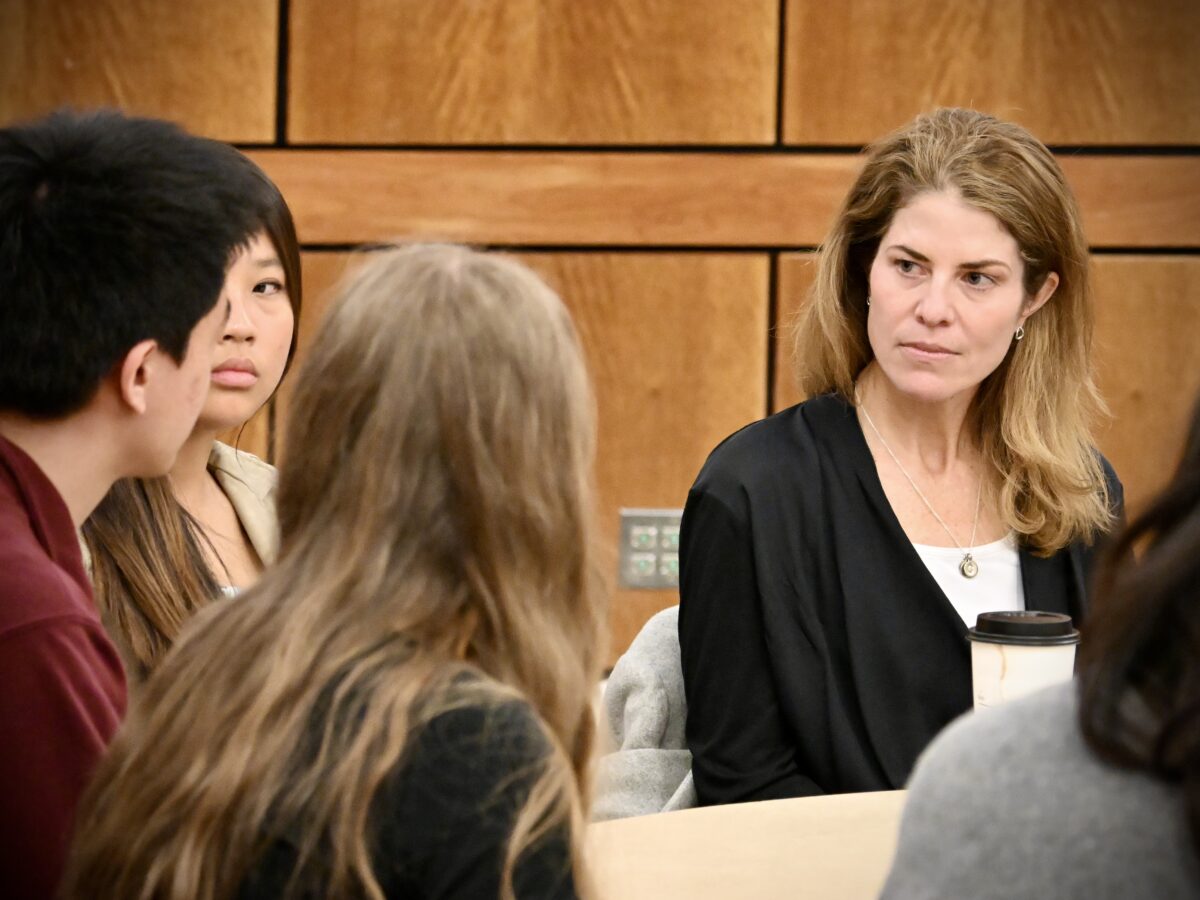
Gloria Riviera '92 has worked in TV and digital news for 25 years.
Whether filing stories from Asia’s Ring of Fire or covering President Obama’s Rose Garden address the day Donald Trump won the 2016 election, Gloria Riviera ’92 has leaned on lessons learned at Exeter throughout her career.
A longtime ABC News correspondent and current host of “No One Is Coming to Save Us,” a podcast that scrutinizes America’s childcare system, Riviera was back on campus this week speaking at assembly and meeting with students. Her appearance was made possible by the Richard and Joan S. Strickler Exonian Fund, created to promote among Academy students an awareness of contemporary issues in journalism from a practitioner’s standpoint and an appreciation for standards of excellence in news writing and editing.
Riviera has come back to campus on occasion since her graduation. Her first visit to campus was as a new lower in 1989 on the day she moved into Dunbar Hall.
“My Exeter beginning was totally blind. I arrived here from Seattle, Washington State, sight unseen. I was about 13 or 14 when I told my mom, ‘I think I want to go to boarding school. And I remember she said, ‘Well, we’re not a boarding school family. You only go to boarding school if you’re in trouble.’ But she made it happen. I don’t know how I got the idea in my head.”
Riviera found lifelong friends in those early Exeter days. She urged her assembly audience to embrace the people sharing their experiences.
“Take a look around, recognize who you’re drawn to and invest in them,” she said. “They will make the world feel just a little smaller and a lot more comforting when you really need it.”
Riviera studied English at Princeton, then got her Master’s degree in journalism from New York University. “I didn’t get any of the reporting jobs that I applied for, none of them. Friends were going to The Daily News, to The New York Times, all over the country. All I got was nos. So when I told my good friend, who was also in news, that I was going to be an assistant, she looked heartbroken, like she was apologizing to me.”
The assistant job was for Sam Donaldson, an ABC News icon whose career on the network stretched from the Vietnam War to Obama’s election. For two years, Donaldson took Riviera everywhere he went. That meant to Arizona to interview presidential candidate John McCain in 2000. It meant Mexico, Israel, Gaza and a lot of time inside the Beltway in Washington D.C. “He was a good friend and he became a great mentor,” Riviera said.
Riviera parlayed Donaldson’s mentorship into on-air correspondent gigs in New York and London, then the network’s Asia correspondent job in Beijing, where she developed her niche for “long-form adventure storytelling.” She, with husband and fellow TV news journalist Jim Sciutto, also raised a family. Their two sons and daughter have traveled the world with their parents, and it was juggling parenthood and a career that wound up being the inspiration for a new story to tell — but not before a “curveball” arrived in 2019 in the form of a brain tumor.
“My tumor was located in my left frontal lobe, and that is where thinking, emotions, personality, judgment, response time, memory — that’s where all of those things happen,” she said. “So after 20 plus years in news, I was faced with a brain cancer that could severely compromise what I loved to do. And at that time, I can tell you, I truly thought that I was solely qualified to give you a story at 6:30 at night, every night, because that’s how traditional news worked then, and really do nothing else.”
Gloria Riviera '92
"I was meant to be here, I truly believe that. It was truly formative for me and it's incredibly empowering. I leave here and I feel like I can do anything I want to do."
Riviera underwent successful brain surgery April 19, 2019. The ordeal led her to leave ABC News but not give up her passion for storytelling. She interviewed in late 2020 to be the producer and host of a podcast on childcare.
“This is an issue that is not quite on your radar yet,” Riviera told Exeter students, “but when you become a parent, this country’s attitude is essentially, ‘Great, good luck. We will see you in kindergarten.’ Those first five years of all of your lives, of everyone’s lives, are critical. … Those first five years of development, the brain is forming, they set the stage, really. And yet the United States is nowhere near so many other countries in what they provide for people.”
“No One Is Coming to Save Us” began as a limited, six-part series. It has celebrated five full seasons.
“I decided to leave ABC, which was terrifying. It was the only home I had ever known, and that becomes very comfortable for better or worse. But a friend at the time told me, ‘You should feel fully supported in your place of work, where you spend your time.’ And that has also stayed with me because one of the places that I felt fully supported was right here at Exeter, where there were ups and downs, but I knew I was in the right place and I knew people had my back.”