Dedicated public servant wins John and Elizabeth Phillips Award
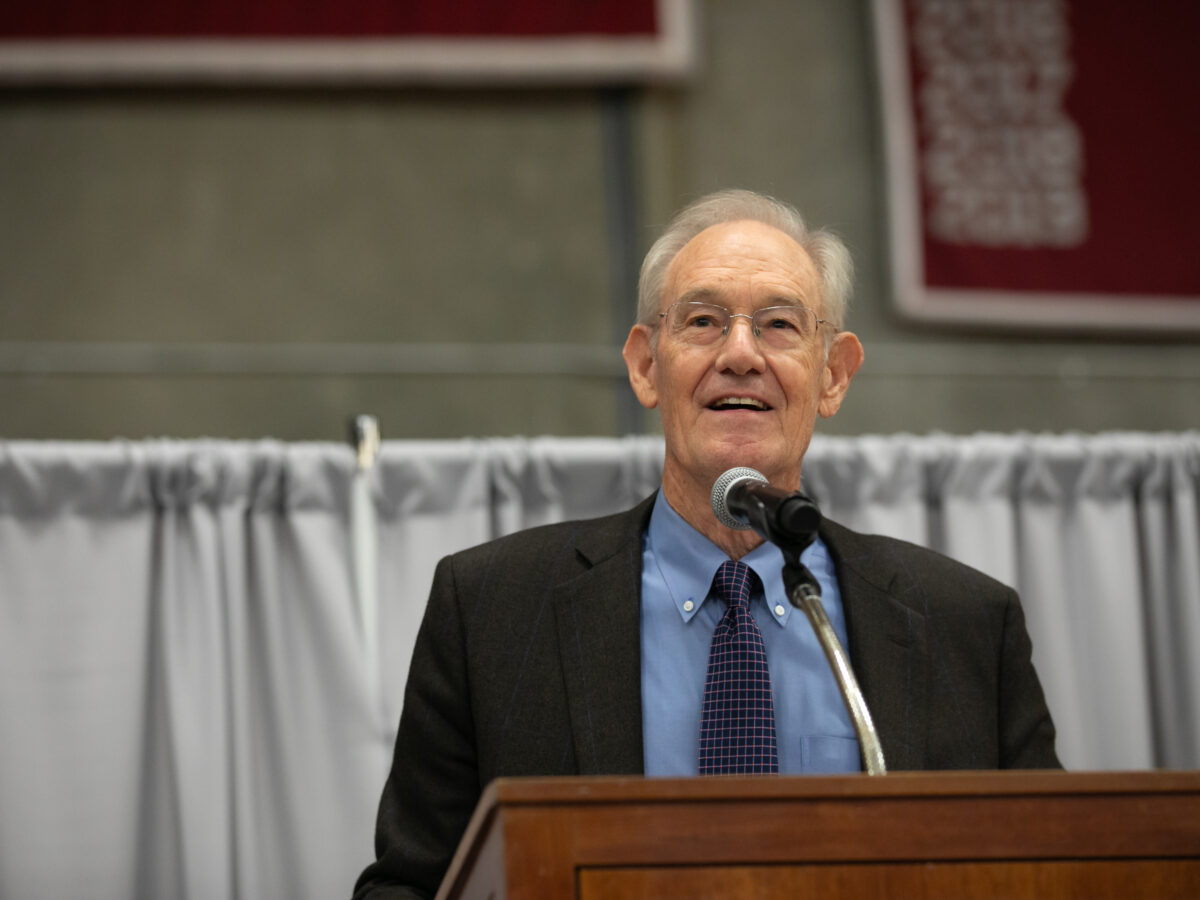
Former Arizona attorney general Terry Goddard ’65 has spent his career championing civic engagement, protecting consumers and promoting government transparency.
Exeter students, administrators, faculty and Trustees gathered in Love Gym to honor Samuel “Terry” Goddard ’65, this year’s recipient of the John and Elizabeth Phillips Award. One of the Academy’s highest alumni honors, the award is given annually to an Exonian who has contributed significantly to the welfare of community, country or humanity.
“Over a lifetime devoted to serving the public good, you have tackled the toughest challenges facing your native Arizona — and our society at large — with patience, determination and empathy,” Rhoda Tamakloe ’01, trustee and president of the Exeter Alumni Association, read from the award citation. “Your training in the law and ability to bring people together around a common goal are constants in a diverse career spanning city and state government, consumer protection, historic preservation and water conservation.”
As the son of a former governor of Arizona, Goddard was raised with the understanding that he had an obligation to give back. After graduating from Exeter and Harvard, he volunteered to serve in the U.S. Navy during the Vietnam War, and remained in the Naval Reserve for 25 years, even as he launched his legal and political career.
From 1984 to 1990, Goddard served four terms as mayor of Phoenix, working to expand citizen participation in government and plan a vibrant future for the growing city. He served as director for the U.S. Department of Housing and Urban Development in Arizona, and in 2002 was elected as the state’s attorney general. In that role, he dedicated himself to promoting consumer and civil rights, including fighting drug cartels and pursuing cases against predatory mortgage lenders.
Both as a mayor and as a private citizen, Goddard has long been a leader of historic preservation efforts in Phoenix, including the painstaking restoration and reopening of the historic Phoenix First Baptist Church as the Monroe Abbey. In addition, Tamakloe said, “As elected leader of the Central Arizona Water Conservation District board, you are raising awareness of the far-reaching impact of drought on some 40 million people and vast agricultural and economic systems dependent on the Colorado River.”
In perhaps his most high-profile effort after leaving the AG’s office, Goddard fought to protect his fellow Arizonans from the expanding influence of “dark money” in politics. “For six years, you worked to get the Voters’ Right to Know Act on the ballot,” Tamakloe read. “In 2022, more than 70% of Arizona voters across party lines approved the measure, making it the nation’s most comprehensive election spending transparency law.”
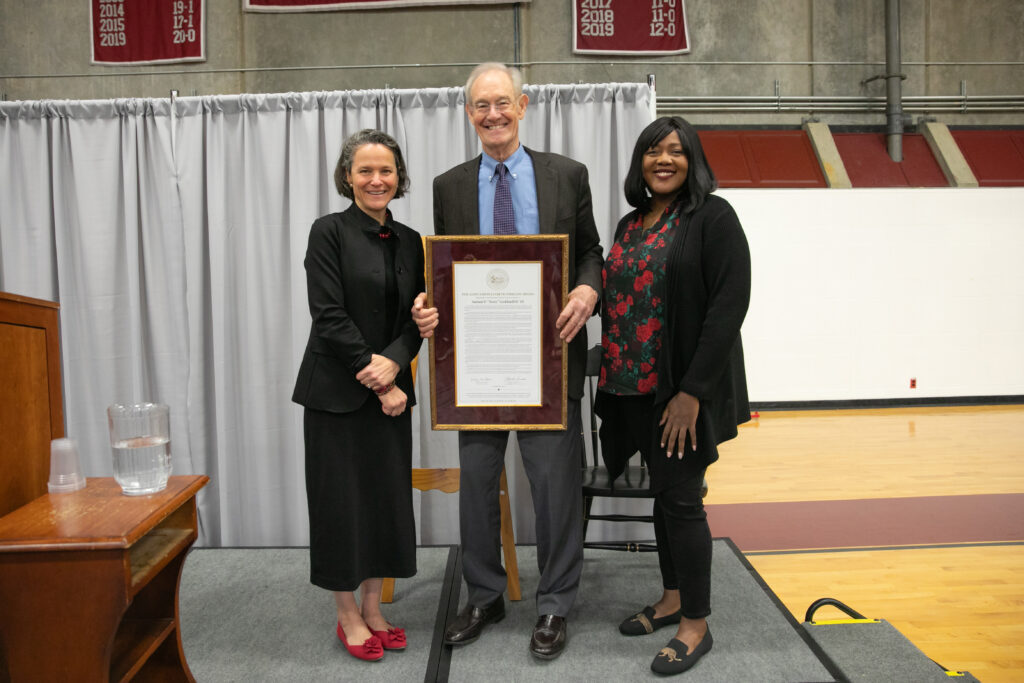
Principal Jenny Elliot and Rhoda Tamakloe ’01 present Terry Goddard ’65 with the John and Elizabeth Phillips Award.
Finding the tools to make change
“I cannot express how much being here today and receiving the John and Elizabeth Phillips Award means to me,” Goddard said in his remarks at the award assembly. He invoked the sterling example of past winners of the award, including Principal William Saltonstall, class of 1924, who left Exeter during Goddard’s time as a student to lead the Peace Corps in Nigeria.
“If I learned anything from the career so nicely recognized today, it is respect for this country’s much-maligned system of governance,” Goddard continued. “I’m not talking about the textbook balance of power, may it rest in peace, or the rule of law, however fragile and imperfect, but [of] how our system gives citizens — gives each of us — the tools to fix its flaws.”
Again and again throughout his career, Goddard responded to the urgent community problems he saw by seeking a solution. “The tools were there, and I encourage you to find them and to use them,” he said.
From suing the Federal Highway Administration early in his career to fighting for six years to get the election transparency initiative on the ballot in Arizona, Goddard said he was often fighting against long odds. “My favorite book growing up was The Little Engine That Could,” he said. “I started learning how to take a long shot and try, just with pushing and pushing to get it across the finish line.”
Goddard said perhaps his most difficult campaign was fighting against the anonymous political contributions known as “dark money,” despite the fact that politicians and voters on both sides of the aisle agreed on the need to do so. After four attempts alongside a dedicated team of volunteers, Goddard managed to get Proposition 211 on the ballot, where it passed with 72% of voter support. “I tell this story not as a primer for action — although I would encourage you to try direct action if you’re so inclined — but to show how citizens in America can get together and help defend our system,” he said.
Advice for a new generation of Exonians
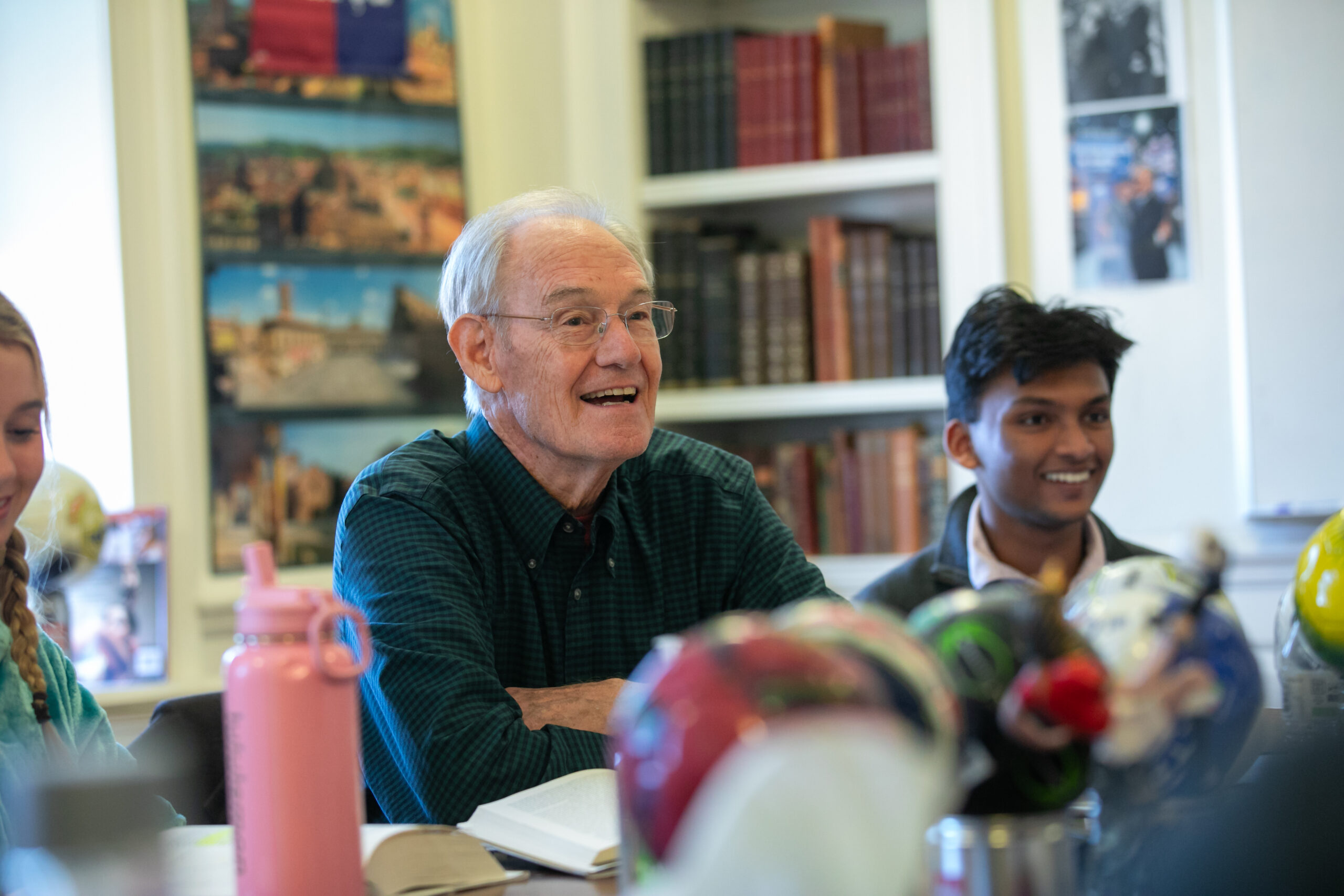
Near the end of his remarks, Goddard spoke of the role Exeter played in preparing him for such a varied career. “My ability to speak up and the confidence to do it was honed at the Harkness table,” he said. “I learned to strive for excellence and learned — perhaps most importantly — that perseverance pays off eventually.”
To the students in the audience, Goddard expressed an expectation that the skills and lessons they are learning at Exeter will soon be put to use addressing the problems they see in today’s society. “I hope that my series of experiences trying to repair what I saw as broken gives you some confidence that a small group [can] challenge the odds [and] change the direction of their community, their state or our entire country,” he said.
In addition to the assembly, Goddard spoke with students while sitting in on classes in history and religion. He also participated in a Harkness discussion on the structural challenges of constitutional democracy with a group of fellow members of the Class of 1965 who returned to campus to see Goddard accept the Phillips Award.