Chris Case ’74: Power Up
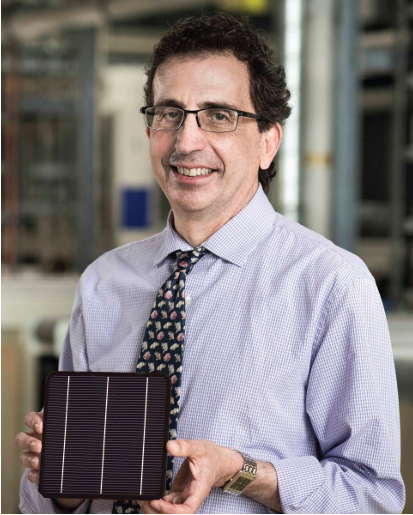
Chris Case ’74 engineers next-generation solar cells
Chris Case ’74 has always been curious. As a child, he created a universal garage door opener, which he used to open his neighbors’ garages. He taught himself to code on a PDP-10 (Programmed Data Processor-10) and wrote a dating program during junior high school. At Exeter he built audio amplifiers for classmates. During college, he constructed a solar-powered demonstration house.
This curiosity ultimately led him to the field of materials science and engineering, applying physics and chemistry principles to understand the structure and properties of materials, including polymers and silicon. “Everything we touch and interact with is atoms and materials,” Case says. “They connect with each other. I really like exploring those connections.”
His niche: solar power. He has spent over 40 years in the development and application of thin-film photovoltaic cells, the semiconductors that make up solar panels. As chief technology officer for the British solar tech startup Oxford PV, he spent 12 years in the development of perovskite-on-silicon tandem solar cells, thin-film semiconductors that are more efficient at capturing the sun’s energy than traditional single silicon solar cells.
Scientists estimate that the amount of solar energy reaching the Earth’s surface every 88 minutes could power the planet for a year. Capturing even a tiny fraction of that power could meet the world’s electric needs, inexpensively and sustainably. “Tandem solar cells are expected to become the main solar technology in the next few years and accelerate the world’s energy transition,” Case says. “It will help save the planet from the climate crisis.”

Case’s tandem cells combine a thin layer of perovskite — a composite that readily absorbs light and harvests more energy than silicon — stacked on top of a silicon layer, creating a more efficient semiconductor that produces less expensive energy. Unlike silicon, perovskite can be engineered into a thin, lightweight material, rolled or even printed. “Perovskite-on-silicon tandem solar cell technology generates from 20 to 50% more energy than a single solar cell,” Case says. The manipulation of materials like perovskite to create end products that have a tangible benefit is “the stuff I adore doing,” he says.
Case’s interest in the environment was piqued in junior high school, when he undertook a project to identify chemical compounds in the Five Mile River, near his home in Connecticut. “There were stories at the time in the local newspapers about possible contamination by manufacturing plants upriver,” Case says. “I don’t think my teacher expected me to do such a thorough job reporting on the pollution in that river. I wasn’t very popular in town after my report became public.”
During his senior year at Exeter, Case secured an internship at the four-year-old Environmental Protection Agency in Washington, D.C. “I wanted more exposure to environmental conservation,” he says. “That experience really made me understand and respect the role of policy, because you need to know policy and regulation to implement programs and change.”
Case discovered thin-film photovoltaics as an engineering student working with solar pioneer Joseph Loferski at Brown, where he later received a master’s degree in engineering and a doctorate in materials science. After a year as a Fulbright-Hays scholar at the Université de Bordeaux, he returned to Brown to complete his Ph.D. and joined the engineering faculty as an assistant professor. He went on to work at AT&T Bell Laboratories, then moved to the U.K. to become chief technology officer for The BOC Group. After consulting for high-tech materials firms, he was recruited by Oxford PV as CTO.
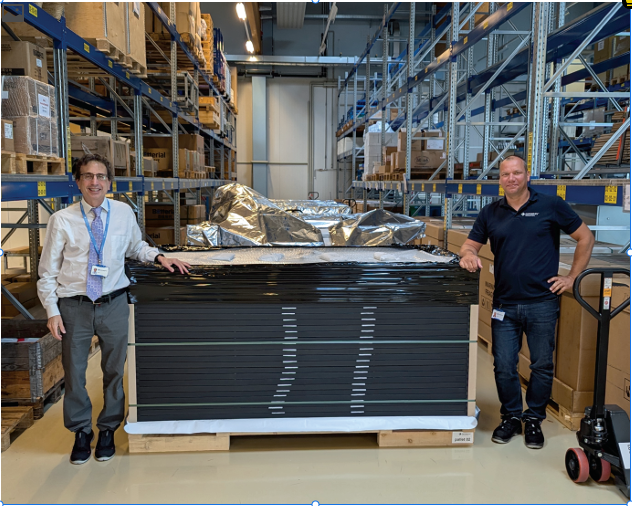
Case successfully scaled the tandem solar cell technology he introduced to Oxford PV. The company has licensed its patent portfolio to other solar cell manufacturers and fabricates its own tandem solar cells and modules at a factory in Brandenberg, Germany. In 2024, Oxford PV sold and shipped its first tandem modules to a large U.S. energy utility for installation in a grid-tied solar farm. Further development in the U.S. has stalled because federal energy policy is emphasizing fossil fuels. “Access to funding for renewable projects in the current political climate is limited,” Case says.
Despite these challenges, he remains an enthusiastic proponent of solar’s potential to address a variety of societal problems, including increasing access to clean water through solar-powered desalination systems and providing inexpensive, consistent electrical power to as many people as possible. “I’m committed to the vision of an all-electric future,” Case says. “Imagine the societal changes if we give people more freedom in their energy decisions.”
Editors Note: This story was originally published in the spring 2026 issue of The Exeter Bulletin.