Ana Glidden ’12: The Next Frontier
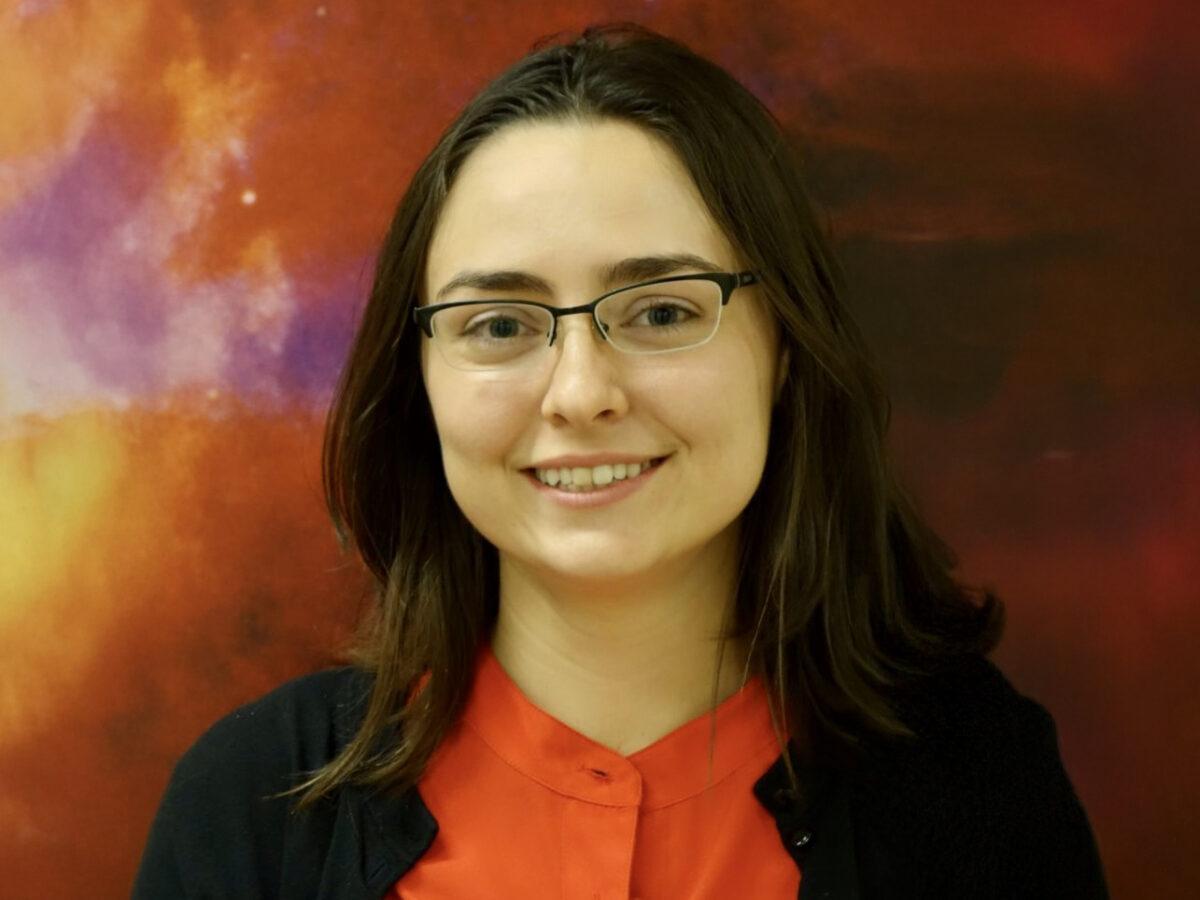
Ana Glidden ’12 explores the atmospheres of distant worlds
Ana Glidden ’12 is looking for signs of life well outside our solar system — 40 light-years away, to be exact, on the exoplanet TRAPPIST-1 e. A postdoctoral researcher in MIT’s Department of Earth, Atmospheric & Planetary Sciences and the Kavli Institute for Astrophysics and Space Research, Glidden was the first author of “JWST-TST DREAMS: Secondary Atmosphere Constraints for the Habitable Zone Planet TRAPPIST-1 e,” published in The Astrophysical Journal Letters in September.
The researchers used a method called transit spectroscopy, by which astronomers look at light from the host star as it passes through the planet’s atmosphere to determine the atmosphere’s composition. The team compared data from the James Webb Space Telescope (JWST) with models Glidden helped develop to assess whether TRAPPIST-1 e might be habitable. As yet, the answer is not clear, but the research is far from complete.
“Our initial observations are one of the most detailed looks at a rocky, habitable-zone exoplanet to date, a steppingstone along the path in the search for life outside the solar system,” Glidden says.
Glidden’s earlier analysis had shown that if the planet had an atmosphere, carbon dioxide would be the most observable gas. Though none was detected on TRAPPIST-1 e, she says, it doesn’t mean there isn’t any at all. The team continues to use transit spectroscopy to explore the characteristics of the planet.
Glidden has an impressive portfolio of astrophysics research. After earning a bachelor of science degree in physics from MIT, she worked as a software engineer, assisting with camera testing for the Transiting Exoplanet Survey Satellite (TESS), an MIT-led NASA mission that uses the transit method to find exoplanets. That work led Glidden to shift her focus from active galactic nuclei and high energy astronomy to characterizing distant planets. She earned a doctorate in planetary science at MIT.
At Exeter, Glidden’s general interest in science led her to astronomy. On the recommendation of Physics Instructor Tatiana Waterman, Glidden enrolled in John Blackwell’s introductory course, where she studied data from the Kepler planet-finding mission and learned about the classification of light curves and finding planets using the transit method. She was invited to participate with Blackwell in the NASA Infrared Processing and Analysis Center Teacher Archive Research Program (NITARP) at Caltech, using ultraviolet satellite images and ground-based optical images to make correlations between the color and luminosity of the hot gas around supermassive black holes at galaxy centers.
Glidden, who is studying the TRAPPIST-1 system of seven Earth-size planets that span the habitable zone, says nothing like that system has ever been found. The team is currently observing the innermost planet, TRAPPIST-1 b, and TRAPPIST-1 e in succession. The studies will allow Glidden and her colleagues to better characterize the exoplanets, as they continue to seek an answer to the age-old question: Are we alone?
“The different ingredients that are necessary for life to form and evolve are mind-boggling,” Glidden says. “We’ve found over 6,000 exoplanets and there have been none like Earth, which makes you realize just how special Earth is.”
This article was originally published in the winter 2026 issue of The Exeter Bulletin.