Against the Grind

From silent classrooms to phone-free Fridays, Exeter is helping students rebuild focus in an age of perpetual digital distraction
Instructors of a new Academy course are providing students with something novel in a fast-paced academic environment: space and time to reflect, free-write and meditate on the present moment. At the start of each EXI506: The Art of Slowing Down class, students gather around the table and share two minutes of silence.
This interdisciplinary course, offered for the first time in the spring term, draws from a range of literary, religious, philosophical and humanistic sources to help students build a practice of creative writing rooted in stillness and slowness. Handwritten “musings” require the students’ sustained attention to themselves and the world around them without technology, and inspire contemplative discussions in line with the school’s Harkness pedagogy. The class designers hope this approach will serve students now and in future endeavors.
“The aim of the class is not production; it’s process,” says Chelsea Woodard, an English instructor who is co-teaching the course with Hannah Hofheinz, an instructor in the Religion, Ethics and Philosophy Department. “We’re really trying to model that in everything we do.”
Prior to the widespread use of smartphones and social media, sitting quietly for two minutes or jotting in a journal may not have seemed like much of a challenge. But as the presence of these technologies has expanded, research has shown that our attention spans have shrunk, and our need for digital stimulation has swelled.
According to decades of research led by Gloria Mark, a chancellor’s professor emerita at the University of California, Irvine, the median attention span is now 40 seconds. So in the time the students sit quietly around that Harkness table, they may have otherwise read an email, sent a text and scrolled through Instagram. Their teachers may have done the same; studies indicate that screen-switching is common among all ages.
“So much of technology makes life better and easier,” Hofheinz says. “But one of its other consequences is that it has brought this misleading promise of multitasking and the seduction of speed and ease with which we can accomplish tasks.” This perception heightens expectations around productivity. “It creates a real vortex that’s a challenge for students and teachers alike,” she adds.
 The Art of Slowing Down isn’t solely a response to this digital disruption. Its exercises are grounded in traditions that date back thousands of years in some cases. But its curriculum dovetails with a growing campuswide effort to help students focus less on screens and more on their mental well-being. With a wellness café during finals week, Legos and playing cards in the common areas of dorms and formal restrictions on cellphones, faculty and staff are working to equip students with strategies and resources to calm and focus their minds amid busy schedules.
“It’s really hard to train for a marathon,” Director of Counseling and Psychological Services Szu-Hui Lee says, “when you’re in the marathon.”
It’s news to no one that Exeter is rigorous. But Lee, who has worked at the school for 13 years, including nine in her present role, has noticed that “the pace just keeps getting faster,” and “the demands on our students are increasing.”
In conversations on the quad, Hofheinz and Woodard spoke about these mounting pressures on student learning and well-being. The increasingly competitive college application process, for example, can spur students to stuff their schedules with extracurricular activities. Digital multitasking, Hofheinz says, “is a big part of the story” too.
In the years since the onset of COVID19, Hofheinz has noticed students struggling to concentrate on an idea, a task, a conversation or even a game. This has become a central focus in her religion, ethics and philosophy classes: “How to help students build those muscles again,” she says, “to have the patience with themselves and the world to be able to actually read, which takes time; or to think through an idea, which takes time; or to sit with a question that doesn’t have an immediate answer, or maybe any clear answer, which also takes time. And that’s very, very hard.”
Eventually, Woodard broached the idea of designing a course more deliberately tailored to this kind of work. She had spoken with poet Marilyn Nelson in October 2024, when Nelson visited Exeter for a Lamont Poetry Series reading. Woodard learned that Nelson had once taught a class that blended poetry and meditation at the United States Military Academy at West Point. At the beginning of each session, students meditated in silence for five minutes to help clear their minds for creative work. They were assigned to do the same at home for 15 minutes — no small task in such a rigorous, highly structured environment. But as the semester went on, the cadets journaled about their experiences at greater and greater lengths. And the long-term effects of the class were, in some cases, profound: Some of Nelson’s students later reported that they had maintained their meditative practices for years, including during their military service.
Woodard, a poet and yoga instructor, appreciated Nelson’s joining the meditative and creative processes. She wondered if she could introduce a similar course at Exeter. It would start, like Nelson’s classes, with silence. “I think yoga is a practice of attention,” Woodard says. And she agrees with Patrick Rosal, another visiting Lamont Poet in 2024, that poetry is also “a practice of attention.” “It begins with that,” she says.
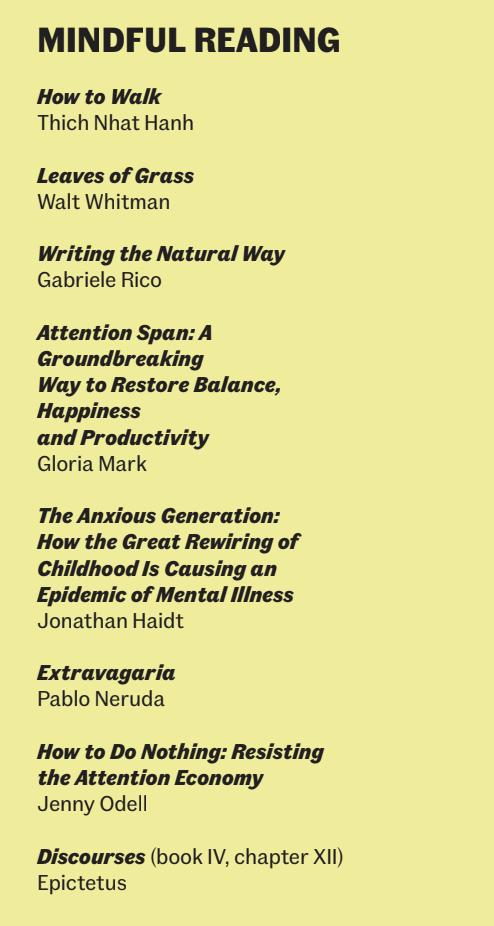
 Gloria Mark, the author of Attention Span: A Groundbreaking Way to Restore Balance, Happiness and Productivity and the Substack newsletter “The Future of Attention,” started studying the intersections of technology, multitasking and distraction more than two decades ago. In 2003, she watched office workers toggle between screens every two and a half minutes or so, which was one finding in a paper titled, “Constant, Constant, Multitasking Craziness.”
By 2012, she found screen-switching was even more prevalent, with the average attention span dropping to 75 seconds. Four years later, Mark’s research team discovered the average had plunged to 47 seconds (the median was 40 seconds). Even more jarringly, Mark and her collaborators revealed that it could take office workers an average of 25 minutes to return to the same task after an interruption.
And this disruption wasn’t confined to the workplace. Mark co-authored a study that found college students were switching tasks twice as often as office workers, leading to more stress and diminished productivity. The more time students looked at their phones inside and outside of the classroom, the lower their grades were.
“We may have the illusion that we are doing more and that our human capacity has expanded when we shift our attention, or multitask, but actually we are doing less,” Mark writes in Attention Span. “Multitasking has repeatedly been shown to be associated with lower performance when objectively measured.”
Although scientists have not established a causal link between the rise of technology in daily activities and the decline of our attention spans over the past two decades, Mark says, “I would be shocked if there was not a relationship.”
In the summer of 2024, Exeter faculty members were encouraged to read another seminal text on that potential relationship, The Anxious Generation: How the Great Rewiring of Childhood Is Causing an Epidemic of Mental Illness by Jonathan Haidt. The book argues that a “phone-based childhood” has replaced a “play-based childhood” and contributed to a documented rise among young people in mental illness and obstacles to learning, including attention fragmentation.
The book helped inspire more conversations about phone use at Exeter. After collecting survey feedback from students, parents, faculty and staff, the school instituted a new policy this academic year. It mandates that cellphones “be stored completely out of sight” during all required student appointments, including classes, labs and assemblies. Still, it’s not a blanket ban. Phones are allowed during meals, transportation to games, club meetings and optional gatherings, among other settings.
“A lot of our peer schools have adopted more rigorous or restrictive cellphone policies, and we have not gone in that direction,” Dean of Students Ashley Taylor says. “With both cell phones and artificial intelligence, I think we are less inclined to suggest they are good or bad, but instead to really focus with our students on being intentional in how we use them.”
She mentioned that Max Stossel, who founded an organization that aims to help teens and schools effectively navigate social media, had told students at assembly to ask themselves, “Am I using my phone or is my phone using me?”
“I think that’s something we’ve really tried to work with the students on,” Taylor says, “rather than just restricting, trying to empower them with information that helps them make some good, healthy choices, knowing that these devices really aren’t going anywhere.” 
For example, students asked the dean’s office to bring back a voluntary “phonefree Fridays” program that debuted last year. If students turn in their phones at assembly in the morning and refrain from retrieving them before the end of the day, they’re entered into a prize raffle. Similarly, students can use a cellphone “parking lot” at the library if they want to study without their devices.
Szu-Hui Lee supports this approach of empowering students when it comes to making decisions regarding phones. “I don’t want to pathologize the kids just because they grew up with technology,” she says. “Let’s not shame them for that, but let’s educate them about how to navigate it.”
Lee and her colleagues in Counseling and Psychological Services (CAPS) want to “build a toolbox of strategies that students can use to cope, to regulate their emotions, to do self-care.”
That includes the trial use of digital resources like Calm, an app that helps users manage stress and sleep. They also recommend turning to music, books, painting, exercise or any number of other activities away from screens. Students can be “too reliant on their phones as their tool,” Lee says.
One day during finals week this winter, the toolbox included writing affirmations and snapping Polaroid pictures with smiling friends. More than 200 students visited stations at a wellness café set up by the library, CAPS and the Health and Human Development Department. “It reminds me that kids want opportunities to slow down when they can,” Lee says.
 She was pleased to learn about The Art of Slowing Down, as she has long been a proponent of the science behind that approach. “Slowing down is just as important as being in the race, because that slowing down allows you to gain the skills you need,” Lee says. “It allows your body to rest and recover, so that you can continue at this peak performance level.”
It’s vital for creativity, Woodard says: “As artists and thinkers and creators, you need to be able to be present.”
During winter term, Katie Loghinov ’27 took a religion, ethics and philosophy course on happiness. The class, taught by Kaitlyn Martin Fox, explained why it was important to be attentive. Essentially because “every moment you’re in has the potential to be something really profound and meaningful,” says Loghinov, who is from the Bay Area and describes herself as a “future-oriented person.”
“I’m never really present in the moment,” she says, “and I find that I’m robbed of a lot of good experiences because of that. I’m either worrying or I’m ruminating.”
Loghinov attributes some of this distraction to the digital sphere. Like many of her classmates, she can find herself spending lots of time on social media. “Even when I’m not scrolling,” she says, “there’s just this stimulation that you get from Instagram or whatever that’s kind of in the back of your mind and creating this busyness feeling.”
But the message from the course on happiness about valuing the present moment resonated deeply with her. “I took a lot away from that class, and I wanted to find a way to actually apply those ‘whys’ that I learned into ‘how,’” Loghinov says.
 So in the spring, she enrolled in The Art of Slowing Down. She was drawn to the technology-free course and its invitation to practice free-writing — composing without stopping or editing for extended periods of time — and clustering, a form of mind mapping that links words and ideas to spur creative work. The idea is for students to observe not just what they create, Hofheinz says, but also how they create, recording their thought processes along the way to see what works best for them. “What does happen to creativity, to your ability to think and write and be together, when you do just settle?” she asks. “What type of practices will help you build back the focus, build back your ability to pay attention and give that gift of togetherness or presence to other people or ideas or your own writing?”
The students aren’t just learning tactics from figures in the literary world. Woodard and Hofheinz are drawing from, among other sources, the engaged Buddhism of Thich Nhat Hanh; the mindfulness practices of Plum Village; the Christian mysticism of Julian of Norwich; and texts and teachings from the yogic tradition. Before the spring term, Woodard was particularly excited to read from Thich Nhat Hanh’s How to Walk and perhaps have students experience a walking meditation. She hopes to ingrain the notion that stillness is less a physical state than a state of mind.
“I do a lot of thinking while I’m moving, driving, walking, but I think that can be meditative in its own way,” Woodard says. In whatever form it takes for them, she says, students have to learn to carve out time for this stillness. Sebastian Ting ’26 hopes to carry practices from the class with him beyond Exeter, aiming to “really slow down and try to be more present in times of struggle.”
Loghinov has been practicing mindfulness more on her own as she pursues an interest in filmmaking. “Honestly, it’s starting to change my life,” she says. “I’m creating space for new ideas and new experiences that I wouldn’t have been able to feel if I was too caught up in the past or the present and not being attentive in every moment.”
AN EXERCISE IN MINDFULNESS
Often, the quality of our gaze will reveal the focus of our attention, as well as its spirit. Walking into a room, it is common to first notice tasks waiting to be completed rather than show love to who or what is there. In this habitual rushing or task-orientation, we might miss opportunities for connection with loved ones or even with ourselves. Over the course of the next few days, you are invited to practice slowing down and looking at people, animals and things with loving eyes.
A nun that instructed Marilyn Nelson told her to simply: “Put your love into your eyes and just look at the world with that gaze…. That’s what contemplation is about, really. It’s learning how to find that gaze in yourself and to put it in the world.”
As you practice, take time to notice any shifts in your eyes, face, body, focus or heart and mind. Does your focus sharpen or does it soften? Do you notice new details or feel your relationships differently? Please write any reflections in your journal.
This practice of “kind attention” was adapted from Jan Chozen Bays’ How to Train an Elephant, interwoven with instruction from poet Marilyn Nelson.