Nominate an Exonian
Help us celebrate those Exonians who have demonstrated exceptional service by nominating fellow alumni for the Founders' Day Award or the John and Elizabeth Phillips Award.
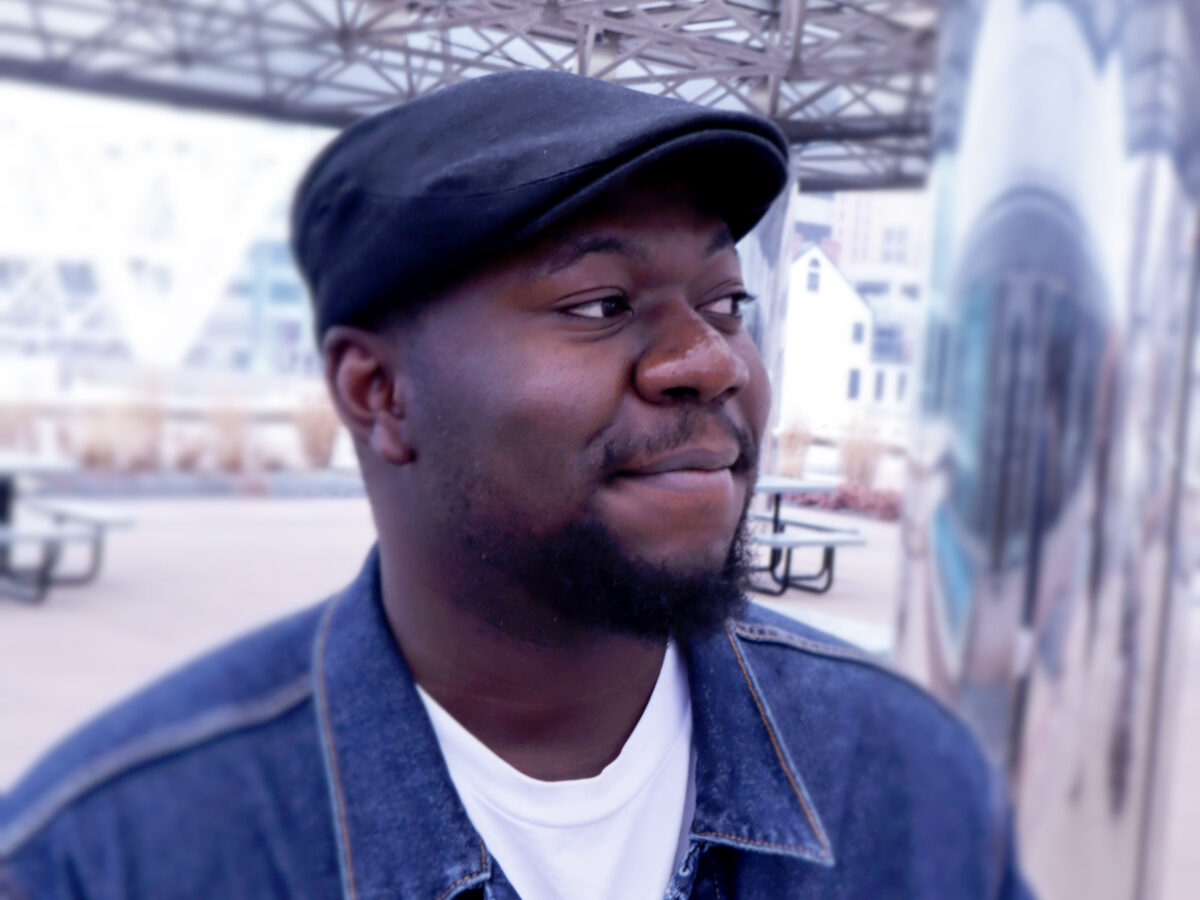
The following is an excerpt from “The Woman Who Brings Home The Ghost of Her Son,” the book Tega Oghenechovwen is working on during his George Bennett Fellowship year at the Academy. The story follows a woman dealing with repeated trauma centered on human loss. It was inspired by a 2020 massacre in which young Nigerians protesting peacefully against police brutality were killed by soldiers in Lagos.
Amaka thumbs through the books on Ikemefuna’s reading table — books by Steve Biko, Malcolm X, Frantz Fanon, and many other thinkers and revolutionaries — as if searching for her son in their pages. She selects Fela’s 1976 Zombie vinyl from the stack by the corner, turns on Ikemefuna’s record player — a gift he had bought himself for his 18th birthday — and places the vinyl on the turntable. She sits behind Ikemefuna’s study desk and listens as Fela sings about how Nigerian soldiers are zombies quickened by the government and turned against innocent, ordinary citizens; how they take orders from above without processing the morality or human consequence of those orders. Amaka feels something — the bold beating of her heart. She listens again. This time with Ikemefuna’s ears, with Ikemefuna’s consciousness, strangely coming to the awareness that her quiet will not serve her.
***
Three months after the massacre, Amaka still cannot trust herself to drive. Instead, she haunts inquisition hearings — where once, to her shock, she’d watched men and women who claimed to have lost loved ones at the Lekki toll gate grow suddenly desperate as soon as a group of important-looking officials she was sure were acting on the government’s behalf started writing and distributing cheques. She haunts morgues and temples of justice, searching for the last trace of Ikemefuna. She rides the bright yellow danfo minibuses and walks the remainder, her body grilled by the sun, her skin coated in dust. If she has learned anything during this period, it is that the government is not only skilled at killing and lying but also in the hiding of dead bodies.
Today, at the gate of Bonny Garrison — the post from which the soldiers responsible for the massacre were deployed — rainwater hangs in the trenches of Amaka’s clavicles. Pouches of flesh, filled with all the sleep she has missed since Ikemefuna died, hang from her eyes. She stares at the giant pit bulls slamming against the other side of the wrought-iron gate, their loud, ugly barks promising her terror. Amaka stands like the Eiffel Tower, feet planted wide, holding up a laminated placard with an enlarged photo of Ikemefuna’s face. She has come this way a few times — with Kola, with Chinwe and Chuks — and their friends, who showed up in T-shirts reading #JusticeForIkem, and Tolani and her boys, who brought their own boys and made videos and the good type of noise. Most of the time, she stays till dusk and attracts, like everywhere else, the crooked eyes of the press and the temporary solidarity of strangers.
A soldier with thin limbs in crisp camo khaki and shiny black boots clatters out from the garrison, stomping towards her. “You this useless woman!” He stares her down with bloodshot eyes before yanking the placard from her. “Your son pikin for toll gate. And so bloody what?” He grabs her wrist.
“Where are you taking me?”
“You want to see your pikin. Right? Move it!”
The pit bulls leap at Amaka and hang at the end of their leashes — suffocating in idiotic fury — as the soldier pulls her into the garrison. He marches her down the length of a sterile archway, into the vast interior of an office where a man, squat and round like a rice cooker, sits behind a mahogany table, eating a meal of reddish-brown beans and well-done steak. The colonel grunts, motioning the soldier to step out.
“You have killed my son.” Amaka clenches her fist and toes. “Why play hide and seek with his body?”
The colonel’s bulk does not permit talking, breathing, and eating simultaneously. He takes his time until he is done stomaching his food.
“I am truly sorry for your loss, madam.” He winces and, to Amaka’s disgust, releases a bubbling, brown fart that increases the temperature of the room and ferments the saliva in her mouth. “But … you can’t keep on like this. Our enemies at Amnesty International have started running their mouths. Because of people like you.” He lumbers to the tea machine and brews two cups of tea, offering her one. In another world, she would have gladly accepted the cup, having exposed herself to the weather, but in this world of the garrison — now reeking of excrement — all Amaka sees in the cup, when she leans over, is her son’s blood. She shakes her head.
“Are you scared of me?”
“Scared?” Her voice wavers. “Why should I be scared?”
He casts her a viperous gaze, flaring his nostrils.
“What of now, madam?”
She drills into the gaze, carefully — daringly — without blinking. He flicks his wrist, gesturing for her dismissal.
As she turns to the door, he commands, “I don’t want to see you around here again! If not —”
Something lurches in her stomach, rising fast through her throat. It bursts past her clenched jaw, loud and jagged, before she can stop it: “Tell me! Was that my son’s corpse you were eating? What more can you do? You beast! You zombie!” She hears herself screaming, blinded by rage. She belts out the opening lines of Fela’s Zombie in a frenzy. She doesn’t notice the colonel hurtle toward her but feels his hard, leathery palm as it crashes on her cheek, shifting her jaw. Paap!
“You are stupid!” he yells.
Paap!
“How dare you call me zombie.”
Paap!
Amaka doesn’t feel the paaps. What wracks her body isn’t the pain but the memory — the anguish, the shame — of the first time she’d slapped Ikemefuna five years ago.
***
They had been vacationing in Jos. Amaka was behind the wheel of a small, rented car, seated in the tight traffic around Gada Biyu, with Ikemefuna in the front passenger seat. They were on their way to climb Shere Hills where they could wholly capture Jos with all its breathtaking wonders and get lost while touching the twilight sky. She monitored the progress of a black Prado jeep, three cars behind theirs, from the rear mirror as its siren blared rudely and shoved its way between the vehicles in front of it. Soon it got right behind her car and whoever was driving began to honk non-stop at her to pull off the road into an adjoining bush.
Amaka refused to budge at first, choosing to crank up the music on the stereo and roll up the windows of the car. The Prado managed to force its way to her side. The front window slowly sank to reveal a man with pencil-thick scars drawn over his paper-thin face. He was impatiently pointing a buckshot gun at her. So, she gave in. She gave in because she was scared for her life; because she was trying to protect Ikemefuna; and because she had a flashback to a moment many, many years earlier when she was pregnant and someone had pointed a gun at his father. Ikemefuna looked at her with fiercely berating eyes, like she had done the unthinkable.
“Why did you yield to those brutes?” he said. “You had the right of way. It wasn’t even an emergency.”
“Well —”
“It was just some politicians, maybe a senator who wanted to —”
“But Ikem, you saw —”
“Just because they have sirens and a stupid- looking security man …”
It had been a ridiculously hot day. Her brain was recoiling from Ikemefuna’s loudening voice. It dawned on her that he was getting beyond reasoning with, beyond the basic sense of self-preservation just like his father had been. And so, she lifted her right hand and struck his face — as if to say, I will not lose you like I lost your father. Ikemefuna squirmed, holding the welt forming on his cheek, his flowing eyes squinting bitterly at the Prado jeep already ahead.
Later that night, she went into his hotel room, put her fingers into his hair, and said, “Ọ dị m n’obi. Dike m. My small husband.” And rather than apologizing for hitting him, she said, “You know what? I bought you suya. I told them to cut in all the delicious parts you like. Fix your face. Follow me.” Ikemefuna got up from his bed and followed her out to the yard. There was not only suya but a brand-new PS2 ready to be unboxed. The sky was vast and lit in a way that encouraged truth-telling. Her heart faltered. She could not tell him; could not warn him that he was eyeing the same tunnel his father had entered — a tunnel whose exit had, sadly, led to his father’s demise. She felt that doing so would only fuel his resentment toward the government and its forces and lead to him taking actions that would consume him. So, she told him that he did not always have to question everything, did not always have to fight; that it was never wise to struggle with a mad person, especially when that mad person was holding a gun; that in the country power was everything. And that if he loved and respected her, he would listen to her, especially when she was calling for caution.
“Ikem, a na m aghota?” She threw her arms around him and placed his head on her bosom.
“Anurum gi, mama.” He nodded. “I understand. Thank you.”
— Tega Oghenechovwen is the 56th Bennett Fellow. His work exploring psychological trauma, social justice, displacement and communal grief has appeared in The Caine Prize for African Writing anthology, The Kenyon Review, Joyland, The Rumpus, and elsewhere. Oghenechovwen has an M.F.A. in creative writing (fiction) from the University of Maryland.
The George Bennett Fellowship is one of the country’s most sought-after post- graduate writing fellowships. It is awarded annually to a promising author who has not yet published a book and includes a stipend for one academic year, as well as housing and meals for the author and their family.
In addition to working on personal writing, the fellow is asked to be available to students, including members of English classes and student literary organizations. The fellowship was established by Elias B.M. Kulukundis ’55 in honor of his teacher, George E. Bennett ’23. Bennett taught in the English Department for 37 years.
Editors Note: This article was first published in the spring 2026 issue of The Exeter Bulletin.
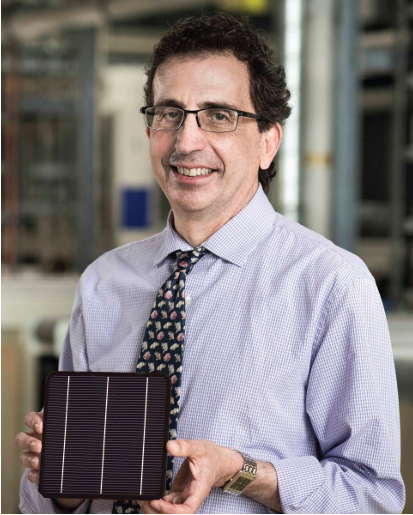
Chris Case ’74 has always been curious. As a child, he created a universal garage door opener, which he used to open his neighbors’ garages. He taught himself to code on a PDP-10 (Programmed Data Processor-10) and wrote a dating program during junior high school. At Exeter he built audio amplifiers for classmates. During college, he constructed a solar-powered demonstration house.
This curiosity ultimately led him to the field of materials science and engineering, applying physics and chemistry principles to understand the structure and properties of materials, including polymers and silicon. “Everything we touch and interact with is atoms and materials,” Case says. “They connect with each other. I really like exploring those connections.”
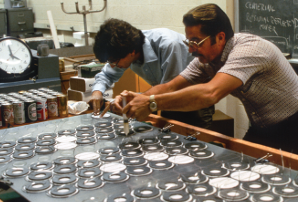
His niche: solar power. He has spent over 40 years in the development and application of thin-film photovoltaic cells, the semiconductors that make up solar panels. As chief technology officer for the British solar tech startup Oxford PV, he spent 12 years in the development of perovskite-on-silicon tandem solar cells, thin-film semiconductors that are more efficient at capturing the sun’s energy than traditional single silicon solar cells.

Scientists estimate that the amount of solar energy reaching the Earth’s surface every 88 minutes could power the planet for a year. Capturing even a tiny fraction of that power could meet the world’s electric needs, inexpensively and sustainably. “Tandem solar cells are expected to become the main solar technology in the next few years and accelerate the world’s energy transition,” Case says. “It will help save the planet from the climate crisis.”

Case’s tandem cells combine a thin layer of perovskite — a composite that readily absorbs light and harvests more energy than silicon — stacked on top of a silicon layer, creating a more efficient semiconductor that produces less expensive energy. Unlike silicon, perovskite can be engineered into a thin, lightweight material, rolled or even printed. “Perovskite-on-silicon tandem solar cell technology generates from 20 to 50% more energy than a single solar cell,” Case says. The manipulation of materials like perovskite to create end products that have a tangible benefit is “the stuff I adore doing,” he says.
Case’s interest in the environment was piqued in junior high school, when he undertook a project to identify chemical compounds in the Five Mile River, near his home in Connecticut. “There were stories at the time in the local newspapers about possible contamination by manufacturing plants upriver,” Case says. “I don’t think my teacher expected me to do such a thorough job reporting on the pollution in that river. I wasn’t very popular in town after my report became public.”

During his senior year at Exeter, Case secured an internship at the four-year-old Environmental Protection Agency in Washington, D.C. “I wanted more exposure to environmental conservation,” he says. “That experience really made me understand and respect the role of policy, because you need to know policy and regulation to implement programs and change.”
Case discovered thin-film photovoltaics as an engineering student working with solar pioneer Joseph Loferski at Brown, where he later received a master’s degree in engineering and a doctorate in materials science. After a year as a Fulbright-Hays scholar at the Université de Bordeaux, he returned to Brown to complete his Ph.D. and joined the engineering faculty as an assistant professor. He went on to work at AT&T Bell Laboratories, then moved to the U.K. to become chief technology officer for The BOC Group. After consulting for high-tech materials firms, he was recruited by Oxford PV as CTO.

Case successfully scaled the tandem solar cell technology he introduced to Oxford PV. The company has licensed its patent portfolio to other solar cell manufacturers and fabricates its own tandem solar cells and modules at a factory in Brandenberg, Germany. In 2024, Oxford PV sold and shipped its first tandem modules to a large U.S. energy utility for installation in a grid-tied solar farm. Further development in the U.S. has stalled because federal energy policy is emphasizing fossil fuels. “Access to funding for renewable projects in the current political climate is limited,” Case says.
Despite these challenges, he remains an enthusiastic proponent of solar’s potential to address a variety of societal problems, including increasing access to clean water through solar-powered desalination systems and providing inexpensive, consistent electrical power to as many people as possible. “I’m committed to the vision of an all-electric future,” Case says. “Imagine the societal changes if we give people more freedom in their energy decisions.”
Editors Note: This story was originally published in the spring 2026 issue of The Exeter Bulletin.
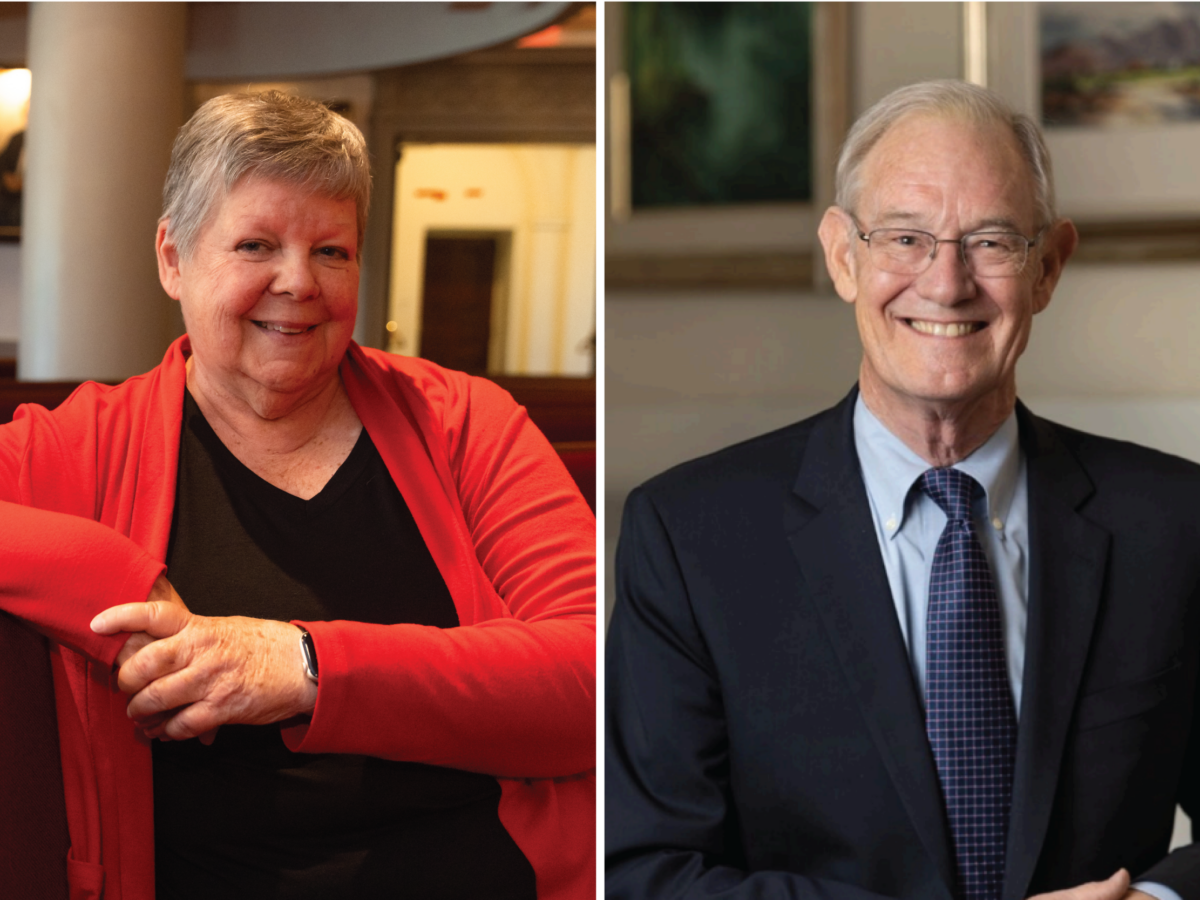
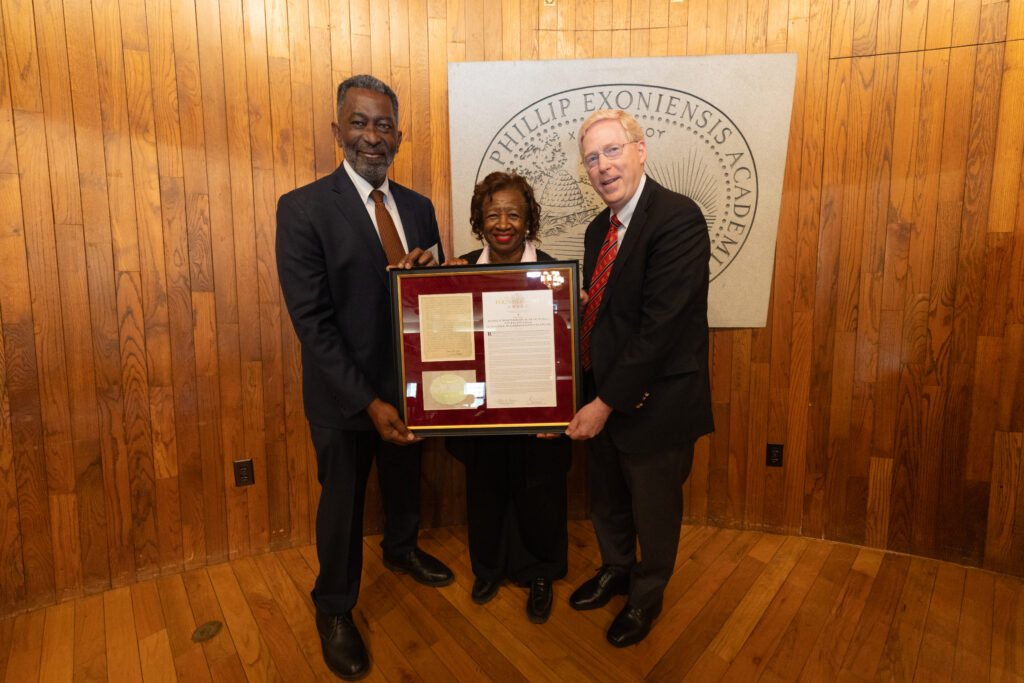
Alumni Association President, Trustee and Awards Committee Chair Sam Brown ’92 has announced the selection of Jan Woodford ’40, ’41, 44, ’49, ’51, 52, ’53, ’59, ’60, ’62, ’70, ’71, ’78 (Hon.) to receive the 2026 Founders’ Day Award, and Samuel P. “Terry” Goddard III ’65 to receive this year’s John and Elizabeth Phillips Award.
Established by the Trustees in 1976, the Founders’ Day Award is given annually in recognition of longtime service to the Academy.
Jan Woodford retired in 2025 as senior adviser of campus events in Exeter’s Alumni Relations office, having served the Academy and its alumni for nearly four decades. She began her career in the fundraising office but later moved to Alumni Relations, where she eventually managed reunion events for 14 reunion classes. During her tenure, she received honorary membership in 13 classes — more than any other community member — and attended or managed more than 750 events (including reunions, memorials, building dedications, graduations and many more).
A veteran of the U.S. Air Force, Woodford also spearheaded Exeter Salutes, an annual programming initiative launched in 2019 that honors members of the Exeter alumni community who currently serve in the armed forces or are veterans and connects them with current students.
Woodford will receive the award and speak during assembly on May 15.
The John and Elizabeth Phillips Award is given annually to an Exonian who has contributed significantly to the welfare of community, country or humanity.
This year’s recipient, Terry Goddard ’65, has dedicated his life to public service, working to increase transparency in government, enhance consumer protections and encourage citizens’ participation in the political process.
After beginning his legal career prosecuting fraud in the Arizona’s attorney general’s office, Goddard served four terms as mayor of Phoenix, Arizona and went on to become Arizona state director for the U.S. Department of Housing and Urban Development. In 2002, Goddard won election to the first of two terms as Arizona’s attorney general. In that role, he focused on promoting consumer and civil rights, fighting drug cartels and pursuing cases against predatory mortgage lenders.
Following the Supreme Court decision in Citizens United v. FEC (2010), which opened the doors to unlimited election spending by wealthy individuals and groups, Goddard waged a determined fight to remove “dark money” from the state’s political system. In 2022, 72% of Arizona’s voters overwhelmingly passed Prop. 211, an initiative establishing the nation’s most comprehensive election spending transparency law, after Goddard succeeded in his fourth attempt to get it on the ballot.
Outside of the political realm, Goddard has taught graduate level courses on urban affairs and other topics at Arizona State University and served as president of the Central Arizona Water Conservation District, which administers the canal system bringing water from the Colorado River to central Arizona. He has also championed historical preservation efforts, working for some 40 years to revitalize and return to public use the historic Phoenix First Baptist Church, renamed the Monroe Abbey.
Goddard will receive the John and Elizabeth Phillips Award and speak during assembly on Oct. 30.
Help us celebrate those Exonians who have demonstrated exceptional service by nominating fellow alumni for the Founders' Day Award or the John and Elizabeth Phillips Award.
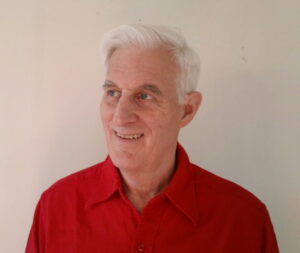
On April 19, 2022, eight weeks after Russia initiated a full-scale invasion of Ukraine, Bill Endicott ’64 sent an email to his friend, the owner of a prosthetics company, with a simple but vital request: Would you be willing to help Ukrainian soldiers? Forty-five minutes later, he had the green light to start an initiative that would provide prosthetics, rehabilitation and support to Ukrainian soldier amputees. He named it Operation Renew Prosthetics (ORP).
At that early stage of the war, Endicott could not have foreseen how desperately Ukrainians would need the help. Reports estimate that there are 115,000 Ukrainian amputees because of the war. With limited access to advanced prosthetics and inpatient rehabilitation, many wounded soldiers endured recovery alone.
Endicott reached out to the Future for Ukraine Foundation, a Ukrainian-run charitable group based in Poland, and expressed ORP’s desire to treat amputees at Medical Center Orthotics & Prosthetics in Maryland. That company, owned by his friend Michael Corcoran, had expertise in caring for blast injuries. Future for Ukraine became ORP’s partner and primary connection to soldiers, who are affectionately called defenders by their compatriots.
The first Ukrainian soldier, Oleksandr “Sasha” Chaika, arrived in the U.S. for treatment in the fall of 2022. In April, a month after he joined the fight, a Russian tank shell exploded near the trench he was in in Popasna. Chaika was hit by shrapnel and lost a leg; doctors gave him a 20% chance of survival. Future for Ukraine covered all his travel expenses and ORP provided a free prosthesis and six weeks of rehabilitation.
Before the war, he was a dancer and choreographer. Today, Chaika is married with a young son and has realized his dream of opening a dance school in Ukraine. “Sasha recovered about as well as you can with a major amputation,” Endicott says. “He told me that one reason he was so motivated to recover was to prove the doctors were right to take a chance on saving him.”
Five more soldiers arrived in the U.S. after Chaika. But with the cost of a single prosthesis ranging from $8,000 to $50,000 or more, the operation was unsustainable. Instead, the organizers decided to establish a clinic in Kyiv, Ukraine’s capital, and train Ukrainians to run it independently.
Endicott has always been driven by a strong moral obligation to help others. He was born in Boston in 1945, in the shadow of World War II, into a family that traces its origins in America to 1628, when John
Endecott (the family changed the spelling to Endicott in the 18th century) landed in Salem and became the first governor of Massachusetts. “My family’s been involved in public service for 400 years,” he says, “so I’ve always felt that a good life is one in which you do some things for yourself, but you do some other things for other people. It’s a balance.”
Growing up in the Cold War era, Russia was a constant presence in Endicott’s life. In elementary school, he dived under his desk during air raid drills. As a student at Exeter in the early 1960s, he studied Russian history. He internalized the turmoil churning across America during the Vietnam War, watching his friends die while he was temporarily deemed ineligible to serve. In 1967, the principal at the time, Ernie Gillespie, gave a speech to the graduating class that became a rallying cry for Endicott, even to this day.
“The part I’ve always remembered goes like this,” Endicott says. “‘I hope, and I expect, that when you find yourselves involved in skirmishes on the frontiers of barbarism … you’ll strike some shrewd blows in favor of civilization. Someday you’ll come back to show us your trophies and your scars, and we’ll be glad to see you.’”
Determined to lead the non sibi life, Endicott embarked on a remarkable career of public service. He studied Russian language at Harvard College and received an M.P.A. from the Harvard Kennedy School. He worked for three U.S. congressmen and the Democratic National Committee, then served as director of research and analysis in the White House Office of Political Affairs during the Clinton administration. He enlisted in the Marine Corps Reserve, rising to the rank of captain, and worked at the Pentagon.
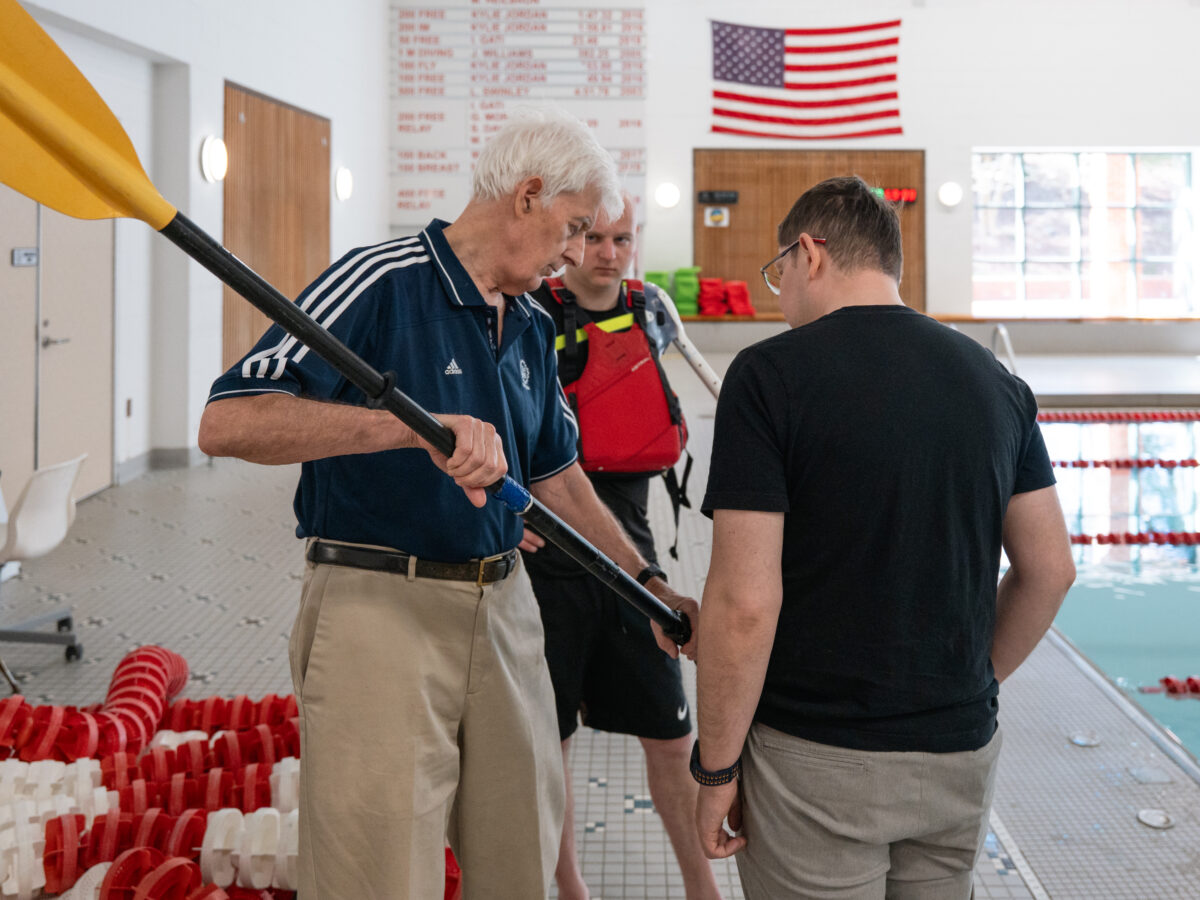
Endicott devoted the little free time he had to his passion: whitewater canoeing and kayaking. Following a collegiate rowing career at Harvard, he became a leading figure in the world of whitewater slalom, as an athlete, author and U.S. Olympic team coach. This is how Endicott and Corcoran first joined forces. In 1988, Corcoran traveled from Dublin to the U.S. to train with Endicott in the hopes of making the Irish Olympic team. Corcoran later relocated to America and co-founded MCOP in 2002. He and Endicott remained close.
In 2022, unified in their belief that Ukraine needed and deserved their help, they founded ORP. Three and a half years later, ORP has successfully cared for 112 soldiers and laid the groundwork for Ukraine to become a world leader in amputee care. They even shared their love of whitewater sports with the Ukrainian soldiers, hoping to establish a kayaking rehabilitation program in Kyiv like the one that exists for soldier amputees in the U.S.
On November 6, 2025, following a sleepless night of air raid alerts, Endicott was in Kyiv for the grand opening of a new clinic, Medical Center Orthotics & Prosthetics Ukraine. It is staffed entirely by Ukrainians, with 19 full-time and six part-time employees, and plans to hire more. They have been trained to operate independently to continue providing prosthetics to their country’s soldiers. Endicott hopes the clinic may someday help civilians as well.
The work of Operation Renew Prosthetics is now complete, but Endicott stands ready to help wherever he can, including possibly raising funds to assist former U.S. soldiers who lost limbs fighting for Ukraine.
“The Ukrainian people are astonishingly resolute and united in the face of all this adversity,” Endicott says. “When I start to worry about my own problems, I think about what Ukraine is facing, and particularly what these soldier amputees are facing. My problems are nothing compared to theirs.”
Endicott, an 80-year-old retiree, says he will always feel compelled to do what he can when duty calls.
“I’d like to think that Ernie would feel that these were ‘shrewd blows,’” he says. “And he was right: There have been some trophies and some scars!”
This article was originally published in the winter 2026 issue of The Exeter Bulletin.
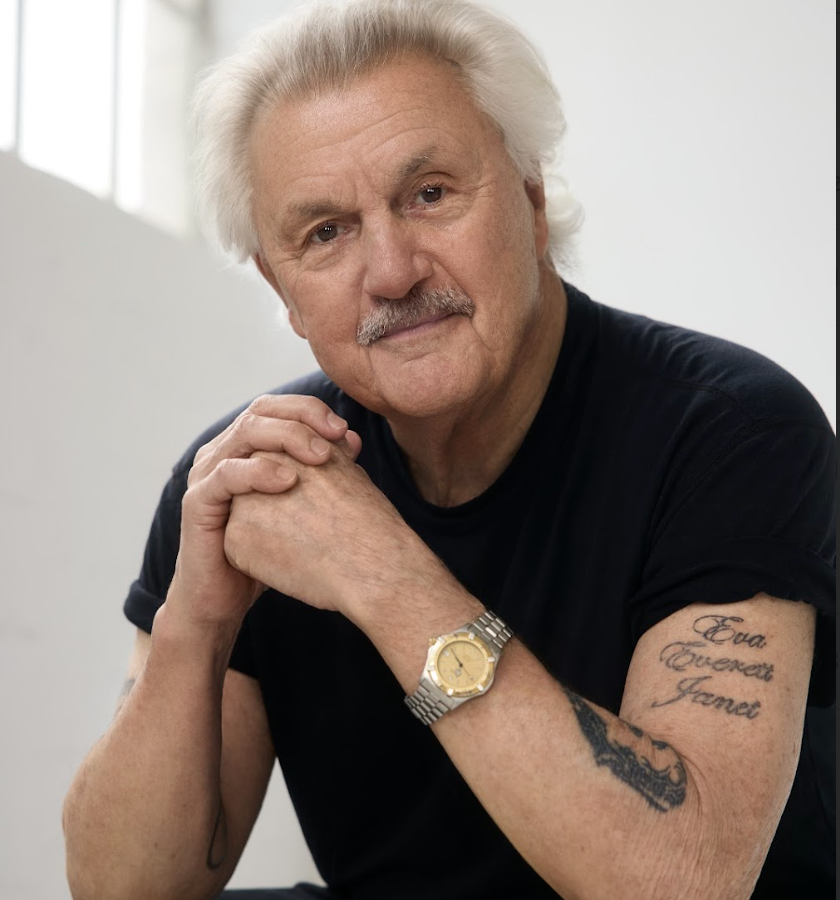
For fans of author John Irving ’61, his most recent novel provides a host of familiar comforts: tattoo parlors, Viennese romps, unconventional family dynamics and, of course, a thinly veiled version of Phillips Exeter Academy. But that novel, Queen Esther, also ventures into uncharted territory, especially when tracing the enigmatic exploits of its titular character, a Jewish orphan named Esther Nacht. Irving — a standout wrestler at Exeter and a lifelong devotee of the sport — discussed his new book with current varsity wrestling coach Justin Muchnick. Here’s some of their conversation.
Let’s start with your main character, Esther. How does she drive this novel?
Esther is born in Vienna in 1905. By the time she’s a 3-year-old, her life has already been shaped by antisemitism. She returns to her birth city in the 1930s, when many Viennese Jews are leaving (or have already left). I wanted my Esther to be the embodiment of the Esther in the Hebrew Bible and the Christian Old Testament. She is the epitome of hiddenness — a secretive, behind-the-scenes operator. But when she reveals herself, watch out! Esther is making up for the Jewish childhood she was denied; she’s going to be the best Jew she can be. I wanted her to be part of the founding of the State of Israel. Her birth child, Jimmy, is my POV character, but Esther is the novel’s main character; she’s the one who makes everything happen. The objective of this ending-driven novel — which concludes in Jerusalem in 1981 — was to create, in Esther, an empathetic Zionist.
On that ending: Why Jerusalem, and why 1981?April 1981 is when — in my life — I was invited to Israel by the Jerusalem International Book Fair and my Israeli publisher. I accepted the invitation at the urging of my favorite European publishers. They were Jewish with longstanding ties to Israel. They were leftist, nonobservant Jews who’d criticized the right-wing Likud government of Menachem Begin for accelerating the settlements in the West Bank. They said the Israeli presence there, and in the Gaza Strip, might make Palestinian self-determination harder to achieve — they believed then that a two-state solution to the Israeli-Palestinian conflict could slip away. Queen Esther is a historical novel, and a historical novel foreshadows the future. In April 1981, the seeds were sown for an eternal conflict.
It’s a conflict that’s taken on a renewed relevance in recent years — perhaps more than you were expecting during the writing process.
The novel has certainly predicted that these troubles were likely to be ongoing. Of course, I wish for a peaceful resolution. I’m hoping for a lasting peace, for the Israelis and the Palestinians.
When researching this book, did you visit Israel? Have you been back since 1981?
It was important to me that I not go back to check my facts — not until I had a finished draft. The dialogue mirrors what I remember being said to me, or what I overheard. But in a historical novel, the dialogue must also be what was commonly said in that time and place. My early readers — several Israeli contacts and friends — assured me it is.
Once the novel was drafted, in July 2024, I visited Jerusalem, to talk to these early readers and to refresh my memory of the visual details — to go where I’d gone 43 years ago. When I was there in 2024, the war in Gaza was ongoing. In the Muslim Quarter, there were no tourists on the Via Dolorosa — the Way of Sorrows, where Christ carried the cross to be crucified. No tourists in the Christian Quarter — not even at Christ’s tomb, in the Church of the Holy Sepulchre. I was alone in the evenings, reading over my day’s notes, mapping out where I would go the next day. Most evenings, my Israeli friends were at anti-Netanyahu protests.
Backtracking from your novel’s ending to its beginning: You included a cameo from Dr. Wilbur Larch, the saintly abortionist-cum-orphanage director from The Cider House Rules.
The beginnings of my novels are often the most autobiographical. I’m conscious of grounding my novels in recognizable locations, and with some familiar character types, but this is the first time that I have re-created or revisited an old character. The reasons for doing so had everything to do with my trajectory for Esther. I needed an orphanage for an abandoned Jewish child. I knew of an orphanage where she would be treated well.
Dr. Larch is much younger than readers or moviegoers who know The Cider House Rules will remember, and there’s an entirely different cast of characters among the unadopted orphans, but I knew Dr. Larch would find out all he could about Esther, and that he’d find the best possible family for her, although they wouldn’t be a Jewish family.
I love Dr. Larch but, for obvious reasons, I’ve got a soft spot for the novel’s wrestling scenes. You’ve set these in Vienna, in a grimy but cosmopolitan gym called the Turnhalle Leopold.
I tried to be truthful to the wrestling gyms I visited when I was in Vienna in 1963–64. At that time, there were more Greco-Roman wrestlers than freestyle wrestlers — freestyle being closer to folkstyle in the U.S. Because Queen Esther is a political novel, I chose to focus on two Soviet and two Israeli wrestlers as characters. Some of the Soviets in Vienna in ’63-’64 were KGB operatives, and some of the Israelis were Mossad operatives — or “working for Wiesenthal” as Nazi hunters. In the novel, I wanted the Soviets and the Israelis to be the only wrestlers that my character Jimmy was close to.
You’ve seen a lot in the sport, both as an athlete and as a coach. So, from one coach to another, what’s your go-to piece of coaching advice?
I was lucky to be associated with excellent wrestling coaches, all in first-rate programs. This began with Coach Seabrooke at Exeter (a Big Ten champion at Illinois, and a two-time NCAA finalist), and it continued when I was at Pittsburgh and Iowa. Great clubs, great coaches. Many of my teammates and workout partners were champions — and so were my sons, both of whom I coached. My son Colin won a New England Championship for Northfield Mount Hermon; my son Brendan won the same title for Vermont Academy. But I, as a wrestler, never got past the semifinals at any tournament — in my Exeter years, in my university years or postcollege.
My foremost advice to a coach, at any level, is you have to know who the superior athletes are, and you have to recognize the hard workers who aren’t as gifted athletically. You coach to the individual. A good athlete will end up on top in a scramble; you coach that guy differently than you would a wrestler who’s not as talented. Some guys thrive in scrambles; other guys get killed in them. Know the difference!
—Justin Muchnick is the varsity wrestling coach at the Academy and a Ph.D. candidate in classics at the Institute of Classical Studies.
This article was originally published in the winter 2026 issue of The Exeter Bulletin.
In my upper year, a group of determined Dunbar residents set out to access the tunnels and visit other dorms. (I hope our advisers aren’t reading this!) Armed with tools, we eventually found a way through our basement into the tunnel system — I remember a big room full of old furnishings in the dim light of our flashlights — and a way into Bancroft. With a little planning, we could sneak over after check-in. Although we feared being caught, the thrill was part of the fun. Eventually, the broken lock was discovered, and we did our best to look innocent.
Jess Isaacs ’02
__________
I was a scholarship boy at Exeter from 1955 till graduation in 1959. One of my duties was washing dishes in the dining halls, especially Dunbar. I ate in Webster, so I used to use the tunnel from Webster to Dunbar. (I believe the tunnel started in Bancroft.) Along the way, underground, was a bakery, and I became friends with the baker, named Armand LePage. After graduation I kept him on my Christmas card list and we kept in touch for many years.
Warren Harkness ’59; P’85
__________
I’m pretty sure I still have stuff in storage in the tunnel under Lamont.
Leah Kotok ’97
__________
Been there as a fac brat. They were our playground.
Scott Estey ’83
__________
I once had the opportunity to visit them with someone who had *ahem * access. But it was too creepy for me (long tunnels with minimal lighting, it just felt like a horror movie setup) and I backed out.
Julie Z. Stickler ’84
__________
Your mention of the tunnels and dining halls reminded me of a cherished memory. In 1968, several of us were waiters (and dishwashers) at the Dunbar Hall dining hall. We frequently brought out large trays of breakfast food to the faculty, typically with multiple plates full of food. One morning, I watched as the boy in front of me caught his foot on the sill and lurched off balance, losing hold of his tray. His sharp, panicked cry attracted every eye in the room. As all the faculty and students stared in horror, the dishes flew upward and forward. … Suddenly, in one impossible movement, the student waiter lunged forward and caught every single item again on this tray before any of the dozens of items hit the ground. There followed five seconds of absolute, stunned silence. Then, in unison every single person in the room stood up as one and the room erupted into applause. The thunderous ovation lasted for almost a minute before anyone sat down to breakfast.
Michael Fossel ’69
__________
Responses originally shared via email or on social media
__________
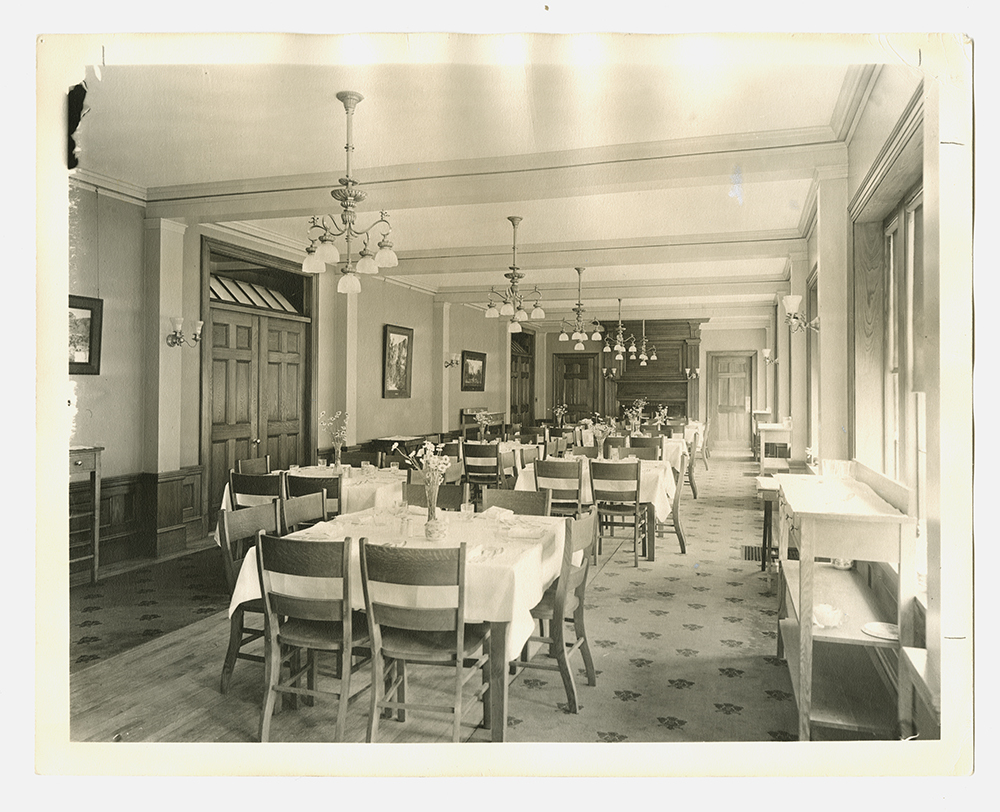
In the first half of the 20th century, meals at Exeter were served in individual dormitory dining rooms. To feed hungry students, food was ferried from basement kitchens beneath one dorm and delivered to others through a network of underground tunnels, then hoisted to servers via dumbwaiters.
Once Elm and Wetherell community dining halls were built, Exeter dined en masse, and the subterranean passageways were no longer needed. Some tunnels are boarded up; others are used for storage. But that hasn’t stopped curious students from seeking them out from time to time.
A 1977 story in The Exonian reported that “two enterprising students copied the keys to a tunnel [door] and they sold the keys at considerable profit to other students who intended to use them for illicit activities.”
This story was originally published in the winter 2026 issue of The Exeter Bulletin.

“This school has a huge endowment; why can’t we have nicer showers?” a teammate joked after swim practice last winter when we huddled up waiting for the water to turn warm. This is a common question among students on campus, including me.
The pursuit of this answer led me to apply for the Student Alumni Representatives (STARs) Council in the spring of lower year. As a member of STARs, I work closely with the Office of Institutional Advancement and serve as a student touchpoint for fundraising and alumni network events. I’ve helped mail thank-you cards to alumni donors; stood behind tables in the dining halls, encouraging students to contribute to The Exeter Fund; and led alumni on campus tours during their reunions.
During one of our bimonthly meetings in late September, I also had the privilege of learning the intricacies of the school’s finances from the Academy’s CFO, Marijka Beauchesne. While explaining the Academy’s annual revenue and expenses, she put into perspective that every small thing we use has a cost. From big-ticket items like building maintenance and faculty compensation to the chairs, the carpet and even the Otto’s pizza we had been served — everything must be factored into the Academy’s budget.
Importantly, she touched on the annual endowment draw — the amount the Academy is permitted to use each year. Of the approximately $1.65 billion total endowment, the annual draw is limited to $75 million, a spending rate of about 4.5%. She explained that when alumni contribute to the endowment, they often designate the money to specific departments such as science or athletics, and the funds must be contained within those sectors. This suddenly resolved the glaring question. Endowment funds are not open for use at all times and are rather intricately structured.
Having the chance to hear these numbers and breakdown directly from the CFO was a special opportunity. Much of this information was new to me, and I believe that this knowledge and transparency should be more widespread in our community. As students at the Academy, it’s empowering to be aware of how Exeter’s money is handled and know the ways it affects us. But more than just developing my financial literacy, STARs has opened me up to the endless possibilities of our Exeter network. I’ve been connected with young alumni currently pursuing careers in my fields of interest and have heard from older alumni about the way their Exeter journeys have impacted the rest of their lives. It’s given me a platform to learn and better appreciate the gift of an Exeter experience.
This story was originally published in the winter 2026 issue of The Exeter Bulletin.

Though religious historian Annette Yoshiko Reed ’91 studies forgetting, it seems likely that 2025 is one year she will long remember. In April, Reed was named a Fellow by the Guggenheim Foundation for her research into the theory of forgetting as a creative force in religious and cultural traditions. In June, she won her division’s TBA Classic Muay Thai World Championship, defeating women more than a decade her junior. In Reed’s view, one could not have been achieved without the other.
“Things that we do with our bodies remind us that knowledge is about making yourself better,” says Reed, the Krister Stendahl Professor of Divinity and Professor of New Testament and Early Christianity at Harvard Divinity School.
Reed is using her Guggenheim year to expand the Taubman Lectures she delivered in 2018 at the University of California, Berkeley, on what was lost with the disappearance of the Dead Sea Scrolls. The scrolls, a collection of some 900 manuscript fragments, have revealed stories of Jewish religion and culture, both known and unfamiliar, since their rediscovery in the 1940s.
Reed had planned to complete her research in 2020. But the pandemic hit, and she found herself balancing helping her young son master online learning with an unexpected opportunity to reflect on the significance of forgetting and its role in creating cultural change.
To Reed, forgetting is perhaps best exemplified by history’s suppression of an earlier pandemic, the 1919 Spanish flu. Until COVID, a majority of Americans had never learned about the earlier public health crisis because it had no real place in the story of 20th-century America. “The information isn’t gone, it’s just the telling of stories — especially the stories of progress — that displaces it,” Reed says, noting that forgetting too often equals loss of lessons learned, well into the future.
An adult convert to Judaism, Reed pinpoints the origin of her interest in Western religion to Russell Weatherspoon’s classes at the Academy. (To this day, she references texts she used at Exeter — youthful marginal notes and all — in her own teaching.)
Arriving on campus as a 14-year-old Japanese American, Reed says, she knew little about Western religion and literature. But as an avid reader she was drawn immediately to connections between them. “When you start reading religious literature,” she says, “you realize much of what’s so compelling in novels and poetry is entwined with biblical and Jewish traditions.”
If Reed’s pre-Guggenheim research focused largely on tracing the spread of ancient Jewish literature, she is using this year to explore why certain texts and scriptures were lost despite being part of a tradition that has emphasized the importance of remembering. The fragmentary nature of the Dead Sea Scrolls also provides a springboard for considering history in general and the broader responsibility of being a historian.
“What are we doing when we’re talking about the past?” Reed says. “We’re telling bits of stories from different perspectives.” Throughout time, she observes, more people’s narratives have been forgotten than have been remembered — particularly those of women.
After the Guggenheim Fellowship, Reed may make time for another story: a memoir about balancing her successes and challenges in the classroom with those at the gym. She hopes to explore what it means to be a teacher who’s perpetually learning and to use her own history to demonstrate that growth and transformation are goals worth remembering.
This article was first published in the fall 2025 issue of The Exeter Bulletin.
As a preteen in Thailand, Aruth “Art” Chinsupakul ’26 kept an uncomfortable secret: He had a severe case of eczema, a chronic inflammatory skin disease. Embarrassed about his skin’s appearance, he took cover under long sleeves even on the hottest days. After swim practice, he’d skip the locker room, afraid he’d face questions from his teammates.
“I missed out on a lot of bonding moments in middle school,” he says. “My friends thought I was being secretive by leaving right after practice, and it made me more distant from the team.”
For short-term relief from the persistent itch and burn, Chinsupakul relied on baby soap, but he knew there had to be a better solution. He turned to his grandmother for help.
“She and I are very close,” he says, “and she has a lot of knowledge about herbal medicine and her own herbal garden.” The seeds of what would become an internationally sold soap brand were sown in his grandmother’s garden.
“She’s the type of person that wouldn’t just give me answers,” he says. “She would make me try and fail.”
With just enough guidance from her, Chinsupakul worked out of his grandmother’s house in Bangkok, experimenting with ingredients sourced from local farmers for his bar soap.
“A lot of my batches would not even form,” he says. “And other batches would snap in half after use or would turn to slime after contact with water, which is pretty unpleasant.”
When he landed on the right combination of herb oils and aloe, Chinsupakul began making larger batches to give away. In doing so, he began to realize just how many people he could help.
“When I was younger, I was so narrow-minded and thought I’m the only one in the world with eczema,” he says. “After I started giving the soap to my friends and family and others with eczema, I got so many positive responses, I thought I should sell this.”
Five years ago, Chinsupakul founded his company Art & Alice, which he named after himself and his 11-year-old sister. He says she motivates him to keep the business going even when he’s far from home during the school year.
“I’ve learned to build systems and rely on teamwork,” he says, “with community partners in Thailand handling production while I stay connected with them through online platforms.”
As Chinsupakul began to scale up production, he took the next step to ensure his process was sustainable. “My first goal was to find a cure for my symptoms, but I strive to challenge myself,” he says. “Sustainability wasn’t my primary goal, but I incorporated it as a way to push my limits.”
To that end, he looked to hire people to grow his soap’s ingredients. “I had a good opportunity through my mom’s work in education and was able to partner with a school for the visually impaired,” he says. “The students help grow the aloe vera plants. It was a turning point for me. I realized that I could not only help others by creating my soap, but I could also help others, like the visually impaired students, to feel independent by making their own income.”
Chinsupakul credits his parents and Harkness for helping nurture his entrepreneurial spirit. “Both my parents are entrepreneurs, so it runs in the family,” he says. “And at Exeter, you’re always thinking of creative solutions. In a Harkness discussion you have to come prepared for each class and be interactive. That’s helped a lot with my time management and communication skills.”
This article was first published in the fall 2025 issue of The Exeter Bulletin.
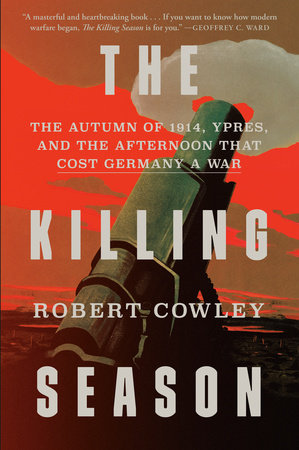
Robert Cowley ’52 spent years taking an in-depth look at the formation of the Western Front during World War I. The resulting book, The Killing Season: The Autumn of 1914, Ypres, and the Afternoon That Cost Germany a War, homes in on just a four-month span that was more deadly than any other period in that conflict.
Cowley, the founding editor of MHQ: The Quarterly Journal of Military History, says the book began nearly 40 years ago as an ambitious plan
to chronicle his journey of the entire 470-mile Western Front. He eventually narrowed his scope to just 50-odd miles and undertook extensive fieldwork, visiting key battle sites: meadows near the Yser River in Belgium; a French wheat field where a German patrol had withdrawn; and other battlefields where trenches, grenades, barbed wire and bones could still be found.
“I am a believer in seeing the places where history was made,” Cowley says. “Scenes of old violence still have stories to tell.”
In the 633-page book, he challenges long-accepted interpretations of the early war, theorizing that Ypres — not the Marne — was the true turning point. Cowley, a first-time author at age 90, notes that his grandson marveled at the weight of the final bound book and adds, “I hope the words carry the same heft.”
This article was first published in the fall 2025 issue of The Exeter Bulletin.