Nominate an Exonian
Help us celebrate those Exonians who have demonstrated exceptional service by nominating fellow alumni for the Founders' Day Award or the John and Elizabeth Phillips Award.

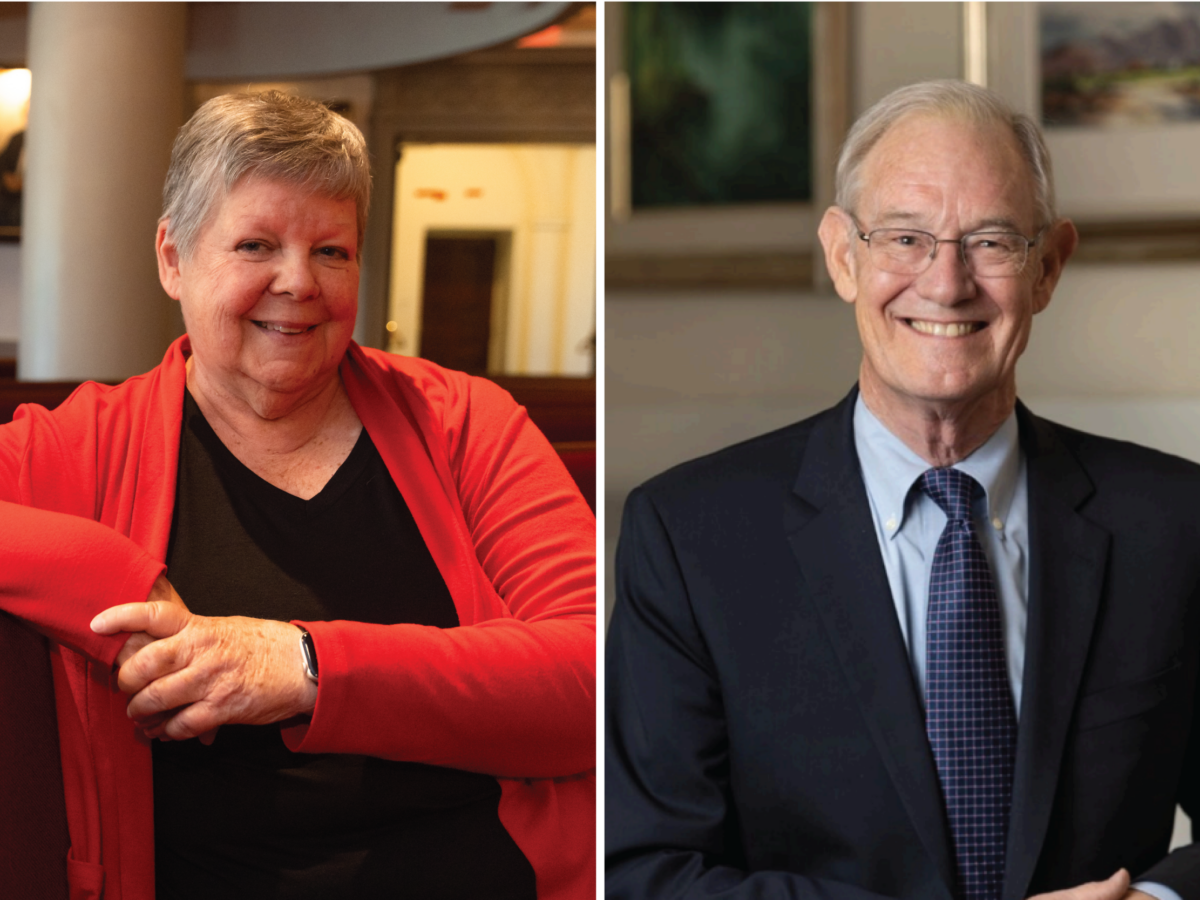
Alumni Association President, Trustee and Awards Committee Chair Sam Brown ’92 has announced the selection of Jan Woodford ’40, ’41, 44, ’49, ’51, 52, ’53, ’59, ’60, ’62, ’70, ’71, ’78 (Hon.) to receive the 2026 Founders’ Day Award, and Samuel P. “Terry” Goddard III ’65 to receive this year’s John and Elizabeth Phillips Award.
Established by the Trustees in 1976, the Founders’ Day Award is given annually in recognition of longtime service to the Academy.
Jan Woodford retired in 2025 as senior adviser of campus events in Exeter’s Alumni Relations office, having served the Academy and its alumni for nearly four decades. She began her career in the fundraising office but later moved to Alumni Relations, where she eventually managed reunion events for 14 reunion classes. During her tenure, she received honorary membership in 13 classes — more than any other community member — and attended or managed more than 750 events (including reunions, memorials, building dedications, graduations and many more).
A veteran of the U.S. Air Force, Woodford also spearheaded Exeter Salutes, an annual programming initiative launched in 2019 that honors members of the Exeter alumni community who currently serve in the armed forces or are veterans and connects them with current students.
Woodford will receive the award and speak during assembly on May 15.
The John and Elizabeth Phillips Award is given annually to an Exonian who has contributed significantly to the welfare of community, country or humanity.
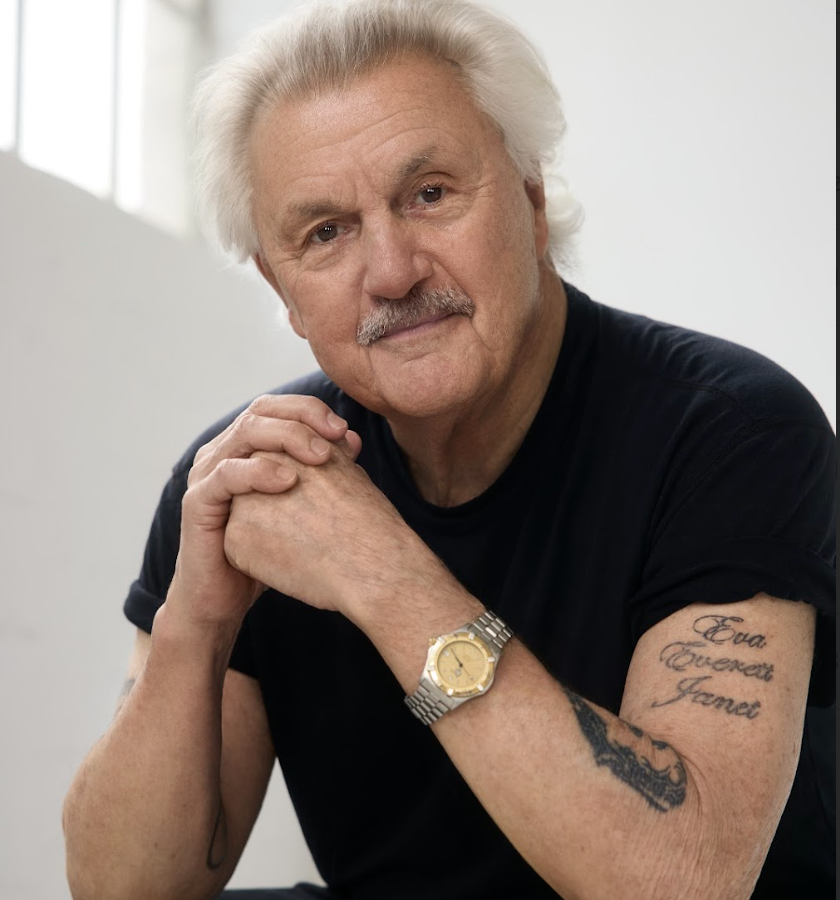
This year’s recipient, Terry Goddard ’65, has dedicated his life to public service, working to increase transparency in government, enhance consumer protections and encourage citizens’ participation in the political process.
After beginning his legal career prosecuting fraud in the Arizona’s attorney general’s office, Goddard served four terms as mayor of Phoenix, Arizona and went on to become Arizona state director for the U.S. Department of Housing and Urban Development. In 2002, Goddard won election to the first of two terms as Arizona’s attorney general. In that role, he focused on promoting consumer and civil rights, fighting drug cartels and pursuing cases against predatory mortgage lenders.
Following the Supreme Court decision in Citizens United v. FEC (2010), which opened the doors to unlimited election spending by wealthy individuals and groups, Goddard waged a determined fight to remove “dark money” from the state’s political system. In 2022, 72% of Arizona’s voters overwhelmingly passed Prop. 211, an initiative establishing the nation’s most comprehensive election spending transparency law, after Goddard succeeded in his fourth attempt to get it on the ballot.
Outside of the political realm, Goddard has taught graduate level courses on urban affairs and other topics at Arizona State University and served as president of the Central Arizona Water Conservation District, which administers the canal system bringing water from the Colorado River to central Arizona. He has also championed historical preservation efforts, working for some 40 years to revitalize and return to public use the historic Phoenix First Baptist Church, renamed the Monroe Abbey.
Goddard will receive the John and Elizabeth Phillips Award and speak during assembly on Oct. 30.
Help us celebrate those Exonians who have demonstrated exceptional service by nominating fellow alumni for the Founders' Day Award or the John and Elizabeth Phillips Award.

On April 19, 2022, eight weeks after Russia initiated a full-scale invasion of Ukraine, Bill Endicott ’64 sent an email to his friend, the owner of a prosthetics company, with a simple but vital request: Would you be willing to help Ukrainian soldiers? Forty-five minutes later, he had the green light to start an initiative that would provide prosthetics, rehabilitation and support to Ukrainian soldier amputees. He named it Operation Renew Prosthetics (ORP).
At that early stage of the war, Endicott could not have foreseen how desperately Ukrainians would need the help. Reports estimate that there are 115,000 Ukrainian amputees because of the war. With limited access to advanced prosthetics and inpatient rehabilitation, many wounded soldiers endured recovery alone.
Endicott reached out to the Future for Ukraine Foundation, a Ukrainian-run charitable group based in Poland, and expressed ORP’s desire to treat amputees at Medical Center Orthotics & Prosthetics in Maryland. That company, owned by his friend Michael Corcoran, had expertise in caring for blast injuries. Future for Ukraine became ORP’s partner and primary connection to soldiers, who are affectionately called defenders by their compatriots.
The first Ukrainian soldier, Oleksandr “Sasha” Chaika, arrived in the U.S. for treatment in the fall of 2022. In April, a month after he joined the fight, a Russian tank shell exploded near the trench he was in in Popasna. Chaika was hit by shrapnel and lost a leg; doctors gave him a 20% chance of survival. Future for Ukraine covered all his travel expenses and ORP provided a free prosthesis and six weeks of rehabilitation.
Before the war, he was a dancer and choreographer. Today, Chaika is married with a young son and has realized his dream of opening a dance school in Ukraine. “Sasha recovered about as well as you can with a major amputation,” Endicott says. “He told me that one reason he was so motivated to recover was to prove the doctors were right to take a chance on saving him.”
Five more soldiers arrived in the U.S. after Chaika. But with the cost of a single prosthesis ranging from $8,000 to $50,000 or more, the operation was unsustainable. Instead, the organizers decided to establish a clinic in Kyiv, Ukraine’s capital, and train Ukrainians to run it independently.
Endicott has always been driven by a strong moral obligation to help others. He was born in Boston in 1945, in the shadow of World War II, into a family that traces its origins in America to 1628, when John

Endecott (the family changed the spelling to Endicott in the 18th century) landed in Salem and became the first governor of Massachusetts. “My family’s been involved in public service for 400 years,” he says, “so I’ve always felt that a good life is one in which you do some things for yourself, but you do some other things for other people. It’s a balance.”
Growing up in the Cold War era, Russia was a constant presence in Endicott’s life. In elementary school, he dived under his desk during air raid drills. As a student at Exeter in the early 1960s, he studied Russian history. He internalized the turmoil churning across America during the Vietnam War, watching his friends die while he was temporarily deemed ineligible to serve. In 1967, the principal at the time, Ernie Gillespie, gave a speech to the graduating class that became a rallying cry for Endicott, even to this day.
“The part I’ve always remembered goes like this,” Endicott says. “‘I hope, and I expect, that when you find yourselves involved in skirmishes on the frontiers of barbarism … you’ll strike some shrewd blows in favor of civilization. Someday you’ll come back to show us your trophies and your scars, and we’ll be glad to see you.’”
Determined to lead the non sibi life, Endicott embarked on a remarkable career of public service. He studied Russian language at Harvard College and received an M.P.A. from the Harvard Kennedy School. He worked for three U.S. congressmen and the Democratic National Committee, then served as director of research and analysis in the White House Office of Political Affairs during the Clinton administration. He enlisted in the Marine Corps Reserve, rising to the rank of captain, and worked at the Pentagon.
Endicott devoted the little free time he had to his passion: whitewater canoeing and kayaking. Following a collegiate rowing career at Harvard, he became a leading figure in the world of whitewater slalom, as an athlete, author and U.S. Olympic team coach. This is how Endicott and Corcoran first joined forces. In 1988, Corcoran traveled from Dublin to the U.S. to train with Endicott in the hopes of making the Irish Olympic team. Corcoran later relocated to America and co-founded MCOP in 2002. He and Endicott remained close.
In 2022, unified in their belief that Ukraine needed and deserved their help, they founded ORP. Three and a half years later, ORP has successfully cared for 112 soldiers and laid the groundwork for Ukraine to become a world leader in amputee care. They even shared their love of whitewater sports with the Ukrainian soldiers, hoping to establish a kayaking rehabilitation program in Kyiv like the one that exists for soldier amputees in the U.S.
On November 6, 2025, following a sleepless night of air raid alerts, Endicott was in Kyiv for the grand opening of a new clinic, Medical Center Orthotics & Prosthetics Ukraine. It is staffed entirely by Ukrainians, with 19 full-time and six part-time employees, and plans to hire more. They have been trained to operate independently to continue providing prosthetics to their country’s soldiers. Endicott hopes the clinic may someday help civilians as well.
The work of Operation Renew Prosthetics is now complete, but Endicott stands ready to help wherever he can, including possibly raising funds to assist former U.S. soldiers who lost limbs fighting for Ukraine.
“The Ukrainian people are astonishingly resolute and united in the face of all this adversity,” Endicott says. “When I start to worry about my own problems, I think about what Ukraine is facing, and particularly what these soldier amputees are facing. My problems are nothing compared to theirs.”
Endicott, an 80-year-old retiree, says he will always feel compelled to do what he can when duty calls.
“I’d like to think that Ernie would feel that these were ‘shrewd blows,’” he says. “And he was right: There have been some trophies and some scars!”
This article was originally published in the winter 2026 issue of The Exeter Bulletin.
For fans of author John Irving ’61, his most recent novel provides a host of familiar comforts: tattoo parlors, Viennese romps, unconventional family dynamics and, of course, a thinly veiled version of Phillips Exeter Academy. But that novel, Queen Esther, also ventures into uncharted territory, especially when tracing the enigmatic exploits of its titular character, a Jewish orphan named Esther Nacht. Irving — a standout wrestler at Exeter and a lifelong devotee of the sport — discussed his new book with current varsity wrestling coach Justin Muchnick. Here’s some of their conversation.
Let’s start with your main character, Esther. How does she drive this novel?
Esther is born in Vienna in 1905. By the time she’s a 3-year-old, her life has already been shaped by antisemitism. She returns to her birth city in the 1930s, when many Viennese Jews are leaving (or have already left). I wanted my Esther to be the embodiment of the Esther in the Hebrew Bible and the Christian Old Testament. She is the epitome of hiddenness — a secretive, behind-the-scenes operator. But when she reveals herself, watch out! Esther is making up for the Jewish childhood she was denied; she’s going to be the best Jew she can be. I wanted her to be part of the founding of the State of Israel. Her birth child, Jimmy, is my POV character, but Esther is the novel’s main character; she’s the one who makes everything happen. The objective of this ending-driven novel — which concludes in Jerusalem in 1981 — was to create, in Esther, an empathetic Zionist.
On that ending: Why Jerusalem, and why 1981?April 1981 is when — in my life — I was invited to Israel by the Jerusalem International Book Fair and my Israeli publisher. I accepted the invitation at the urging of my favorite European publishers. They were Jewish with longstanding ties to Israel. They were leftist, nonobservant Jews who’d criticized the right-wing Likud government of Menachem Begin for accelerating the settlements in the West Bank. They said the Israeli presence there, and in the Gaza Strip, might make Palestinian self-determination harder to achieve — they believed then that a two-state solution to the Israeli-Palestinian conflict could slip away. Queen Esther is a historical novel, and a historical novel foreshadows the future. In April 1981, the seeds were sown for an eternal conflict.
It’s a conflict that’s taken on a renewed relevance in recent years — perhaps more than you were expecting during the writing process.
The novel has certainly predicted that these troubles were likely to be ongoing. Of course, I wish for a peaceful resolution. I’m hoping for a lasting peace, for the Israelis and the Palestinians.
When researching this book, did you visit Israel? Have you been back since 1981?
It was important to me that I not go back to check my facts — not until I had a finished draft. The dialogue mirrors what I remember being said to me, or what I overheard. But in a historical novel, the dialogue must also be what was commonly said in that time and place. My early readers — several Israeli contacts and friends — assured me it is.
Once the novel was drafted, in July 2024, I visited Jerusalem, to talk to these early readers and to refresh my memory of the visual details — to go where I’d gone 43 years ago. When I was there in 2024, the war in Gaza was ongoing. In the Muslim Quarter, there were no tourists on the Via Dolorosa — the Way of Sorrows, where Christ carried the cross to be crucified. No tourists in the Christian Quarter — not even at Christ’s tomb, in the Church of the Holy Sepulchre. I was alone in the evenings, reading over my day’s notes, mapping out where I would go the next day. Most evenings, my Israeli friends were at anti-Netanyahu protests.
Backtracking from your novel’s ending to its beginning: You included a cameo from Dr. Wilbur Larch, the saintly abortionist-cum-orphanage director from The Cider House Rules.
The beginnings of my novels are often the most autobiographical. I’m conscious of grounding my novels in recognizable locations, and with some familiar character types, but this is the first time that I have re-created or revisited an old character. The reasons for doing so had everything to do with my trajectory for Esther. I needed an orphanage for an abandoned Jewish child. I knew of an orphanage where she would be treated well.
Dr. Larch is much younger than readers or moviegoers who know The Cider House Rules will remember, and there’s an entirely different cast of characters among the unadopted orphans, but I knew Dr. Larch would find out all he could about Esther, and that he’d find the best possible family for her, although they wouldn’t be a Jewish family.
I love Dr. Larch but, for obvious reasons, I’ve got a soft spot for the novel’s wrestling scenes. You’ve set these in Vienna, in a grimy but cosmopolitan gym called the Turnhalle Leopold.
I tried to be truthful to the wrestling gyms I visited when I was in Vienna in 1963–64. At that time, there were more Greco-Roman wrestlers than freestyle wrestlers — freestyle being closer to folkstyle in the U.S. Because Queen Esther is a political novel, I chose to focus on two Soviet and two Israeli wrestlers as characters. Some of the Soviets in Vienna in ’63-’64 were KGB operatives, and some of the Israelis were Mossad operatives — or “working for Wiesenthal” as Nazi hunters. In the novel, I wanted the Soviets and the Israelis to be the only wrestlers that my character Jimmy was close to.
You’ve seen a lot in the sport, both as an athlete and as a coach. So, from one coach to another, what’s your go-to piece of coaching advice?
I was lucky to be associated with excellent wrestling coaches, all in first-rate programs. This began with Coach Seabrooke at Exeter (a Big Ten champion at Illinois, and a two-time NCAA finalist), and it continued when I was at Pittsburgh and Iowa. Great clubs, great coaches. Many of my teammates and workout partners were champions — and so were my sons, both of whom I coached. My son Colin won a New England Championship for Northfield Mount Hermon; my son Brendan won the same title for Vermont Academy. But I, as a wrestler, never got past the semifinals at any tournament — in my Exeter years, in my university years or postcollege.
My foremost advice to a coach, at any level, is you have to know who the superior athletes are, and you have to recognize the hard workers who aren’t as gifted athletically. You coach to the individual. A good athlete will end up on top in a scramble; you coach that guy differently than you would a wrestler who’s not as talented. Some guys thrive in scrambles; other guys get killed in them. Know the difference!
—Justin Muchnick is the varsity wrestling coach at the Academy and a Ph.D. candidate in classics at the Institute of Classical Studies.
This article was originally published in the winter 2026 issue of The Exeter Bulletin.
In my upper year, a group of determined Dunbar residents set out to access the tunnels and visit other dorms. (I hope our advisers aren’t reading this!) Armed with tools, we eventually found a way through our basement into the tunnel system — I remember a big room full of old furnishings in the dim light of our flashlights — and a way into Bancroft. With a little planning, we could sneak over after check-in. Although we feared being caught, the thrill was part of the fun. Eventually, the broken lock was discovered, and we did our best to look innocent.
Jess Isaacs ’02
__________
I was a scholarship boy at Exeter from 1955 till graduation in 1959. One of my duties was washing dishes in the dining halls, especially Dunbar. I ate in Webster, so I used to use the tunnel from Webster to Dunbar. (I believe the tunnel started in Bancroft.) Along the way, underground, was a bakery, and I became friends with the baker, named Armand LePage. After graduation I kept him on my Christmas card list and we kept in touch for many years.
Warren Harkness ’59; P’85
__________
I’m pretty sure I still have stuff in storage in the tunnel under Lamont.
Leah Kotok ’97
__________
Been there as a fac brat. They were our playground.
Scott Estey ’83
__________
I once had the opportunity to visit them with someone who had *ahem * access. But it was too creepy for me (long tunnels with minimal lighting, it just felt like a horror movie setup) and I backed out.
Julie Z. Stickler ’84
__________
Your mention of the tunnels and dining halls reminded me of a cherished memory. In 1968, several of us were waiters (and dishwashers) at the Dunbar Hall dining hall. We frequently brought out large trays of breakfast food to the faculty, typically with multiple plates full of food. One morning, I watched as the boy in front of me caught his foot on the sill and lurched off balance, losing hold of his tray. His sharp, panicked cry attracted every eye in the room. As all the faculty and students stared in horror, the dishes flew upward and forward. … Suddenly, in one impossible movement, the student waiter lunged forward and caught every single item again on this tray before any of the dozens of items hit the ground. There followed five seconds of absolute, stunned silence. Then, in unison every single person in the room stood up as one and the room erupted into applause. The thunderous ovation lasted for almost a minute before anyone sat down to breakfast.
Michael Fossel ’69
__________
Responses originally shared via email or on social media
__________
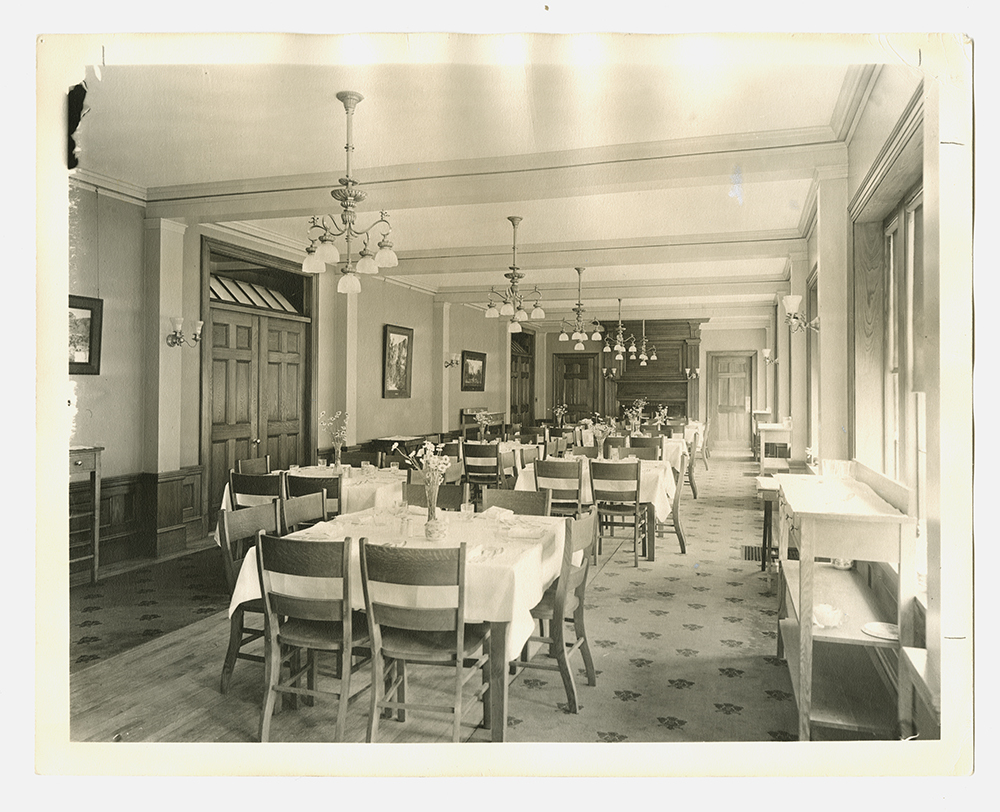
In the first half of the 20th century, meals at Exeter were served in individual dormitory dining rooms. To feed hungry students, food was ferried from basement kitchens beneath one dorm and delivered to others through a network of underground tunnels, then hoisted to servers via dumbwaiters.
Once Elm and Wetherell community dining halls were built, Exeter dined en masse, and the subterranean passageways were no longer needed. Some tunnels are boarded up; others are used for storage. But that hasn’t stopped curious students from seeking them out from time to time.
A 1977 story in The Exonian reported that “two enterprising students copied the keys to a tunnel [door] and they sold the keys at considerable profit to other students who intended to use them for illicit activities.”
This story was originally published in the winter 2026 issue of The Exeter Bulletin.
This school has a huge endowment; why can’t we have nicer showers?” a teammate joked after swim practice last winter when we huddled up waiting for the water to turn warm. This is a common question among students on campus, including me.
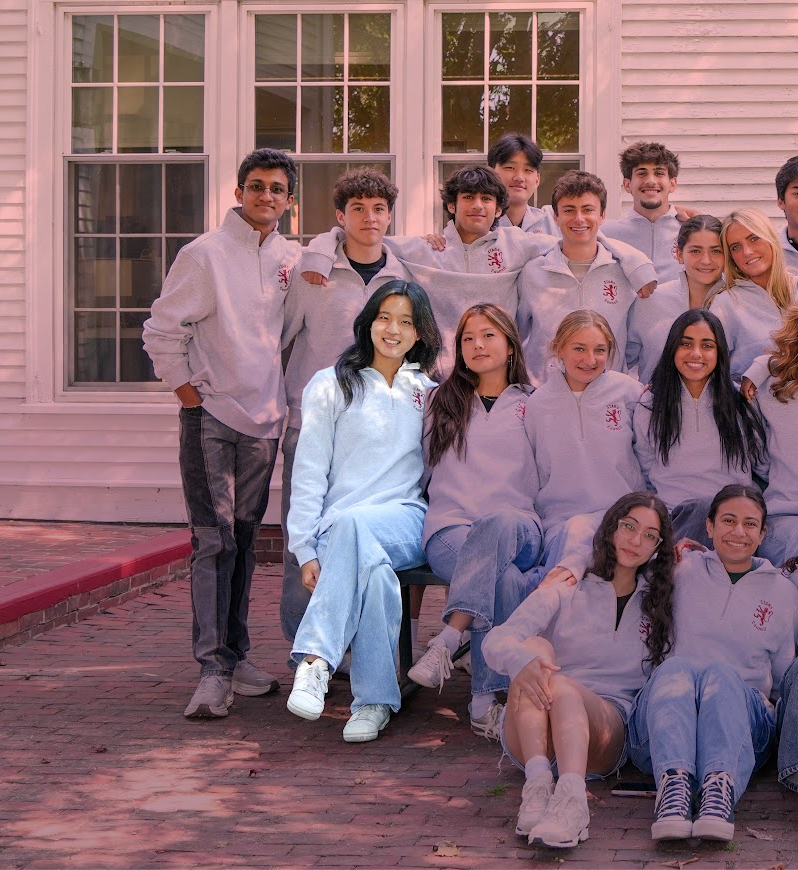
The pursuit of this answer led me to apply for the Student Alumni Representatives (STARs) Council in the spring of lower year. As a member of STARs, I work closely with the Office of Institutional Advancement and serve as a student touchpoint for fundraising and alumni network events. I’ve helped mail thank-you cards to alumni donors; stood behind tables in the dining halls, encouraging students to contribute to The Exeter Fund; and led alumni on campus tours during their reunions.
During one of our bimonthly meetings in late September, I also had the privilege of learning the intricacies of the school’s finances from the Academy’s CFO, Marijka Beauchesne. While explaining the Academy’s annual revenue and expenses, she put into perspective that every small thing we use has a cost. From big-ticket items like building maintenance and faculty compensation to the chairs, the carpet and even the Otto’s pizza we had been served — everything must be factored into the Academy’s budget.
Importantly, she touched on the annual endowment draw — the amount the Academy is permitted to use each year. Of the approximately $1.65 billion total endowment, the annual draw is limited to $75 million, a spending rate of about 4.5%. She explained that when alumni contribute to the endowment, they often designate the money to specific departments such as science or athletics, and the funds must be contained within those sectors. This suddenly resolved the glaring question. Endowment funds are not open for use at all times and are rather intricately structured.
Having the chance to hear these numbers and breakdown directly from the CFO was a special opportunity. Much of this information was new to me, and I believe that this knowledge and transparency should be more widespread in our community. As students at the Academy, it’s empowering to be aware of how Exeter’s money is handled and know the ways it affects us. But more than just developing my financial literacy, STARs has opened me up to the endless possibilities of our Exeter network. I’ve been connected with young alumni currently pursuing careers in my fields of interest and have heard from older alumni about the way their Exeter journeys have impacted the rest of their lives. It’s given me a platform to learn and better appreciate the gift of an Exeter experience.
This story was originally published in the winter 2026 issue of The Exeter Bulletin.
Though religious historian Annette Yoshiko Reed ’91 studies forgetting, it seems likely that 2025 is one year she will long remember. In April, Reed was named a Fellow by the Guggenheim Foundation for her research into the theory of forgetting as a creative force in religious and cultural traditions. In June, she won her division’s TBA Classic Muay Thai World Championship, defeating women more than a decade her junior. In Reed’s view, one could not have been achieved without the other.
“Things that we do with our bodies remind us that knowledge is about making yourself better,” says Reed, the Krister Stendahl Professor of Divinity and Professor of New Testament and Early Christianity at Harvard Divinity School.
Reed is using her Guggenheim year to expand the Taubman Lectures she delivered in 2018 at the University of California, Berkeley, on what was lost with the disappearance of the Dead Sea Scrolls. The scrolls, a collection of some 900 manuscript fragments, have revealed stories of Jewish religion and culture, both known and unfamiliar, since their rediscovery in the 1940s.
Reed had planned to complete her research in 2020. But the pandemic hit, and she found herself balancing helping her young son master online learning with an unexpected opportunity to reflect on the significance of forgetting and its role in creating cultural change.
To Reed, forgetting is perhaps best exemplified by history’s suppression of an earlier pandemic, the 1919 Spanish flu. Until COVID, a majority of Americans had never learned about the earlier public health crisis because it had no real place in the story of 20th-century America. “The information isn’t gone, it’s just the telling of stories — especially the stories of progress — that displaces it,” Reed says, noting that forgetting too often equals loss of lessons learned, well into the future.
An adult convert to Judaism, Reed pinpoints the origin of her interest in Western religion to Russell Weatherspoon’s classes at the Academy. (To this day, she references texts she used at Exeter — youthful marginal notes and all — in her own teaching.)
Arriving on campus as a 14-year-old Japanese American, Reed says, she knew little about Western religion and literature. But as an avid reader she was drawn immediately to connections between them. “When you start reading religious literature,” she says, “you realize much of what’s so compelling in novels and poetry is entwined with biblical and Jewish traditions.”
If Reed’s pre-Guggenheim research focused largely on tracing the spread of ancient Jewish literature, she is using this year to explore why certain texts and scriptures were lost despite being part of a tradition that has emphasized the importance of remembering. The fragmentary nature of the Dead Sea Scrolls also provides a springboard for considering history in general and the broader responsibility of being a historian.
“What are we doing when we’re talking about the past?” Reed says. “We’re telling bits of stories from different perspectives.” Throughout time, she observes, more people’s narratives have been forgotten than have been remembered — particularly those of women.
After the Guggenheim Fellowship, Reed may make time for another story: a memoir about balancing her successes and challenges in the classroom with those at the gym. She hopes to explore what it means to be a teacher who’s perpetually learning and to use her own history to demonstrate that growth and transformation are goals worth remembering.
This article was first published in the fall 2025 issue of The Exeter Bulletin.
As a preteen in Thailand, Aruth “Art” Chinsupakul ’26 kept an uncomfortable secret: He had a severe case of eczema, a chronic inflammatory skin disease. Embarrassed about his skin’s appearance, he took cover under long sleeves even on the hottest days. After swim practice, he’d skip the locker room, afraid he’d face questions from his teammates.
“I missed out on a lot of bonding moments in middle school,” he says. “My friends thought I was being secretive by leaving right after practice, and it made me more distant from the team.”
For short-term relief from the persistent itch and burn, Chinsupakul relied on baby soap, but he knew there had to be a better solution. He turned to his grandmother for help.
“She and I are very close,” he says, “and she has a lot of knowledge about herbal medicine and her own herbal garden.” The seeds of what would become an internationally sold soap brand were sown in his grandmother’s garden.
“She’s the type of person that wouldn’t just give me answers,” he says. “She would make me try and fail.”
With just enough guidance from her, Chinsupakul worked out of his grandmother’s house in Bangkok, experimenting with ingredients sourced from local farmers for his bar soap.
“A lot of my batches would not even form,” he says. “And other batches would snap in half after use or would turn to slime after contact with water, which is pretty unpleasant.”
When he landed on the right combination of herb oils and aloe, Chinsupakul began making larger batches to give away. In doing so, he began to realize just how many people he could help.
“When I was younger, I was so narrow-minded and thought I’m the only one in the world with eczema,” he says. “After I started giving the soap to my friends and family and others with eczema, I got so many positive responses, I thought I should sell this.”
Five years ago, Chinsupakul founded his company Art & Alice, which he named after himself and his 11-year-old sister. He says she motivates him to keep the business going even when he’s far from home during the school year.
“I’ve learned to build systems and rely on teamwork,” he says, “with community partners in Thailand handling production while I stay connected with them through online platforms.”
As Chinsupakul began to scale up production, he took the next step to ensure his process was sustainable. “My first goal was to find a cure for my symptoms, but I strive to challenge myself,” he says. “Sustainability wasn’t my primary goal, but I incorporated it as a way to push my limits.”
To that end, he looked to hire people to grow his soap’s ingredients. “I had a good opportunity through my mom’s work in education and was able to partner with a school for the visually impaired,” he says. “The students help grow the aloe vera plants. It was a turning point for me. I realized that I could not only help others by creating my soap, but I could also help others, like the visually impaired students, to feel independent by making their own income.”
Chinsupakul credits his parents and Harkness for helping nurture his entrepreneurial spirit. “Both my parents are entrepreneurs, so it runs in the family,” he says. “And at Exeter, you’re always thinking of creative solutions. In a Harkness discussion you have to come prepared for each class and be interactive. That’s helped a lot with my time management and communication skills.”
This article was first published in the fall 2025 issue of The Exeter Bulletin.
Robert Cowley ’52 spent years taking an in-depth look at the formation of the Western Front during World War I. The resulting book, The Killing Season: The Autumn of 1914, Ypres, and the Afternoon That Cost Germany a War, homes in on just a four-month span that was more deadly than any other period in that conflict.
Cowley, the founding editor of MHQ: The Quarterly Journal of Military History, says the book began nearly 40 years ago as an ambitious plan
to chronicle his journey of the entire 470-mile Western Front. He eventually narrowed his scope to just 50-odd miles and undertook extensive fieldwork, visiting key battle sites: meadows near the Yser River in Belgium; a French wheat field where a German patrol had withdrawn; and other battlefields where trenches, grenades, barbed wire and bones could still be found.
“I am a believer in seeing the places where history was made,” Cowley says. “Scenes of old violence still have stories to tell.”
In the 633-page book, he challenges long-accepted interpretations of the early war, theorizing that Ypres — not the Marne — was the true turning point. Cowley, a first-time author at age 90, notes that his grandson marveled at the weight of the final bound book and adds, “I hope the words carry the same heft.”
This article was first published in the fall 2025 issue of The Exeter Bulletin.
Frisbees were flying as students and faculty celebrated this year’s Academy Life Day. Started in 1995 as part of a wider initiative to improve residential life at Exeter, the day set aside for dormwide activities has become a beloved fall-term tradition.
The exact activity each dorm does — dodgeball, apple picking and beach-combing are some of the choices — is never the point. What’s important is that the students do it together. “Making connections is at the heart of Exeter’s residential program,” Dean of Residential Life Matt Hartnett says. “Academy Life Day provides an extended opportunity for students to build bonds with each other in a fun, device-free, nonclassroom environment.”
Holding the event early in the school year, when students may be especially open to meeting new people, is aimed at maximizing students’ potential for making connections.
Hartnett adds, “It’s also just plain fun for everyone to get outside on a beautiful day after the first week of classes.”
Smiles abound on Academy Life Day as students and faculty enjoy the campus quads or visit local apple orchards, trails and beaches.
This article was first published in the fall 2025 issue of The Exeter Bulletin.
Exeter students, administrators, faculty and Trustees gathered in Love Gym to celebrate the longtime educator and activist James R. W. “Wick” Sloane ’71; P’03, this year’s recipient of the John and Elizabeth Phillips Award. One of the Academy’s highest alumni honors, the Phillips Award is given annually to an Exonian who has contributed significantly to the welfare of community, country or humanity.
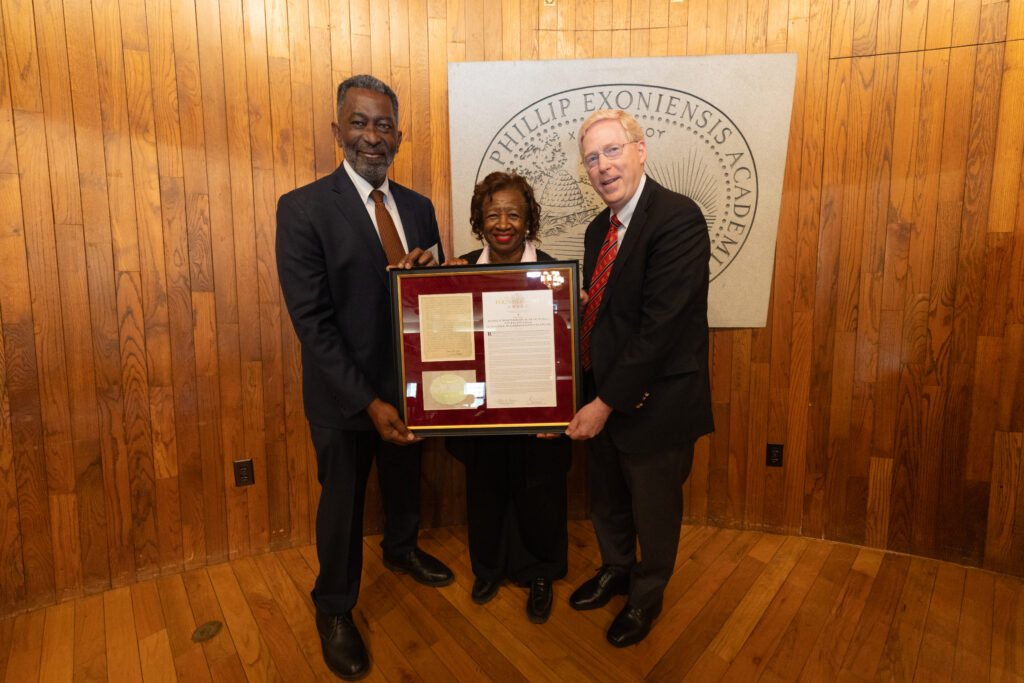
“Through your writing and your grassroots activism, you have helped address the challenges facing millions of veterans and low-income college students across the nation,” Sam Brown ’92, trustee and president of the Exeter Alumni Association, read from the award citation.
After a diverse career that included reporting gigs for newspapers and more than a decade of executive roles in the insurance industry, Sloane began working at Bunker Hill Community College in 2006. He started with a nighttime shift in the school’s tutoring center, and later became an adjunct faculty member, teaching late-night classes in the college’s nationally recognized Midnight Classes program. Eventually, Sloane worked as senior special programs coordinator in charge of helping students transfer to four-year colleges.
In all these roles, Sloane went out of his way to support his students, many of whom were juggling school with jobs, family responsibilities and other challenges. “When you discovered that a student hadn’t eaten that day, you bought bread and peanut butter and made them a sandwich,” Brown read from the award citation. “You expanded on those efforts by soliciting donations from local businesses and helping to open a mobile food market on campus.”
Sloane also became a regular contributor to the publication Inside Higher Ed, and wrote extensively about issues facing low-income students like the ones at Bunker Hill, including hunger and homelessness. In 2013, his open letter to then-President Barack Obama asked why the same students eligible for federal free and reduced lunch through high school lost those benefits once they began attending college. Sloane’s work spurred lawmakers to persuade the U.S. Government Accountability Office to conduct the first-ever study of food insecurity at U.S. colleges and universities in 2019, and led to new or proposed legislation addressing the issue at the local, state and federal levels.
Sloane began his remarks by referencing the words of W. Ernest Gillespie, who served as the Academy’s interim principal from 1963–64: “Return often, and show us your trophies and your scars.”
“Those words are my Exeter as much as non sibi,” Sloane continued. “[They] create for each of us the 50/50 expectation that all of us will return here with as many scars as trophies, and scars are often where the trophies come from.”
He shared the story of one of his most prominent “scars” — learning he had been “fired on false charges” from his position as chief financial officer at the University of Hawaii in 2003. By that time, Sloane had already developed a love and respect for community colleges and their students, having interacted with them through the University of Hawaii system. “These are thousands of men and women, not that different from any of us, except they never had a break,” Sloane said. “They never had a break equal even to one day at Exeter.”
At a hearing on higher education in Boston, Sloane met the president of Bunker Hill Community College, one of the largest and most diverse community colleges in Massachusetts. At his persistent urging, she agreed to give him a night shift in the college’s tutoring center.
“I kept showing up, until the chairman of the English department found me and offered me a section of College Writing 1 in D118, a windowless basement classroom at 8:30 on Mondays and Wednesdays,” Sloane recalled. “That first class changed me.”
Sloane spoke about his students, many of whom faced challenges far beyond those of a typical undergraduate. He and his colleague, Kathleen O’Neill, were managing the school’s emergency assistance fund when they learned many students were going hungry most days, as they couldn’t afford food.
“We weren’t trained as social workers, but that’s what we became because students were hungry,” he said. “We started with peanut butter, jelly, and bread from the supermarket across the street, three blocks from where Paul Revere landed to begin his midnight ride.”
Thanks to donations from local businesses and the Greater Boston Food Bank, Sloane and O’Neill began distributing food on campus, to the tune of more than 700,000 pounds of food since 2012, Sloane said. When they failed to get attention from the state government, they went to federal legislators like Massachusetts Sen. Elizabeth Warren, leading to nationwide program and legislative changes aimed at combating food insecurity.
“[Hunger] has been the injustice I’ve sought to solve,” Sloane told the current Exeter students seated in the gymnasium. “You’ll find your own. You will come across an issue that you simply can’t turn away from — so don’t. Instead, get to work.”
Sloane and Brown were joined onstage by Principal Bill Rawson ’71; ’65, ’70 (Hon.); P’08, a classmate of Sloane’s at Exeter. In addition to speaking in assembly, Sloane joined students in class discussions, visiting a session of the integrated studies course Social Innovation and the religion, ethics and philosophy course Ethics of the Marketplace. He also attended a luncheon with students held at the Class of 1945 Library.