Phillips Exeter Academy

For the sustainable future

Exeter’s founding document predates the advent of the principles of sustainability by about 200 years, but today the ideals of each seem inextricable.

Just as the philosophy of non sibi calls on Exonians to use the wisdom gained at the Academy for others as well as for oneself, the concept of sustainability recognizes that our actions have consequences beyond ourselves. Exonians are motivated by non sibi to face the challenges of their day, and there are perhaps no greater challenges facing society today than the matter of sustainability and the crisis of climate change.

It is amid these challenges that Exeter publishes its first comprehensive sustainability and climate action plan, “a road map for a community-wide commitment to action.” Titled Building From Strength Toward a Zero Carbon Future, the document quotes the Intergovernmental Panel on Climate Change in calling the climate crisis “a grave and mounting threat to our well-being and a healthy planet.”

The document begins with a refreshed environmental mission statement and three overarching goals, then lays out a strategy to achieve them. “If Exeter is to create a truly sustainable campus and meet our responsibilities to future generations, we must set goals that match the urgency and scope of the climate crisis,” the document declares. The plan — endorsed in concept by the Trustees in January and made final this spring — leans on the good work done by the Exeter community over the last two decades and a campus culture of conservationism prevalent since Exonians commemorated the first Earth Day 53 years ago. It also recognizes that the immediacy and complexity of climate change has grown since the school’s adoption of an environmental mission statement in 2004. “Consequently,” the plan reads, “our commitment to reducing our environmental impact and educating our students [on the issue] has increased, and must continue to increase.”

The document quotes Principal Bill Rawson ’71; P’08: “Just as we continually re-examine every aspect of Exeter life to ensure we are the best version of ourselves and living up to our founding principles, we must reassess our commitment to sustainability and our impact on the environment.”

The new environmental mission statement, revising an original from 2004, says:

Phillips Exeter Academy is committed to fostering a culture of sustainability in our community. Through our academic programs, we educate our students about the principles of sustainability and the threat of climate change and cultivate their capacity to take action. Through our operations, we will continue to manage our natural resources and campus facilities responsibly, reduce our environmental impact, and minimize our contributions to climate change.

The three overarching goals call on the school to:

1.         Ensure that every student graduates from Exeter with a fundamental understanding of the principles of sustainability and the issues posed by climate change.

2.         Reduce scope 1 and 2 carbon emissions (from a 2005 baseline) 75 % by 2031 and achieve zero carbon emissions by 2050.

3.         Integrate principles of sustainability into all Exeter programs and operations.

The plan dedicates a chapter to each goal: Education; Emissions and Energy; and Sustainability Integration. The chapters lay out where the school stands in each area and how it intends to achieve the stated goal. The text is the product of more than a year of work by Principal Rawson and the Environmental Stewardship Committee, led by Warren Biggins, manager of sustainability and natural resources, and Andrew McTammany ’04, an instructor in science and the school’s sustainability education coordinator. The 23-page document was completed in March, but the desire for bold vision on the subject is long-standing.

“The Academy has been thinking about sustainability for a long time,” says Biggins, who came to Exeter in 2019 after working in the sustainability department at Pitzer College in California. “My position has existed for over 10 years. There have been various attempts at some sort of a sustainability master plan.” The newly published plan establishes Exeter as a leader among secondary institutions, Biggins says, adding: “On the college and university level, it’s pretty much par for the course at this time. At the high school level, it’s going to be early, and it’s going to be really, really ambitious.”

“All Exonians understand that the climate crisis is one of the most pressing issues of our time, but few know exactly what they can do about it,” says Safira Schiowitz ’23, co-head of Exeter’s Environmental Action Committee. “I hope that the climate action plan will encourage students to find unique ways to contribute to climate change mitigation.”

Building from strength

More than just a vision for the future, the plan confirms the strength of the Academy’s foundation on the subject of sustainability. The Courses of Instruction boast 12 sustainability-oriented classes across disciplines, including Regenerative Agriculture, Earth and the Climate Crisis and Literature and the Land. Student clubs like the Environmental Action Committee and Exeter Climate Lobby have long championed the cause of a sustainable Exeter, and the school’s Global Initiatives program offers students a variety of experiential and immersive opportunities related to the environment.

The school has made significant progress in curbing greenhouse gas emissions, slashing output by nearly 60% since 2005. Eight buildings use geothermal wells for heating and cooling, and a solar array installed in 2018 atop William Boyce Thompson Field House has generated an annual average of 575,000 kilowatts of electricity, enough to power 54 homes.

Since 2008, Exeter has constructed six LEED-certified buildings, including the gold-standard field house and The David E. and Stacey L. Goel Center for Theater and Dance. The 12-unit faculty housing development being built on High Street uses all-electric construction, avoiding HVAC and appliances reliant on fossil fuels.

Impressive headway, certainly, but the climate action plan pushes the community to “aim higher and act more ambitiously,” and puts the institution’s intentions on the record. “It gives us something to point to when we’re doing something new,” Biggins says. “When we’re building a new building, when we’re replacing a vehicle, when we’re replacing some piece of grounds equipment. Having the formalized approved plan is really a nice tool to have to achieve the goals that we want to achieve on campus.”

Dr. Ira Helfand ’67, a trustee who advised Principal Rawson and the committee throughout the plan’s creation, adds, “It represents a clear commitment to prepare our students to be leaders in the difficult transition that humanity will have to make if we are going to avoid the most catastrophic consequences of climate change.”

Digging into the plan

The document’s first chapter purposefully focuses on education. The committee acknowledges that Exeter’s “primary contribution to climate action is through climate education.” The Academy’s environmental footprint

is infinitesimal in global terms, but Exonians who are well-informed about the science and potential solutions of climate change can have a great effect on society.

The plan does not create new courses or academic or extracurricular programs. That process will be led by the faculty with input from students. “It will embolden our faculty to design new curricular experiences around sustainability,” McTammany says. “It will empower our students to propose field courses and projects that center environmental issues. Our teachers won’t just be teaching content, they’ll inspire purpose and prepare our students to be difference makers. And that’s something our faculty are already really good at.”

The educational goals include working with student groups to design and implement projects such as dorm composting and wetland restoration, and developing sustainability-related internships through the alumni network. Bea Burack ’21, a sophomore at Dartmouth College who spent four years at Exeter working to raise awareness about the threat of climate change and who is currently helping revise Dartmouth’s climate action plan, calls the stated goal to educate students in an interdisciplinary fashion “promising but vague,” adding, “I’m wondering how it will be executed.” She says she hopes the school will offer more specifics as the plan evolves, but she fully supports the proposal to expand internship opportunities. “I interned at the Conservation Law Foundation after my upper year, through a program supported by Exeter,” she recalls. “That was a transformative and fascinating experience for me and has driven my continued interest in pursuing a career as an environmental lawyer.”

The second chapter of the plan is multilayered and dedicated to emissions and energy. The first layer calls for reducing emissions — direct (scope 1) or indirect through purchased electricity (scope 2) — by 75% from a 2005 baseline by 2031. As noted, the Academy has made great strides toward this goal already, and Biggins calls the aim “very achievable and realistic.”

The second element of the emissions goal targets achieving zero carbon emissions by 2050. To quantify just how ambitious this aim is, consider that even though the institution has cut its emissions from fossil fuels, it still emitted more than 10 metric tons of carbon dioxide into the atmosphere last year. Eliminating that will require fresh ideas.

“It’s important to aim so high because it’s what the best available science tells us we have to do,” Biggins says. “Not as just the Academy, it’s what civilization has to do to avoid the worst effects of global climate change.”

Biggins says that if one were to build PEA from scratch today, achieving zero carbon would be in the blueprints. “You’d have your buildings heated and cooled via heat pump, and your water heated via heat pump,” he says.

“Whether that’s air source heat pump or geothermal heat pump, those technologies exist and are available. You would also have an electric vehicle fleet. The charging station infrastructure is all available. … For the most part, the grounds equipment technology is there. And then what are you left with? Well, you’re left with supplying the electricity needed to power everything via renewable electricity. That technology exists too.”

It is a more daunting task to convert an Exeter nearing its 250th anniversary. Some of its 2 million square feet of buildings date to Grover Cleveland’s second presidential term. “It’s a radical re-imagining of our building systems at a real large scale,” Biggins says. “And that’s why we’ve got to start thinking about this stuff because it’s not something that can be done in a summer.”

The third goal, sustainability integration, focuses on the day-to-day operations of the school and its community. From quantifying the amount of water used and developing strategies to reduce consumption, to adding electric-vehicle chargers at parking locations across campus, to increasing campus’ waste diversion rate, every facet of campus life is considered.

‘A living document’

The plan is meant to be updated at least every five years with progress reported against the stated goals. Biggins calls the plan “a living document” and says its next iteration will have more specifics informed by the work that is done. “We’re going to be updating it in a formal way to guide our steps through the next five, 10, 15, 20 years on the way to 2050,” he says. As the plan states in the concluding paragraph, “our actions will determine whether or not we achieve our goals.”

Helfand, the Academy trustee, calls the plan an essential and praiseworthy first step. “Along with the danger of nuclear war, the climate crisis is one of the two great existential threats facing humanity today,” he says. “How we deal with these threats will be the defining narrative of the 21st century.

“Some of the steps that we have to take will be expensive and they will involve sacrifice. But the science is clear. Exeter and society as a whole are going to have to make major changes in the way we live. I am very proud that the Academy is addressing this challenge head-on.”  

This story was originally published in the Spring 2023 issue of The Exeter Bulletin.

Imagine Exeter in 2050

Here’s what our zero carbon campus might look like:

1. Everything will run on electricity! From our fleet of campus vehicles (buses, gators, pickups) and equipment (snowblowers, lawn mowers) to appliances (stoves and clothes driers in faculty housing). Charging stations will be omnipresent.

2. The all-electric heating and cooling systems will be powered by geothermal wells rather than fossil fuels.

3. Expanded climate education curriculum inspires new student-led projects on campus, like dorm composting and wetland restoration.

4. Solar panels on academic buildings and residences will generate clean, renewable behind-the-meter electricity, supplemented by off-campus power purchase agreements and renewable energy certificates.

Light reading

Measuring just 5 millimeters by 7 millimeters and weighing less than a gram, The Rose Garden of Omar Khayyam (pictured above) is the smallest book in the Class of 1945 Library’s vast collection. The volume’s crimson leather covers hold quatrains of lyric poetry about love, death and the afterlife — legible only with a magnifying glass. The book’s introduction states that the entire Rose Garden “could be covered by an ordinary U.S. postage stamp twice over.”

The hand-bound treasure was printed by Commonwealth Press in Worcester, Massachusetts. It was given to Exeter in 1936 by Frederick Vroom, brother of Davis Library Librarian Mildred Vroom. The Center for Archives and Special Collections currently houses 17 tiny books, including The Declaration of Independence, Paul Revere’s Ride: A Deposition and Henry David Thoreau’s Wild Apples: History of the Apple Tree.  

This story was originally published in the Spring 2023 issue of The Exeter Bulletin.

Exeter Deconstructed: The Davis Library

Everything old is new again, or so they say, which is particularly useful at a school celebrating 243 years. The expression is apt for the venerable Davis Library building, which is getting a renewed purpose in its second century.

Once a library, then a student center, then PEA Dance’s makeshift studio and finally office space for Admissions, the building is poised to become home to the Department of Classical Languages. Plans include four classrooms on the first floor and renovations to second-floor spaces to create a new Latin Study and a versatile hall for a variety of school functions.

Davis Library opened in 1912. It is named for Benjamin P. Davis, a member of the class of 1863 who bequeathed $50,000 to the school to fund a library. For 60 years, the building served as intended before yielding in 1971 to the much larger Class of 1945 Library erected beside it.

The space soon found a second life as the Davis Student Center, home to The Exonian, WPEA and clubs of every order. When the old Thompson Science Building was renovated in 2005 to become what today is the Elizabeth Phillips Academy Center, Davis was again without a tenant.

Admissions’ financial aid operations moved into the first floor, and in 2009, the former reading room on the second floor was converted into a dance studio. The dancers moved out in 2018 with the arrival of The David E. and Stacey L. Goel Center for Theater and Dance. Admissions found other accommodations. That left 7,000 square feet of brick and marble awaiting their next chapter.

Work on that new chapter is scheduled to commence in August 2024.

This story was originally published in the Spring 2023 issue of The Exeter Bulletin.

Exonians in review: Spring 2023

Alumni are encouraged to advise the Bulletin editor (bulletin@exeter.edu) of their own publications, recordings, films, etc., in any field, and those of their classmates, for inclusion in future Exonians in Review columns. Please send a review copy of your published work to the editor to be considered for an extended profile in future issues. Works can be sent to: Phillips Exeter Academy, The Exeter Bulletin, 20 Main Street, Exeter, NH 03833.

ALUMNI

1955—Charley Ellis. Figuring It Out: Sixty Years of Answering Investors’ Most Important Questions. (Wiley, 2022)

— Inside Vanguard: Leadership Secrets From the Company That Continues to Rewrite the Rules of the Investing Business. (McGrawHill, 2022)

1958—John Newton. An American in Revolutionary Iran. (Tasora Books, 2022)

1963—Dave Rice. Sequelae: Tanka Prose. (Just Keep Walking Press, 2023)

1964—Russell McGuirk, editor. The Moulids of Egypt: Egyptian Saint’s Day Festivals, by J.W. McPherson. (The University of Chicago Press, 2023)

1966—Peter Thompson. Bughouse Blues. (Running Wild Press, 2023)

1974—David Keppel. Creative Uncertainty: A New Philosophy for a World Out of Balance. (Bowker, 2021)

1975—John Montgomery, with Mark Van Clief. Net Zero Business Models: Winning in the Global Net Zero Economy. (Wiley, 2023)

1975—David Potter. Disruption: Why Things Change. (Oxford University Press, 2021)

1980—Elise Thoron, with Ibe Kyoko. The Way of Washi Tales. (The Legacy Press, 2023)

Felon: An American Washi Tale, director. A solo show written by Reginald Dwayne Betts and performed March 2-4, 2023, at McCarter Theatre Center’s Berlind Theatre in Princeton, N.J.

1985—Lewis Flinn, composer and lyricist. Hood: The Robin Hood Musical Adventure, musical. (Asolo Repertory Theatre in Sarasota, Florida, 2022)

1992—Gigi Foster, with Sanjeev Sabhlok. Do lockdowns and border closures serve the “greater good”? A cost-benefit analysis of Australia’s reaction to COVID-19. (Connor Court Publishing Pty Ltd, 2022)

1995—Wil Seabrook, singer-songwriter. Believe, five-song EP. (streaming platforms, 2023)

1997—Susie Suh, singer-songwriter. Invisible Love, album. (Collective Records, 2021)

2001—David Cooper, with Lawrence Mishel. “America’s Vast Pay Inequality Is a Story of Unequal Power,” article. (American Bar Association Human Rights Magazine, Vol. 48, No. 2, January 2023)

2001—Emma Wynn. The World Is Our Anchor. (FutureCycle Press, 2023)

2017—Meghan Chou, writer. Autopsy of a Night at a Bar, play. Premiered at The Tank in New York in March 2023.

FACULTY

Todd Hearon, with Greg Brown ’93. “‘Caliban in After-Life’: Reimagining Shakespeare’s Monster in Music and Words,” article. (Literary Matters, Winter 2023)


This story was originally published in the Spring 2023 issue of The Exeter Bulletin.

Early Investments

Even before the class period has officially begun, the conversation around the Harkness table in ECO510: Macroeconomic Issues in the United States is well underway. A handful of students talk through the finer points of the previous night’s reading as their classmates trickle through the arched doorway of Academy Building room 029.

Sensing a potential starting point for the day’s discussion, History Instructor Aykut Kilinc interjects with precision, opening the topic to the now full table without disrupting momentum of the exchange. “For those that have just arrived, we are trying to remember the notion that expansionary fiscal policy increases interest rates, right?” Kilinc summarizes, while simultaneously teeing up an entry point for any takers.

Charles Holtz ’23 picks up the cue. “If expansionary fiscal policy drives up interest rates, then ‘crowding out’ occurs,” he says of the idea that government spending, funded by an increase in taxes, causes a decrease in private sector spending.

This senior-level course, one of three economics offerings at the Academy, explores macroeconomic theory on a national scale, examining the intertwined entities of the U.S. economy and its government. It seeks to help students answer questions like, “How does a nation’s economy grow?” and “Who sees the benefits of that growth?”

Students dig into the factors that led to economic crises throughout history, including the 2008 recession and the financial repercussions of the COVID-19 pandemic, and how these events affect people across different racial, gender, generational and other segments of society. As the period progresses, the history and theories the students are discussing get increasingly current. Topics seemingly ripped from the headlines —rising inflation, the national unemployment rate, and the Federal Reserve’s decision to raise interest rates — fire up the conversation.

“How do banks determine their interest rate?” Kilinc asks. The material is dense and answers require a group effort. Students thumb through text pages and scroll Google search results. “It’s based on consumer behavior, GDP and the Federal Reserve,” Holtz and Daisy Newbury ’23 respond together.

Kilinc plays a short video that begins with a still frame of a numbers o staggering Newbury reads it aloud, twice: “21 trillion, 784 billion, 284 million, 284 thousand, 284 dollars.”

“This is the national debt,” the video’s voiceover says, going on to explain that because the government’s interest rate is relatively low, it can afford to continue to spend despite the increasing deficit — a tenet of Modern Monetary Theory.

Ale Murat ’23 points out a conflicting view from the reading. “The book says countries should only run a deficit on their national debt when there’s a recession or when there’s war or when there’s troubled times. But when it’s peacetimes where the countries are near full employment, then it shouldn’t create a deficit in this national debt,” she says. “Isn’t that what’s happening here? They don’t care how large the national debt gets, and they’re just playing on the fact that interest rates are low?”

“It’s almost like walking on a tightrope,” Kilinc acknowledges.

And with that, the period comes to an end, but the conversation continues as students step out of the classroom and into the Academy Building halls.

Editor’s note: This article first appeared in the spring 2023 issue of The Exeter Bulletin.

Finis Origine Pendet: Quiet Crossings

There’s a silence when we walk past each other now. It’s not a bad silence, I’d say. We see each other, we smile, we wave. He looks down at his phone and keeps walking, always on the way to something. Usually, I am too. When we cross paths, I ponder what his smile means.

Sometimes he’s easy to read, like when we made eye contact while I was walking with my friends from the dining hall, and he was walking towards us on the other side of the path. He was wearing a big fluffy brown Patagonia sweater, and he saw me, and he smiled really big, and he waved his arms back and forth so fast like pages of a book animation. It was so cute. He looked so cute. We didn’t say anything, but that day I felt he was so happy to see me and that made me feel so warm. I didn’t say anything back because I didn’t feel the need to. Does he know I was happy to see him? I hope he knows I’m always so happy to see him.

Sometimes I get nervous to say hi to him. Sometimes I want to tell him that his sweater is nice. Is that weird? Will he think I’m hitting on him? A lot of the time, he’s too far away for me to say something, but at what distance is he close enough? My mind is littered with thoughts that pile like crushed cans and plastic wrap thrown into a sea of doubt. Am I bothering him? Making him late? Does he still care anymore? Why is his smile less big? Often, I ponder what his smile means, and I remind myself that he is busy with things I know little to too much about and things I don’t know about and that I shouldn’t take his smile personally. I remember that I am so happy to see him, and I continue down the path. I wear a blushed smile.

Editor’s Note: This poem first appeared in the winter 2023 edition of Pendulum, Exeter’s literary arts journal.

Exeter launches sustainability and climate action plan

Exeter’s campus of tomorrow is a place powered by the sun and heated by the earth. Its community is schooled on the latest sustainability principles, its equipment and vehicles all run on electricity, and its smokestacks cast little but shadows.

That is the vision Principal Bill Rawson ’71; P’08 revealed Monday in sharing the Academy’s first sustainability and climate action plan, “a road map for a community-wide commitment to action” with a refreshed environmental mission statement and a comprehensive vision to realize it.

Standing in a darkened Assembly Hall, Principal Rawson shared highlights from the 23-page document that is formally titled Building From Strength Toward a Zero Carbon Future. “This is the cover page of our sustainability and climate action plan. You will see that we are ‘building from strength’. Exeter has a strong record of environmental stewardship going back many years, and we are aiming high going forward. We are imagining a zero carbon future for our school.”

Principal Rawson’s announcement kicked off the school’s annual Climate Action Day. Now in its ninth year, Climate Action Day is intended to raise awareness of climate change, teach students about their natural world and reflect on environmentalism as an integral part of human existence.

The new environmental mission statement, revising an original from 2004, says:

Phillips Exeter Academy is committed to fostering a culture of sustainability in our community. Through our academic programs, we educate our students about the principles of sustainability and the threat of climate change and cultivate their capacity to take action. Through our operations, we will continue to manage our natural resources and campus facilities responsibly, reduce our environmental impact, and minimize our contributions to climate change.

The plan’s three overarching goals call on the school to:

  • Ensure that every student graduates from Exeter with a fundamental understanding of the principles of sustainability and the issues posed by climate change.
  • Reduce scope 1 and 2 carbon emissions by 75 percent (from a 2005 baseline) by 2031 and achieve zero carbon emissions by 2050.
  • Integrate principles of sustainability into all Exeter programs and operations.

The plan dedicates a chapter to each goal — headlined Education; Emissions and Energy; and Sustainability Integration, respectively. The chapters lay out where the school currently stands in each area and how it intends to achieve the stated goal. The text is the product of more than a year of work led by Principal Rawson and the Environmental Stewardship Committee, led by Warren Biggins, manager of sustainability and natural resources since 2019, and Andrew McTammany ’04, an instructor in science and the school’s sustainability education coordinator. The document was completed last month, but the desire for bold vision on the subject is long-standing.

“The Academy has been thinking about sustainability for a long time,” said Biggins. The newly published plan establishes Exeter as a leader among secondary institutions, he said. “On the college and university level, it’s pretty much par for the course at this time. At the high school level, it’s going to be early, and it’s going to be really, really ambitious.”

Principal Rawson told the students Monday the plan is in part theirs to realize.

“I hope when you get the opportunity to read our plan that you find the climate action plan both exciting and inspiring,” he said. “We face serious sustainability challenges on a global scale. We read about the climate crisis almost every day. We have a responsibility as a school to aim high, and we have responsibilities as individuals to decide how we act.

“We seek to educate and empower you to become future environmental leaders in whatever ways and in whatever disciplines and career paths you choose.”

Sustainability

Exeter’s campus of tomorrow is a place powered by the sun and heated by the earth. Its community is schooled on the latest sustainability principles, its equipment and vehicles all run on electricity, and its smokestacks cast little but shadows.

That is the vision Principal Bill Rawson ’71; P’08 revealed Monday in sharing the Academy’s first sustainability and climate action plan, “a road map for a community-wide commitment to action” with a refreshed environmental mission statement and a comprehensive vision to realize it.

Standing in a darkened Assembly Hall, Principal Rawson shared highlights from the 23-page document that is formally titled Building From Strength Toward a Zero Carbon Future. “This is the cover page of our sustainability and climate action plan. You will see that we are ‘building from strength’. Exeter has a strong record of environmental stewardship going back many years, and we are aiming high going forward. We are imagining a zero carbon future for our school.”

Principal Rawson’s announcement kicked off the school’s annual Climate Action Day. Now in its ninth year, Climate Action Day is intended to raise awareness of climate change, teach students about their natural world and reflect on environmentalism as an integral part of human existence.

The new environmental mission statement, revising an original from 2004, says:

Phillips Exeter Academy is committed to fostering a culture of sustainability in our community. Through our academic programs, we educate our students about the principles of sustainability and the threat of climate change and cultivate their capacity to take action. Through our operations, we will continue to manage our natural resources and campus facilities responsibly, reduce our environmental impact, and minimize our contributions to climate change.

The plan’s three overarching goals call on the school to:

  • Ensure that every student graduates from Exeter with a fundamental understanding of the principles of sustainability and the issues posed by climate change.
  • Reduce scope 1 and 2 carbon emissions by 75 percent (from a 2005 baseline) by 2031 and achieve zero carbon emissions by 2050.
  • Integrate principles of sustainability into all Exeter programs and operations.

The plan dedicates a chapter to each goal — headlined Education; Emissions and Energy; and Sustainability Integration, respectively. The chapters lay out where the school currently stands in each area and how it intends to achieve the stated goal. The text is the product of more than a year of work led by Principal Rawson and the Environmental Stewardship Committee, led by Warren Biggins, manager of sustainability and natural resources since 2019, and Andrew McTammany ’04, an instructor in science and the school’s sustainability education coordinator. The document was completed last month, but the desire for bold vision on the subject is long-standing.

“The Academy has been thinking about sustainability for a long time,” said Biggins. The newly published plan establishes Exeter as a leader among secondary institutions, he said. “On the college and university level, it’s pretty much par for the course at this time. At the high school level, it’s going to be early, and it’s going to be really, really ambitious.”

Principal Rawson told the students Monday the plan is in part theirs to realize.

“I hope when you get the opportunity to read our plan that you find the climate action plan both exciting and inspiring,” he said. “We face serious sustainability challenges on a global scale. We read about the climate crisis almost every day. We have a responsibility as a school to aim high, and we have responsibilities as individuals to decide how we act.

“We seek to educate and empower you to become future environmental leaders in whatever ways and in whatever disciplines and career paths you choose.”

Nurturing nature and community

“I think my heart, maybe your heart too, was born with some sort of wildness in it,” said Dr. Drew Lanham to the students gathered in the Assembly Hall on Monday. Lanham, a conservation ornithologist, poet and professor of wildlife at Clemson University, was the keynote speaker for Exeter’s ninth annual Climate Action Day, which students spent attending workshops, Q&A sessions and hands-on activities focused on environmentalism, conservation and climate change awareness and action.

While Lanham’s research and teaching has focused on the impact of forest management of birds and other wildlife, his more recent work investigates how race and ethnicity relate to wildlife and other conservation issues. In the keynote, he spoke lyrically of his childhood in South Carolina, and growing up with a yearning to be close to nature as well as an awareness of his home state’s violent racist past.

Invoking humans’ responsibilities as “nature’s nurturers,” Lanham repeatedly drew a contrast between our awareness of the natural world and our relationship with technology. He also referenced Exeter’s adoption of its first sustainability and climate action plan, which Principal Bill Rawson ’71; P’08 announced from the stage earlier that morning. “You’ve just committed to foster a culture of sustainability,” Lanham said. “What does that mean? Commit to foster community. That’s really what you need to remember.”

Early on, Lanham admitted that students in the audience and other young people are saddled by the burdens of previous generations, and tasked with solving a climate crisis that is not of their own making. “We expect from you a larger degree of hope,” he said. Near the end of his speech, he challenged them to embrace this mission.

“What does it take for all of you to suddenly become the geothermal wells that bring up heat, that bring up energy, that helps sustain more than your single being?” he said. “There will be more expected of you, Exeter, than others. How will you carry that charge forward?”

Electrifying transportation

The day’s programming included presentations from three alumni. Duncan McIntyre ’00, Madison Condon ’04 and Jackson Parell ’18 exemplify who Principal Rawson called the “future environmental leaders” he hopes the new climate action plan will inspire.

More than 50 students gathered in the Elting Room in Phillips Hall to hear from McIntyre, founder and CEO of the Massachusetts-based company Highland Electric Transportation.

In an interactive presentation titled “Electrifying Our Transportation,” McIntyre started by stressing the huge impact that transportation has on climate change. Around one quarter (23%) of global carbon emissions come from transportation, he said, with that figure reaching one-third (35%) in the United States.

He moved on to present a brief history of electric vehicles, including milestones such as the Bailey, which went 1,000 miles on a battery produced by Thomas Edison in 1910, and Elon Musk’s brash unveiling of the as-yet-unreleased Tesla Roadster in 2006. Today, with nearly every major car manufacturer offering electric vehicles, McIntyre said the industry is moving decidedly toward electrification. “Climate change and public health is one primary reason,” he said. “Technology, [and the fact that electric] vehicles are just better [than they used to be], is the secondary reason, and cost is the third reason — they operate cheaper and longer.”

McIntyre invited students to ask questions, Harkness-style, throughout his presentation. Many of them took him up on the offer, inquiring about the environmental impact of lithium (a key ingredient in electric car batteries), the probability of solar-powered vehicles and the relatively high cost of electric cars as an obstacle to their adoption, among other topics.

While “everyone can make their own decision on whether they buy a gas vehicle or an electric vehicle in the future,” McIntyre stressed that the real environmental impact would come when corporations choose to electrify the fleets of vehicles — school buses, garbage trucks, delivery vans among them— that operate every day. His company, which owns and operates electric school buses for school districts and fleet managers, is working to be part of that conversion.

Clashing ‘experts’

Madison Condon ’04 credits three things from her childhood for putting her on the path to try to save the planet. The environmentally conscious cartoon Captain Planet, the Dr. Seuss conservation parable The Lorax, and a TIME magazine report in the mid-1990s on the threat of climate change.

“I just remember thinking ‘Well, this seems like an important problem,’” she recalled.

Condon was back on campus — and on the Assembly Hall stage for what she said was the first time — to speak to students about the climate crisis. Her address was titled “Fighting Corporate Lies,” but her self-described “chaotic” presentation was more a history lesson on the struggle to inform about and respond to climate change and the long-standing division between science and economists on the crisis’ impact.

Condon teaches environmental and corporate law at Boston University. A focus of her recent research is climate change’s relationship to corporate governance, market risk and regulation. She opened her remarks Monday by expressing envy for a time in the 1970s, when passionate activists moved mountains that resulted in the founding of the Environmental Protection Agency, the passage of the Clean Water Act and a general awareness that society needed to act.

“Moms actually lit ‘E.P.A.’ on fire in gasoline on one of their lawns and took EPA officials hostage, these moms. People were very agitated about the environment, and I think about this a lot and say, ‘Why aren’t we doing that?’”

“Why aren’t we so mad? Because it’s just as bad, really. It really is.”

She used milestones in her own life as markers in the timeline of climate science and the understanding of the issue, conveying the slow pace of action in the face of knowledge. The first Intergovernmental Panel on Climate Change report, zeroing in on human-affected global warming, was published in 1990, for instance. The alarm bell has been ringing for decades, and yet society is not responding to the warnings.

Much of the blame for that, Condon posits, belongs to economists who too often have disregarded science in their analysis of climate change’s impact on the global economy. Repeatedly, policy makers have made decisions based those faulty narratives.

“I’m really mad that economists have dominated the policy space for a very long time, although that is waning,” Condon said. “It’s 2023, and economists are still doing a bad job.”

A walk in the woods

It took a global pandemic, years of soul searching and a near death experience for Jackson Parell ’18 to figure out how he could make an impact in the fight against climate change. But as he told Exeter students, all you really need is passion.

Speaking virtually, the Stanford University senior talked about completing an 8,000-mile hiking adventure that helped him find his life’s calling. In the early days of the COVID-19 pandemic, Parell and three classmates left California to quarantine in Jackson, Wyoming. It was there that the earliest seeds, of what would become a record-breaking accomplishment, were sown. Parell and another of his displaced friends, Sammy Potter, would spend months planning and training to hike three of the longest trails in the United States all within 2021 — a feat known as the Calendar-Year Triple Crown. What’s more, Parell would be the youngest to ever do it.

Throughout their journey, the two battled exhaustion, heat, cold, snow, rain and physical ailments. It was an especially harrowing moment that helped shape Parell’s path post-hike.

While on the Pacific Crest Trail in Oregon, Parell and Potter were hiking separately. Parell was stopped along the route by law enforcement alerting him of wildfires in the area. Suddenly surrounded by a “massive plume of smoke” and with no way of knowing if Potter was hiking into danger, Parell says he felt a “sense of morbid anticipation” that the worst had happened to his friend. Potter emerged unharmed, Parell explained, before saying, “I realized in that moment how climate change made me feel and I hated it. This was a really seminal moment for me, my entire focus has been around the issue of climate change and how we can do a better job to address it.”

After his hike, Parell returned to Stanford with a new focus formed by his time on trail. “I’ve done a lot of research on wildfires and my senior thesis involved mapping PM2.5, which is the main pollutant from wildfires across the United States and looking at the effect of PM2.5 as well as proximity to wildfires on mental health.”

Parell left students with words of motivation, hoping they too might find their own moments of clarity that would lead to a life of positive impact on the world.

“Start that process of figuring out what your passion is as soon as you leave this room. And if you can’t find it immediately in front of you, then identify something you like. For me that was being outdoors, and then try something new. Go outside your comfort zone. It doesn’t have to be the [the Triple Crown] but just something new. Because you just might find your passion.”

History of Harkness: the man behind the ‘revolution’

“On one side a stubborn man with an idea, on the other an eminent schoolman who feels he may be wrong.”

So wrote Principal Lewis Perry of his close friend, philanthropist Edward Harkness, who challenged Perry and Phillips Exeter Academy to come up with a “radical” new approach to secondary school education.

Their plan revolutionized teaching at Exeter, and 75 years later continues to define an Exeter education in every way.

It was the spring of 1930. After months of research and meetings with faculty, Principal Lewis Perry traveled to New York to meet with Edward S. Harkness, his close friend and one of the country’s leading philanthropists. With him, Perry brought an outline of how Exeter planned to use a substantial gift Harkness had proposed to make to Phillips Exeter.

Documents preserved in the Academy Archives make one thing dramatically clear: Harkness was not pleased by Perry’s proposal. “You are thinking of improving an existing institution by building on what you have got now. I am thinking of something much more radical than that,” Harkness told him. Funding small improvements—an expanded advising system, a guest speaker series—did not interest Harkness. He wanted to see a proposal containing ideas “of a fundamental nature that were so sweeping and so different from methods prevailing here that one could see at a glance that were they adopted, the whole educational system in our secondary schools would not only be changed, but changed enormously for the better.”

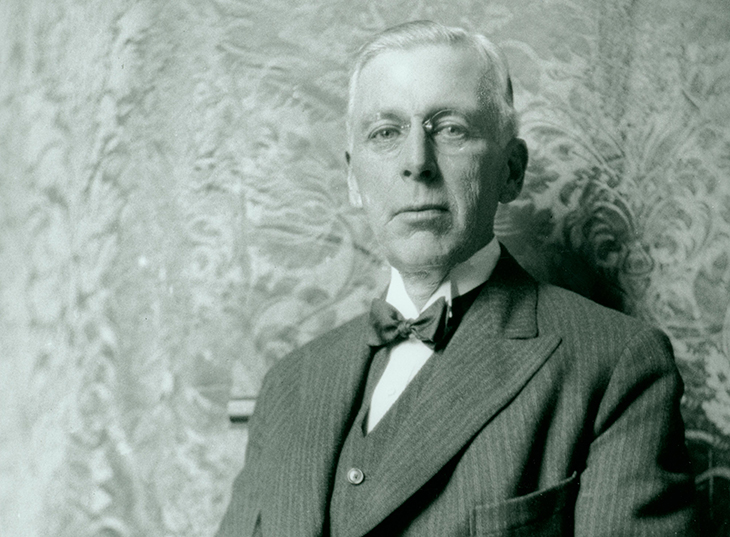
Principal Lewis Perry.

Harkness sent Perry and his committee back to the drawing board. Six months later they returned with a plan that Harkness agreed to fund. The gift Harkness made to Exeter—the munificent sum of $5.8 million, the equivalent of $69 million in today’s dollars—seemed to fall from the sky at a time of great need at the Academy. Harkness was not a graduate of Exeter and had no formal ties to the school. His unprecedented generosity revolutionized teaching at Exeter and continues to define an Exeter education in every way 75 years later. This much is commonly known to those associated with the Academy.

Today, Harkness tables form the center of just about every classroom at Exeter, and the Harkness philosophy of collaborative learning shapes everything from meetings of dormitory proctors to a scrimmage in basketball practice.

Exactly who Harkness was and why he chose to make such a gift is less widely known. It is a remarkable tale involving one of the wealthiest people in America in his time, who gave away his fortune with little fanfare. It is the tale of a friendship between Harkness and Perry, two very different men. It is the tale, too, of Harkness’ tenacious vision for educational reform, born of his own lackluster career as a student, a vision that shaped not just Exeter but Harvard and Yale, creating a blueprint for modern-day colleges and boarding schools.

Today Harkness is invoked hundreds of times a day at Exeter, though often without any thought of the man himself, who remains one of the Academy’s most significant benefactors. Harkness has become a philosophy; an approach to teaching and learning; a concept that shapes everything on the Academy campus from meetings of dormitory proctors to a scrimmage in basketball practice. Harkness tables form the center of just about every classroom. The classrooms themselves are known as Harkness classrooms. Casual conversations and formal debates are termed Harkness discussions. New faculty are introduced to the Harkness method of teaching.

Edward Harkness would probably not be happy to discover the frequent mentions of his name. A supremely modest man, he shunned publicity of any sort. But the rest is exactly what he intended when he made his gift to the Academy in 1930. He had in mind nothing less than changing the face of education.

A family of philanthropists

Edward Stephen Harkness was born on January 22, 1874, in Cleveland, OH, the youngest of three children. His father, Stephen Harkness, came to Ohio as a young man and worked as a harness-maker before expanding his business interests in livestock, grain and distilling, and banking. A few years before the birth of his youngest son, he became a silent partner in the fledgling oil refining business established by John D. Rockefeller, later incorporated as the Standard Oil Company. Along with his other businesses, this shrewd investment made Stephen Harkness a multimillionaire by the time of his death in 1888, when Edward was just 14.

Edward’s brother, Charles, who was then 27, took over management of the family fortune in consultation with their mother. Following his father’s wishes, Charles continued to invest in Standard Oil, even when returns on the stock were low. The family’s loyalty to Rockefeller and his company paid off with the invention of the automobile, sending profits in oil skyrocketing and creating a Harkness fortune worth more than $100 million.

Edward Harkness (far left), whose father was an early investor in Standard Oil, gave away more than $129 million, much of it to colleges and secondary schools. Committed to reforming American education, he pushed Exeter to come up with a “real revolution in [its] methods.”

Edward’s siblings both died young, and without heirs. When his mother died in 1926, Edward became the sole inheritor of what was then one of the largest fortunes in America. Harkness married, but had no children. With his wife, Mary, he devoted his life to a systematic dispersal of his wealth, managing his assets with the intention of giving away everything in his lifetime. From the early 1920s to his death in 1940 at the age of 66, Harkness made charitable gifts totaling more than $129 million, the equivalent of nearly $2 billion in today’s dollars. Though his giving was not on the scale of Rockefeller and Carnegie (who gave away $550 million and $350 million, respectively, over the course of their lives), Harkness ranks as a major American philanthropist.

His sister-in-law once reportedly said to Harkness, “You really would prefer to be under the sofa than anywhere else, wouldn’t you?” She described him as someone with “never a thought of publicity, or acclaim, truly a Christian.” Harkness did not attach his name to the many gifts he made in the areas of health care, education and the arts, and he often stipulated that there be little or no public notice made of them. His mother, Anna, gave funds for construction of the Harkness Tower in the Memorial Quadrangle at Yale in memory of her son, Charles, and for the Harkness Pavilion at Columbia-Presbyterian Hospital in memory of her husband. The great generosity of Edward Harkness went largely unmarked, a fact that in today’s world is perhaps more notable than the sums he gave away and the many causes he supported.

With an initial endowment of $10 million, Anna Harkness established one of the family’s major philanthropic efforts, the Commonwealth Fund, which continues to support access to health care and improvement of health care systems to this day. Edward served as the president of the fund throughout his life. Together mother and son gave $25 million for the construction of the medical center in New York now known as Columbia-Presbyterian Hospital.

After his mother’s death, Harkness established the Pilgrim Trust in Great Britain, which is still in existence, funding conservation and historic preservation projects as well as prison reform and programs for drug and alcohol treatment. Harkness was a major benefactor of the New York Public Library and the Metropolitan Museum of Art, in addition to his wide-ranging support for secondary schools and colleges. He made gifts to Yale, Harvard, Columbia, Cornell and numerous other colleges, and was a supporter of colleges for women and African Americans, including Vassar, Wellesley, Tuskegee Institute and Fisk University.

In the years before the Harkness gift, lives of Exeter students were radically different from those of today. Classes were taught recitation style, with the teacher lecturing to 25 to 35 students seated in rows. When students wanted to get the teacher’s attention they did so not by raising their hands, but by snapping their fingers.

Harkness’ experiences at St. Paul’s and at Yale shaped his thinking about education. Not a natural student, he struggled to maintain his grades and to adjust to the competitive environments at both institutions. When considering his gift to Exeter, he told Lewis Perry, “I want to see somebody try teaching—not by recitations in a formal recitation room where the teacher is on a platform raised above the pupils and there is a class of 20 or more boys who recite lessons. . . . I think the bright boys get along all right by that method, but I am thinking of a boy who isn’t a bright boy—not necessarily a dull boy, but diffident, and not being equal doesn’t speak up in class and admit his difficulties.”

Although Harkness made gifts of up to a quarter-million dollars to Phillips Andover, Lawrenceville, St. Paul’s, Taft, Deerfield Academy and the Hill School, his gift to Phillips Exeter was his largest to a secondary school. It was also the gift that most clearly reflected his concept of a new approach to education and the one calculated by Harkness himself to have the greatest impact.

Exeter before Harkness

A century ago, in the years before the Harkness gift, lives of Exeter students were radically different from those of today. Classes were large (with 25 to 35 students in a section) and were taught recitation style, with the teacher lecturing to students who sat in rows. Teachers called boys by their last names, and when students wanted to get the teacher’s attention they did so not by raising their hands, but by snapping their fingers. In his 1923 history of Exeter, Lawrence M. Crosbie noted: “The casual visitor to a recitation in the Academy is always startled and sometimes shocked by the old Exeter custom of snapping the fingers. If the boy hesitates in his recitation, a fusillade of snaps from those who know or think that they know rings out. It is often disconcerting to a new boy, but he soon learns to stand his guns, no matter how fast the musketry rattles about him.” Students who did well in this environment were known as “sharks.”

Principal Harlan Page Amen, who led the Academy in the years before Lewis Perry took the helm, captured the prevailing spirit of Exeter in a reflection published in The Exeter Bulletin in 1906. “Too much intellectual and moral flabbiness is found in the students in our secondary schools,” Amen asserted. “The Academy’s demand for earnest study and manly conduct must, of course, be enforced by the designation of a penalty. The ultimate, if not immediate, fruit of idleness or misconduct is separation from the school.” Amen summarized his principles with the motto disce aut discede — learn or get out.

Also contributing to this stern atmosphere was the lack of a centralized residential or social life. Because there were not enough dormitory rooms on campus, most students lived in rooming houses in town. It was possible for students to attend classes and return to their rooming houses, having little interaction with the instructor or fellow students. For many students, the Exeter community consisted of the boarders with whom they shared their rooming houses.

This was the world Lewis Perry entered when he became the eighth principal of Phillips Exeter in 1914, leaving behind a position on the faculty at Williams College as an instructor in English and elocution. Principal Amen had overseen the addition of a number of new buildings and the expansion of the campus, but the need for dormitory space remained a serious problem, and the Academy was in precarious shape financially. Two weeks after Perry’s election as principal, the Academy Building (the main classroom building on campus) burned to the ground. Perry immediately took on the task of rebuilding. Throughout the 1920s, he spearheaded fund-raising drives to reduce the Academy’s debt and make improvements to the physical plant.

A fateful friendship

When Phillips Andover received a substantial gift from a benefactor in the late 1920s, English instructor Frank Cushwa reportedly said to Lewis Perry, “We’re beaten. Exeter can never catch up.”

An article in The Atlantic Monthly published after the receipt of the Harkness gift reports Perry’s response: “ ‘Don’t be too sure,’ said Dr. Perry, in that calm, deliberate tone of his, bland and sanguine, which Young Men in a Hurry find so exasperating. ‘Don’t be too sure. Wait and see.’ ” The article goes on to comment: “Then came the 150th anniversary of Andover (1928) and Perry was invited to speak . . . What he said was that Exeter was little sister Cinderella, and that she was pleased to be asked to Andover’s grand party . . . unbeknownst to anybody, there was a catch in that speech . . . For little sister’s coach-and-four was waiting just around the corner of the next three years.”

Perry served as principal through June of 1946, a remarkable tenure of 32 years that spanned two world wars and the Depression. A beloved and revered leader, he shepherded Exeter through difficult times and oversaw a period of substantial expansion to the physical facilities and curriculum. Of all his achievements, however, none has been more enduring than his role in obtaining and implementing the Harkness gift, which shaped the physical dimensions of the Exeter campus as it is known today and instituted a teaching method that continues to influence educators.

Harkness might have been expected to make a major gift to St. Paul’s, his alma mater, but he chose Exeter in part because of his friendship with Perry. The men met at a wedding in St. Paul, MN, in 1902. Academy English instructor Richard F. Niebling, in an article for The Exeter Bulletin published in 1982, described theirs as “a lifelong friendship between two quite divergent personalities (perhaps the best after-dinner speaker in America, and a man who hardly ever spoke in public).” The Perrys often visited the Harknesses at their vacation homes in Connecticut and Charlestown, SC. Sharing a love for the theater, Perry and Harkness regularly met in New York to take in the latest productions on Broadway. Harkness recruited Perry to serve on the board of the Commonwealth Fund, further cementing their mutual respect.

Remembering Harkness after his death, Lewis Perry wrote: “I had never known in the early days that Ned Harkness was such a rich man. At this period I was an instructor at Williams, and whenever I came to New York Ned Harkness and I dined together and went to the theater. I always insisted that if Ned got the tickets, I paid for the dinner. Years after, out of the clear sky, Ned said: ‘You know, Lewis, that there is no man in the world I care for more than you. Do you want to know why? . . . Because you were such a damn fool that you did not know I had money.’ ”

Perry also recalled dining with Harkness the same night that the papers which created the Commonwealth Fund were signed. “He was very happy that night and welcomed the thought of what the Commonwealth Fund might accomplish,” Perry wrote, “but he was never overly optimistic about what his gifts would bring to pass. His was a wise and realistic attitude on the subject of giving. The road of a philanthropist is not always smooth, but Mr. Harkness always had in mind the good of humanity, and this consistent attitude made him the great humanitarian he was . . . Both [Edward and Mary Harkness] helped an infinite number of individuals, the type whom organizations do not assist, and they always helped in a quiet way unknown to any but the beneficiary.”

Harkness was motivated to make his major gift to Exeter because he trusted Perry’s judgment and ability to make good use of the money. “Exeter got the money,” Perry was later quoted as saying, “because Mr. Harkness knew we wouldn’t splurge with it.” Perhaps Harkness also realized that his close relationship with Perry could give him a degree of influence and oversight he might not have at another institution. However, it appears that in the end he chose Exeter because he believed, with its history and reputation, it was a school positioned to lead others. Harkness clearly saw his gift to Exeter as only the beginning. It was his hope that the method of teaching he helped introduce at the Academy would become a model for schools nationwide.

Change at the college level

In addressing the needs of secondary schools, Harkness was taking a logical next step, building on gifts he had earlier made to Harvard and Yale. Both independent secondary schools and colleges had seen steady growth in the early 1900s, without making many accommodations for the larger enrollments. Harkness wanted to address the problem of classes that were too big and based on a rote approach to learning and the problem of inadequate housing and a decentralized—or nonexistent—campus life, problems he saw as inextricably linked. He was particularly concerned about the segregation that occurred between the full-paying students and scholarship students, based on the housing they were able to afford off campus. A residential campus with housing for all would promote greater equity, encourage a closer relationship between teachers and students, and establish a cohesive social life allowing students of all backgrounds to interact on a regular basis.

In 1928, Harkness approached Yale with a proposal to fund a “College System” that would reorganize teaching and living arrangements through the construction of more classrooms and dormitories on campus, dividing the student body into smaller units for social and residential purposes and allowing for smaller class sizes.

When Yale could not come to agreement about accepting the gift in the time frame Harkness specified, he then approached President Lowell of Harvard, where a similar “House Plan” was already under consideration. Harkness readily agreed to fund the Harvard House Plan with a gift of $11 million. He “rightly believed that the way to improve such institutions was not to give small sums to many of them but enough to one or two to complete the object he had in mind,” President Lowell later wrote of Harkness. “[Harkness] offered no advice on details, which showed both his wisdom and his modesty; his wisdom, because seeing that his plan was fully understood, he left the execution of it to the experts; his modesty, because he never desired credit for his philanthropies, or the thought that he had put into them.”

As further proof of that modesty, Lowell described a walk he took with Harkness to inspect the first of the two Harvard Houses then under construction. “[He] took me by the arm and said he wanted to ask me a favor, probably the only one he would ever ask, that I would allow one of the houses to be named after me,” Lowell wrote. “Quickly I answered, ‘Certainly, if you will allow another to be named after you.’ He dropped my arm and moved away almost as if I had suggested a crime. His autobiography in Who’s Who is ten lines.”

In 1930, Harkness reached an agreement with Yale to fund the College System, enabling the construction of five new quadrangles and the refurbishment of three existing quadrangles, creating distinct residential colleges with their own dining halls and providing housing on campus for every undergraduate. In addition, Harkness funded a work-study plan to allow students unable to afford tuition to earn scholarships by working on campus. He also made a major gift establishing the Yale School of Drama and funding construction of the theater. His giving to Yale came to $12 million.

‘The big idea’

Harkness had already made three gifts to Exeter during the 1920s, totaling $445,000, initiating each of these gifts himself by asking Perry if Exeter was in need of money. It was. The first gift of $100,000, made to support teachers’ salaries, eventually went to funding the construction of Amen Hall when the faculty voted to divert the money for this purpose.

It was in 1929, when Perry and Harkness were at the theater in New York one night, that Harkness proposed making a more substantial gift to Exeter. According to Perry, he said, “Lewis, I want to do for Exeter what I have done for Harvard and Yale, and if you will get up a scheme, I’ll give you all the money you need to put it into operation.”

As Perry noted in a subsequent report to the trustees, “The possibilities of Mr. Harkness’ proposal were so staggering that it was difficult at first to either get or give a clear idea as to what we wanted. . . .” At Harkness’ suggestion, Perry and Director of Studies George B. Rogers embarked on a study tour of British schools, visiting 21 secondary schools in between January and March of 1930. Rogers wrote up a report on their findings, and Perry appointed a committee to make recommendations to Harkness. The proposal presented to Harkness in March of 1930 included a larger and more active advisory system, more dormitories, the creation of honors sections, funding for a visiting lecturers series and the construction of a student union building— plans that would require $1 to $2 million to fund.

Harkness’ unfavorable reaction is preserved in Perry’s handwritten notes, made on scraps of paper. “Harkness . . . has his mind fixed on smaller classes 8-10 and on the conference method of instruction . . . His whole idea is the dull boy, like himself, who was in large class in mathematics and did not know what was going on. Remember the conference system of teaching that is the big idea! On one side a stubborn man with an idea, on the other an eminent schoolman who feels he may be wrong. Must prove our case and sell him an idea. Not recitations, conferences.”

Whatever Perry’s doubts about the “conference” approach to teaching, he and his committee returned to Harkness the following fall with a plan proposing class sizes of 12 students taught on the “conference or tutorial method of instruction.” A House System was also proposed, requiring the construction of new dormitories that would allow students to live on campus in smaller groups and faculty to be housed in Academy dormitories. Each teacher would act as adviser to about 12 students, and students would remain in residence in one dormitory throughout the last three years of their time at the Academy, having the same adviser each of these years. The plan, estimated to cost $5 million, was unanimously approved by Exeter’s trustees.

Although not an Exeter alumnus, Harkness gave the Academy $5.8 million (the equivalent of $109 million today) to implement the “conference method of instruction” because he trusted Principal Lewis Perry’s judgment and ability to make good use of the money.

“We want you to understand that if we receive this gift we are going into the plan wholeheartedly,” Perry wrote to Harkness on October 30, 1930. “It is a plan in which we believe and one which we think will be of primary importance to American secondary education. No school has ever had the chance for constructive work which will be ours if you will give us this grant.”

Harkness accepted the proposal a week later, in a brief letter that began: “I have been greatly interested in reading your letter of October 30th. The plan discussed therein for changing the method of teaching and housing at Exeter coincides with my ideas and the offer I am about to make is based on this plan as described. . . . When this gift is made public, will you be kind enough to see that no mention is made of the amount thereof?”

On November 17, 1930, the announcement of a generous gift from Harkness was made to the press. Perry wrote to Harkness on November 21: “Letters have been coming in all day by the score in regard to your magnificent gift. I got all the faculty together Tuesday night and with much applause, and every man on his feet, they pledged themselves to carry this on.”

The plan comes to life

As the plan evolved in the months that followed, it called for hiring 25 additional teachers;building four new dormitories and remodeling existing ones; constructing a new classroom building, Phillips Hall, and adding new classroom wings to the Academy Building—the result of which was that each teacher would now have his own classroom. A fund for sabbatical leaves for teachers was also included. Roughly one-third of the funding for the final proposal went to buildings; two-thirds went to teachers’ salaries and such benefits as the sabbatical fund.

Initially, the plan included another classroom innovation new to Exeter: a tracking system that grouped students by ability, with separate sections for “advanced” and “slower” students. Heralded at the time as a significant feature of the new system, one that might better address the needs of the overlooked students Harkness hoped to reach, this aspect of the Harkness method was not to last.

Implementation of the Harkness plan was phased in over the next three years, with a third of the 25 new faculty members hired each year. By 1935, the faculty consisted of 80 men, and enrollment had increased from 600 to 700 students. A report on the hiring of the new faculty in The Exeter Bulletin noted: “This work has been done according to the principle that the men should be young enough in years or spirit to carry out the conference idea of instruction, and old enough to have a sufficient background and experience to give substance and authority to their instruction. The belief holds here that this method of instruction will make greater demands on the teachers than the former method . . .” Most of the new hires were in their late 20s or early 30s, apparently deemed the age best suited for the blend of energy and experience the Harkness teaching method required.

Classics and mathematics classes were the first to adopt the Harkness method in 1931 because they were taught in the Academy Building, the only building in which renovated rooms were ready by the start of the school year. English, history and French adopted the smaller class sizes and conference style with the completion of Phillips Hall the following year. In addition to Phillips Hall and the new wings in the Academy Building, the Harkness gift funded the construction of Bancroft, Langdell, Merrill and Wheelwright halls, giving the Academy a total of 13 large dormitories, housing between 35 and 70 students each, and eight house dorms, with three to 14 students each. For the first time, there were accommodations for instructors with families.

The Harkness gift financed the construction of a new classroom building and four new dormitories (including Wheelwright, above).

The new construction made possible by the Harkness gift complemented the building projects undertaken in the 1920s, which included completion of Lamont Infirmary and Cilley, Wentworth,and Amen dormitories, and the acquisition of Phillips Church. In 1930, William Boyce Thompson, a member of the class of 1890, gave $1 million to Exeter to fund the construction of Jeremiah Smith Hall and the Thompson Science Building. Together the gifts from Thompson and Harkness created the upper quadrangle, defining much of the Exeter campus as it is known today. In 1935, when the last of the Harkness buildings had been completed, Exeter had become a campus of over 400 acres with 60 buildings.

Not a school, but a faith

Although there was reportedly some resistance to the new teaching method from existing faculty (and an ongoing discussion of what constituted the ideal class size and how students should be tracked in sections at different levels), the response to the changes brought about by the Harkness plan was largely enthusiastic.

“I had not suspected that a merely physical change in the classroom could so influence our work as it has done,” observed instructor Henry S. Couse in a letter to Lewis Perry written during the first term of Harkness teaching. “Sitting in a group about a table instead of in formal rows of seats has abolished almost completely the stiff duality which used to obtain between instructor and class, when, I am afraid, his elevation on a platform tended to hedge him about with too much dignity and make him somewhat unapproachable, even to the fearless curious student; and which certainly did tend to make the student still less articulate. The very naturalness of the new arrangement, besides being more comfortable, has in good part wiped out that class-consciousness. Now, there is a freedom of discussion, an eagerness to participate, that I never saw before, the value of which to both student and instructor is incalculable. And it comes mostly from sitting about a table.”

“It is a rare privilege to have the opportunity of teaching in such surroundings as Phillips Hall affords,” noted William G. Saltonstall, one of the newly hired Harkness teachers who went on to become principal on Perry’s retirement. “A fine room cannot help but challenge the teacher to live up to his physical equipment. Most boys take real pride in the appearance of a pleasant room—learn to handle books with more respect and to examine maps and pictures with greater care. Discipline is never a problem. If better teaching is not done in Phillips Hall it is entirely the teacher’s fault.”

Historian Arthur M. Schlesinger Jr. ’33, who attended Exeter during the implementation of the Harkness plan, recalled: “We sat around tables and talked back to the master; education became, not a performance, but a process. Also the standards were high. I barely passed in my first term and thereafter set to work. I had never worked so hard in my life. When I went on to Harvard later, everything was easy. So far as the training of my mind was concerned, Exeter could hardly have been more effective for me.”

One of the greatest hopes of Edward Harkness, that the new approach to teaching he helped to shape and funded at Phillips Exeter would spread to schools across the country, did not fully come to pass. The influence of the Harkness method was clearly felt at other preparatory schools, notably Lawrenceville, which instituted a similar plan with funding from Harkness. Many other schools saw the wisdom in holding smaller classes focused on discussion; a number adopted the use of seminar tables in the Harkness style. But the plan Harkness insisted on seeing realized at Exeter was not taken up by public secondary schools or most colleges, at least in part because of the expense.

Nonetheless, through his gifts to Harvard, Yale, Exeter and other schools, Harkness had an undeniable impact on educational methods, as over the years small classes and personal exchange between student and teacher have come to be seen as the ideal to which many secondary schools and colleges at least aspire. Exeter has spread the Harkness gospel both directly and indirectly. Every summer, the Academy’s teaching conferences—the Exeter Humanities Institute; the Anja Greer Conference on Secondary School Mathematics, Science and Technology; the Rex McGuinn Conference on Shakespeare; and the Exeter Math Institute—bring hundreds of teachers to Exeter for a weeklong immersion in Harkness learning. And many alumni/ae educators have incorporated Harkness principles into their own schools.

In the January 1931 issue of The Exeter Bulletin, Lewis Perry explained the plan for the Harkness gift in detail. “There can be no doubt that colleges are entering upon an intellectual renascence. The preparatory school now must prepare its students for a vital intellectual life at college. To stir a boy’s intellectual curiosity and to extend his intellectual interest, then, is the function of the school of the present and the future. This may be quite a different matter from preparing a boy for College Board examinations, which can often be done by endless drill without necessarily stimulating a boy’s intellectual life. . . . Mr. Harkness, who has done so much to aid the colleges of our time to realize their ideals, understands that the preparatory school is affected by the colleges and vice versa; that both school and college are partners in a great educational enterprise. . . . Constantly in our minds, then, is the thought that Exeter is not merely a school but a faith. And we mean to keep the faith—to our founder, to the boys of the present, and to the generations yet to come.”

At Exeter, there is no question about the far-reaching effects of Harkness’ generosity and vision. His gift created the residential campus we now know, a place rich in the social and intellectual interchange that is a hallmark of the Exeter experience for today’s students and faculty, and one which continues to shape the lives of thousands of alumni/ae. A simple but profound notion defined his thinking about education: that a small group of students, seated around a table and guided by an instructor, could best be engaged in learning by voicing their own ideas and questions and listening to those of others. It was a powerful concept whose power has not waned.

This feature first appeared in the fall 2006 issue of The Exeter Bulletin.