Phillips Exeter Academy

Exeter Deconstructed: The Class of 1945 Library stamp

When the history of the Class of 1945 Library is finally written, that story can be signed, sealed and delivered with the library’s very own stamp.

In 2005, the library was included in a commemorative set of U.S. Postal Service stamps titled “Masterworks of Modern Architecture.” Twelve iconic American buildings were featured, including the Guggenheim Museum and the Chrysler Building in New York City and the National Gallery of Art in Washington, D.C.

Louis Kahn’s design has long been a darling of architects. In 1997, the American Institute of Architects presented the library with its Twenty-Five Year Award, given annually to a building of “architectural significance that is still fulfilling its original purpose after 25 years.” That honor came with an inscription: “The massive block of dark red brick reveals surprising delicacy. It is artistically ahead of its time, and will continue to enlighten as a spiritual touchstone of great design for generations of architects.”

Exeter’s inclusion in the stamp set was first proposed by the Postal Service in 2003 to then-Assistant Principal Thomas Hassan, who kept it a secret for almost two years until the final dozen buildings were announced. When the unveiling took place on May 20, 2005, The Exonian wryly noted that no mail was moving at the Academy, as the post office was abandoned. The mailroom staff had slipped out to watch the ceremony.

Academics afield

Energy and excitement filled Love Gymnasium on Sept. 10, 2021, as the entire school community of students and faculty gathered for the first time in 18 months for Opening Assembly. In the front rows, members of the class of 2022 listened as Principal Bill Rawson ’71; P’08 offered a reminder of Exeter’s mission “to unite goodness and knowledge and inspire youth from every quarter to lead purposeful lives.”

But as all Exonians know, the pursuit of goodness and knowledge doesn’t begin after Opening Assembly, and it doesn’t end after that last class in late May. Summer may be for rest, relaxation, family and friends — but it also offers many students, including those featured here, the precious time and space to continue the pursuit of learning and to follow their sense of purpose into the wider world.

Zander Galli ’22: Guardian of biodiversity

For as long as he can remember, Zander Galli ’22 has been interested in wildlife and nature. After his lower year, Galli planned a trip to Africa, where he initially thought he’d be working with cheetahs. In fact, he headed to the Munyawana Conservancy in southeastern South Africa for a conservation project involving pangolins, the rare insect-eating mammals that are covered in overlapping scales resembling the leaves of an artichoke. “They have this entrancing aura that’s hard to describe if you’re not right next to it,” Galli says. “It’s like stumbling on some otherworldly alien, they’re just so strange and beautiful.”

While often compared to anteaters, pangolins are in fact more closely related to the Carnivora order, which includes cats, dogs and bears. Their unique scales are made of keratin, the same protein that forms human hair and fingernails. Despite having no proven medicinal value, the scales are highly sought after for use in traditional cures for ailments ranging from arthritis to cancer. Due to a robust poaching trade over the past 10 to 15 years, pangolins are now believed to be the most-trafficked mammal in the world.

Though the COVID-19 pandemic scuttled all travel in the summer of 2020, Galli returned to the same conservancy this summer. His job was to help rehabilitate three young pangolins that had been rescued from the poaching trade and reintroduce them into the wild. Pangolins are normally solitary, nocturnal creatures, but these orphaned animals were completely dependent on Galli and his colleagues to dig up ant and termite nests for them to feed on. “At night, you bring them back and sleep right next to them, because you have to keep them warm and make sure they don’t get sick,” Galli says. “It’s very stressful for them.”

In addition to the threat of poaching, “the climate crisis is really affecting the areas that pangolins live, especially the drier areas,” Galli says. “When the rainfall is much lower, the insects are way less prevalent, so the pangolins have to spend more time out of their shelters looking for them.” Not only are the animals exerting more energy and risking starvation, but they’re more easily hunted when they’re in the open. All eight pangolin species native to Asia and Africa are currently classified as threatened with extinction by the International Union for Conservation of Nature.

Galli also spent a month this summer in the Namib Desert in northwest Namibia, working with the Giraffe Conservation Foundation to track and place satellite tags on giraffes. “The foundation used the tagging data to track the giraffe migration between the Namibian and Angolan border and set up community conservation programs,” he explains.

After taking Advanced Biology his upper year, Galli is now working with Science Instructor Townley Chisholm on a senior project to create a new biology curriculum. “It connects natural disruption to zoonotic diseases, like COVID and Ebola and HIV, and explains how the status quo of natural destruction will probably lead to more diseases like those,” he says. Galli hopes to test the curriculum in Exeter biology classrooms before rolling it out to a wider audience. 

In addition to his conservation interests, Galli is on the wrestling and crew teams, serves as co-head of the Daniel Webster Debate Society and sits on the Community Conduct Committee. Next spring, he will travel to the nation’s capital for the Washington Intern Program and plans to intern at an environ-mental law or policy organization.

In a TEDx talk Galli gave at Exeter in the spring of 2019, he advised fellow Exonians to “think of biodiversity as a massive Jenga tower” in which every species is important to the solidity of the tower. He still sees this metaphor as an apt one for illustrating the need to take climate change — as well as the plight of the pangolin and other threatened animals — seriously.

“I think the most important thing for humans is to think of ourselves as part of nature and recognize and appreciate how our actions have effects we can’t even picture,” Galli says. “We just don’t know enough about how all these ecosystems function, and how the entire biosphere keeps us alive. We don’t know when that tipping point will be.”  


Emma Finn ’22: Champion of ancient Greek

Emma Finn ’22 started taking Latin in sixth grade and chose to come to Exeter in part to continue her studies. In pursuit of a Classics diploma, she enrolled in her first Greek course during her upper year and was immediately hooked. “I love Latin, but for me Greek is a more fluid language,” Finn says. “There are these little words called particles that can convey sarcasm and nuance in a way you can only really get while speaking in English.”

When Finn heard that Matthew Hartnett, chair of the Department of Classical Languages, was looking for a student to work remotely over the summer to revise ΑΓΩΝ (pronounced “ahg-own”), the ancient Greek text-book he wrote that is used in Exeter’s introductory Greek courses, she jumped at the opportunity. “My goal for the project was not just to make it easier to learn, but to make people really fall in love with the language the way I did,” she says.

In addition to reformatting the appendix, indexing prepositions and other tasks, Finn added new sentences to the textbook to ensure better distribution of vocabulary words. She particularly enjoyed researching and writing short biographies of the authors whose texts are included in the book, hopefully inspiring her fellow Greek scholars to read more of their work.

“It’s been great practice to see the curriculum and the material through a different lens,” she says. “I’ve always loved storytelling, and it’s been really rewarding to shift from being a consumer of knowledge to being able to produce it in ways that will have an impact on other students’ learning.” 

“Emma came up with a lot of ways to make learning the vocabulary and grammar easier, including little mnemonic devices, tricks and tips,” Hartnett says. “Because she can still see Greek through a student’s eyes, she helped us present the material in a way that’s easier for students to understand.”

Finn’s academic interests also led her to Exeter History Instructor Aykut Kilinc, who enlisted her help in designing lesson plans and curriculum for his economics course. “We read this really interesting book that’s basically a comprehensive history of U.S. trade policy,” she says. “Which I know doesn’t sound interesting, but it turns out to be a great way of looking at the broader political shifts in the United States over time.” 

On top of those two projects, Finn found time to complete a summer internship for the New-York Historical Society. Working remotely from her home in Maryland, she wrote a blog post about the pioneering female journalist Ruth Hale for the muse-um’s Center for Women’s History and helped develop lesson plan content for Museums for Digital Learning, an educational platform that provides K-12 schools with curated resources.

For her academic excellence, Finn was recently selected as a Coolidge Scholar, an honor that comes with a scholarship for four years of under-graduate study at any accredited college or university in the United States. Coolidge Scholars are also selected based on a demonstrated interest in public policy and a record of humility and service. In Finn’s case, she has been involved in the Exeter Student Service Organization since her prep year and is now the co-president. She’s also co-head of Exeter’s Economics Club and Microfinance Club, which provides small loans to entrepreneurs in the developing world.

Before the pandemic, Finn frequently volunteered to care for abandoned horses at the Hidden Pond Equine Rescue in Brentwood, New Hampshire. “The goal is to socialize the horses and get them used to being around humans again so they can be adopted,” Finn says. An experienced equestrian who started riding when she was 6 years old, Finn competed in horse shows on weekends during her lower year and hopes to resume riding and volunteering with horses during the new school year.

Janessa Vargas ’22: Advocate for immigrants

As a first-generation Mexican American, Janessa Vargas ’22 has always been aware of how pervasive questions around immigration status can be in families and communities like her own. While at home in New Jersey near the outset of the COVID-19 pandemic, she started working with Make the Road, a nonprofit organization that focuses on empowering working-class and immigrant communities. Building on that experience, Vargas dove deep into researching U.S. immigration policy this summer through a fellowship with the National Advocacy Institute at the American Civil Liberties Union (ACLU).

With Make the Road, Vargas helped people apply for Deferred Action for Childhood Arrivals (DACA), the Obama-era program that protects from deportation certain undocumented people brought to the United States as children and allows them to work. “For my [ACLU] research proposal, I asked the question, ‘How do we achieve citizenship for people who are left out of this very specific pool that the government or politicians think are worthy or have ‘earned’ their citizenship?’” Vargas explains. 

She interviewed immigration lawyers and community organizers, both in her area and in other regions of the country, to get a more complex picture of the issue. “The way I tackled the research project was bringing humanity to policy,” she says. “I would mix people’s interviews — their realities — with the law and present the human perspective. I tried to show how a lack of citizenship and a lack of stability in one’s immigration status is so pervasive in people’s lives, and in the lives of my family and my community.”

In July, around the time Vargas was preparing to present her research (virtually) to some 200 people, a federal judge in Texas ruled that DACA was unlawful and suspended the program. As the debate over immigration reform continues in Congress, Vargas will travel to Saint Peter’s University in New Jersey to speak at a campus event on immigration in September. She also plans to head to Washington, D.C., for events surrounding the vote on the planned budget, which she hopes will include “the pathway to citizenship for millions of people.”

Vargas rounded out her summer with a stint doing research for the Greater Good Institute, a youth-led think tank, as well as classes on literature and philosophy through the Yale Young Global Scholars Program. For good measure, she attended a five-day virtual course on critical race theory at the African American Policy Forum, led by the scholar and writer Kimberlé Crenshaw.

At Exeter, Vargas has immersed herself in the ongoing work devoted to promoting anti-racism and diversity, equity and inclusion on campus. She is head of diversity and equity for Student Council; co-head of the Afro-Latinx Exonian Society, Feminist Union and Democratic Club; and has worked as a student proctor in the Office of Multicultural Affairs. She also co-leads Model UN, which she’s been involved with since her prep year. “Like most Exonians, I’m pretty overcommitted,” Vargas says.

“But even though I’m spread in a lot of places, I feel like it’s all within the same area of work.”  

She’s seen the positive impact of anti-racist work in the Exeter curriculum, as well as in Model UN. “I saw the board before me take accountability and take people out of spaces where they were causing harm, admit that wrong, and make clear that things need to change,” Vargas says. “Now our board is made up mostly of women of color, so I’ve seen that transformation in a club where I probably would have least expected it.”

Vargas is also excited to begin working with GLSEN (the Gay, Lesbian and Straight Education Network), a nationwide organization that seeks to protect and create positive environments for LGBTQ students in K-12 schools. “I think the crux of my Exeter career is making sure that it’s a better place for people like me after I’ve left it,” she says. Referring to the oft-quoted statement made by one of her heroes, James Baldwin, about America, Vargas says she too believes that “if you love something, then you criticize it and make it better.” 

My radical school

As a 10-year-old growing up in San Francisco, I was obsessed with the Summer of Love. I would save my allowance and take the 22 Fillmore bus down to Haight-Ashbury and stare with envy and longing at the flower children there. I wanted to play guitar like them, to drop out like them, to belong to a radical movement like them. Instead, I baked brownies for the Girl Scouts and did my homework. My one radical gesture consisted of spending the rest of my allowance on tarot cards from the Mystic Eye Bookstore and then doing readings for gullible friends.

But the longing to belong to a radical community never left me. Little did I know that, in interviewing at Phillips Exeter in the fall of 1971, I would be fulfilling that dream. At the time and for some time afterward, Exeter seemed the epitome of the very opposite of that vision: It seemed staid, restrained and committed to convention and tradition.

But over the last (God help me) 50 years that I have been connected to the school as a student, teacher, parent and, now, emerita, I have seen what is precious and radical continue to emerge in a variety of different and unexpected ways. Yes, when I arrived in the fall of 1972, the engraved Latin slab over the entry to the Academy Building read, “Here come boys to be made into men,” but I also walked under that sign into a history classroom with Ms. Jane Scarborough, who modeled fearless inquiry at the table — and made me realize that a woman could more than hold her own in a room full of men. If she could do it, then so could I. As a lower, I learned to never let gender keep me from speaking my mind. The dictionary’s first definition of radical? “Relating to or affecting the fundamental nature of something; far-reaching or thorough.” Yes, indeed.

When I returned to Exeter, 22 years and several careers later, I was again surprised. I thought I was returning to the school I had left.

But in the intervening time, the Academy had pushed forward in surprisingly progressive ways. Harkness pedagogy, originally intended as “a real revolution in methods,” had continued to evolve, becoming even more student-led and student-centered than I remembered. As a teacher, I always loved the moment when a student would say something about a book that I thought I knew well, making an offhand remark of such fresh insight that I could feel the hairs on the back of my neck stand up.

But more exciting still was seeing a Harkness approach applied to student life outside the classroom. Activities, clubs and meetings, whether the Gay-Straight Alliance, Middle East Society or Pirate Club, seemed to be asking, “Who are you? And how can we help you be who you are?” Dorm life evolved with the option of all-gender dorms, providing more choice for students. A second meaning of radical? “Advocating thorough or complete political or social change.” Change was in the air and Exeter was part of it.

My own children felt that change as students there and responded to it in ways that helped them grow into the engaged people they are today. A term at Mountain School turned my son into a climate warrior, while Dramat fed a dream of writing for TV. And Exeter gave my daughter the support to begin a quest in search of gender identity and expression that led to her happy pursuit of a career in social work and psychotherapy. At the conclusion of a year commemorating 50 years of coeducation at Exeter, I look at my children and see yet another expression of what it means to be radical: “Of, or springing direct from, the root or stem base of a plant.” They have sprung from the same base, the same soil that nurtured me. And I cannot wait to see the ways in which Exeter will continue to thrive and help her students grow into who they are meant to be. As an emerita, I will stand on the sidelines and cheer for the radical change to come. 

Post from the past

My father, Frank R. Lacy, and his younger brother, Burritt S. Lacy, both entered the Academy as uppers in September 1897 and graduated in the class of 1899. The letters that my father wrote home to his parents in Dubuque, Iowa, and which, to my good fortune, they preserved, paint a picture of life at Exeter in the Principal Harlan P. Amen era that later Exonians may find interesting.

Although the letters I have start only in the spring of 1898, it appears from the inscription “in Oct. 1897,” on the back of a picture of Burritt sitting at a desk in 11 Peabody Hall, that the Lacy brothers lived in Peabody throughout their two years at the Academy as two of its first occupants. In fact, the building seems not to have been quite ready for them. In a letter dated October 12, my father reports that he was still sleeping on a “lounge” because bed springs, which the Academy had ordered from Boston, had not yet arrived. Could this have been a belated attempt to adjust the school’s bed sizes to accommodate the 6-foot-6 Burritt and other oversized boys present or to come? In other respects, the brothers took the furnishing of their room into their own hands. My father writes enthusiastically about a Morris chair that they bought for $10. Their mother had sent them andirons for the fire-place, and they had purchased a screen and soapstone to complete the equipment necessary for its safe and efficient use.

The Academy apparently did not yet have dining halls, and Frank and Burritt took all their meals at Mrs. Read’s boarding house. The price was right. My father’s letter of June 20, 1898, thanking his father for a draft of $40, indicates that part of the money would be spent on paying his and Burritt’s bills of $9 each for board from June 22 to July 3. The Lacy boys were expected by their father to keep meticulous records of every penny they spent while at Exeter. I turned my father’s account book over to the Academy’s archivist some years ago. It would also appear that there was not yet an infirmary. In May 1899, Burritt, along with a number of other boys, came down with German measles. He simply stayed in his bed in his room, and Frank “had the doctor come and see him.” To cope with the constant threat of catching cold, Frank, at the beginning of his senior year, sent away for a half dozen bottles of cod liver oil, which, he assured his parents, he took regularly.

Grading then, as in my time in the 1940s, was tough. Notes to the report card state that “A” represents practi-cally perfect work and is a mark seldom conferred, and that “B” represents highly satisfactory work."

There were team sports. My father reports watching a football game and a track meet in Andover, and he exults in the camaraderie of a student parade through the town of Exeter and a bonfire following Exeter’s decisive victory in the track meet. His own physical training seems to have been limited to workouts in the gymnasium. He and Burritt did play tennis with some frequency, on their own, and my father writes of lengthy canoe trips and swimming up the river. The boys also had bicycles and, in those pre-automotive days, were apparently free to go as far afield as they desired. One letter tells of a 24-mile round trip to Rye Beach.

A more startling revelation in the letters is of the boys’ frequent exercise with firearms. In their senior year, they appear to have brought an arsenal with them. The letter of Oct. 6, 1898, to Papa and Mama reports they had gone out with the revolver and practiced firing. Later letters have them shooting a rifle and hunting (unsuccessfully) in the snowy woods with a shotgun!

They often wrote of academics as well. The letters include a “Report of Proficiency, Faithfulness and Attendance of F. R. Lacy of the Upper Middle Class for the Term ending June 21, 1898,” which, I believe, gives a full listing of the curriculum of the time: Latin, Authors and Composition; Greek, Authors and Composition; Mathematics; French; German; Physics; Chemistry; History, Ancient and Modern; English, Authors and Composition; Declamation; Mechanical Drawing; and Physical Training. In the ancient languages and English, separate grades were given on “Authors” (reading) and “Composition,” which in the case of the ancient languages I take to mean the ability to translate English into good classical Latin or Greek. Declamation consisted of memorizing a set piece and declaiming it before an audience including a faculty judge.
Grading then, as in my time in the 1940s, was tough. Notes to the report card state that “A” represents practically perfect work and is a mark seldom conferred, and that “B” represents highly satisfactory work. My father was graded on Latin, Authors and Composition; French; German; Physics; English, Authors and Composition; and Declamation. I assume this represented a typical class load.

Classes were referred to as “recitations,” for what-ever that means. There were, of course, no Harkness tables, but the classes were small. A letter dated Jan. 26, 1899, mentions an analytic geometry class of just seven. It appears that there could be some flexibility as to required attendance. In March 1898, my father writes that he has been invited by the teacher to join a geometry class and, because of a conflict with a laboratory obligation, was considering going once a week instead of the two times that the class would regularly meet.

I have always regretted that I was not able to coax him into visiting the Academy while I was a student there, but Dubuque was still a long way from Exeter and in 1943, with the war ongoing, travel was not easy — so he never made it."

The pervasive influence of Harvard on the Academy, as a major source of its freshman class, is very evident. A letter of March 13, 1898 mentions that Harvard’s president, Charles Eliot, had that week spoken to the whole student body in chapel. The Harvard Examinations, which were given at Exeter over a full week following the end of the spring term, were, at least for the Lacy boys — and, I suspect, for the whole Academy — the high point of the academic year. Regular recitations ended, in 1898, on June 21 with the “Trustees’ Examination.” There was then a week during which the whole teaching staff was present in the old Academy Building to provide individual tutoring to any of the examinees who felt the need of help. Then, commencing on June 28 and continuing through July 2, examinations, which may have served both as qualifying and placement tests, were given by Harvard in all of the subjects in which the applicants wished to be examined. My father writes that “the order of ‘our’ Harvard exams is as follows: Tuesday: Advanced German, Thursday: Elementary Latin, Friday: Physics, Geometry, Algebra, English, Saturday: Elementary French and German.” Were there also Yale exams or Princeton exams given at the Academy? Or did you have to go elsewhere to be tested if you were so misguided as to have come to Exeter with the thought of applying to a college other than Harvard?

In reading these letters, I cannot but be impressed by the magnitude of the changes wrought at the Academy in the 43 years between my father’s graduation and my arrival in 1942. Some things that have changed greatly since my time were then still the same: My father and I both traveled between home and school by train, accepted Latin as the heart of the Academy’s curriculum and wrote letters home in longhand. But the school had in that 43-year interval been transformed. It had a new Academy Building and two other large new class buildings, numerous new dormitories and dining halls, greatly expanded playing fields and sports buildings, an infirmary, and even a church and an inn. I could go on. Dr. Lewis Perry (principal, 1914-1946) with the munificent support of Edward Harkness and other generous donors, had created a physical and social environment my father would not have recognized. I have always regretted that I was not able to coax him into visiting the Academy while I was a student there, but Dubuque was still a long way from Exeter and in 1943, with the war ongoing, travel was not easy — so he never made it. 

Editor’s Note: The letters written by Frank R. Lacy were given to Ben Lacy some years ago, he says, by his sister, Margaret Lacy Zimansky, of Iowa City, with whom his father lived during the last years of his life. The letters will now be preserved and added to the permanent collection of the Academy Archives.

Exeter commits to need-blind admissions

Cost will no longer be a barrier to any qualified student who dreams of attending Phillips Exeter Academy, Principal Bill Rawson ’71 and Morgan Sze ’83, president of the Trustees, announced in a joint statement to the Academy community Wednesday.

Beginning with students who enter Exeter in the coming academic year, the Academy will adopt a “need-blind” admissions process and make its decisions without regard for a family’s ability to pay the tuition.

“When Exeter was founded 240 years ago, John and Elizabeth Phillips made a commitment that continues to serve as one of our core values: ‘And it [the Academy] shall ever be equally open to youth of requisite qualifications from every quarter,’” Rawson and Sze wrote in an email to students, employees, alumni and parents.

“The commitment expressed in our Deed of Gift ensures that all our students, regardless of economic circumstances, are not only able to attend but also know they belong at Exeter. Financial aid makes it possible for students from “every quarter” to join the Academy community and learn, lead and thrive here. Today, we renew our commitment to youth from every quarter.”

“Today, we renew our commitment to youth from every quarter.”
—Principal Bill Rawson ’71; P’08

Exeter has a long history of meeting the financial needs of its students. Approximately half of the school’s students receive financial assistance each year, and families who make less than $75,000 a year pay no tuition at all. The Academy awards more than $25 million annually in financial assistance to its students, and the largest distribution of endowment income is designated to financial aid.

The announcement comes after Exeter benefactors over the past two years committed to more than $90 million in new endowment for financial aid. With that renewed support, the Academy Trustees voted unanimously late last month to make a commitment to “need-blind” admissions.

“It has been particularly exciting to see the support from alumnae through the Women’s Leadership Circle initiative,” Morgan Dudley ’77, director of institutional advancement, said. “As part of our celebration of 50 years of coeducation, gifts through the WLC support financial aid for girls, empowering young women to bring their voices to the Harkness table, regardless of financial need.”

“Need-blind admission resonates deeply with our students, alumni and parents who saw this as a wonderful opportunity to take our financial aid program to the next level of supporting youth from every quarter,” Bill Leahy, Exeter’s dean of enrollment, said. “This move heightens our commitment of access and allows all admission decisions to be made without consideration of a family’s ability to afford our tuition. Our focus in admission is to continue to attract and enroll those students with the most to give and the most to gain from an Exeter education.”

Need-blind admission resonates deeply with our students, alumni and parents who saw this as a wonderful opportunity to take our financial aid program to the next level of supporting youth from every quarter."
Bill Leahy, Exeter's dean of enrollment

The Exeter community embraced the historic news and the Academy’s commitment to making an Exeter education accessible.

“Excellent! Many people have worked hard and waited a long time for this,” Ross Elkins ’78 wrote in an email. “It is heartening in every sense.”

“We will be forever grateful for our son’s full scholarship to attend Exeter for a post-grad year,” Laurie Easton Parker P’11 said. “Without the financial aid, that superior education would have been out of reach for our family. Thank you from the bottom of our hearts!”

Added Jim Rogers ’63; P’05, “This is wonderful news and such an important and fitting milestone for PEA.”

Vision quest: New coaches offer new focus

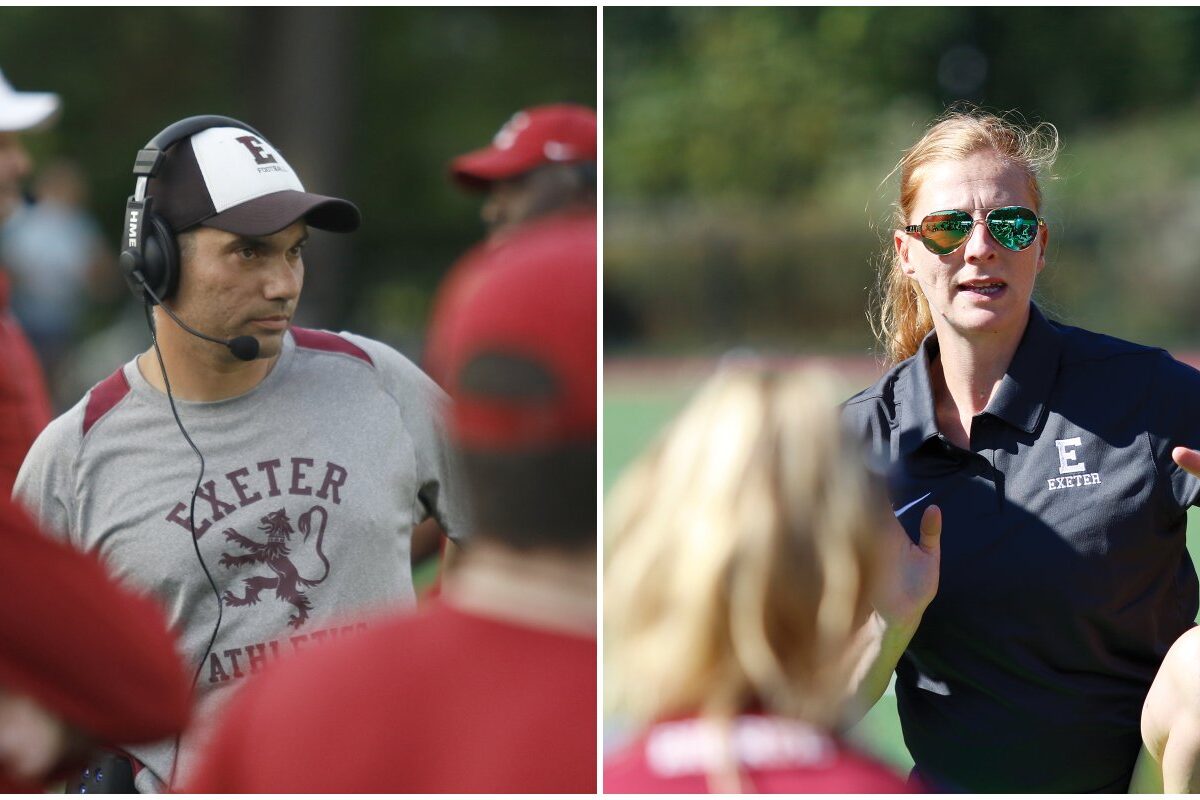
Two new faces patrol the PEA sidelines this fall. Panos Voulgaris is the new head coach for varsity football, while Samantha Fahey has stepped in as the head coach for varsity field hockey. Each faces a challenge to rebuild. And each has plans for their respective program to make a big impact in the Exeter community and beyond while continuing to honor the rich tradition of Big Red athletics.

Voulgaris is a career coach and educator who is passionate about the game of football and excited to bring Big Red to new heights. “Football requires mental and physical toughness at a high level,” Voulgaris says. “It teaches the values of perseverance and teamwork that kids can take with them for the rest of their lives. Being able to teach the game in a residential environment where kids come from a diversity of backgrounds on all levels is unique and exciting.”

Voulgaris is no stranger to prep school football, having spent the past 14 years as a teacher, administrator and head coach. He arrives in Exeter after a successful coaching stint at Noble and Greenough School, where he led the program to a bowl game victory in his first season. Prior to his time at Nobles, Voulgaris was responsible for turning the Episcopal High School and Taft School programs into regional powerhouses. He led both programs to championship seasons while seeing more than a hundred former student-athletes go on to play collegiately across the country. His teams’ on-field success can be attributed to working from the ground up, building a foundation of strong camaraderie, culture and training.

“Preparation and teamwork are essential to any football team’s success,” he says. “I’ve always emphasized hard work, selflessness and fun as being key components to a football team. One of our goals is to continually improve our practice habits as we move forward. This will be instru-mental to setting our program’s foundation and establish-ing a jumping board to a great future.”

Voulgaris, who earned his bachelor’s degree and played college football at Merrimack College before earning a master’s degree at Harvard University, has surrounded himself with a great team of coaches that features a lot of experience and expertise on the field, in the classroom and in the Exeter community.

“I’m fortunate enough to work with an experienced coaching staff who have done a great job working with our kids and love and appreciate all that is Exeter,” Voulgaris says. “They are dedicated to our process, believe in our philosophical objectives from both a football and cultural standpoint, and know how to have fun on the football field.”

If Samantha Fahey’s name sounds familiar to Big Red followers, that is because she has returned to the Exeter field hockey sidelines after previously serving as head coach in 2013. After spending time in her home state of New York, Fahey is back to lead the program and serve as a physical education instructor.

“I loved my time here and could not be more excited to come back,” says Fahey. “This campus and community makes for a very easy transition. The students are responsible, intelligent and highly motivated — qualities that mimic my experience working with collegiate athletes. I am thrilled to work under [Director of Physical Education and Athletics] Jason Baseden’s guidance and vision. I believe great things are in store for Big Red.”

Fahey’s coaching career started immediately after an impressive playing career at the University of New Hampshire, where she helped lead the Wildcats to

the NCAA tournament while earning All-America, all-conference and academic honor roll awards.

“It was my college coach who encouraged me to get into coaching, and I am very grateful for that,” Fahey says. “My college experience has given me so much throughout my life and career, and I hope field hockey can do the same for other female student-athletes. I truly enjoy mentoring young women and helping them find their path. I love the sport, the community around it, and I am thankful for everything that athletics has done for my life.”

After graduating from UNH, Fahey earned her master’s degree at Michigan State University while coaching with the Spartans field hockey program. From there Fahey returned to coach at UNH before moving on to Harvard University and eventually Columbia University, where she was the Lions’ top assistant for the past five years. Since returning to the Seacoast, Fahey has established a clear vision for the Big Red program, with influence from her Exeter colleagues.

“As a coach you always notice what great coaches and great programs do, and you gravitate to follow that path,” she says. “There are so many great coaches and teachers here that I want to learn from. Off the bat, I look at a program that coach Christina Breen has built with Exeter girls lacrosse, and I want to mirror that. I want to build a program with high standards, where the students are setting the bar and are continually pushing themselves. My hope is to build tradition and a program that involves our PEA community and surrounding community.”

Keyed in

In front of a small, socially distanced audience, David Goodall ’24 takes a seat on the piano bench poised center stage in the Forrestal-Bowld Music Center.

For more than four minutes, his fingers dance along the black-and-white keys and the notes of “Malagueña” from Ernesto Lecuona’s Andalucía fill the room. In a final, commanding crescendo, Goodall completes his first solo program as an Exonian.

Goodall was one of 11 musicians who performed in the May soloist concert, which celebrated the work students and teachers accomplished together over winter and spring terms. The evening was especially exciting because Goodall played his piece on a handcrafted Bösdendorfer piano, recently gifted to the Academy by Caroline Levine in memory of Tommy Gallant, an Exeter music instructor from 1967 to 1998.

Chair of the Music Department Kristofer Johnson calls the piano, now part of Exeter’s permanent collection, “remarkable.” The students agree. “Before coming to Exeter I had no idea pianos were capable of producing such intimate experiences,” says Goodall, who has been studying piano since age 5. “Playing the Bösdendorfer was unlike any piano I had previously played. It was capable of bringing forth stunning emotion that filled the entire Bowld with beautiful tones. I felt that I could play better than I ever had.”  

Beyond the book: Our library at 50

For many years, former Academy Archivist Ed Desrochers ’45 (Hon.) read letters from the Academy’s holdings as part of the orientation program for new students. These included a three-letter sequence from a new student, the first of which expressed terrible homesickness and how much he missed his family. By the third letter, written about two weeks after the first, there was a different sentiment, as it ended with, “Tell Papa that if he thinks I am homesick, he is very much mistaken, for I wouldn’t go home for anything, until vacation.” One fall, at the end of the program, a young man stayed behind, approached Desrochers and said, “Thank you for reading those letters. Until I heard them, I thought I was the only kid who felt that way. I think I can make it now.”

Similarly, Desrochers often ended his Parents Weekend program with correspondence, in this case a letter from statesman Daniel Webster, who wrote to his son, then a student at Exeter, saying, “You are at the most important period of your life,” and urging him to “cherish all the good counsel which your dear mother used to give you.” Each time, Desrochers recalls, “I would watch some of the parents just melt in front of me … and there was always a line of parents requesting a copy of the letter.”

Our library is a place of stored memories and shared experiences, a place of community connection across generations, a place where the holdings are just the beginning of the story.

We think of a library, even now in the digital age, as being most of all about books. The Class of 1945 Library certainly has many of those. Since its opening in 1971 with 80,000 volumes, the collection has grown to 140,000, and it continues to expand through databases that give access to library holdings throughout the world. But it is about so much more. As these letters make clear, our library is a place of stored memories and shared experiences, a place of community connection across generations, a place where the holdings are just the beginning of the story.

More than 50 years ago, the Program Statement, written by the library committee that recommended Louis Kahn as architect, suggested the new library be about what takes place inside, calling for a building that was “no longer a mere depository for books and periodicals, the modern library becomes … a quiet retreat for study, reading, and reflection; the intellectual center of the community.” Surely, over its first five decades, the Academy Library has fulfilled that directive, and beyond. Not only a quiet place for reflection and study, the library has touched the lives of so many — students and faculty, of course, but also alumni, parents, staff and friends outside the Academy community. Its impact demonstrates that the wisdom of author Wendy Lesser’s comment on its architecture, in her biography of Kahn, also applies to what’s happened on the inside of our library, that “There is always something new to be discovered here: that is the main thing the library seems to be saying.”

“There is always something new to be discovered here: that is the main thing the library seems to be saying.”

Wendy Lesser, author “You Say to Brick: The Life of Louis Kahn”

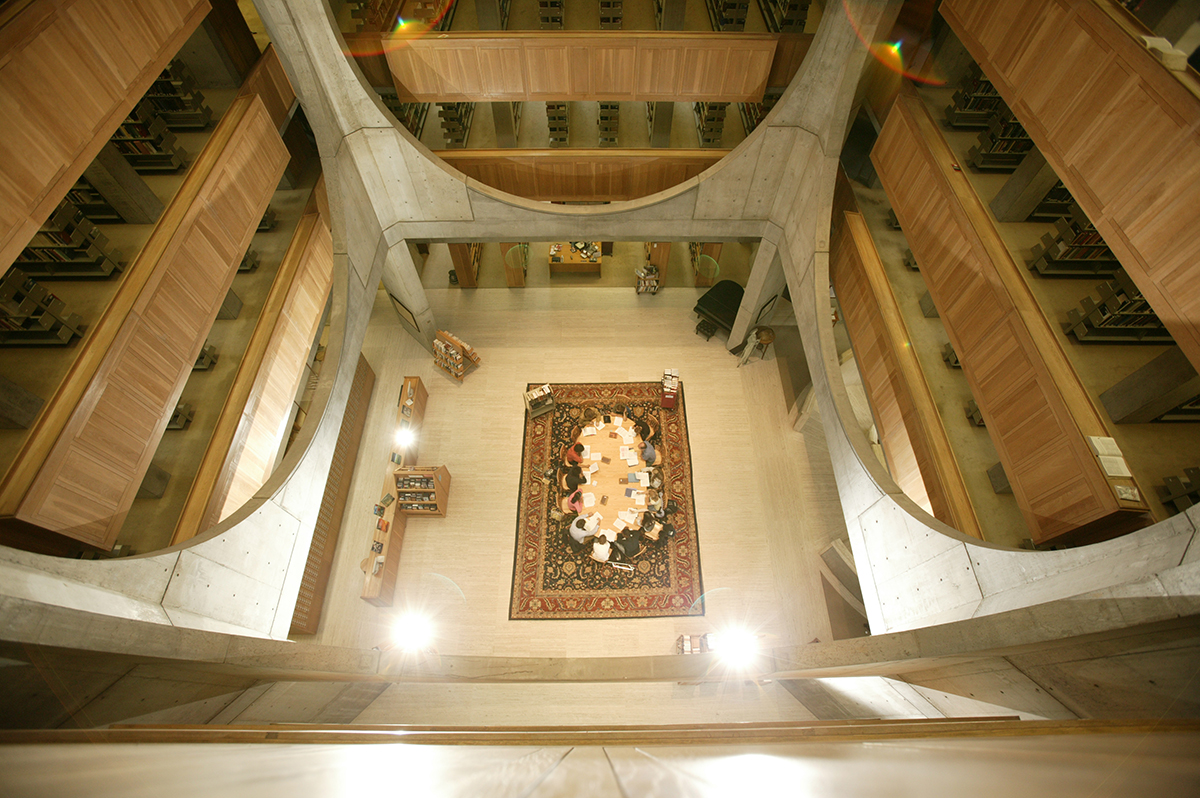
In what is surely a most important moment in the library’s history, both symbolically and practically, Librarian Jacquelyn Thomas ’45, ’62, ’69 (Hon.); P’78, P’79, P’81 decided to place a Harkness table in the middle of Rockefeller Hall, thereby acknowledging that the icon of Exeter’s pedagogy should have pride of place in the library, that it, too, should be recognized as a classroom, albeit a very large and glorious one. Classes have met there ever since, undisturbed and focused, as patrons walked by observing at the table what Exeter is all about.

Harkness tables and Harkness classes in the library have proliferated, so that the dozens of classes held there annually in the early years now number in the hundreds. Prominent among them were those in Junior Studies, an interdisciplinary course for preps begun when the new curriculum was adopted in the mid-1980s. At the end of fall term, all preps and their instructors gathered in Rockefeller Hall for their first Exeter “graduation,” complete with officiants garbed in academic robes, proclamations read and time capsules stored. Four years later, those preps, now seniors, opened those capsules to revisit the artifacts inside from their first term at the Academy.

As preps matured as scholars, the extent of their use of library resources grew, culminating for many in the History Department’s term paper, when 300-plus uppers and a few seniors descended on the library each spring. A collection of sources as extensive as ours, not to mention online databases, allowed students to explore most any topic they could conjure up, such as Boris Pasternak’s Doctor Zhivago as a Cold War weapon through recently released CIA documents; or the 1918 influenza pandemic in New York through the official papers of the city’s Department of Health; or Henry Kissinger’s role in the opening of China through the foreign relations papers in our stacks.

Sometimes this research produced unexpected discover-ies. In 2014, upper Dana Tung included in her bibliography Richard Nixon’s Six Crises, in which she found a “dickey slip” issued to T.G. Katzman on Nov. 14, 1972, 42 years earlier, for missing A.A. Polychronis’ science class. On the opposite side was a note, written by Nathan Radford ’91, stating “… T.G. got this Dicky even before I was born and who knows maybe I’m writing this to someone who isn’t even born yet. … Don’t get stressed. … Stop to smell the roses. Listen to the Grateful Dead. Jerry saves. … Good luck.” Here the library brought together, through Dana’s discovery, three Exonians, generations apart. Dana added her own note to the book, along with Nathan’s, awaiting discovery by a future Exonian.

English classes have long made use of the library’s rare copy of Shakespeare’s Second Folio from 1632 and, more recently, his Fourth Folio, students delicately leafing through with white gloves to marvel at these treasures. Homage to The Bard has taken more robust forms, including the 450th birthday celebration with students, faculty and alums standing on the Harkness table in Rockefeller Hall performing scenes from his plays. That was just part of a spectacular that also featured poetry on a Caliban theme written by English Instructor Todd Hearon and set to music by Greg Brown ’93. The students of English Instructor Becky Moore’s Children’s Literature course used the library’s design itself for a class in which they partnered with children from the Harris Family Children’s Center. Having identified the countless geometric shapes one sees simply by looking around and up in Rockefeller Hall, Becky’s students helped the youngsters find and name them, increasing their mathematical vocabulary.

The Art Department also made constructive use of the design features of Rockefeller Hall. One assignment for an architecture course required students to build a parachute device that would cradle an egg. After the parachute was dropped from the upper levels, it would hopefully land the egg safely, unbroken, on the floor. Naturally, the final day of this project, when students launched their parachutes, became a spectator sport as eager onlookers watched the result: safe landing or … splat. That event has since been moved outside the building, for obvious reasons. And the Modern Language Department for a time oversaw a browsing area and video collection for eager linguists. These examples help explain how the library has secured its place as one of the Academy’s most exciting classrooms.

While we may think of students being those using the library’s resources, faculty have also profited from its holdings for their very serious scholarship. Among the many is former History Instructor Ted Bedford ’48, who, when writing a book on 20th-century American history, recounted asking Reference Librarian Marilyn Worboys whether the Harvard or Dartmouth libraries might have an obscure collection of Depression-era interviews. “Did you check the catalog?” she asked. He hadn’t and, of course, the book was just upstairs. Former History Instructor Michael Golay used the library extensively for his book The Tide of Empire, as well as for a current work in progress. And since he wrote seven books, History Instructor Don Cole no doubt logged many hours rummaging through the collection. Other Exeter faculty have found the library to be a welcoming host for presentations of their published work, as when Dolores Kendrick read from her Women of Plums: Poems in the Voices of Slave Women, just one of the many Academy authors to find there an appreciative audience.

In addition, the George Bennett Fellow, a writer-in-residence chosen by a faculty committee, makes their office in the library for the year and presents readings there for the Academy and the public. Current faculty may also become a Friends Faculty Fellow, thanks to Librarian Gail Scanlon’s idea of inviting instructors into the library, with summer stipends, to work on a project of their choosing. That program is funded by the Friends of the Academy Library, a group of alumni, parents of alumni, emeriti and retired staff whose contributions each year also provide support for acquisitions and many of the concerts, exhibits and other library offerings. The Friends, begun in 1930 and revitalized with the opening of the library in the early 1970s, were for many years chaired by Rob Shapiro ’68, surely one of the library’s most dedicated cheerleaders — his name now gracing the door of one of the classrooms on the fourth floor.

A collection of sources as extensive as ours, not to mention online databases, allow students to explore most any topic they can conjure up.

Just as the library’s holdings have expanded to assist scholars in their work, the collection has grown to accommodate patrons with a variety of interests. As the popularity of CDs grew in the 1980s so did the library’s music holdings — classical, jazz, folk, most any genre — expanding to fill the mezzanine room above the card catalog. When technology shifted to DVDs, the Student Council proposed and the library agreed in 2001 to house CinemExeter, making available what has become a collection of hundreds of movies for student use outside the library. Students have not only contributed ideas about library acquisitions. Over the years they have also urged — and in one Exonian article titled “Library Fascism” even demanded — expanded library hours for more time to study. The latest request, delivered more diplomatically, suggested an earlier opening hour on Sunday. Such eager scholars deserve the kind of library Exeter has provided.

The interior spaces of the library have undergone some revision, particularly of late, all designed to enhance study and reflection. Glass-enclosed study rooms have been added on the third floor, in spaces created by removing stacks not needed for shelving books, providing opportunities for collaborative study of up to four or five students. The Kaplanoff Room on the ground floor is now the Library Commons, where students can study, socialize and even enjoy food and beverages. Most recently, the entire basement has been renovated into expanded space for the archives, with tables in the open middle for research, and the Jay Whipple Special Collections Vault, which will display many of the library’s treasures, to be overseen by our current archivist, Magee Lawhorn.

The Academy Library has also inspired intellectual stimulation and reflection in very public ways, becoming an open forum where art and ideas are presented and discussed. In 1983, Corliss Lamont ’22 endowed, at the suggestion of Librarian Jackie Thomas, a program to bring two poets each year to the Academy. Since then, virtually every major poet, beginning with Argentine writer Jorge Luis Borges, has presented a reading in the library — a list that includes four Nobel laureates and numerous Pulitzer Prize winners. As a companion, in 2004 the Lamont Younger Poet Prize was established, to honor deceased English instructor Rex McGuinn, a champion of young poets, by recognizing the best of prep and lower poetry. Award ceremonies are often held, appropriately, in the library’s Lamont Room, in which formerly hung a portrait of Lamont, painted by the eminent Mexican muralist Diego Rivera. In welcoming the audience to the 2006 awards ceremony, Thomas admitted, “Corliss didn’t much like that portrait, so it’s all right if you don’t either.” Though currently on loan, when the portrait is returned to the Academy, visitors will be able to render their own judgment.

Events hosted in the library have included a symposium on the works of James Agee ’28; an evening with the Benchley family of writers; and a talk with James Baldwin as part of a partnership with the Lamont Gallery on the Harlem Renaissance.

Other events hosted in the library have included a symposium on the works of James Agee ’28, author of the American classic Let Us Now Praise Famous Men, attended by Father Flye, age 96, Agee’s correspondent when a student at Exeter; an evening with the Benchley family of writers with several Benchleys on hand, Nathaniel ’34, Robert ’38 and Robert III; and a talk with James Baldwin, novelist, poet and activist and author of such works as The Fire Next Time, as part of a partnership with the Lamont Gallery on the Harlem Renaissance. Such programs introduced the community to a broad range of American letters, from serious issues of social criticism to lighter topics of humor and satire.

In 2000, “The French Children of the Holocaust: A Memorial Exhibition” featured 250 photographs of children deported to concentration camps, with PEA’s La Cantate, an all-girl vocal group, singing a Yiddish lullaby as part of the opening reception. Projects related to the exhibit developed by a religion class on the Holocaust were displayed in cases in the library’s entry. A year later, 10 monks from Drepung Gomang Monastic University in South India created over several days a large, intricate, colorful and architecturally breathtaking sand mandala on the floor of the hall, entrancing onlookers, who by the time of the ending ceremony of dispersal numbered in the hundreds. Accompanying the sand mandala exhibit were images from Tibet taken by globetrotting photographer Ellen Kaplowitz. In 2006, Michael Rockefeller’s pictures of Dani warriors from the western highlands of New Guinea were on display in the hall named in his memory. A more recent exhibit, titled in a manner to appeal to patrons of all ages, “Harry Potter’s World: Renaissance Science, Magic and Medicine,” explored the ways in which Renaissance traditions played a role in the development of modern science, as well as assisting J.K Rowling in creating the magical world of Harry Potter. These programs represent just a sampling of countless such events hosted in the library since 1971 that expanded and enriched the educational experience of all venturing inside.

As guests walked into the library to attend such events, they might have passed by displays created by the librarians. “Tally Ho” featured just 100 items from John H. Daniels’ ’39 collection of 5,000 “Sporting Books, Prints, Manuscripts and Ephemera” dating from 1500 to the present. Another displayed a portion of the AIDS Memorial Quilt as part of AIDS awareness week in 1994. In 1985, librarians created a “Banned Books” display, an event repeated often since, most recently featuring banned books written by Exeter alums John Irving ’61, John Knowles ’45 and Dan Brown ’82. Such displays seem to encourage a belief in historian Edmund Morgan’s notion that libraries should be “nurseries of heresy and independence of thought.”

Often over the years, exhibits have also showcased the library’s Special Collections, which feature remarkable treasures from the 16th to 21st centuries and have grown significantly since the library’s opening. In 2007, “Expanding the Known World” featured accounts written by noted explorers and sea captains — James Cook on his first Pacific voyage in 1769, Captain William Bligh, he of mutiny fame, on voyages in the South Pacific, and George Vancouver’s expedition to northwestern North America. Speaking of Captain Bligh, among the library’s extensive collection of original manuscripts is Nordhoff and Hall’s Mutiny on the Bounty. While many of the Special Collections are housed in the archives for safekeeping, the Bates Mountaineering Collection of 500-plus titles is housed in its own room open to the public. When the Academy received the 300-plus films of the Ottaway/Adams Silent Film Collection, a showing of “The Phantom of the Opera” marked the event, signifying the collection’s availability for entertainment as well as research. In 1987, the library published a pamphlet, Rarities of Our Time, which details all of the impressive holdings in the Special Collections, yet another part of the library’s inventory of discoveries to be found.

While libraries aren’t usually considered performance spaces, yet another gift our library has bestowed to the community is that it has become a stage, with special qualities that help make it so. Music Librarian Drew Gatto has commented that, “I have always thought of our library as an instrument unto itself … an active performer and participant in the magic being created.” Such magical moments have included the Summer Concert Series, long a welcome addition to the musical experience of not only the Academy but the larger Exeter community, featuring classical, jazz and folk programs. For many years Rob Richards, dressed as Ebenezer Scrooge, has performed Dickens’ A Christmas Carol before audiences that included pajama-clad Academy children sitting on the floor at his feet, enraptured. Storytellers Jay O’Callahan and Odds Bodkin have made repeated appearances, inspiring the creation of the R.W. Ellis “Anvil” Prizes for storytelling, open to Exeter students, with performances often held in the Kaplanoff Room.

“I have always thought of our library as an instrument unto itself … an active performer and participant in the magic being created.”

— Music Librarian Drew Gatto  

Not all visitors or events in the library have been planned, or even welcomed. The first interloper of note, a cat named Mycroft belonging to English Instructor John Kane and his wife, Mary Ann, would slip inside and curl up in sunlit corners, requiring the librarians to launch a Mycroft search before closing to ensure his departure. While accomplishing that chore, they weren’t similarly successful one December night in ferreting out persons hidden away. Then-Librarian Ted Bedford recounted how students snuck out of hiding after the 9 p.m. closing to decorate the giant Christmas tree in Rockefeller Hall, so that surprised librarians found the next morning an evergreen, previously decorated only with lights, now adorned with all manner of cranberry and popcorn garlands and handmade ornaments. Given the tree’s height of 30 feet, that was, as Bedford reported, “no easy task, even for elves with high SAT scores.” Other uninvited guests were not so constructive. Take the Andover students who released 57 mice, painted blue, on floor 3M, requiring their capture by librarians, on their hands and knees. Jackie Thomas patrolled the next day with her cat, McCavity, to ensure the job was complete.

Exeter students have demonstrated their adolescent side as well, using the upper floors as launching pads for all manner of debris: a giant pumpkin, snowballs and, once, a large, inflated palm tree suspended first into the center of Rockefeller Hall and then days later on the outside of the building. In this case. the perpetrator was apprehended and appeared before a faculty committee to receive his punishment. To demonstrate the rehabilitative power of the school’s discipline system, that miscreant is now a tenured member of the Academy’s Science Department.

While four-legged creatures have sometimes been a bane to librarians, their latest appearance is very much a planned event and a welcome one to students — the Study Paws program, which brings faculty and staff dogs to the library to provide furry companionship to harried students during stressful times, particularly in May. That might be considered an oddity for a library, but then again, our resourceful librarians have devised over the years many ingenious ways to lure students inside, such as a miniature golf course laid out among all floors; game nights when various board games are set up around the building; and sleepovers for library proctors, much of this due to the creativity of Librarian Gail Scanlon. Once upon a time, dances were held in Rockefeller Hall, until the evening Thomas noticed, standing in the Kaplanoff Room on the ground floor, the ceiling pulsating above her. That was the last dance. That inviting space has, however, been the scene of all manner of less rambunctious social occasions — retirement send-offs, faculty receptions, small alumni dinners, even weddings and wedding receptions, the latest just this past August between two PEA faculty, Instructors Andrew McTammany ’04 and Tyler Caldwell.

Classes are rarely canceled at Exeter, but they were on Nov. 16, 1971, in order for all students, working in shifts of 400 with faculty acting as monitors, to carry 60,000 volumes, in book brigades, from Davis Library into the new library. Since then, that day has been recognized as the Academy Library’s official opening, celebrated on some occasions with talks by its first librarian, Rodney Armstrong, and Kahn biographer Carter Wiseman ’63, on others by a cutting of a large chocolate cake, in the shape of the library of course, with streamers released from upper floors. On the 40th anniversary, the program featured a three-dimensional installation and projected images with performances by Music Department Instructors Jon Sakata and Jung Mi Lee, an evening that no doubt left attendees with a new appreciation of Goethe’s observation that “architecture is frozen music.” This year, we celebrate the 50th anniversary of our library, an event designed by students that will feature art and film installations with music and poetry performances.

Nothing less is demanded in order to suitably pay tribute to our library, which has become, after all, a national landmark. In 1997 the American Institute of Architects, which each year recognizes a single building that “exemplifies a design of enduring significance,” selected Exeter’s library. In 2005, the library was one of 12 “Masterworks of Modern American Architecture” to be honored with a stamp issued by the U.S. Postal Service (see “Exeter Deconstructed,” pg. 24). More important than those accolades is what has happened, what has been discovered, inside the building and what that has meant to all who ventured inside. Librarians over the years, its chief stewards, but assisted by faculty, students, alumni and friends, clearly have always seen the library as more than a depository of books. For the past 50 years, in addition to making it a haven for scholars of all ages, they have made it the intellectual and cultural center of the campus. Beyond expanding the mind, we have discovered there much to excite our emotions and enrich the spirit, a legacy that gives great promise for the next 50 years.

Archives provide home for Exeter’s treasures

Two floors below the splendor of Rockefeller Hall and its soaring reaches and downstairs from the warm confines of the Library Commons, the Class of 1945 Library’s latest treasure awaits discovery.

The Center for Archives and Special Collections, quietly opened on the library’s bottom floor amid the grip of the pandemic, is home to Exeter history and its rarest cultural and literary gems. Once a dreary basement filled with two centuries of the Academy’s past, the space has come to life through the vision of now-retired Librarian Gail Scanlon, the artistry of Ann Beha Architects and the generosity of the family of Jay N. Whipple Jr. ’51.

Magdaline “Magee” Lawhorn, the head of Archives and Special Collections since 2019, helped shepherd the project to the finish and is the proud keeper of a space she hopes becomes a popular destination for Exeter students.

“People value their own history, and they want to collect their own story for future generations,” Lawhorn said. “But I think now the field has shifted to be like, ‘OK, we’re not just here to hoard things and preserve them, we have to create teachable moments from these resources or else, they’re just taking up valuable space.’

“I want these collections to be seen. I don’t want us to just hide them somewhere. Because at the end of the day, yes, we’re supposed to preserve and protect these materials for humanity, but at the same time, if we’re protecting them to the point where they’re inaccessible, we’re doing a disservice to humanity as a whole.”

Lawhorn recently offered a tour of the revamped space to reveal some of the center’s new spaces:

The Whipple vault

The Jay Whipple Special Collections Vault is one of the jewels of the redesigned space. The vault features a state-of-the-art fire suppression system. “[The Whipple family] understood that we need to preserve the history of the school,” Lawhorn said. “We have the Shakespeare folios, we have first editions — things that like, we might want to either showcase here, which is nice to have like a showpiece area, but also things that we just want to protect.”

Rare books and first editions

Exeter has been gifted some wonderful collections and libraries through the years. First editions include the works of Virginia Woolf, Willa Cather, John Updike, John Steinbeck and more. “Many of these were gifts, or, for instance, we have Jeremiah Smith’s personal library back there,” Lawhorn said. “A lot personal collections and personal working libraries donated over time.”

The archives

When your school was founded five months before the British surrender at Yorktown, you have a lot of history to preserve. Digitization efforts are continuous, but the archives features shelves and shelves of documents, publications, research papers and other memorabilia saved since Exeter’s early days.

The vitrines

Six new glass display cases allow the archivists to show off some of the school’s most prized possessions, safely and thematically. “People can access it on all sides, which I think is important,” Lawhorn said. “I enjoy this more versus sometimes just hanging something on a wall. It makes it more user-friendly.”

Exonians in print

There is no lack of authors in Exeter’s alumni rolls, and the archives has published works from hundreds of them dating back to graduates from the 1800s.

A classroom

The addition of a classroom provides space for faculty and students to study the center’s treasures together. English Instructor Eimer Page’s seniors visited recently to pore over the Academy’s Second and Fourth Shakespeare folios, the former first published in 1632. “We concentrated on Hamlet and the discrepancies between the folios and the 21st century versions,” Lawhorn said. The class space, sandwiched between the offices of Lawhorn and her assistant, makes it easier to put Exeter’s past into the hands of current students (adorned in gloves, of course).

Big Red makes history at Head of the Charles

Exeter girls crew made history Sunday at the Head of the Charles Regatta, racing to a second-place finish in the youth girls four championship, the first time Big Red has earned a medal at the famed regatta.

Exeter’s four of Jacqueline Luque ’22 (cox), Charlotte Pulkinnen ’22, Matilda Damon ’23, Jamie Reidy ’24 and Edie Fisher ’24 finished second in a field of 84 crews, covering the 5-kilometer course in 18 minutes, 53.539 seconds — less than a second behind the first-place boat.  

The Head of the Charles is the world’s largest regatta, with a field of hundreds of talented crews that draw thousands of spectators to the banks of Boston’s Charles River.

I’m just so excited for this group. They embraced the philosophy that you get faster for your teammates, were hungry to improve, and always seeking ways to perfect their form."
Coach Sally Morris

“I am beyond excited, happy and proud for the girls four,” said Big Red head coach Sally Morris. “I knew that they rowed well, and that they trained hard and loved to work hard and for each other. What I did not know was how fast they would be with respect to this international regatta, racing against top crews from around the world. My hands were shaking as I saw Phillips Exeter Academy at the head of the pack.”

Luque even received consistent praise of her performance on the live broadcast of the race.

“I’m just so excited for this group. They embraced the philosophy that you get faster for your teammates, were hungry to improve, and always seeking ways to perfect their form,” Morris said. “I am so proud.”

The course, which winds through difficult turns and under narrow bridges filled with rowdy spectators, creates a tall task for any coxswain. The regatta is often referred to as the coxswain race. Luque answered the call in expert fashion.

“This crew has a tenacious, humble, intelligent, and confident coxswain in Jacqueline Luque,” Morris said. “Jacqueline prepared her mind and soul for this race by careful study of the course, watching videos of previous races, and research into effective calls and strategic hull placement at each critical turn in the course. Without the keen line she executed over a three-mile, winding course, the boat would not have gone this fast.”

The boys four also enjoyed an incredibly strong performance for Big Red as a crew of Ryan Kim ’23 (cox), Weiyi Huang ’23, Haakon Kohler ’23, Alexander Galli ’22 and Justin Rigg ’23 rowed to a 17th-place finish in a field of 84 boats with a time of 17:56.389.

The boys eight crew of Juno Cowans ’23 (cox), Ware Guite ’22, Carson Bloom ’22, Charlie Holtz ’23, Shrayes Upadhyayula ’22, Mikey Bean ’22, Andreas Lorgen ’22, Parker Seymour ’23 and Alex Luque ’22 was 53rd with a time of 16:55.002. The girls eight crew of Veruka Salomone ’23, Michelle Park ’22, Emma Lyle ’22, Lucy Weil ’22, Ellie Ana Sperantsas ’24, Jancie Robbins ’23, Hannah Vogel ’23, Vedika Amin ’24, Liza McMahan ’22 and Cindy Su ’23 rounded out Big Red’s effort with a 54th-place finish, crossing the line at 19:41.812.