

Diversity, equity and inclusion .. are principles that prompt us to honor and dignify the humanity of all people regardless of where they come from and what they aim to become.”— Anna Gifty Opoku-Agyeman
commonmedia
Willie O'Ree, hockey trailblazer, addresses assembly
When the sharpened blades of Willie O’Ree’s skates met the sheet of ice inside the hallowed Montreal Forum in January of 1958, the hard-checking winger from Fredericton, New Brunswick, achieved his life’s goal of playing in the National Hockey League as a member of the Boston Bruins.
It wasn’t until later that the then 22-year-old would begin to comprehend the magnitude of the moment not only for himself, but for the league, the sport of hockey and the generations players that would follow.
“I didn’t realize at the time that I had broken the color barrier in the National Hockey League — that there had never been a Black player,” he told Assembly.
Like Jackie Robinson, who a decade earlier broke Major League Baseball’s color line, O’Ree’s presence in his sport drew jeers from opposing players and fans.
“I never fought because of racial remarks because I knew I’d be in the penalty box all the time if I did,” he said. “I just let it go in one ear and out the other.”
Racial prejudice wasn’t the only adversity O’Ree overcame during his career. As a junior player he was struck in the face with a puck causing the loss of sight in his right eye. Fearing his disability would prevent him from getting a shot at the pros, he kept the extent of his injury a secret.
“I just said, forget about what you can’t see and concentrate on what you can see,” he said.
During his 20-year professional hockey career, O’Ree played in just 45 contests across two seasons at the game’s highest level, but his impact on the sport and the NHL continues decades later. After hanging up the skates, O’Ree began working with league as an ambassador for NHL’s Diversity Program. His “Hockey is for Everyone” initiative seeks to bring the game to underserved communities across North America.
“We won’t turn any boy or girl away. If they want learn how to skate, we’ll have them learn how to skate. If they want to play hockey and get into an organized hockey program, that’s our job.”
Following the presentation members of Exeter’s hockey program, Akili Tulloch ‘22 and Manan Mendiratta ’22, moderated a Q&A session where O’Ree addressed the state of diversity in the NHL today.
“The game is so much better than it was, it’s opened up to not only Black players, but all players of color,” he said. “There are approximately 40 players of color playing in the league now.”
O’Ree’s Assembly appearance came on the eve of MLK Day weekend which featured a series of events including the student-produced variety show, “UnSilenced,” and a keynote address from Anna Gifty Opoku-Agyema.
The Bruins will honor O’Ree by retiring his jersey number in a ceremony on Jan. 18.
Exeter embraces life, legacy of Dr. King
Harkness warms a winter morning
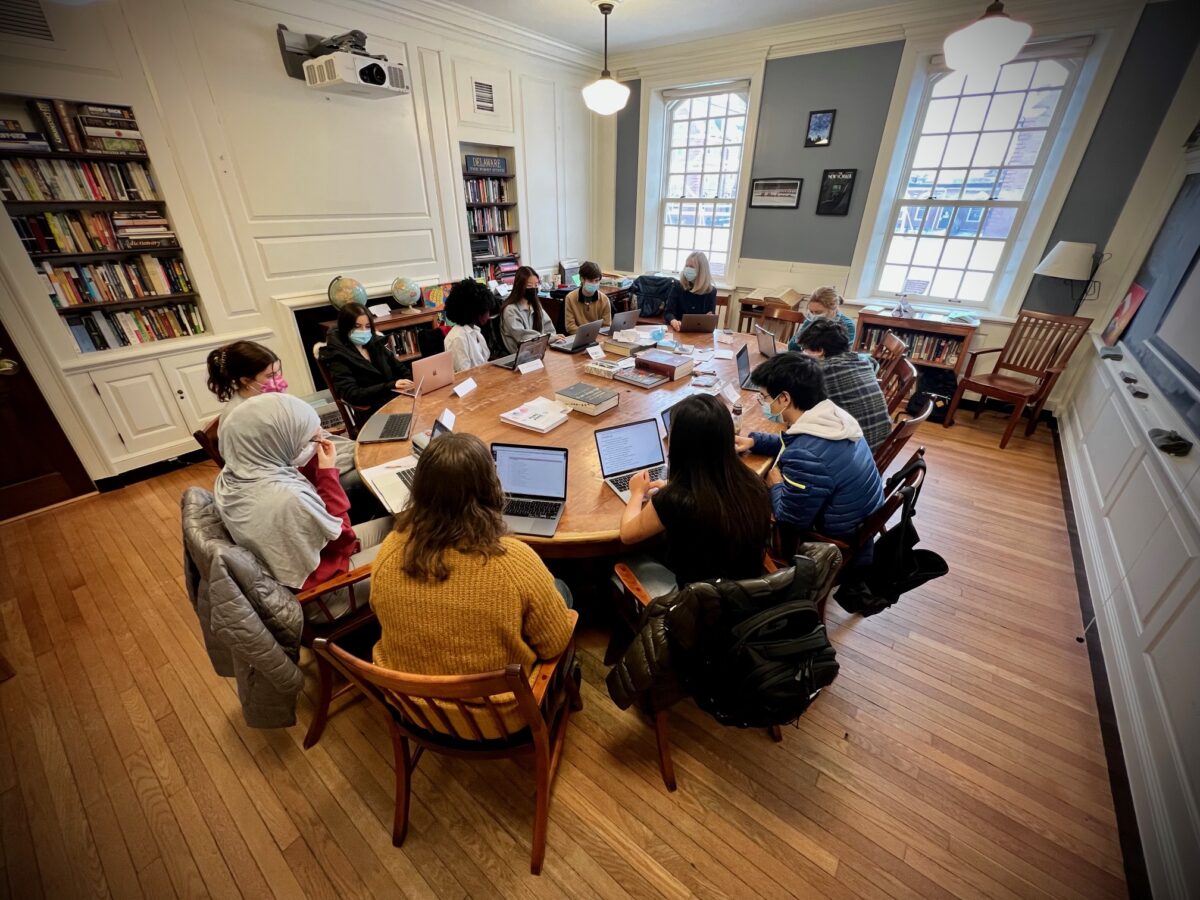
The tappity-tap-tap of laptop keys is the only sound in Phillips Hall’s Room 108. With eyes closed, it could pass for July rain on a pane, but this is a gray January morning, and the term “wind chill” is trending.
Genny Moriarty’s English 320 class is warming up with a writing exercise. What do you think of when you hear the word “tending”? Describe a moment, a memory, of someone caring for you.
The tappity-taps wane, and Moriarty introduces the day’s topic: Elizabeth Alexander’s poem “Tending.” Alexander is most famous for her poem “Praise Song for the Day,” composed for and delivered at President Barack Obama’s first inauguration. She also graced Exeter’s stage in 2019 as part of the Lamont Poetry Series.
Alexander visits this day via YouTube and a recorded recitation of “Tending.” The dozen 10th-graders follow with a collective reading, handing the poem around the Harkness table line-by-line like a bucket brigade fighting a fire.
In the pull-out bed with my brother
in my grandfather’s Riverton apartment
my knees and ankles throbbed from growing,
pulsing so hard they kept me awake.
Moriarty asks the students to peel off into groups of two and three for a few minutes to share their interpretations and note the lines and phrases that jumped out. Then, the group discussion kicks in.

“The last five or six lines don’t really make sense,” Max says.
Did sleep elude me because I could feel
the heft of unuttered love in his tending
our small bodies, love a silent, mammoth thing
that overwhelmed me, that kept me awake
as my growing bones did, growing larger
than anything else I would know?
“I felt those were some of my favorite lines,” says Rowan. “How I interpreted them is that she’s trying to describe the love her grandfather has for them, and how he shows it.”
Adds Avery, “I thought his love was so much, her body can’t hold it all.”
“The word ‘overwhelmed’ …” says Audrey, “like his love is so unconditional and all-encompassing, I guess there’s a sense there’s so much of it, she’s almost taken aback by it.”
Parmis notes Alexander’s word choices belie the poem’s theme of love and caring. “Overwhelming, prison doors, the physical pain she’s feeling … Those are not things usually associated with love,” she says. “Is this a positive poem or negative?”
“I feel like it’s negative,” answers Kenza. “I’m gathering that maybe the narrator has a smaller, less confident sense of herself. Maybe love overwhelms her because maybe she doesn’t think she’s worth it.”
“Love isn’t always perfectly happy,” suggests Hannah. “She’s trying to show the good and bad sides of it.”
Moriarty steers the students back to their own writing for the class’ final few minutes, then sends them off into the January gray, a model Harkness discussion under their belts.
Rock star geologist gives Exeter a tour of Mars
Sarah Milkovich ’96 has remote learning down.
It’s not that the Exeter grad embraces the Zoom life. It’s that her area of expertise — and her focus for most of the past 15 years — is 200 million miles away.
Milkovich is part of NASA’s Jet Propulsion Laboratory and the lead science systems engineer for the Mars 2020 rover mission that includes the rover Perseverance and the robotic helicopter Ingenuity. A planetary geologist by training, she is part of the team zig-zagging the Red Planet from Earth, scraping rocks, scooping soil and collecting samples for immediate and future study.
>> Watch Dr. Milkovich’s full assembly address
Milkovich shifted her virtual focus closer to home last week, addressing the Academy’s assembly over Zoom. She gave Exeter students a tour of Mars courtesy of Perseverance’s imagery and an overview of what she does and what the mission hopes to accomplish.

The Mars of today is extremely inhospitable. An early January day — late summer in the planet’s northern hemisphere, where Perseverance roams — ranges from a high temperature of 21°F to a low of -115°F. The Martian atmosphere consists almost entirely of carbon dioxide and is so thin so as to prohibit the existence of liquid water at the surface.
But Milkovich told her audience that Mars of about 3.6 billion years ago is believed to have been a far different place, one very similar to Earth in the same period. “The idea is, that if ancient Mars and ancient Earth were so similar to each other and on ancient Earth, the conditions were right to start life, why couldn’t it have started on Mars as well? And that’s what Perseverance is all about; trying to answer that question.”
Milkovich’s curiosity of the heavens began while still a student at Exeter. A native of Ithaca, New York, she spent summer breaks at home interning at Cornell University and working on a project that designed a spacecraft that could orbit an asteroid and record its findings. She received her bachelor’s degree in planetary science from California Institute of Technology and her master’s and doctorate from Brown University in planetary geology, with studies of ice on Mars and volcanoes on Mercury. She started at NASA’s JPL in 2005.
Most of the past 15 years, she has worked on Mars projects, and the last year has been Perseverance. The second rover, after Curiosity, to scour the planet, Perseverance set down last February.

You have to be ready to say, ‘Yes, that sounds terrifying, but I'm going to try it because it also sounds fascinating'."
“We’re studying the rocks, and we find really compelling rocks that we think could tell us a lot about the history of Mars and the potential for past life on Mars,” Milkovich explained. “We have a drill, and we collect cores of rocks, seal them up for hopefully a future mission that will come pick up those cores and bring them back to Earth for analysis in laboratories. So, we are the first step of a Mars sample return campaign, which is hugely exciting to a planetary geologist!”
Milkovich fielded questions after her presentation, helping would-be space explorers to imagine a future in the field — and offering advice that extends to any pursuit.
“A lot what happens is that something comes by and you have to be ready to say, ‘Yes, that sounds terrifying, but I’m going to try it because it also sounds fascinating,’” she said, “and just leap wholeheartedly in.”
For the record, she is hopeful that there is life elsewhere in the universe, she does not believe aliens have visited Earth and that any future habitation of Mars will be limited to the hardiest of souls.
“Long-term settlements, like in buildings or underground, that psychologically will be very difficult,” Milkovich said. “If you think about the difficulties that we’ve all had in the last couple years, wearing masks and staying indoors … Think about Mars. If you’re ever not in a room, you’re going to be wearing a spacesuit. You will never feel the breeze on your face. So, I think it’s only going to be a very rare small group of people who are going to want to live like that. I think that’s when of the things that people don’t take into account when they get really excited about long-term human presence on Mars.”
A couple hundred million miles away isn’t so bad.
More to explore


Exeter Today
Happiness is just a deep breath away, author says
Health’s Angels lift up student wellness
Exeter student group is dedicated to promoting good habits and self-care to peers.
It’s a chilly fall day, but under a tent on the quad, students are all smiles.
They’re participating in a positive psychology event created by the Health’s Angels, Exeter’s peer health education leaders, to promote student well-being. “There’s scientific proof that smiling makes you feel better and happier, even if you fake it,” says Health’s Angel member Anne Chen ’22, who manned the smiling booth, snapping Polaroids.
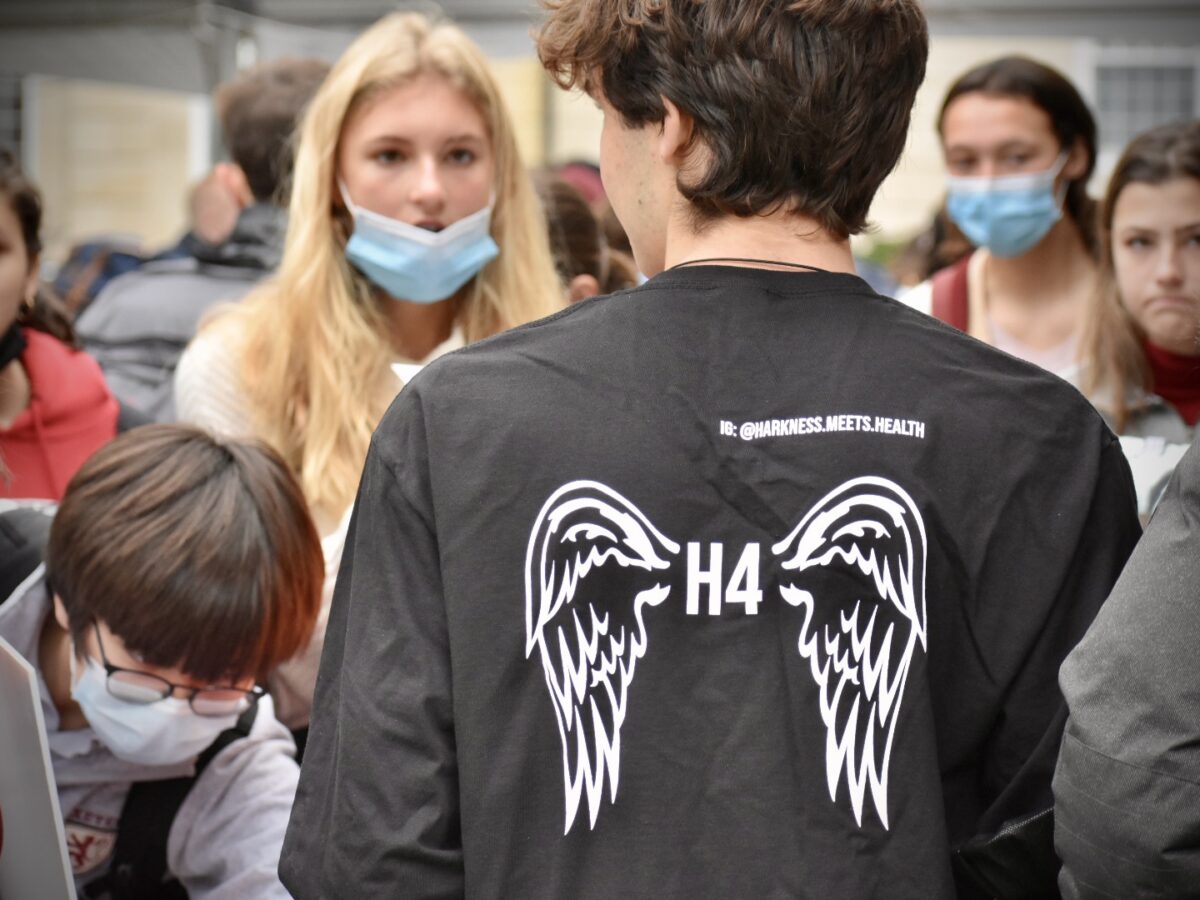
The Health’s Angels don’t have wings — except the ones printed on the back of their black T-shirts — but they’re helping lift up student wellness and self-care at Exeter. The positive psychology event is just one of many activities that the student volunteers have created in conjunction with the Health & Human Development Department and the team at Counseling and Psychological Services. “We tackle a lot of issues that are important to students, like stress and lack of sleep,” says Georgie Venci ’22. This year, Venci helped rebrand the volunteer group, formerly known as H4, as the Health’s Angels. “I enjoy being part of the solution and encouraging kids to have positive health practices,” he says.
Established by current Dean of Residential Life Carol Cahalane to help disseminate student health information, H4’s earliest efforts included distributing newsletters with timely health suggestions around campus, even taping them to the walls of bathroom stalls. While Health’s Angels still produce and distribute newsletters, “we wanted to grow the program into a peer education program,” says Michelle Soucy, chair of the department of Health Education and a Health’s Angel adviser. “If you’re trying to send a healthy message to teens, it’s going to be more successful coming from their peers than adults.”
Members of Health’s Angels are lowers, uppers and seniors who completed a year of health education; they’re invited by health faculty to apply to be in the group. Through their work, they can become nationally certified peer educators. “Our goal is to have a diverse range of health educators — day students, boarding students, athletes, non-athletes — a group of kids who wouldn’t normally work together,” Soucy says.
The Angels’ weekly lunches with Soucy and other health educators are an opportunity to connect, brainstorm and have fun. Wellness initiatives and events are created based on feedback from peers. The positive psychology fair was their first major event; during “Hell Weeks” (the busy two weeks between Thanksgiving and winter breaks), the Angels hung oversized mandalas in Agora for students to color as a relaxation exercise. They’ve also produced bookmarks with suggested language for students to use if they want to access counseling on campus. Members also lead “House Calls,” a 15-minute program focusing on specific topics like sexual health, nutrition and stress for dorm residents or sports teams. “The kids are really dedicated to improving health on our campus, especially mental health,” says Soucy.

Venci was excited to join Health’s Angels as a lower. “I joined because I wanted to be a positive voice of change and let people know there are others who want to support them,” he says. “I think that’s helpful to hear, especially for new students.” He adds, “Health’s Angels feels like a collaboration with your best friends. I always look forward to our lunches.”
Chen agrees. “Everyone’s so excited to do this work,” she says. As a proctor in Williams House, she regularly talks to students about health concerns. “My dorm has struggled with dietary habits and eating right because everyone is so busy,” she says. “I talk to them a lot about maximizing dining hall options and establishing eating patterns and schedules.”
Future health events include a tour of the athletic facilities, including Downer Family Fitness Center, for non-athletes, introducing students to the trainers and teaching them proper use of the fitness equipment. “A lot of people are intimidated by the gym,” says Malcolm John ’22. “It’s a barrier to so many people’s fitness. We can show people it’s not scary and how to use the gym effectively.”
Being a Health’s Angel has changed Chen’s definition of what it means to be healthy. “I have a more nuanced understanding of health issues here at Exeter,” she says. “I take much better care of myself. Health’s Angels has made me a better proctor and friend.”
That’s worth smiling about.
Pedaling tales: Bike trek finds global impact of climate crisis
Devi Lockwood ’10 discovered her love for listening to people and hearing their stories amid one of the darkest episodes of her life.
A junior at Harvard in April 2013, Lockwood was in Boston when two brothers detonated homemade bombs near the finish line of the Boston Marathon. Three people were killed in the blasts; 264 more were injured, including 17 who lost limbs.
A manhunt ensued, with the entire city on lockdown until the perpetrators were caught.
“When that lifted, all I wanted to do was talk to strangers and to remind myself that not everyone is murderous,” Lockwood told an assembly audience last week during a visit to Exeter. “I cut open a cardboard box and wrote ‘open call for stories’ in Sharpie on it, and wore that as a sign around my neck while I walked around the city. And some people stared at me, they thought it was pretty weird, but some people approached me to share a story. And once I started having these conversations and listening to strangers, I really didn’t want to stop.”
That summer, Lockwood rode her bicycle 800 miles down the Mississippi River, wearing the sign as she went. “The farther down the river I rode my bike, the more stories I was hearing, specifically about water and climate change, in terms of intensifying storms, salt water encroachment on the land, and people making the decision to leave places that they had called home for generations in the aftermath of a big storm.”
What began as self-therapy turned into an odyssey that continues today. Lockwood has traveled across 20 countries on six continents — mainly by bicycle — to document stories about the effects of climate change. Her research has resulted in her first book, 1,001 Voices on Climate Change, published by Simon & Schuster in August 2021.
“I was wondering, what might it mean to put those voices in dialogue with the stories of people from other parts of the world?” she recalled. “My goal became to listen to those stories about water and climate change, and amplify the voices of people I met, who were the most impacted.”
After a brief assembly presentation, Lockwood sat for an interview on stage with seniors Lina Huang and Emma Chen. Below are highlights of that conversation:
You’ve collected 1,001 stories, which is a tremendous amount, and we’re wondering if you see any recurring themes throughout that? And how do you highlight some of these unifying elements while preserving the unique context of each story?
I would say one thing that surprised me in how common it was across geographies was the theme that climate change can drive migration. I remember meeting this one modern dancer in Bangkok, and he told me that his family had grown rice for generations in the rural North. And because of changing rainfall patterns, growing rice as a livelihood was just becoming unpredictable and something that he couldn’t imagine for himself and his future. He, like many people of his generation, and he wasn’t that much older than I was, had made the decision to move to a city in search of work. … Climate change is driving migration and it’s exacerbating related issues. It’s not just about what’s happening in the air or in the rain, but how people are impacted by that has this domino effect elsewhere.
Your theme of slowing down was really powerful for me to read, especially with the notion of, you have to keep on moving, you have to keep on doing things; and just the ability to let yourself have space and time was really powerful. Along those lines, you mentioned it contributed to your practice of deep listening and how you get your interviewees to open up to you. How did you develop your techniques, and how did they change over time?
I was really bad at this at first, I have to be honest. I listened back to some of those audio recordings I made while I was traveling down the Mississippi River, and I was like, “oh God, I’m stepping over people, I’m asking questions when they’re not even done answering what I had just asked before.” And it made me realize that good listening is often listening without the intention to respond. It’s being present. It’s being comfortable with silence sometimes, frankly, which I think was something that had scared me beforehand. I felt the need to just jump right in and ask a question, but sometimes silence is just people thinking of the next thing to say. That’s not a bad thing.
And I think just fully communicating, non-verbally, that I am there to experience the gift of someone sharing their story with me, and receiving it as such. And so yeah, all of those things combine together. And it’s a practice that is not always easy, especially if it’s someone’s point of view that I disagree with, but try to approach those types of conversations also from a place of curiosity, frankly. Why do you think the way that you think? How did you get to this point, and what can I learn from that? And I really do believe that everyone has something to teach me, if only I slow down enough to listen. It’s not always easy to do that, but it can be a really fun thing to do at its best.”
When you write these stories, how do you see yourself? What do you see as your role, as a documenter or a story re-teller? And how much do you edit in the process?
It was fun to sit down and rehash all of this, in part, because when I was writing, it was mostly during the pandemic year. And so I wasn’t able to travel physically, but I was traveling in my mind in the evenings when I was writing this after work. It was a really big challenge for me to figure out how much of myself to put in this book, because I didn’t want readers to feel like I was using the storytellers, or that the book was all about me, because it’s really not. But I also realized that I had to be the narrative sinew connecting these stories together, because it doesn’t make sense if it’s not grounded in the journey that led there in the first place.
I think a lot of the editing process was figuring out which stories to include, which felt the most interesting to me, which would bring in new themes, and also talk not only about the lived experiences of people who are living with climate change right now, but I interviewed a handful of climate scientists, too. Getting those two types of stories in dialogue with each other, that was the juxtaposition that I was trying to get at. And yeah, just getting it to cohere as a whole was a really fun adventure of a process.”
When you mentioned listening, that brought to mind [that] you’re an Exeter graduate. And I feel like part of Harkness is also learning to listen and let other people speak. So, I’m wondering, how did your time at Exeter inform your work?
Oh, my God, so many different ways. I think I was a pretty shy and quiet kid when I came here. I was a new upper, I lived in Gould House, I was grateful to have a tiny community in the bigger one; but also felt really overwhelmed my whole first semester, because every day, all day, from when I woke up and went to breakfast till when I went to sleep was having conversations with people, and I wasn’t used to talking that much and it was really tiring. But then I got used to it, and I think I realized I can have a conversation with anyone, and that’s a great technique for doing this kind of project. Yeah, Harkness is as much about listening as it is about talking, so I think that that was a practice that I started to learn how to do here.
I just had a handful of really incredible teachers while I was here who were able to bring out different aspects of thinking deeply about language. I remember being in Ms. Moore’s English class, and we would underline verbs and have these long, drawn-out conversations about what a verb is and what it does and how good writing is driven by verbs and verbs are the engine of the sentence, and I think about that all the time. Or even being in Ms. Foley’s class, we did a gender studies class together, and I did a final project where I was doing interviews and then writing poems based on those interviews. And that was a version of what I ended up doing for my senior thesis at Harvard that then inspired this book. So yeah, it all comes back to here.
How did you change throughout this experience? And also, do you have any advice for students here, how we can be more open to exploring?
It’s important to learn how to manage your time really well, and then sometimes it’s important to throw that lesson out the window, too. I think that there’s a certain weirdness that not a lot of people talk about that, OK, you go through high school and then you go through college, and then what? Suddenly this map that I’ve followed so carefully from birth to college graduation, it’s like, “Oh, oh God, I need to make some decisions for myself right now.” And that’s a really scary time, because also the community dissolves overnight, people are going in different directions. And for me, this project was how I channeled my creativity through that time and got through that time. And it was a weird path into young adulthood, I guess.
But I think if I were to give advice, I would encourage you guys to use the scariness of that time to listen to yourself more than anyone else, and be like, “OK, what is it that I love? What is it that energizes me? What am I really good at?” And then, “How can I use that in service of a cause that I care deeply about?” For me it took this form, but for you guys it might look like something completely different, and that’s equally valid. I think really taking that time to be with yourself and to get to know yourself at that point can be really important.
What do you think the climate change movement should do moving forward, especially because you talked about highlighting stories and going beyond the statistics to show the human side of things?
I think there was one really instructive interview I did in New Zealand with this couple who were what we might call climate deniers. And I was curious to ask them, “OK, what led you to this point? How’d you get there?” And they told me about seeing the same coverage about climate change over and over again on the news on TV, where they would see an image of an iceberg calving into the water and glacier, and they felt skeptical of that because the imagery was always the same. So, I think the more that we can find different ways to discuss these issues and to just, frankly, diversify the metaphors that we use, not only the human stories and the voices but it doesn’t have to be polar bears. It doesn’t have to be always defaulting to the white coastal male elite, who we might turn to, to be the so-called expert on these issues.
For me, expertise also comes from lived experience, and that’s equally as valid as having a PhD in atmospheric sciences. And it’s important that we understand those dynamics and understand the science, and really great metaphor and good asking questions of those scientists can help us get there, to a point where it’s maintaining the nuance of the science but also easy to understand. But not only that, but we need to just broaden how we discuss these issues, and I think that the movement as a whole can do a better job of that.
You are a science journalist, and in journalism, there’s been a reexamining of the concept of objectivity. And I’m curious about how you deal with the lens you bring to your work, and you as a person going out there collecting stories.
I think it’s important for writers to know themselves really well and know where their biases are and know where their blind spots are and be open to being called out on that, so I think that that’s an openness that I’ve tried to bring. But it’s an important question, I think the backbone of good journalism is facts, and facts are not questionable. So, I think that some of that discourse has been leaning into this really problematic territory where people feel like they can dispute facts or do their own research on an issue. And so that’s where I’d really shy away from it, and be like, “No, we have these things in common, and then what we do with them is what the job of the journalist is.”
More to explore

Exeter Today
Assembly lineup boasts groundbreakers, changemakers

Exeter Today
Exonians urge climate commission to 'take the leap'
Fall MVPs and All-NEPSAC award winners announced
What is awesome? Sam Buttrey '79 wins Jeopardy!
Making progress
Freshly returned from Thanksgiving break, dozens of students gather in the ample space of the Bancroft Hall common room. The meeting on this Tuesday morning is part of the ongoing Core Values Project. Built into the academic schedule, these regular meetings further the community-wide, anti-oppression work done over the past year, focusing on student-led initiatives.
As the group of nearly 50 fans out around the room, some in chairs, others more comfortable on the floor, moderator and Director of Athletic Training Adam Hernandez gets the conversation started. Students in this CVP subgroup, “Windows and Mirrors: Multimedia Representations of Anti-oppression, Community Values, and Justice at PEA,” spent the fall term split into seven clusters ideating ways to spread messages of equity using various platforms.
The directive from Hernandez is for the groups to intermix and share the progress of their projects to this point in the year. Evan Gonzalez ’22 speaks on behalf of his groupmates about their hope to revive a once-popular travel opportunity for students to visit the National Museum of African American History and Culture in Washington, D.C.
“We want to make these trips as available as possible,” he says. “Right now, we’re hoping to secure a couple of buses for anyone who wants to sign up.”
Other students share plans to hold a fashion show, make a video or create an art installation, all with the common thread of diversity, equity and inclusion.
Similar meetings, with varying DEI themes and objectives, happen simultaneously across campus including “Talk About It,” moderated by Associate Dean of Multicultural Student Affairs Hadley Camilus and Charlie Coughlin ’22, which started as an anti-racist minicourse last school year. Other subgroups are being pitched for winter term.
Eric Zhang ’22 says he signed up for the “Windows and Mirrors” subgroup because of the freedom to get creative with how to deliver a message.
“The multimedia aspect gives you so many different outlets to reach as many people as possible,” he says. “I think that this core values project kind of gives us the opportunity to make an impact on the rest of the school.”
Students will reconvene in the new year with a push to have projects completed by the end of winter term.
News


Exeter Today
