Phillips Exeter Academy

Panel probes the power of language

At a time when talking about race in the classroom is more important than ever, a moderated panel discussion offered by Exeter’s Office of Multicultural Affairs (OMA) focused on the evolution of the term “Negro,” as well as how teachers and students can navigate the use of such sensitive language in order to foster more open, inclusive conversations.

Entitled “Negro…Pejorative, Outdated, or Both?” the webinar took place Feb. 16, as part of OMA’s commemoration of Black History Month. In response to a question from moderator Ki Odums ’23, Dr. Patricia Davis opened with a brief background of how the term Negro came into widespread use in the late 19th-early 20th century, with the leading intellectual and activist W.E.B. Du Bois as its greatest advocate.

“He believed ‘Negro’ was more appropriate…as opposed to ‘colored,’ which was the previous term,” Davis, who teaches communication studies at Northeastern University, said of Du Bois. “He felt it made a stronger statement about who African Americans were, particularly during an era when [they] were making strong citizenship claims in the face of Jim Crow.”

With the rise of the Black Power movement in the mid- to late-1960s, “Black” emerged as the preferred term, with “Negro” dismissed as outdated and relatively negative. “African American” came into widespread use in the 1980s, and Davis said she now uses both “Black” and “African American” interchangeably in her own writing.

I always tell my students ‘Make sure that you’re attuned to the potential sensitivities of your classmates.’"
Dr. Patricia Davis, Northeastern University

Davis’s co-panelist Dr. Lamont Slater, who teaches history at Talladega College, sees the term “Negro” as outdated, but not necessarily pejorative. He uses it not only as a historical point of reference but also as a marker of a “prideful moment” in Black history, particularly during the Harlem Renaissance and the New Negro Movement of the 1920s and ’30s. “However, [“Negro”] can be looked at as negative as well, depending on the person’s body language, and who’s using it,” Slater added. He mentioned the notorious example of Senator Harry Reid, who observed in 2008 that his then-Senate colleague Barack Obama could potentially win the presidency because he was “light-skinned” with “no Negro dialect.”

So much about language in the classroom depends upon who is speaking, agreed a third panelist, Dr. Benjamin Wendorf of Quinsigamond Community College. As a white professor who teaches African and African American history, Wendorf says, “I’m not going to position myself as an expert on the people that we’re covering in this history…I have to earn trust with students, especially Black students and students of color.”

All three panelists spoke of the difficulty of reading primary sources with students, many of which might contain language that is now considered offensive. They agreed that making efforts to prepare students beforehand so they know to expect sensitive content is crucial. Before they read negative references to Black people in historical texts, Slater said, he tries to present uplifting texts as a counterweight, including works like Maya Angelou’s I Know Why the Caged Bird Sings and The Warmth of Other Suns, Isabel Wilkerson’s history of the Great Migration.   

During the Q&A, moderator E.J. Barthelemy ’23 asked a question from an audience member about what the panelists would direct a white student to do when reading a primary source quotation aloud in class that contains the word “Negro.” Should they voice the word, or simply leave a pause, and why?

“You have to know your audience,” Slater answered, adding that teachers should have a clear plan on how they run their classroom in order to prepare for such moments. He explained how his own teaching methods draw on his experiences teaching in southern Africa and the traditional concept of ubuntu, which emphasizes our common humanity and interconnection.

Was reading aloud in class even necessary, OMA Dean Hadley Camilus wondered, given that everyone is looking at the same texts?

Slater and Wendorf agreed that they tend to avoid reading material aloud in class, though Wendorf added that in some instances, it might be necessary in order to get the full meaning of the work. He mentioned the influential 1897 essay “Strivings of the Negro People,” in which Du Bois described the “double-consciousness” he and other African Americans were experiencing at the end of the 19th century. “These are famous, classic phrases, and those sentences include the word ‘Negro’ within them,” Wendorf said. “Or if you’re looking at Langston Hughes poetry, for instance…it requires you to look at every single word of the poem…and it’s meant to be read aloud.”

In the end, all agreed that maintaining awareness of and responsiveness to those around you was crucial for both teachers and students. “I always tell my students ‘Make sure that you’re attuned to the potential sensitivities of your classmates,’” Davis said of reading “Negro” or other such terms aloud. “I wish I could give more advice than that, but it’s a tough one because it’s such a complicated, nuanced issue.”
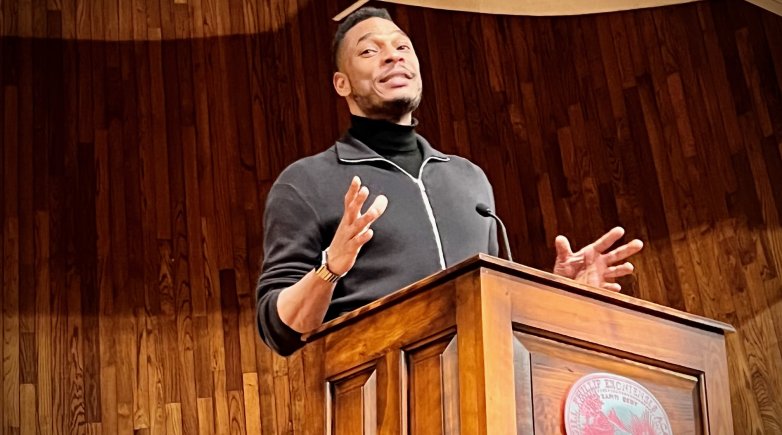
Terrance Hayes pens love letters to his 'Assassin'

The sonnet is the valentine of poems, a love letter of verse born in Italy and shared with a kiss for most of eight centuries. “How do I love thee?” asked Elizabeth Barrett Browning in a sonnet. “Let me count the ways.”

Which makes all-pro poet Terrence Hayes’ choice to deploy the convention in his 2018 collection American Sonnets for My Past and Future Assassin curious at first glance. Love notes? Not these sonnets. Hayes’ poems are live grenades.

He shared with the Exeter community his motivations, his inspirations and his creative process Wednesday night as the Lamont Poet for winter term. Reading from the collection and from other works, then fielding questions, Hayes beguiled an Assembly Hall audience that included Exeter students currently studying American Sonnets.

The Lamont Poet Series was established in 1982. Two poets are invited to campus each year to give readings of their poetry and — in pre-pandemic times — to attend English classes. Past visitors have included poets laureate and presidential inauguration poets. The likes of Allen Ginsberg, Gwendolyn Brooks, Seamus Heaney and Donald Hall have served as Lamont Poets.

Hayes fits comfortably among those ranks, and not only because his resume is so rich — though it unquestionably is. The author of six poetry collections — Muscular Music (Tia Chucha Press, 1999), Hip Logic (Penguin, 2002), Wind in a Box (Penguin, 2006), Lighthead (Penguin, 2010), How to Be Drawn (Penguin, 2015) and American Sonnets for My Past and Future Assassin (Penguin 2018)  — he has won the National Book Award; a Whiting Award; an NAACP Image Award; and fellowships from the National Endowment for the Arts, the Guggenheim Foundation, and the MacArthur Foundation. He is on the board of chancellors of the Academy of American Poets.

He also teaches creative writing at New York University, but he told his Exeter audience when asked how being a teacher has influenced his poetry that he tries not to cross the streams. He doesn’t teach his own poetry, and he said his mom introduces him as a professor — not a poet.

But it’s the writing process that seems to consume him, never more so perhaps than when he started the work that would become American Sonnets. Hayes said the election of Donald Trump in 2016 launched him into action — he vowed to write a poem every day of Trump’s presidency. The “assassin” in the collection’s title (and in the name of 72 of the sonnets within) was initially an America that would make such a choice at the ballot box, and in an interview in 2018, he explained why the traditional love poem seemed the right vehicle to channel his frustration and pain.

“I’m trying to go in one way and come out another way. So, yeah, I’m trying to see how many turns I can fit into a poem, but also, I like the sonnet as a way of addressing an idea: How can I write a traditional love poem to someone or something I don’t deem worthy of my love? I just don’t know what other form would be able to hold this particular moment.”

One of the first poems he read Wednesday, which comes sixth in the collection, illustrates his point:

I lock you in an American sonnet that is part prison,
Part panic closet, a little room in a house set aflame.
I lock you in a form that is part music box, part meat
Grinder to separate the song of the bird from the bone.
I lock your persona in a dream-inducing sleeper hold
While your better selves watch from the bleachers.

Hayes also read some of his newer work, including unpublished material, such as a long poem where he takes on the soothing voice of Bob Ross, the learn-to-paint Svengali who has found new popularity on YouTube two decades after his death. In the poem, Ross is guiding his reader through the creation of a painting, as usual, only this time he is painting on a black canvas with only black paint.

A question-and-answer session dug into Hayes’ process further — one that emphasizes creation and revision over a final destination — and he closed the evening by answering a question about what he thinks is the difference between a song and a poem. With a diplomatic nod to Bob Dylan and other famous lyricists, he said songs use music as a crutch that poems don’t get to use. “But I’m a poet,” he said with a smile. “Of course I’d say that.”

Applying to college is 'the stuff of greatness.' Honest.

The parents and guardians of students in the class of 2023 might feel as if they have only just joined the Exeter community, but it won’t be long before those students are matriculating at colleges and universities beyond. To help prepare the families for what’s next, Exeter’s College Counseling Office played virtual host to its annual College Admissions Weekend.

This year’s program was highlighted by a panel of admissions officers from a wide range of selective universities and a keynote address from Thyra Briggs, vice president for admission and financial aid at Harvey Mudd College.

Briggs has spent 30 years in the world of admissions and —as she noted in her remarks Friday evening — 25 years reading applications from Exeter students. “We know that when Exeter students arrive on our campus, they have already seen the value of being educated in a community that values diversity and inclusion, are able to take advantage of our many resources and are eager to engage,” Briggs said.

Briggs told her virtual audience that as disruptive as the pandemic has been, it has forced colleges to “step of our virtual game” when it comes to engaging prospective students digitally. “Ironically, by closing our campuses, we opened access to a much broader range of students.”

While much has changed in the college application and admission process through the years, Briggs underscored some universal truths that haven’t changed, including that where a student ultimately lands matters less than what they do while they are there. “This is still not a treasure hunt, with only one prize at the end,” she said.

“We are still looking for a well-rounded class, which doesn’t necessarily mean a class of well-rounded individuals,” she said. “Nor should they all be what we often call ‘pointy’ — students who are incredibly focused on one area. Well-rounded students are great; and pointy students are often the catalysts for discussion in a class.”

Attendees of the weekend’s program also took part in a mock admissions case study exercise, in which parents, guardians and admission officers read, reviewed and discussed the applications of several candidates for admission. The case study was meant to highlight how different parts of the Common Application, test scores, recommendations and institutional priorities factor into decisions as a way to understand the broader college admission landscape.

The two-day program concluded with meetings with Exeter’s college counselors to learn about the College Counseling Office’s mission and philosophy and about CCO resources, programs, tasks and recommended reading.

Exeter’s College Counseling Office employs 10 full-time counselors to help students learn to identify their goals and interests, to navigate college admissions landscape and to make decisions about higher education. Each student has agency for self-evaluation, research and application writing that is essential to make the best choice for them.

Briggs quoted an essay written by Kelly Corrigan in The New York Times in 2019 to encourage parents about a process that can often seem overwhelming.

“Something beautiful is being formed in the dumpster fire that is senior fall,” Corrigan wrote. “Regardless of outcome, the college application process itself can force the kind of growth parents dream of. Tell every high school senior you know this most-encouraging truth: making decisions, weighing fiscal demands, understanding yourself, managing a hundred to-dos, overcoming your worst fears — this is the stuff of greatness.”

Wrestling claims second at Class A Championships

The tournament season started in impressive fashion for Exeter wrestling as Big Red wrapped up second place in the 2022 Class A Championships on Saturday in the Thompson Field House. Big Red’s finish marks the seventh straight season that Exeter has finished in the top four in the highly competitive Class A tournament.

Strong performances and competitive matches were the norm throughout the day. Exeter saw six wrestlers earn their way to a top-three finish in their respective weight classes.

“Our entire program did a great job today,” said Exeter head coach Dave Hudson. “I’m proud of how everyone pitched in to host a great event and I’m even more proud of how we competed. Finishing second amongst this collection of teams is a great accomplishment and they should all be very proud of their effort.”

Nathan Puchalski ’23 (136 lbs.), Alexander Galli ’22 (145 lbs.), Dean Hall ’22 (195 lbs.), and Jack Mosley (285 lbs.) each battled their way to second-place finishes in their respective divisions, while Matthew Indelecarto ’22 (152 lbs.) earned third.

This weekend was the first of three consecutive championship weekends for Big Red. Exeter will travel to Avon Old Farms for the New England Championships next weekend before a select number of qualifiers will travel to Prep Nationals in two weeks.

To watch all of the matches on-demand, please go to Exeter Live. For full results and brackets, please go to FloArena.

10 Exonian scientists who break barriers

Thousands of Exonians have made meaningful contributions in scientific fields ranging from microbiology to physics and computer science. Here are 10 whose work integrates knowledge and methods from different disciplines in ways that reflect the dynamic nature of learning science at Exeter today.

Elkan R. Blout ’35

While developing the film chemistry for instant photography at Polaroid Corporation (and authoring or co-authoring more than 50 patent applications), Blout conducted biophysics research at Harvard on peptides and polypeptides, the building blocks for proteins in the body.

John K. Hall ’58

After spending more than three decades mapping bodies of water in the Middle East, marine geophysicist Hall turned to exploring the even more uncharted waters of the Alpha Ridge in the Arctic Ocean using a specially designed research hovercraft.

Robert Nussbaum ’67

A clinician and leader in the fields of human genetics and neuroscience, Nussbaum has focused his research on tracing the genetic roots of hereditary diseases such as Parkinson’s disease.

Michael Fossel ’69

With degrees in psychology, neurobiology and medicine, Fossel has devoted his career to studying how humans age. His biotech company, Telocyte, focuses on the potential of telomerase therapy to treat age-related diseases such as Alzheimer’s.

Emery Brown ’74

A leading physician-scientist in anesthesiology, Brown is one of only 25 people — and the first African American, the first statistician and the first anesthesiologist — elected to all three branches of the National Academies: Medicine, Sciences and Engineering.

Sarah Spence ’80

As a physician and clinical researcher at Boston Children’s Hospital, Spence works to better understand the connection between the brain and behavior in order to diagnose and support children with autism spectrum disorder, or ASD.

Julie Livingston ’84

Livingston is a medical historian whose work intersects the fields of history, anthropology and public health. Her exploration of health care in Botswana through both archival research and ethnography earned her a 2013 MacArthur “Genius” grant.

Alison Buttenheim ’87

A social scientist and public health researcher who studies the role of behavior in infectious disease prevention, Buttenheim helped determine recommendations for equitable distribution of COVID-19 vaccines, and was part of the team overseeing clinical trials of the Moderna vaccine at the University of Pennsylvania.

Aomawa Shields ’93

As an astronomer and astrobiologist, Shields uses computer modeling and other data to search for exoplanets — planets orbiting stars outside our solar system — with atmospheres that might potentially be habitable to life. She spent more than a decade acting in Hollywood before returning to academia, and is still active in science communication and outreach.

Sarah Milkovich ’96

As a planetary geologist and science systems engineer working at NASA’s Jet Propulsion Lab, Milkovich studies the layers of ice and dust on Mars’ surface in an attempt to trace the planet’s geological history.

Are you an Exonian scientist with a career that defies a singular definition? Do you know one? We want to hear from you. Email us at bulletin@exeter.edu. 

Editor’s note: This article first appeared in the winter 2022 issue of The Exeter Bulletin.

Making Science Matter

When Emma Chen ’22 arrived at Exeter as a prep from Shanghai, China, she followed her twin interests in science and art to MATTER, Exeter’s student-run science, technology, engineering and mathematics, or STEM, publication.

As an illustrator, Chen enjoys drawing cartoon cells and other vivid, colorful images for the magazine’s wide array of articles, which aim to make science relevant and accessible for everyone in the Exeter community. “Working with MATTER really helped me get to know other people interested in STEM,” says Chen, now the magazine’s co-editor-in-chief along with Lina Huang ’22. “It’s especially important because a lot of students do research outside of Exeter and I feel like we don’t really get to know about it, because on campus everyone’s just doing schoolwork.”

Since its launch in 2013, MATTER has grown to include eight co-editors and more than 100 writers and other contributors. The magazine’s content is driven entirely by its student writers and editors, and the topics they see as relevant to themselves and their peers.

“We’re bringing science to the Exeter community in a way that connects with our unique positions as students at this school,” Huang says. In addition to print and online issues, the magazine has a sleek website, an active Instagram presence and a regular column in The Exonian.

With the pandemic’s arrival, science became relevant to everyone’s lives in a new way. As Huang puts it: “Science doesn’t operate in a vacuum.” The magazine’s most recent issue, published last May when students were back on campus together, dedicated an entire section to COVID-19, including stories on vaccines and how to combat the pandemic’s effects on mental health. Separate sections tackled other of-the-moment topics, such as environmental racism, the Elizabeth Holmes trial, and breakthrough research on the effect of trauma on our genes.

Chen, Huang and their fellow MATTER magazine club members plan to publish two issues this school year, including an installment focused specifically on science at Exeter. “We’re really zooming in on our classmates and teachers, and all the research they’re doing,” Chen says.

Editor’s note: This article first appeared in the winter 2022 issue of The Exeter Bulletin.

How Exeter nurtures the innovators of the future

Sunlight streams through a wall of windows into a second-floor classroom in Phelps Science Center, illuminating the trappings of a well-equipped biology lab — including three octagonal lab tables with four stools each, a blond wood Harkness table and a taxidermied bear head resting on a countertop, mouth agape.

 It’s barely a week before Thanksgiving break and Lina Huang ’22 and the other students in Integrated Studies 419: Bioethics assemble for one of their last classes of the fall term. They aren’t using the lab tables, where several weeks ago they were manipulating the genes of different bacteria using CRISPR-Cas9, the powerful technology that has sparked ongoing debate over the morality of editing human genomes. Instead, two classmates are delivering a final presentation on medical paternalism and whether doctors are justified in withholding information about the risk of stillbirth from their pregnant patients.

Among those listening in are Religion Instructor Austin Washington and Science Instructor Michele Chapman. The pair are co-teaching this interdisciplinary course investigating gene editing, cloning and stem cell research, as well as medical technologies ranging from in vitro fertilization to organ donation and vaccination, from a host of perspectives. “The students can take the course for either science or religion credit based on their needs or their interests,” Chapman explains. “It’s been really successful.”


Lina Huang ’22 

Huang, who hadn’t done any lab experiments before coming to Exeter as a prep, finds classes that cross disciplines and combine hands-on lab work with Harkness discussion most thrilling. “People come into science class with a bunch of questions about how our course material applies to things they’ve seen, things they’ve read or experiences they’ve had,” Huang says. “In Biology 520, when we covered the circulatory system, we not only learned how blood travels through the body, but we also explored, in a lab, how blood pressure varies with changes in posture and activity.”

Like an ever-growing number of Exeter students, Huang is taking full advantage of the school’s wide-ranging science offerings, including advanced courses in biology — her primary area of interest — as well as physics, chemistry and computer science. Her experience, and that of many other Exonians learning science today, is a direct result of the decision made more than two decades ago to create a new, more open science facility that would fully incorporate the Harkness method into science learning for the first time.


The history of Harkness science

When Stanford N. Phelps ’52 donated $15 million in 1999 for the construction of a new science building, he imagined expanding the realm of possibility not just for the Academy and its students, but also for the world. “I wanted to make the science building a reality because I believe the nation will benefit from the future contributions of Exeter students who study within its walls,” he said at the dedication ceremony for the Phelps Science Center in October 2001.

That opening ceremony was the culmination of a process that began with a meeting Exeter’s science faculty had with the Trustees around 1994. “We intentionally brought them into the Thompson Science Building and said, here’s where we’re finding this building to be inadequate,” says Scott Saltman, science instructor and Exeter’s director of studies. “The response that we got from them was — you’re absolutely right.”

Thompson had opened in the fall of 1931, just shy of a year after Edward Harkness made the gift of $5.8 million that would change the school’s pedagogy forever. As a consequence of timing, science learning was largely left out of the Harkness revolution, as there was no accommodation for the now-famous oval tables in the building’s classrooms.

According to Saltman, adding Harkness tables to the new science center was actually one of the last decisions made during its design. By the 1990s, most classrooms in Thompson featured movable chair-desks arranged in a U-shaped configuration, in addition to the lab bench and teacher’s bench. At first, Saltman and his colleagues envisioned using similar setups in the new building, but after experimenting in a mock-up classroom with a special reconfigurable version of a Harkness table, they found they never moved the pieces out of the oval shape. “We were experiencing in real time how taking the teacher out of the center and putting people on more of an equal footing does to the way a group interacts with each other,” Saltman says. “When we moved an established class into that room, they immediately interacted in different ways.”

By conscious and collaborative design, the Phelps Science Center is a building that not only fully incorporates Harkness, but reflects the dynamic, expansive nature of modern science itself. In addition to 22 classroom-labs, each with its own Harkness table and laboratory space, there are four common labs for biology, chemistry and physics, as well as a flexible multi-science lab. The common labs are very visible spaces, with front walls completely made of glass, while angled windows in the classrooms strategically reveal lab work while keeping class discussions a bit more concealed. “It’s modern, beautiful and practical,” says Albert Léger, chair of the Science Department, of the building. “We have the best of both worlds — we can discover together in a more informal, tactile way at the lab bench, and then come back together at the Harkness table and talk about what we saw and our next steps.”


Science learning at Exeter today

Like Huang, Neil Chowdhury ’22 was immediately captivated by the specific way he was learning science at Exeter. “Being able to do a lab in chemistry and then go straight to the table and talk about how it worked and everything — that is a cool experience,” he says.

Chowdhury has taken a wide array of science courses, including organic chemistry, modern physics and astronomy. He is also co-head of three science-related clubs: including the Chemistry Club, Science Bowl (a buzzer-based competition) and the Physics Club. The latter group won the 14th U.S. Association for Young Physicists Tournament in 2021, besting 10 rival teams by tackling problems like how a lava lamp works and the physics of terrestrial and lunar impact craters.


Neil Chowdhury ’22

Along with many other Exeter students, Chowdhury and his fellow Physics Club members take advantage of the Design Lab, a well-outfitted maker space located in the physics wing of the Phelps Science Center. Featuring a 3D printer, laser cutter and other high-tech tools, the lab was the result of student demand for a more informal workshop space to build, create and learn. “People are always in there trying to build their own electric skateboards and scooters,” Chowdhury says.

“It’s a different place than the rest of the building,” Léger says of the Design Lab, which was added more than a decade after the Science Center opened. “There’s room for play in science — it doesn’t have to be tedious.”

For Saltman, the Design Lab is a perfect example of the way the Science Center and the curriculum has been able to grow and change along with technology and science itself. “Things we couldn’t necessarily have envisioned happening in 2001, we can do the configuring to make it happen,” he says. “A lot of that is due to the flexibility of the common lab spaces, where we can move things around to make that work.”

As flexible as the building may be, students studying science at Exeter aren’t confined within the walls of Phelps. Over the years, the curriculum has grown to include an array of field courses, including ornithology, earth science, ecology and animal behavior. It’s not uncommon, Léger says, to see one of the Academy’s familiar Red Dragon vans heading out of Phelps at 7:30 a.m. for a field trip.

In her marine biology class last year, Huang took a trip to a mud flat, where she dug for Nemertea worms and collected organisms on a rainy, cold day in January. “It felt really great to still be pursuing science even in this extreme weather,” she says. “When we got back, we looked at the organisms under a microscope and categorized them, then went through the process of scientific inquiry to see how they were adapted to the environment of the mud flat.”

Above all, Chowdhury and Huang appreciate the openness and collaborative spirit of learning science at Exeter. Huang remembers working with her physics classmates to figure out how to launch a ball into a cup as their final project of the course. “Finals week is usually associated with a lot of stress and tests,” Huang says. “But here we could bounce ideas off of friends and enjoy comparing our approaches to physics.”

Chowdhury describes the third-floor lounge in Phelps, with its high ceilings, comfy chairs and sweeping view of campus, as an ideal place for relaxing, socializing — and doing science. For the Robotics Club, he and other members recently set up a large playing field for their robots there. “I’m working on programming the robot to accomplish all the game objectives,” he says. “I think we’re getting a dedicated lab space soon, but for now the lounge is the only place where that stuff fits.”


Teaching the scientists of tomorrow

Over the past decade, the Science Department has seen a steady increase in the number of students enrolled in its courses, as well as an increasing number of those choosing to take advanced science courses and electives. In 2021, the annual enrollment in science classes totaled 3,045, including 427 enrollments in 500-level classes or higher. “We’ve adjusted our curriculum in ways that support the students better,” Saltman says.

Faculty are also meeting student demand for opportunities to engage in college-level research. “Our students have done research at their old school, or over the summer, and they want to continue,” Léger says.

After taking an earlier genetics course at Exeter, Leena Hamad ’17, for example, applied and was selected for Biology 670, a research course that delves into the genetics of Drosophila melanogaster, the common fruit fly. Initiated in 2012 as part of “StanEx,” a collaboration between Dr. Seung Kim ’81, professor of developmental biology and of medicine at Stanford, and Science Instructors Townley Chisholm and Anne Rankin, the course teaches Exeter students how to genetically modify fruit flies and breed their own new fruit fly lines.

“It is kind of amazing to me that we were able to get our hands on facilities for microscopy and all these technologies,” Hamad says. “We were 16- and 17-year-olds just dabbling with research, and most of us hadn’t really used any of the tools before.” She recalls the fruit fly course as a lot of independent work, independent thinking and troubleshooting — all skills that have proved invaluable in her college and professional experience.

“In my later lab work, it was routine practice to isolate DNA from things, and it all started at Exeter.”

Hamad says she has tried to explain the experience of learning science via the Harkness method to others who haven’t shared it. “They’re confused, because it seems like science is something that’s instructed to you,” she says. “But science is a lot more than learning the facts — it’s something that’s constantly developing and evolving, and you have to learn how to ask questions about the things you’re being taught and delve deeper. In a real-life lab setting, that’s what it’s all about.”

She credits her Exeter experience with showing her the value of a multifaceted approach to learning, including seeing the deeper connections between different subjects and disciplines. While at Harvard, Hamad concentrated in molecular and cellular biology, but minored in political science and earned a certificate in Arabic. Now pursuing her M.Phil. degree in health, medicine and society at Cambridge University, she’s diving deeper into subjects such as philosophy, ethics, and the history of science and medicine, and plans to enroll in a combined M.D./Ph.D. program to become a physician-scientist.


Looking ahead

The future of science at Exeter, Léger says, is about continuing to break down barriers and weave together different disciplines. “Can somebody learn about an organ in biology, write a code for its function in computer science, build it in the Design Lab and then test it in physics?” he asks. “Modern science is more and more interdisciplinary.”

That’s certainly true for this fall’s Bioethics class and Huang’s experience integrating ideas from theology, history, philosophy and law with modern medicine and biological research. Huang welcomes such academic opportunities to make connections, especially during the unprecedented challenges of the past two years. “The pandemic emphasized how science touches so many parts of our daily lives,” she says. “It’s so important to gain a foundation in these scientific principles so that when we approach topics like vaccines, or masking, we do so with an informed understanding of how it all works.”

When it comes to educating the scientists of tomorrow, Léger is prepared to dream big. “We’re always thinking, how can we meet the students where they are?” he says. “In the science building, we can do just about anything we put our minds to.”

Editor’s note: This feature first appeared in the Winter 2022 issue of The Exeter Bulletin.

Meet the 2021-22 Phillips Dissertation Year Fellows

The fellowship program was created in 2013 to support Ph.D. candidates in the completion stage of their dissertation and provide those who might not otherwise consider careers in a residential secondary school the opportunity to gain hands-on experience.

In alignment with the Academy’s equity and inclusion efforts, the Fellowship Committee sought candidates who are traditionally underrepresented in the graduate school environment and who express an interest in becoming part of an independent secondary school. The fellowship selection process also gave priority consideration to scholars researching topics related to race, identity and culture.

In addition to their dissertation work, the fellows deliver two online seminars per term and make themselves available to engage in discussions with students or groups interested in their fields of study. “Our fellows will be largely remote this year,” Dean of Faculty Ellen Wolff says. “But we do hope to bring them to campus as scholars in residence for a week or two.”

Nyesa Enakaya is studying chemistry at California State University. Her research focuses on the synthesis of small molecules that interact with hemoglobin and the treatment applications for sickle-cell anemia and general hypoxia. She hopes to inspire students of color to pursue careers in science by communicating the real-life applications of chemistry. 

“I hope through this fellowship I can gain experience working with younger students, as all of my teaching experience is with undergraduate students. I also hope to learn from the faculty at Exeter. They have very unique teaching methods that I would love to implement in my own teaching. … I am so excited to work with the student body!“

Rachel Afua Ansong is completing her doctorate in English and creative writing at the University of Rhode Island. Her dissertation, “The Text(tiles) of Adinkra Symbols: West African Art, Gender, & Poetic Translations,” explores what it means to be separated from your country and how art becomes a mode of survival, for redefining heritage and self. 

“I am looking forward to translating my research into poetic or visual art workshops that allow students to think about ways in which they can teach others about the work that drives them. Oftentimes, younger students might think that research is complicated and mundane, but I hope to teach them ways to make literary and historical research personal and engaging. I hope that my work serves as an example for underrepresented students in higher education that they can make and take space.”

Editor’s note: This article first appeared in the winter 2022 issue of The Exeter Bulletin.

Founders' Day, John and Elizabeth Phillips awards announced

General Alumni Association President, Trustee and Awards Committee Chair Janney Wilson ’83 has announced the selection of Andrew W. Hertig ’57; ’31, ’69, ’83 (Hon.); P’83, P’86, P’88 to receive the Founders’ Day Award in May and Dr. Sasha B. Kramer ’94 to receive the John and Elizabeth Phillips Award in October.

Hertig returned to Exeter in 1968 to join the faculty as an instructor in history. In 1994, he was appointed the 1959 Independence Foundation Professor. He retired in 2013 after devoting 45 years to teaching.

Hertig has received the Rupert Radford Faculty Fellowship Award, the Brown Family Faculty Award and the George S. Heyer Award. He will receive the Founders’ Day Award and speak during assembly May 20.

Kramer has been living and working in Haiti since 2004. She is co-founder and executive director of Sustainable Organic Integrated Livelihoods (SOIL), a nonprofit based in the Caribbean nation.

SOIL is a research and development organization which designs, tests and implements sustainable and cost-effective solutions to the sanitation crisis in Haiti, focusing on innovative approaches to sustainable sanitation service delivery and a strategic, catalytic approach to financial sustainability. SOIL transforms human excreta into rich compost for agricultural application, thereby improving public health and increasing farming productivity.

Kramer will receive the John and Elizabeth Phillips Award and speak during assembly Oct. 21.

A momentous decision