The Art of Harkness
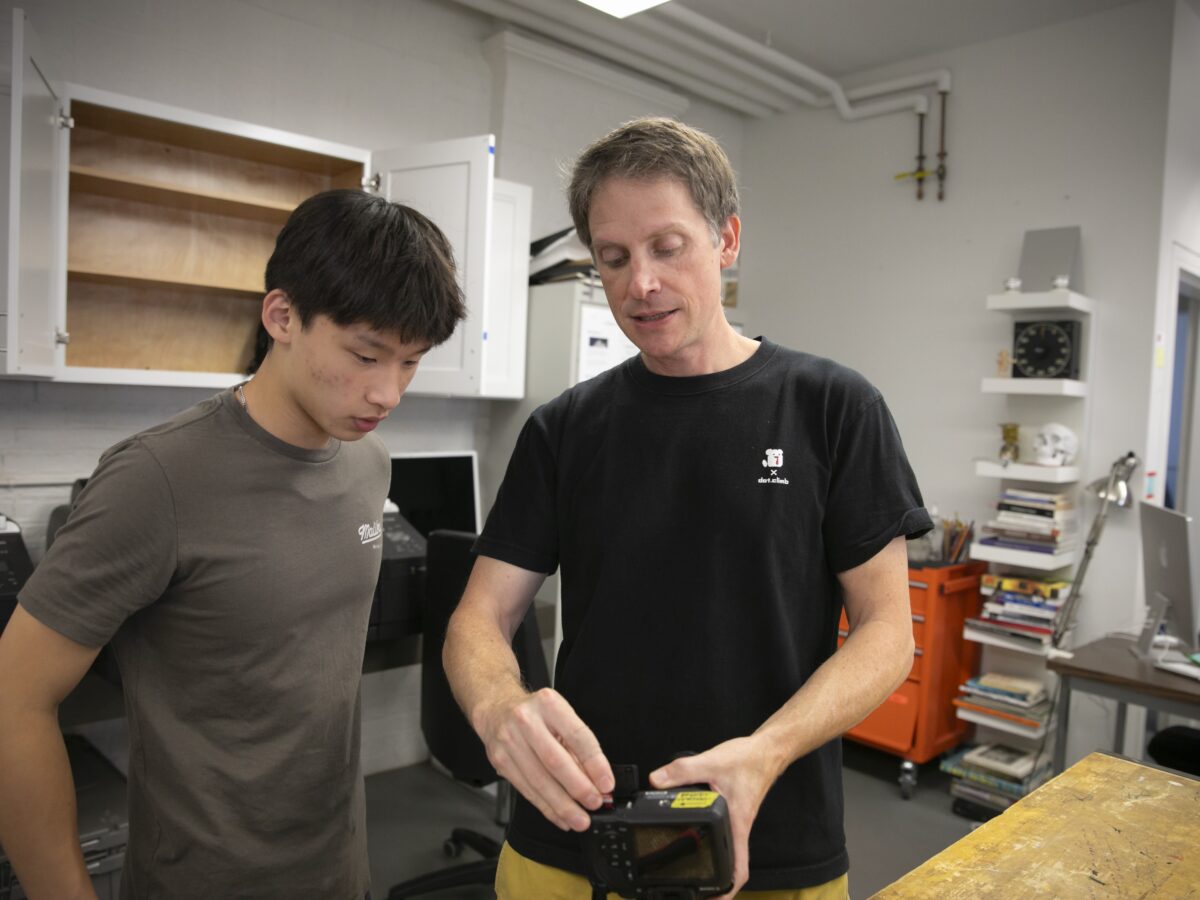
Inside the studio with Adam Hosmer, chair of Exeter's Art Department
After growing up in Massachusetts, where his mother taught art at his elementary school, Adam Hosmer embarked on his own creative path, studying music and opera at the New England Conservatory in Boston. He met his future wife while traveling abroad during a gap year before college and later moved to her native Japan, where he worked as a commercial photographer and earned an MFA from the University of Tokyo. He then spent roughly a decade as the only art teacher at a small, progressive, dual-language K-12 international school.
When Hosmer decided to return to the United States in 2023, he was drawn to Exeter’s rigorous studio-based curriculum, which gives students hands-on experience making art in a wide range of mediums. From printmaking and painting to photography and 3D design, each course combines practical and technical skill building with creative expression and collaborative analysis, a combination that Hosmer believes lends itself naturally to Harkness learning.
“Harkness is inherent in most art practices when you’re in a group,” he says. “You’re always going through a process of self-criticism, and it’s helpful when you have other people around who can give you input and positive feedback.”
Student artwork is displayed throughout campus, including a celebratory exhibition every spring in the Mayer Art Center and Lamont Gallery by students in upper-level classes like ART500: Studio Thesis and ART690: Capstone Intensive Studio. “Our classes are structured in a way that encourages autonomy the more advanced they get,” Hosmer says.
While he enjoys helping students do such high-level, focused work, he also relishes teaching introductory art courses like ART205: Photography I: Composing Concepts. “So many students come to the class not really knowing what it’s going to be, and then many of them realize that they already have a fairly developed visual language when it comes to photography,” Hosmer says. “They’re able to see the patterns or choices that they make in their work that they weren’t necessarily aware of, and they can latch onto them and start to see themselves as artistic in a way that they didn’t before.”
Students pursue their passions
In upper-level art classes like ART500 and ART690, students work closely with their teachers to create long-term studio projects along with readings, research and critiques spanning both art history and contemporary art movements. “Art is a tool that puts a magnifying glass into different aspects of identity and different aspects of who you are and how you want to express yourself,” Hosmer says. “This is a very welcoming environment and a safe place to explore those kinds of ideas with support from teachers and from peers as well.”
Learning from practicing artists
Like all of Exeter’s Art Department faculty, Hosmer is a practicing artist in various mediums, including photography, painting and ceramics. He sees part of his role as department chair as helping his colleagues balance teaching with their own creative work, which allows them to develop their craft while modeling serious artistic engagement for their students.
Meaningful student-teacher collaboration
Irene Rudd ’26, a student of Hosmer’s in ART500, created “Worth Writing Home About,” an assemblage of vintage postcards and postcards made with her photographs. Rudd wrote messages on the cards, displayed them on hanging wires and invited people to write their own messages, challenging them to consider aspects of letter-writing that have been left behind in the age of instant messages and Instagram. “It weds a concept to a visual form in a way that is innovative, but also forms a narrative that you can read in different ways,” Hosmer says of Rudd’s project.
New voices on campus
Thanks to the department’s Michael Clark Rockefeller Class of 1956 Visiting Artist Fund, Hosmer and his colleagues are able to bring contemporary artists to campus to engage with students for workshops, talks and co-sponsored events. Recent visitors have included photographer Gus Powell, ceramicists Ken Matsuzaki and Tomoo Hamada, and jewelry designer Jameel Mohammed ’13. Just as with their teachers, Hosmer believes getting to work with serious artists gives students different models of creative engagement in an important way. “It makes it real in a way that is attractive,” he says.