Alum asks Exeter, ‘Are we doomed?”
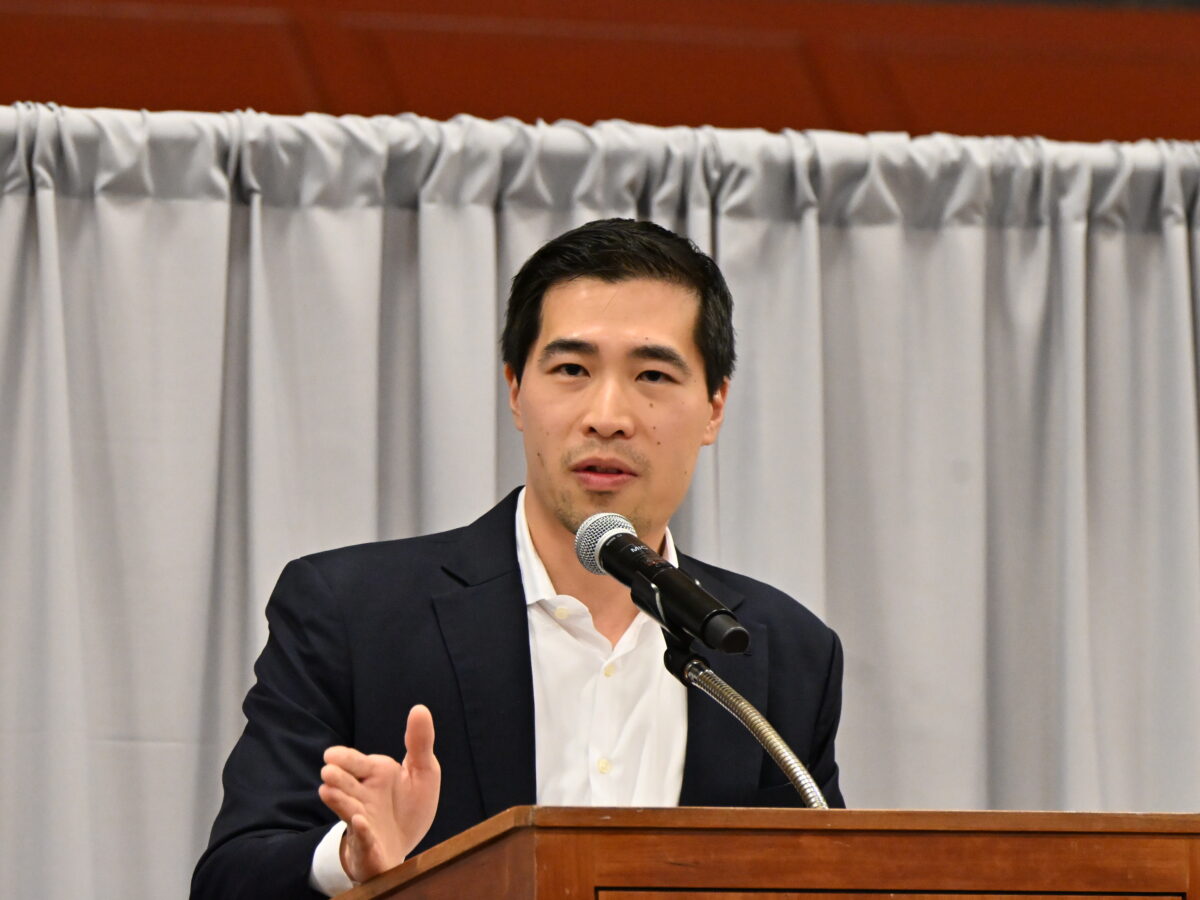
Economist Geng Ngarmboonanant ’11 tells assembly the answer depends on "courage" to choose a path to a more affordable future.
The Harkness table is a transformational setting for discovery, as nearly a century of learners at Exeter would attest. Just as impactful in a student’s growth can be a guest speaker’s message that opens a closed door or serves as a call to action.
Exeter’s assembly program has long provided Exonians with inspiration, offering speakers that include Nobelists and Pulitzer Prize winners and alumni young and old. Twice weekly, the Academy rises from the table and gathers in community to hear from thinkers, leaders, builders and changemakers.
Already this fall, the list of speakers has included Max Stier, the director of the Partnership for Public Service, a nonprofit dedicated to making government more effective and accountable; Dr. Kimberly O’Brien, a clinician who specializes in adolescent mental health; and Dr. Nancy Ascher, the first woman to perform a liver transplant.
The list also includes Geng Ngarmboonanant ’11, who returned to campus Oct. 2 to speak on “an uplifting topic” he titled “Are We Doomed?” Ngarmboonanant’s expertise is economic policy. He is a managing director at J.P. Morgan who formerly served as deputy chief of staff to Treasury secretary Janet Yellen during the Biden administration.

Ngarmboonanant used a figure familiar to both former and current Exeter math students to express his concerns about the present-day American economy. “Alex” is character in multiple Exeter math sets who frequently needs the students’ help to find his way out of the desert to a lemonade stand or gas station. How the students steer him, through solving the various problems place before them, determines Alex’s fate.
“What if we lifted this out of a theoretical math problem into a real life one?” Ngarmboonanant asked. “What if Alex made all the right decisions, made all the right turns, drove on the right side of the road, but the lemonade stand that was promised to him was never there in the first place? What if the gas station keeps moving farther and farther down the road?
“I’m worried that for a lot of people in America, the economy right now feels like a version of Alex’s problem with no answer. That for a lot of people, they made the right decisions, made the right turns, worked hard just like Alex did in the desert, but the lemonade, the gas station, the relief never comes.”
Ngarmboonanant used the economic indicators of jobs, housing and the national debt — “What you’ll earn, what you’ll own and what you owe” — to illustrate the challenges teens will face in the coming years.
“Are we doomed? My answer: it depends on us. It depends on the specific choices that all of us make over the next few years,” he said. “We are blessed to live in a democracy, which means that how this economy works is a collective choice that we make.”
Ngarmboonanant left the assembled with messages shaped by the Exeter foundational values of non sibi and goodness and knowledge.
“When I was at Exeter, I was most impressed by the people who were tri-varsity, got good grades, crushed their 333s. But eventually you’ll realize that intelligence and talent is everywhere, but courage, real courage is rarer,” he said. “It isn’t always big and full of great acts of resistance. It can be quiet in the small choices that we make every single day to do the right thing now and into the future.
“Having been in many rooms of power, I can safely say that very few people are actually irreplaceable. In fact, I believe that no one is extraordinary. Everyone is ordinary, but the beautiful thing is that ordinary people together can do extraordinary things. The next few years and beyond will be filled with a lot of uncertainty, but this is our world to shape and with courage, I look forward to seeing all of you doing extraordinary things.”
Watch assembly!
Most of our guest speakers’ remarks are streamed live and available on demand on Exeter Live.