A conversation with the principal
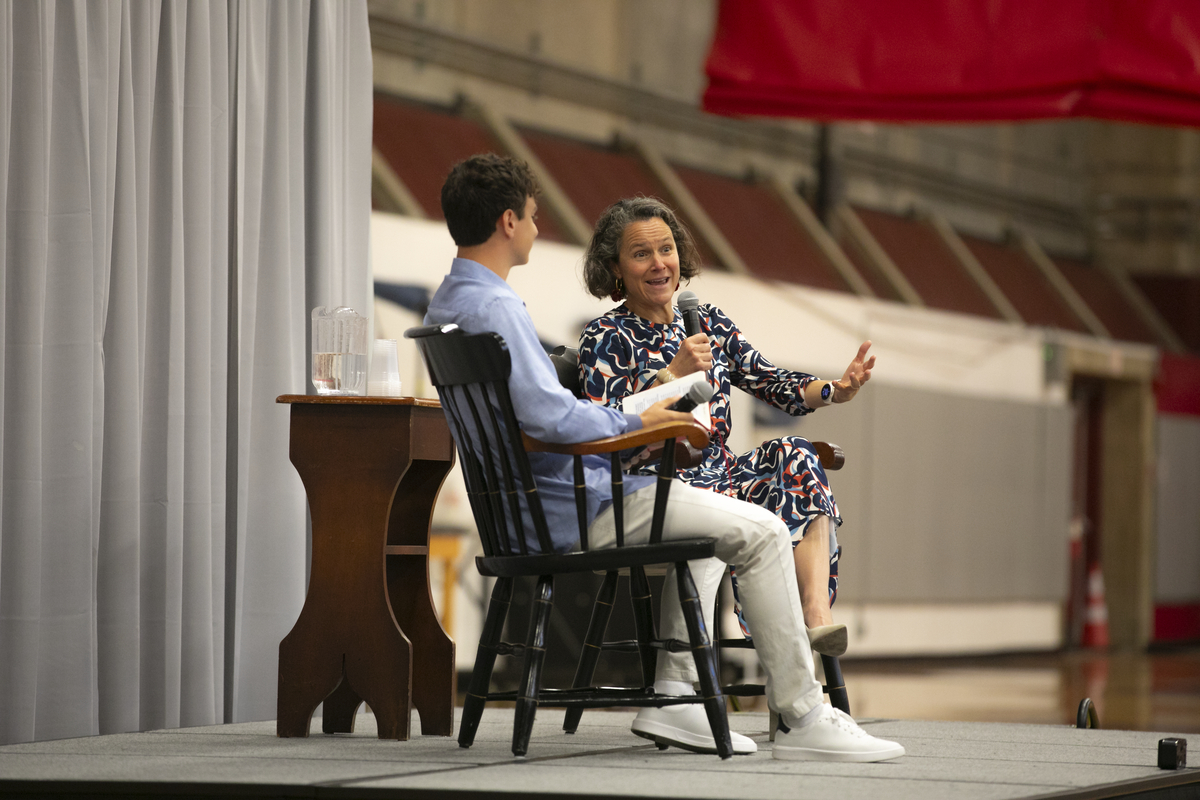
Principal Elliott shares advice, vision and some humbling experiences in Student Council Q&A.
Student Council took the stage for its annual assembly last week, providing a window to the student body of what its mission is and how students can put the council to work for them.
And, as is tradition, the council used its time to interview the principal. Student Council President Ari Benenson ’27 posed a series of questions to Principal Jenny Elliott to give Exeter students some insight into her life and what her plans are for the year.
The following is a transcript, edited for length and clarity, of that conversation:
Before you were Principal Elliott, many years ago, you were an Andover student, as we all know. I want to start this conversation by going back to that version of you. What were you actually like in high school? Do you have any particularly memorable or embarrassing experiences or stories from back then?
Just what every adult wants to do, talk about our embarrassing stories from high school. There are many, I would say. I got to go to boarding school as a new 10th grader. I grew up in New York, outside of the city, and boarding school was not something that my family had known about or had really considered. I am the third of four kids. And it was my older brother who said, “I really am interested in checking out these schools.” … He ended up going to Andover. And so, he came home and he would bring friends home because we didn’t live that far away from school. And I loved the ways that he and his friends, when they came home, could so swiftly move between really serious conversations and really playful conversations. And I loved the way they talked about school. They loved school. They really were into school. And I remember thinking, “I’m like that. I really like school.”
I was really invested in my sports, in community service, in the radio station, in what we call at Andover, “Blue Key Heads.” I was a Blue Key Head. Spirit was really important to me. So, I did a bunch of different things, but I probably spent less time on my schoolwork than I should have.
Ari asked me about an embarrassing moment. My senior year, our field hockey team was pretty good. … We were coming up to Andover-Exeter and we were playing up here and the girls teams that year were really good. Volleyball team, soccer, field hockey, cross country, we all won New Englands that year. We got this idea in our head to shave the back of our head, put an A in it.
So, I shaved an A in the back of my head. I had pretty long hair and I put it up and just shaved this big old A in the back of my head. And my parents were like, “What in the world?” I came up here all confident that we had this really good team and showed up. I had a huge A in my head — and we did not win that game. I know. It was hugely humbling. We did not win. We ended up winning New England, but we did not win AE, which was embarrassing and really felt silly with the huge A in the back of my head.
At Exeter, we spend a lot of time talking about our successes, goals that we set for ourselves and we work so hard to achieve, but we don’t talk as much about the times when we worked hard and believed that we deserve to succeed and nevertheless fell short. Have you had moments like that in your own life and how do you learn to deal with disappointment when your hard work doesn’t lead to the outcome you hope for? And do you have any advice for all of us?
Sure. I mean, at every stage of my life, I think I’ve had these experiences. My dad was a really big proponent of, if you work hard, things are going to work out. And we know this is just not always true, right? It doesn’t always work. You don’t always get what you want or what you believe you should have because of your hard work and your talent or your ability or your passion or your commitment. I felt that in high school for sure. I felt that professionally in terms of really working to bring something about in terms of a change at school and recognizing that the process wasn’t what my community needed at that time and feeling really disappointed and frustrated by that. Oftentimes, in the Dean of Students office in particular, you’re working with students and you really want to support the timeline and their sense of urgency about getting things done and the rest of the school doesn’t necessarily want to move at that pace.
And that was a hard lesson that I learned in terms of how do you move in a way that honors what the kids need and also respects where the community is and what that process needs to look like.
Professionally, I have applied for roles that I haven’t gotten before that I thought I deserved. It’s interesting, you sometimes go through phases of life where you are more confident than you should be. And with each of those disappointments, I think you have a clear-eyed check, like “maybe I need to check myself a little bit here.” To your point about what advice might I have? It’s taken me some time, but I’ve found the people in my life that I can have those really raw, vulnerable, hard moments with where you can be honest about how disappointed you are. Sometimes I’ll respond with anger. At times that’s just totally disguising how disappointed I feel, maybe ashamed, really sad. And to find those safe people who can get you to a place where you can admit those things, like you’re not angry, you’ll say things like they don’t know what they’re doing or they’ve totally got this wrong.
When you dig in, that’s not actually what you think, you’re just so disappointed in yourself and that it didn’t work out the way you wanted to. Trying to reframe that and dig a little, like scratch a little deeper into those emotions to get at what’s really real and figure out who are the folks that you can process that with, I think is really important.
You mentioned in those times, people that you lean on, you need to have those people and you’ve been a student, a teacher, a coach, a dean, a parent, and now principal. I know many people look up to you, the students, faculty, many people look up to you, but who’s someone that you’ve always looked up to? Who’s your hero might you say and why?
In high school, we called them house counselors at that point, but my house counselor and my coach for two different seasons is still one of those folks for me. She was here on Saturday coaching the Andover field hockey team. I would say she’s kind of a compass north for me. She’s just someone who has more integrity in her pinky than many people I know. She’s always been that person that I can sort of come to and I know when I go to her, she’s going to be honest with me. And you know those people that you know, like, “Oof, I’m not going to have that conversation yet because I’m not ready to hear what they’re going to say to me.” She’s one of those people in my life. But when I get there and I muster the courage to talk with her, she’s going to be honest with me.
In student council, we talk a lot about policy changes and specifically AI now. And just to be clear, every question today has been generated entirely through my own brain and my friend’s brains and an actual human to human interaction with absolutely no assistance from artificial intelligence whatsoever. But on that note, you spoke a bit about AI during Opening Assembly, but we’d like to hear more of your thoughts on it. How do you think we should interact with AI at Exeter? Should we avoid it entirely? And what excites you the most and what worries you the most when it comes to AI and academia?
I have so many thoughts on this. I think we’re in a moment, I really believe, and as someone who studies history, I often spend time wondering how is this chapter going to be written in 20 years, in 40 years, in 60 years? I think we’re going to write this as a moment when the external landscape is shifting really swiftly and we don’t have a ton of control over the pace, over what’s happening, and that we are needing, and the verb I keep coming back to is we are navigating. We are thinking about how is it that we are going to live in this world, respond to these changes, what are we going to do? I’m incredibly grateful that I get to be part of a community that has a very strong mission and sense of identity.
I think in choppy seas, when in uncertain times, you need those really clear guideposts. I think we’re hearing and we’re learning and we’re reading every day more and more about how AI is changing the ways we work, the ways we engage, the ways we consider each other, the ways we consider our own capacities. I think there are real risks to our learning. I think AI poses real risks to the work that we are devoted to doing. Some of the terms that are being used right now are cognitive offloading and atrophying of skills, this term cognitive surrender. I don’t think any of us signed up to join this community to engage in a cognitive surrender, right? That’s not what we’re looking to do here. I think trying to get really clear on what do we know about the way humans learn, about the ways that our minds build and strengthen like muscles, specific skills and competencies, and how is it that over time humans have navigated really tumultuous, uncertain times?
We need to look into the future and be able to say, “This is going to be amazing and you are going to be able to engage in this world in hugely constructive ways, in radically creative ways, in ways that we need humans.” I think that’s our obligation to you. Trying to figure out how we get ourselves into that place despite the very deep worries and concerns that we have about this. What is that going to take? In my mind, I think that’s going to take some discomfort. As teachers, we like being ahead of you. We have expertise, we have experience, we know a lot about our content material, and we have a lot of skill and we like being ahead of you so that we can be coaching and we can be guiding and we can be creating context for you.
And this is a hugely uncomfortable moment where we’re not always ahead of you. And I think as students, you need to have some grace for teachers how we’re doing this and we need to have some grace with you in terms of the ways that we’re engaging. I want to be able to create space for conversations for us to be thinking about this together and that’s going to be hard and it’s going to take time and we don’t all agree. I think actually, and I’ve said this before with colleagues, if we were to do a word cloud right now and I just asked you to for 30 seconds type in all of your feelings about AI, I think we’d have a massive range on the board and I think most of us would say like, “Yep, I feel all of those things.” Competing feelings, dissonant feelings. When we have that dissonance internally, like that cognitive dissonance, that’s really uncomfortable. And so how do we support each other through that? I think that is the work of a school. We are hugely fortunate that we get to have these student-teacher ratios in class and in advising groups and in dorms. We have these contexts and spaces to be able to engage in these conversations, and what I really, really don’t want to do is avoid this and pretend that it’s not happening. I think we need to be able to get brave and develop that trusting dynamic in those spaces and be able to engage with each other on this front. I’m not prescribing how we’re going to use AI. I actually think that’s the work that we’re going to need to do is to figure out what makes sense to be discerning, to be thinking about what are the skills that we know you need and how do we ensure that you’re able to develop them during your time here?
That’s our job and I think you need to also trust us on our judgment on this front, too.
You’ve worked at other schools, at other boarding schools. Is there anything that you saw or implemented at Andover or Choate, some of our rival boarding schools, like a policy or an idea that makes you think, “I want to do something just like this at Exeter?”
Look, all of our schools are really different and part of the job is honoring what’s distinct about us. At the Robert Lewis Stevenson School in California where I worked, part of its mission is to lead a joyful life. How awesome is that? And that was probably one of the most instructive places I’ve ever been to be part of a community like that, where part of our job every day was to be thinking about how do we spark joy? How do we carve out space for joy? I do think those are probably some of my favorite traditions in spaces like ours where we are pursuing excellence and where we believe in hard work and the dignity of hard work and the integrity of hard work, that we also need to flex those other muscles. As humans, whether you want to admit it or not, we love to play.
So how do we create space for that? How do we create space for levity and recognize that we can still be very serious people? We can think of ourselves as intellectuals and academics and be playful and that that’s OK. I do wonder, and I will look for opportunities where that’s possible. I’ll note this about myself: I recognize I continue to live in New England and somehow I keep trying to go further north. I’m actually pretty wimpy in the cold and the short days and the darkness actually get me down. And so trying to find ways in the winter in particular when we can open up spaces for play is going to be something I’m going to be seeking and looking forward to. Traditions get born through good collaboration, so I welcome your ideas on this front.
I want to end by going back to your Andover resume. Very impressive. You’re an Andover graduate, you’re an alum, you’ve spent 12 years as a teacher, squash coach, dean of students, and you even have three sons who went there. I know you said AE earlier, but with EA coming up, the question on everyone’s mind is, have you fully been converted to red or are we going to see you wearing blue on the sidelines?
To be clear, I said Andover-Exeter because I was talking about the context of when I was a senior, so that was relevant. I will say though, I’ve confessed this to a few of my colleagues, it’s taking me some time to just get EA to roll off the tongue. I’m really fixated on trying to make sure I always say EA, EA, EA. I think you guys need to do some coaching for me on some cheers. I want to make sure those things become muscle memory and that I get real clear on that. You’ll learn about me, I’m very loyal and I’m very spirited and I like getting into things, so I don’t have doubts that I’m going to be all in.
I’m really excited for those moments when I get to be so proud of you and so excited for you. I’ve already seen them being on your sidelines. Field hockey was like 3-3 for a while the other day and it was super exciting when that fourth goal was scored and that fifth goal. That’s super fun. I will look to you to guide me and lead me, tell me, help me know where I’m supposed to be in certain places. Invite me to the sideline where you think I need to be.