Michael Ambler ’82: Restoring the Land
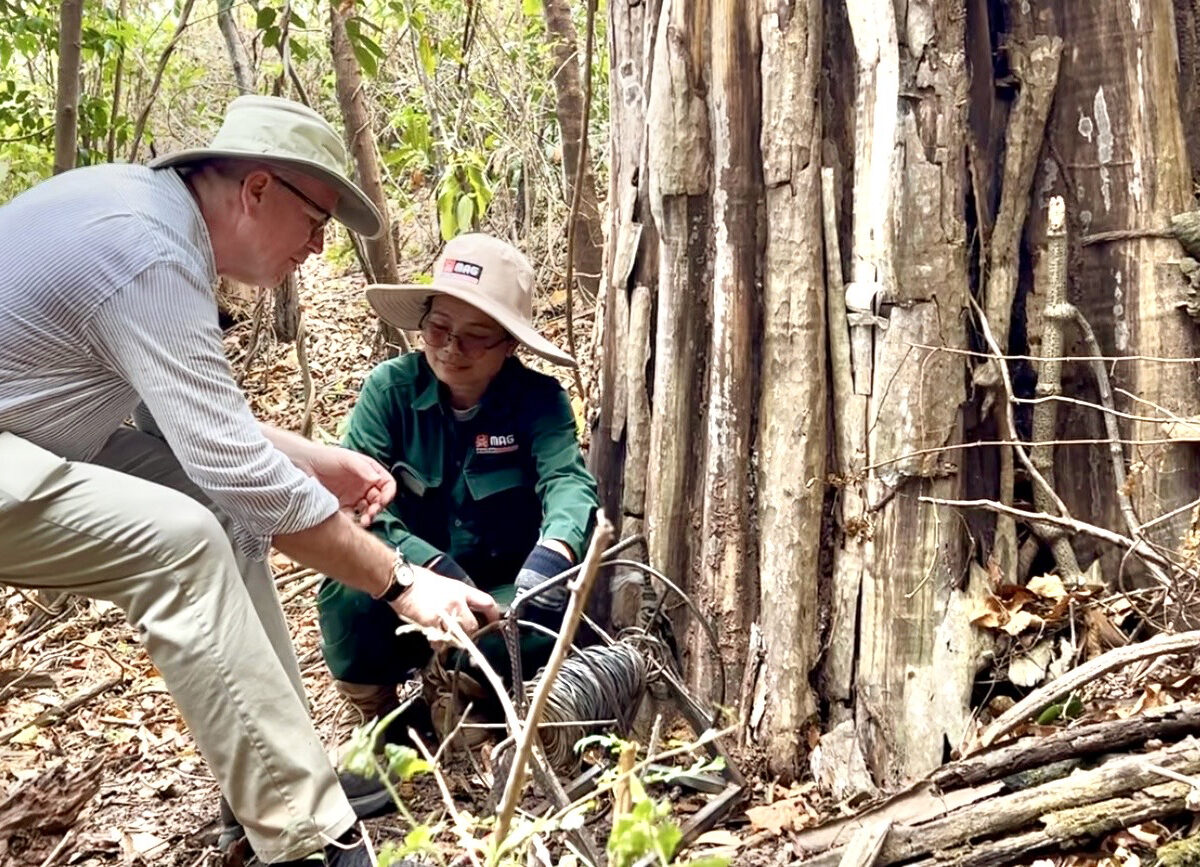
Michael Ambler ’82 helps fund bomb-cleanup teams in Laos
Over a decade ago, the Rev. Michael Ambler ’82 spun a globe to figure out how far the frequent-flyer miles left over from his career as a lawyer would take him on vacation. Southeast Asia and back, as it turned out. He didn’t anticipate that he would fall in love with the region and discover his third act: founding Restoration Laos, a nonprofit that supports Lao teams removing unexploded Vietnam War-era bombs.
The teams primarily remove cluster munitions, about the size of a tennis ball and filled with ball bearings. These bombs were among about 270 million dropped in an effort to stop the North Vietnamese moving material along the Ho Chi Minh Trail. An assumed 30 percent explosion failure rate means that roughly 78 million live “bombies,” as they’re called locally, are still on the ground.
“Laos was not a belligerent in the war,” Ambler says, “and if it was in our interest to drop all those bombs, it’s now our responsibility to clean them up.”
When he and his wife, Darreby, class of 1979, established Restoration Laos in 2022, some financial support was available for bomb removal from the U.S. and other nations’ governments, but it was limited. “I thought, I can’t solve that problem, but I can solve it for some people,” he says, reflecting on the many villages likely to wait 50 more years before anybody reaches them. He contacted the U.S. embassy in the capital, Vientiane, to propose the idea of piggybacking on government funding in support of one team and received an unequivocally positive response.
“The goal is not to clear every bomb in Laos,” Ambler says, but “to clear the bombs where the people are” — in rice paddies, gardens, schoolyards and heavily foraged forests. Restoration Laos’ eight-person Explosive Ordnance Disposal (EOD) Team 5 is currently trained and managed by the Mines Advisory Group, a British nongovernmental organization.
The team destroys 1,200-plus bombs of varying sizes annually in Khammouane Province. It surrounds cluster bombs with sandbags to direct the blasts below ground. The sandbags are made of hemp, a pricier but more environmentally friendly alternative to plastic.
Ambler travels to Laos two or three times a year. But he doesn’t want to be seen as just another Westerner with money, so he’s learning to speak Lao. (“The Harkness table taught me I could do hard things badly and survive,” he says with a laugh.)
He has also developed a close connection with EOD Team 5 members, accompanying them at work even though he doesn’t have the training to participate in bomb removal. Seeing detonations up close allows Ambler to describe the work vividly and accurately when he’s speaking in the United States in support of the effort. He has addressed church groups, veterans’ organizations — and even a gathering of spies.
Public speaking comes naturally for Ambler, a former rector of Grace Episcopal Church in Bath, Maine, and canon to the ordinary for the Episcopal Diocese of Maine. In contrast to his work as an attorney and a priest, both of which entailed “wrangling concepts,” Ambler says Restoration Laos allows him to contribute to the greater good in a way that is tangible, not to mention noncontroversial.
“Every single bomb we detonate is a bomb that doesn’t kill a child,” he says, noting that no one has ever approached him to debate the “wisdom or ethics of the Vietnam War. In this unbelievably polarized time, I’ve never met anybody who didn’t think this was a thing worth doing.”