David Kenneth Dimmock: A Memorial Minute
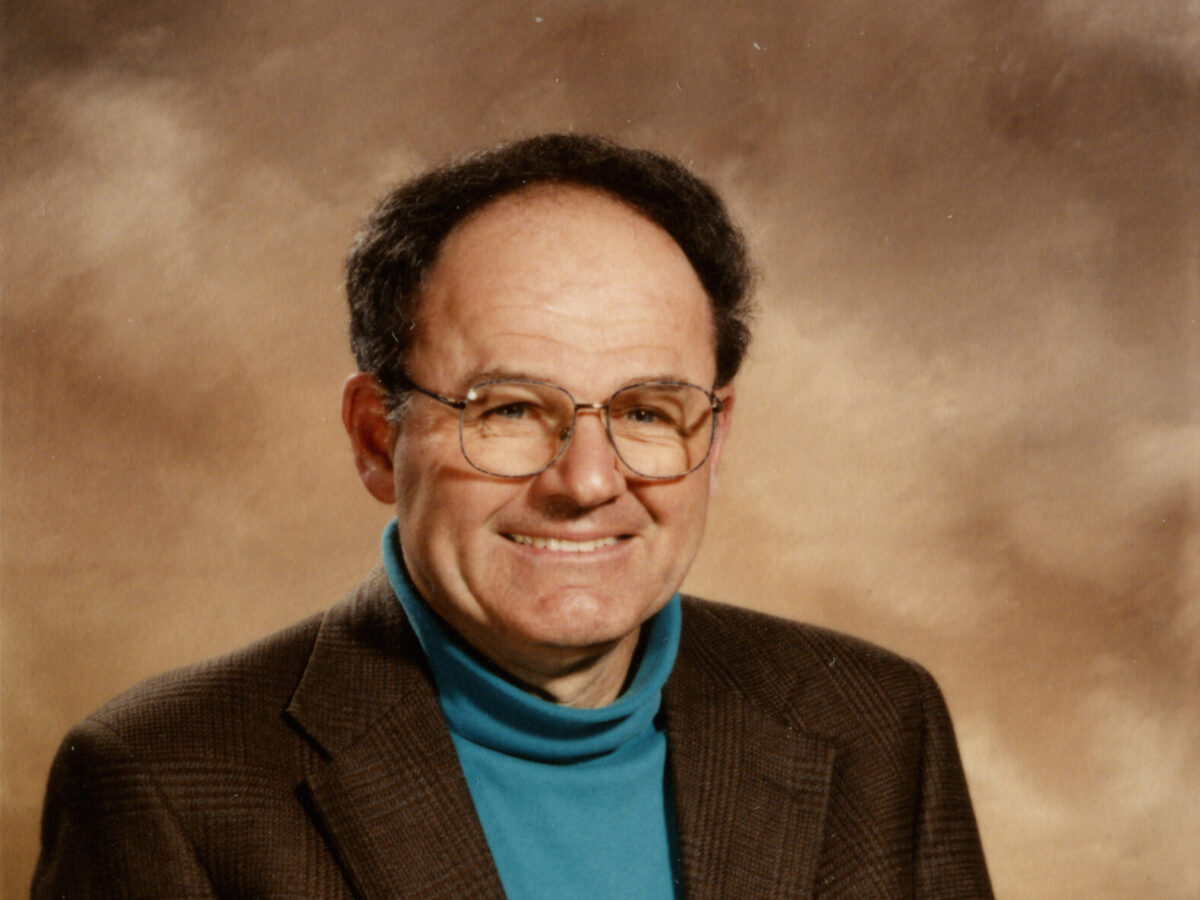
When given the opportunity to write remembrances about David Dimmock, dozens of alumni responded. It did not matter if their memories were from the classroom, the dormitory, or the x-country team; the common denominator was of a kind, caring, gentle, and thoughtful teacher important to their Exeter experience. Soft-spoken and thoughtful, David went about the business of teaching and coaching with quiet dedication. Never calling attention to himself, he faithfully fulfilled his responsibilities. No muss. No fuss. He was what an older generation might have called a gentleman, a gentle man.
Born on Independence Day in 1939, Dave Dimmock grew up in Connecticut, graduating from New London High School and then attending the University of Connecticut where he earned B.S. and M.S. degrees in Electrical Engineering. From 1962 to 1967, he served as an officer in the U.S. Army Corps of Engineers. Having risen to the rank of Captain and having completed his military service, David accepted his first teaching appointment, working as an Instructor of Mathematics at the University of Vermont. In July 1972, he began a career at Exeter, an appointment he cherished for the next twenty-seven years.
Writing on the occasion of David’s retirement in 1999, Ty Tingley commended David on his years of steadfast service: “you have lived values that we seek to inspire in our students— loyalty, hard work, service to others, kindness, patience, civility.” As Principal, Ty particularly appreciated Dave’s selflessness: “In a world increasingly preoccupied with attitudes of entitlement, you have asked little of others or of the school.” David’s service, he noted, was rooted in a preoccupation with teaching and learning, qualities that informed his work in the classroom, in the dormitories, and on the athletic fields.
Celebrating the 25th anniversary of David’s teaching appointment, Dean of Faculty, Jack Herney, underscored the importance of David’s work on committees, perhaps the least appreciated of the many tasks undertaken by boarding school faculties: “You bring to any group a fundamental honesty and an instinct for the direct approach, not long on words perhaps but distinguished by clarity of thinking, absent of pretension, grounded in principle and without any hidden agenda—just the straight scoop.” The list of committees, on which David served–often as chair–touched upon virtually every aspect of boarding school life: Admissions, Prize, Discipline, Financial Aid, Milton Mountain, and Commencement. Invested always in the best interests of our community, David was a colleague we trusted, a teacher we admired, a friend upon whom we could invariably rely.
From the moment David arrived in Exeter, he knew he had found his calling. In a letter to Principal Kurtz, just two years after David had joined the Math Department, David proclaimed, the job is “very demanding, but at the same time, very satisfying . . . I can honestly say there is no other work I would rather be doing.” David expressed appreciated the Academy’s fundamental values: the Harkness pedagogy with its small, discussioncentered classes; a generous scholarship program that “enables us to have a diversified student body;” the strength of a caring, dedicated teaching faculty; and the many opportunities for students and faculty to interact in and beyond the classroom. Given the opportunity to share memories of David, dozens of Exonians responded. Maxwell Grant, class of ’88, remembers first semester Prep year. He likens “those first few weeks of an Exeter education” to “drinking out of a firehose, even though our first teachers knew it and did their best to . . . keep down the sheer pressure of it.” For Max, Harkness Math bright and early on Saturday mornings felt like repeatedly “re-discovering and shock-testing the Pythagorean theorem.” From the young Prep’s perspective, “we might as well have been calculating the return trajectory of the Space Shuttle.” But Dave Dimmock knew “we could do it, and he would cajole and murmur and nod . . ., walking the space between the table and the blackboard, listening for the next step and floating over to the board” to write down our collective thoughts. There “was a kind of ballet to it all,” Mr. Dimmock allowing the “moment to sink in, letting us hold it as a tribute to our own ingenuity. But of course, the true ingenuity was his.” While Max never did flourish as a mathematician, he did take away something special: “Mr. Dimmock showed me . . . the poetry of math, the thrill of discovery, and the eloquence of quiet encouragement.”
Paul Wilson, Class of ’89, echoes Maxwell Grant’s experience with Mr. Dimmock, who “was available at any hour” to meet with his students, helping them work step-by-step through challenging math concepts. Susan Cole Ross, Class of ’77, remembers Mr. Dimmock for his “kindness, kindness, kindness.” David “had a generous way of making one feel like the most important person as he gently bowed a bit for full eye contact with a young coed in the early days of coeducation.” More than forty years after graduating from Exeter, Jonathan Bean, Class of ’81, believes Dave Dimmock was “one of the kindest and gentlest souls” he ever met. Suzy Welch, Class of ‘78, experienced a calculus epiphany with Mr. Dimmock in her upper year: “I will never forget the day that a calc concept finally clicked for me, and I literally exclaimed, ‘OH I GET IT! IT’S SO BEAUTIFUL!’ out loud in class. My fellow students laughed, and I was a little embarrassed, but Professor Dimmock looked directly at me with a smile — and I am sure of this — tears of joy in his eyes. His purpose was to lead young people to just such moments of discovery. From that moment on, I understood that math was a magical language all its own, and that some people were born to teach it.”
David’s commitment to teaching extended well beyond the classroom.. As Kirk Stambler’s, Class of ’76, advisor in Dunbar Hall, David was “unfailingly kind and approachable,” making Kirk’s “transition to the Academy as seamless and comfortable as it could possibly be.” Neil Kaye, Class of ’76, credits Dave with getting him through calculus, and perhaps more importantly, making Dunbar a warm and welcoming place: “When he was on duty, he always made slice & bake chocolate chip cookies for us. That was the perfect welcoming touch and made everyone feel at home.” Zack Gleit, Class of ’83, recalls Mr. Dimmock’s love for the movie, “Chariots of Fire.” He “loved the cross-country part of the storyline, . . . loved the theme music,” which was often heard coming from his study. It was clear from the note Zack sent to us that David modeled something special for the students under his care: the passage of time only strengthened their appreciation for his civility, kindness, and generosity.
Among David’s many Academy responsibilities, coaching Cross-country and distance running in outdoor track occupied a special place in his heart. In the fall of 1977, he succeeded Ralph Loveshin, a legendary figure, as head coach of the boys’ cross-country team. Jamie Trowbridge, Class of ’78, and David’s first team captain, appreciated Coach Dimmock’s strong work ethic. Always well prepared, he worked tirelessly “recording and analyzing the results from our workouts and races,” this at a time before computers when such analysis was done by hand. “He gave his time and attention equally to every runner on the team. He was constant with words of encouragement and quick to recognize improvement of any kind. Our team won some races, and we lost some. He did not seem to care about that. He just tried to help every runner do his best.” Nick Caruso, Class of ’77, has a clear memory of Mr. Dimmock’s “blue Volvo station wagon . . . patiently waiting for us as he clocked our times along the route.” Nick says Mr. Dimmock was “a very gentle soul. For our home XC meets, instead of a traditional track starting gun . . . he used a cow bell to signal the start.”
Judd Levingston, Class of ’82, ran cross-country for three seasons. He remembers David keeping “meticulous team records in pencil from year to year so any team member (or alumnus!) could ask him how they had performed against an opposing school on their course or ours.” Encouraging us to run with “a sense of adventure and abandon” and to savor “our youth and fitness,” David would sometimes borrow a school van to “drive the team to Apple Annie’s where we’d go for a six to eight-mile workout run on the roads and then finish things off at the orchard by taking turns around the cider press.” A coach who encouraged his runners to be the best they could be, David led the squad to an Interschols championship in the fall of 1979. Exeter’s harriers placed four runners in the top eight in a field of twelve teams and eighty runners. For four seasons, Nick Warne, Class of’80, ran cross country and track under Coach Dimmock. He notes that for distance runners, “ there is a constant sense of camaraderie which Mr. Dimmock encouraged throughout the year. During cross-country, there is an even stronger sense of team since we train, travel and race as a team with strong dependencies” upon one another. As runners, we had an identity and a community. This identity only mattered to us, and to Mr. Dimmock, but we owned it and it helped to shape who we became. Nick and his teammates took special pleasure in winning the Interschols championship in 1979 not only for their personal achievement but because it recognized all of Coach Dimmock’s hard work.
Former Modern Language Instructor, Brian Morgan worked with David in coaching Track & Field. He notes that “David was an avid distance runner himself, not so much as a competitor, but rather as a form of relaxation. He would seek out small marathon or halfmarathon events in bucolic surroundings, often in Western Massachusetts, and run them for pure enjoyment. Closer to home, Rick Parris and I would often join him for a 10k jaunt in the Exeter environs, using back roads and dirt tracks whenever possible.”
David was also an avid cyclist. Stephanie Girard remembers joining David and Rick Parris on a bike ride. At the time, she figured she would have no difficulty keeping pace with “two men 20 years her senior.” Their trek took them over back roads to UNH, where they picnicked on the university lawn before cycling back to town. Stephanie says, “We got back to campus with just about enough time for me to “stretch, shower, change, and get over to the opening faculty party in the library. I think I lasted about 45 minutes; I was so beat.” The next fall, the three took a long, languorous ride south to Maudslay State Park near Newburyport.” Though more physically and mentally prepared for this second outing, Stephanie admits she “was still the one panting the most at the end of the day. David looked as if he hadn’t even broken a sweat.” David shared his enthusiasm for running and cycling not only with colleagues but also with the young people he mentored in the Big Brother/Big Sister program. David once rode his bicycle from Seattle, Wash. across the entire country, back home to Exeter, N.H.
A deeply religious man, he also had an abiding interest in sacred music, and for several years, sang in the Congregational Church choir. When the calendar allowed, he often ventured abroad to explore European churches and cathedrals, taking special pleasure in attending evensong services. On one trip to the United Kingdom, David travelled to the village of Dymock, the ancestral home of the Dimmock family. It is fitting that this idyllic village has a rich cultural heritage, having been home to the Dymock Poets, a group of writers which included Rupert Brooke.
For many years after retirement and then living at the River Woods community of Exeter, David stayed connected to the Academy. In his quiet and understated way, he let the Dean of Student’s office know of his willingness to tutor struggling math students for no compensation. For many years, these struggling students benefitted from David’s wisdom, caring, and especially kindness.
Having lived a life of loving service, David Dimmock died in November, 2022. A headstone has been placed at the East Neck Cemetery in Waterford, Connecticut. David is survived by his sister, Shirley Dimmock Perregaux; brother-in-law, Paul Perregaux; brother, Wayne Dimmock, and by sixteen nieces, nephews, grand-nieces, and grand-nephews.
I move that this Memorial Minute be submitted to David’s siblings and spread upon the minutes of the faculty.
Respectfully submitted, Eric S. Bergofsky, Co-Chair John D. Herney Brian Morgan Douglas G. Rogers, Co-Chair