‘Create, imagine, connect’: Exeter celebrates King
Academy centers words, wisdom of civil rights icon.
Exeter students, faculty and staff spent a snowy Monday commemorating the life and legacy of the civil rights leader Martin Luther King Jr. with a full slate of speakers, workshops and discussion.
The student emcees of the event — Dani Mendez ’27 and Kyle Kennedy’s ’26 — kicked off the morning’s events by welcoming Principal Bill Rawson ’71; ’65, ’70 (Hon.); P’08 to the stage in Love Gymnasium. Rawson spoke of how powerful a presence King was in his life; how he grew up watching the civil rights leader on television and reading about him in the newspaper; and how King’s work helped shape his understanding of the world.
“I realize it is different for you,” Rawson told the students. “You were not alive during Dr. King’s lifetime. Even your parents weren’t alive then.” Just as Rawson learned about the Depression and World War II through his father’s stories, current Exonians learn about King’s life and legacy through reading about him, watching documentaries and hearing stories told by those who knew him.
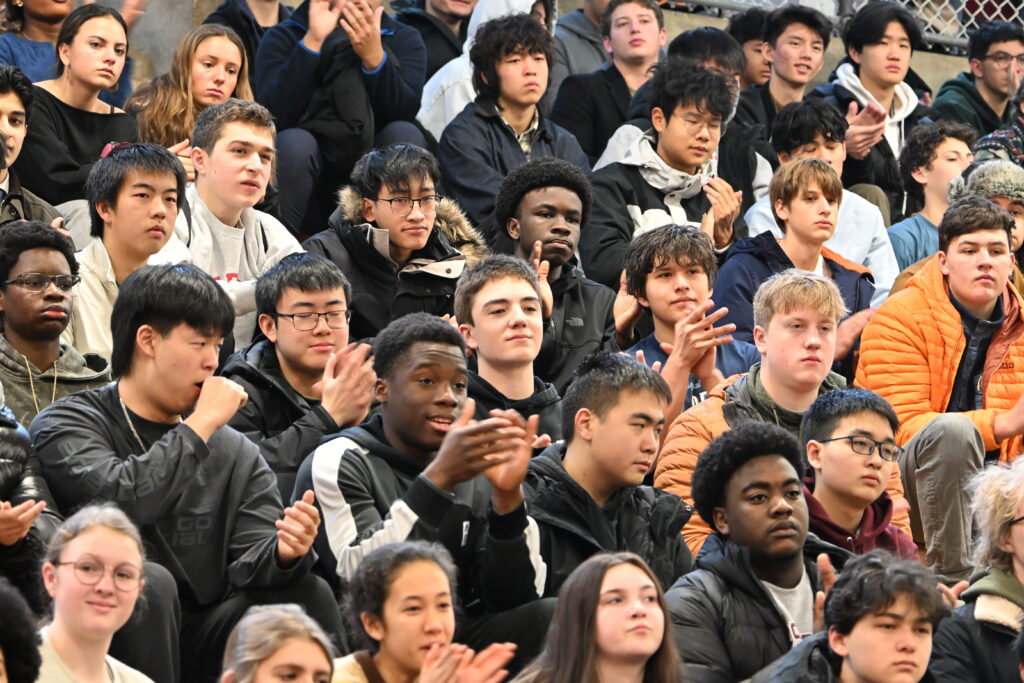
“[Today] is a chance for you to understand who Dr. King was, to learn about his life, and to be inspired by his courage and his conviction,” Rawson said. “When you hear Dr. King’s words today…keep in mind that he was and still is speaking directly to each and every one of us.”
Keynote speaker focuses on farmworkers
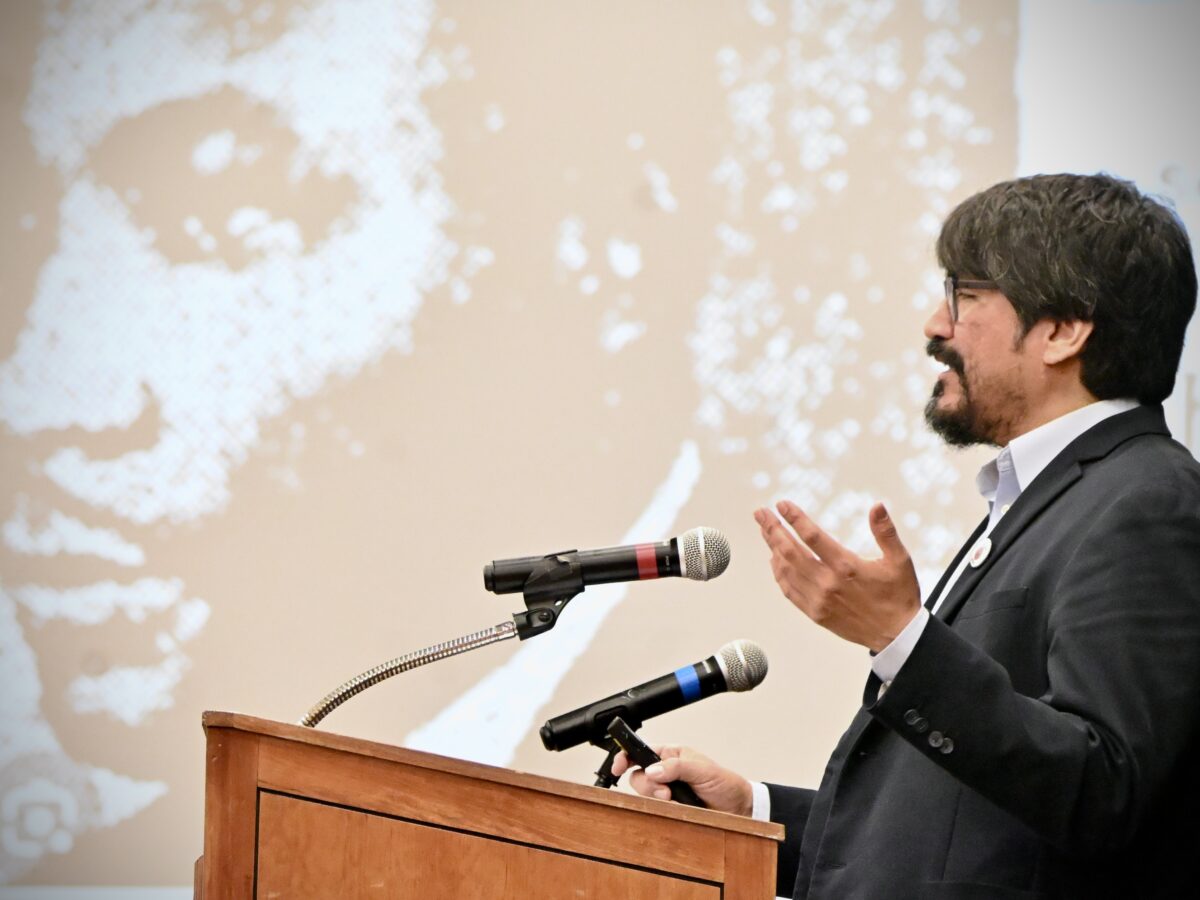
Stephanie Bramlett, Exeter’s director of equity and inclusion, introduced the day’s keynote speaker. Oliver Rosales, a professor of history and ethnic studies at Bakersfield College, is the author of the award-winning book Civil Rights in Bakersfield: Segregation and Multiracial Activism in the Central Valley.
“The legacy of Dr. King looms incredibly large for historians,” Rosales said. “My goal today is to paint a picture about the intersection of Dr. King’s work with the farmworker movement, or what’s known as the heart and soul of the Mexican American civil rights movement.”
Rosales spoke of his personal and family ties to the agricultural region in California where his grandfather immigrated to from Mexico, and where César Chávez and other leaders would launch the farmworker movement in the mid-1960s just as King was leading his own movement of nonviolent protest in the South. “I committed myself to researching and teaching history in a region that I wrote about, and that my family was rooted [in],” Rosales said.
Through his talk, Rosales explored the ties between Chávez and King and their respective movements, beginning with their mutual inspiration by Mahatma Gandhi’s philosophy of civil disobedience. Just as King’s famous “Letter from a Birmingham Jail” in 1963 became a seminal text for the civil rights movement, Chávez’s “Letter from Delano,” defending the farmworkers’ nonviolent struggle during a grape strike and boycott in 1969, would form the cornerstone of his United Farm Workers (UFW) movement.
“The most important history isn’t always made in the halls of power, but in the coalitions that we create when we imagine a different kind of strength,” Rosales said.
Rosales read from a telegram King sent to Chávez shortly before he was assassinated in April 1968, praising Chávez’s hunger strike aimed at ensuring nonviolence in the farmworker’s movement. The link between civil rights and the labor movement continued under the leadership of Coretta Scott King, who threw her support strongly behind Chávez, Dolores Huerta and other UFW leaders.
Scott King had “a special empathy with farmworkers,” Rosales explained, because of her childhood in the rural South. He displayed a photograph of Scott King with Huerta, singing “De Colores,” the anthem of the farmworker movement. “It was a song about the beauty of a world made of many colors,” Rosales said. He then sang a few measures in Spanish, to the audience’s delight.
“It was the multiracial power of what Coretta Scott King called a ‘coalition of conscience’ that made the farmworker movement an enduring American civil rights legacy,” Rosales said. “It was the love of many colors that made Coretta Scott King bridge the world of her husband’s work with the struggle of the farmworkers.”
‘How will you show up?’
In concluding his keynote, Rosales challenged the students in the audience, particularly seniors preparing to leave for college, to consider their own paths forward. “How will you show up?” he asked. “Will you define your success by the prestige of the rooms that you enter or by the coalitions that you create? Will you have the courage to imagine a strength that doesn’t rely on the threat of violence? Finally, who will you connect with? The legacy of King [and] the legacy of Chávez teaches us that our brotherhood, our sisterhood is grounded in our common commitment toward each other.
“Whether in a jail cell in Birmingham, a cotton field in Alabama or a community college in Bakersfield, the work of democracy is never finished, and it’s waiting for you to choose it.”
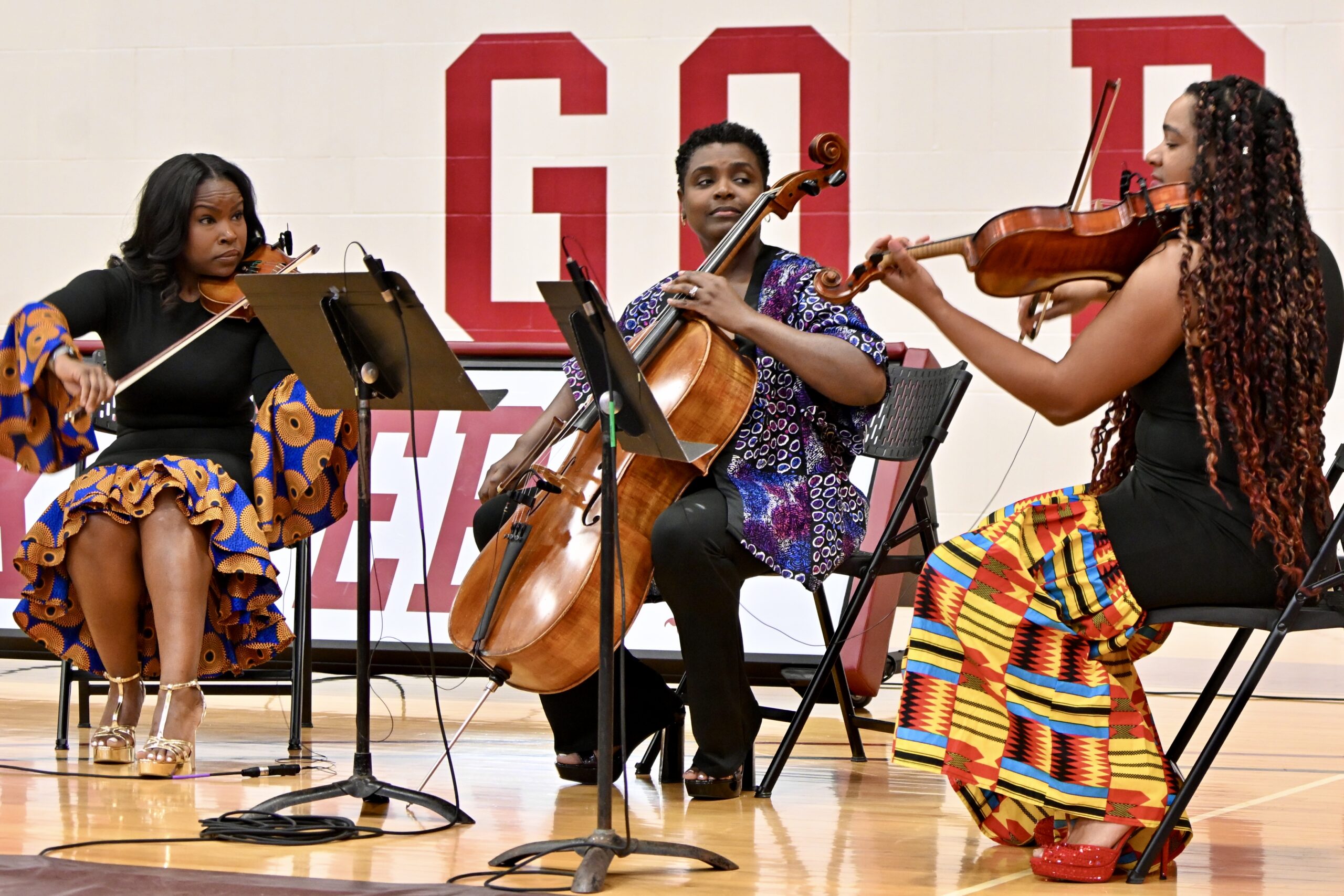
The String Queens, a trio of string musicians based in Washington, D.C., performed before Rawson’s opening remarks, and again at the end of the keynote address, earning standing ovations from the assembled school community. The trio also joined Exeter’s Concert Choir for a performance in the Bowld on Sunday as part of the MLK Day commemoration.
Devoted committee
Each January since 1990, the Exeter’s observance of MLK Day has sought to center the work of King and the messages of the Civil Rights Movement. Through the work of a student-driven committee, the programming helps to advance the school’s mission to develop young learners who will “face the challenges of their day. Teaching and living the principles of a just and sustainable society.”
This year, the committee presented workshops that invited their fellow students to “create, imagine, connect.”
In a morning workshop titled “Growing Your Chosen Family: How We Build Our Own Beloved Communities Across Identities,” students ruminated on the ideas of belonging and inclusion. Workshop co-leader Rory Hart, chair of the History & Global Studies Department at the Hun School of Princeton, New Jersey, challenged students to consider times in their lives when they felt they didn’t belong. The workshop was co-led by Oluj Okeremi ’27, Ese Okparavero ’27 and Myles Oluwo ’27. As his classmates pondered Hart’s prompt about belonging, Oluwo reminded the group that “there is a big difference between being included and truly belonging.”
The interactive workshop gave students a chance to respond digitally to series of questions such as, “What does it feel like to be included but not belong?” Responses like “silenced,” “small,” and “unseen” quickly populated the projection screen.
Okparavero said he hopes his classmates found value in the exercises and discussion. “I want my peers to know that they matter and no matter where they go, they belong.”
A letter from jail
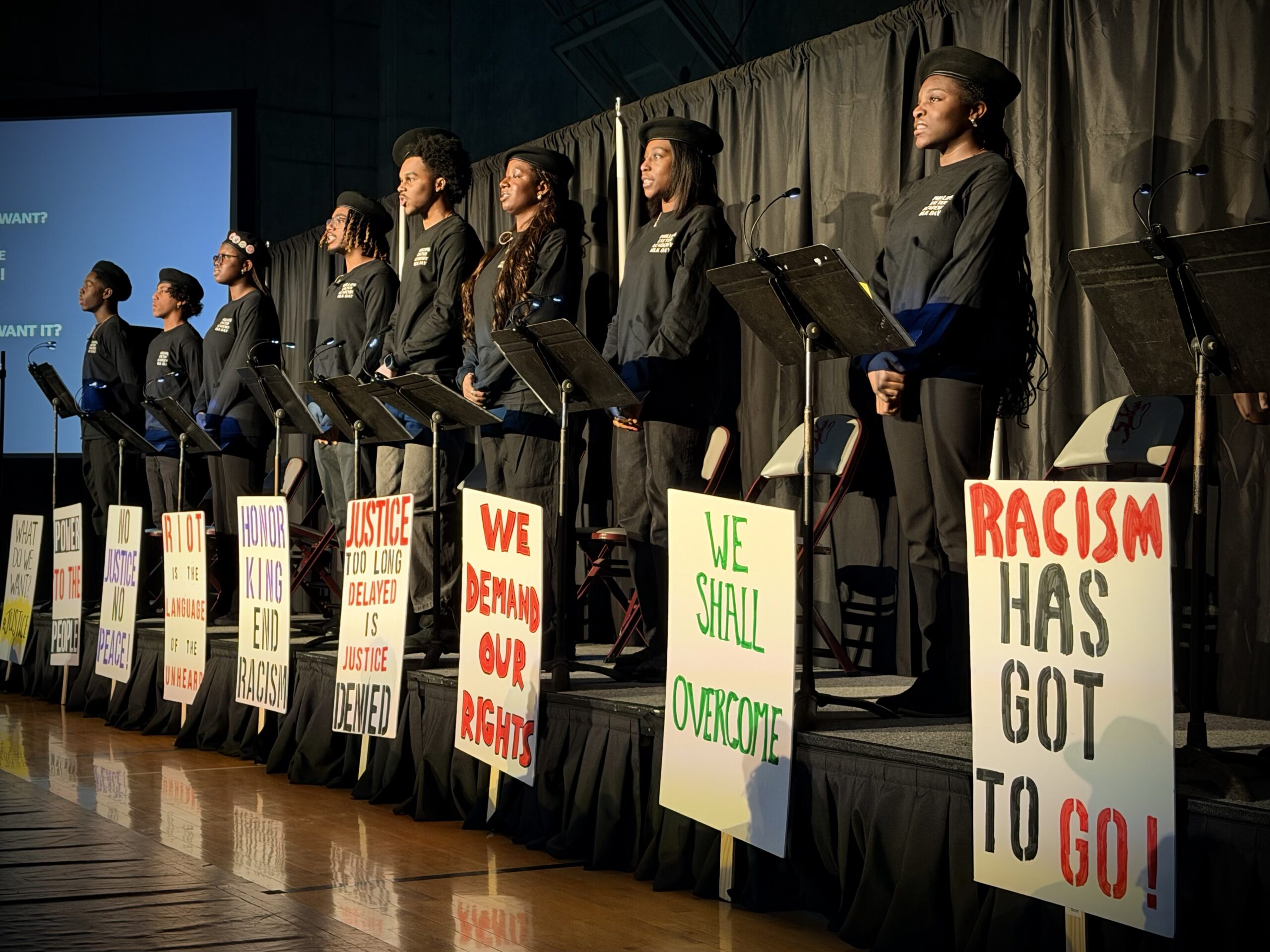
The day concluded with a reunion in Love Gym and a powerful reading of King’s seminal “Letter From Birmingham Jail,” a missive to his fellow clergy who had disapproved of his active participation in civil disobedience.
Nine Exeter students sat on stage behind signs with messages like “We Demand Our Rights” and “Racism Has Got To Go,” and took turns reading from the letter.
Near the letter’s end, King wryly apologized for his verbosity.
“Never before have I written so long a letter. I’m afraid it is much too long to take your precious time. I can assure you that it would have been much shorter if I had been writing from a comfortable desk, but what else can one do when he is alone in a narrow jail cell, other than write long letters, think long thoughts and pray long prayers?”